
Can you propagate string of pearls in water? Yes, though soil is more reliable. For string of pearls in water, take a 3–5 inch (8–13 cm) stem, strip the pearls from the bottom inch, let it callus for a day, then rest only the bare stem in water with the pearls above the rim. Pot at the first roots, because this succulent rots easily.
Key takeaway: String of pearls in water is a short rooting trick. Keep the pearls dry, keep water shallow and move it to gritty cactus mix fast.
| Method | Speed and reliability | Source |
|---|---|---|
| 3–5 inch (8–13 cm) stem with nodes in potting mix | Easy and quick | NC State |
| String of pearls in water | Works; higher rot risk | Home-grower method |
| Single pearl dropped on soil | Slower, less reliable | NC State |
| Stems laid on soil surface | Easy; roots form at contact points | Matches its natural creeping habit |

Does String of Pearls in Water Really Root?
It can, because the stems root readily at nodes. NC State Extension says that in the wild this South African succulent creeps along the ground and forms roots wherever it touches soil. It recommends propagation by 3–5 inch (8–13 cm) stem cuttings with a few nodes covered in potting mix, which it calls easy and quick. Water rooting uses the same rooting ability, but the plant stores water in its bead-like leaves, and constant moisture invites rot. That’s why string of pearls in water needs a light touch.
How Do You Root String of Pearls in Water Step by Step?
- Wear gloves. NC State says the sap can cause skin irritation and rash.
- Cut a healthy 3–5 inch (8–13 cm) strand with clean scissors.
- Remove pearls from the bottom ½–1 inch (1–2.5 cm) of stem to expose a node or two.
- Let it callus for a day in a dry, shaded spot.
- Fill a small glass with water so only the bare stem touches it.
- Prop the strand so pearls rest on the rim or on plastic wrap with a hole poked in it.
- Place in bright, indirect light, which NC State says indoor plants need.
- Change the water weekly and pot at the first roots.

What Supplies Do You Need for String of Pearls in Water?
- Gloves for the irritating sap.
- Clean, sharp scissors wiped with rubbing alcohol.
- A small, shallow glass or shot glass so strands drape over the rim.
- Plastic wrap or a mesh lid to hold pearls above the water.
- Room-temperature water, dechlorinated if your tap water smells of chlorine.
- A shallow pot and cactus mix ready for potting day.
A bright windowsill out of harsh afternoon sun is the only other thing you need. Avoid deep vases, where it’s hard to keep pearls dry.
How Long Does String of Pearls in Water Take to Root?
Usually a couple of weeks in warm conditions. Roots appear as thin white threads at the nodes. NC State lists 70–80°F (21–27°C) as the best summer range, so propagate in spring or summer. Don’t wait for a large root mass; roots about ½ inch (1 cm) long are enough to pot.
Why Is My String of Pearls in Water Rotting?
- Pearls underwater: Submerged pearls turn mushy within days.
- No callus: A fresh, wet cut lets rot in.
- Stale water: Change it weekly or when cloudy.
- Cold: Low temperatures slow rooting and favor rot.
- Weak stem: Shriveled, thin strands from a declining plant root poorly.
Cut above any soft section, let it callus again and restart. Our guide to pythium root rot explains why stagnant water favors rot.
When Should You Move String of Pearls in Water to Soil?
As soon as roots appear. NC State recommends cactus potting mix or potting soil mixed with sand or perlite. Use a shallow pot with drainage:
- Fill the pot with gritty mix and moisten lightly.
- Lay the rooted strand on the surface, pressing the rooted section in.
- Pin longer strands down with a bent paper clip so nodes touch soil.
- Water lightly for the first week, then let the mix dry somewhat between waterings.
See perlite and vermiculite for mixing tips.
Is Soil Propagation Better Than String of Pearls in Water?
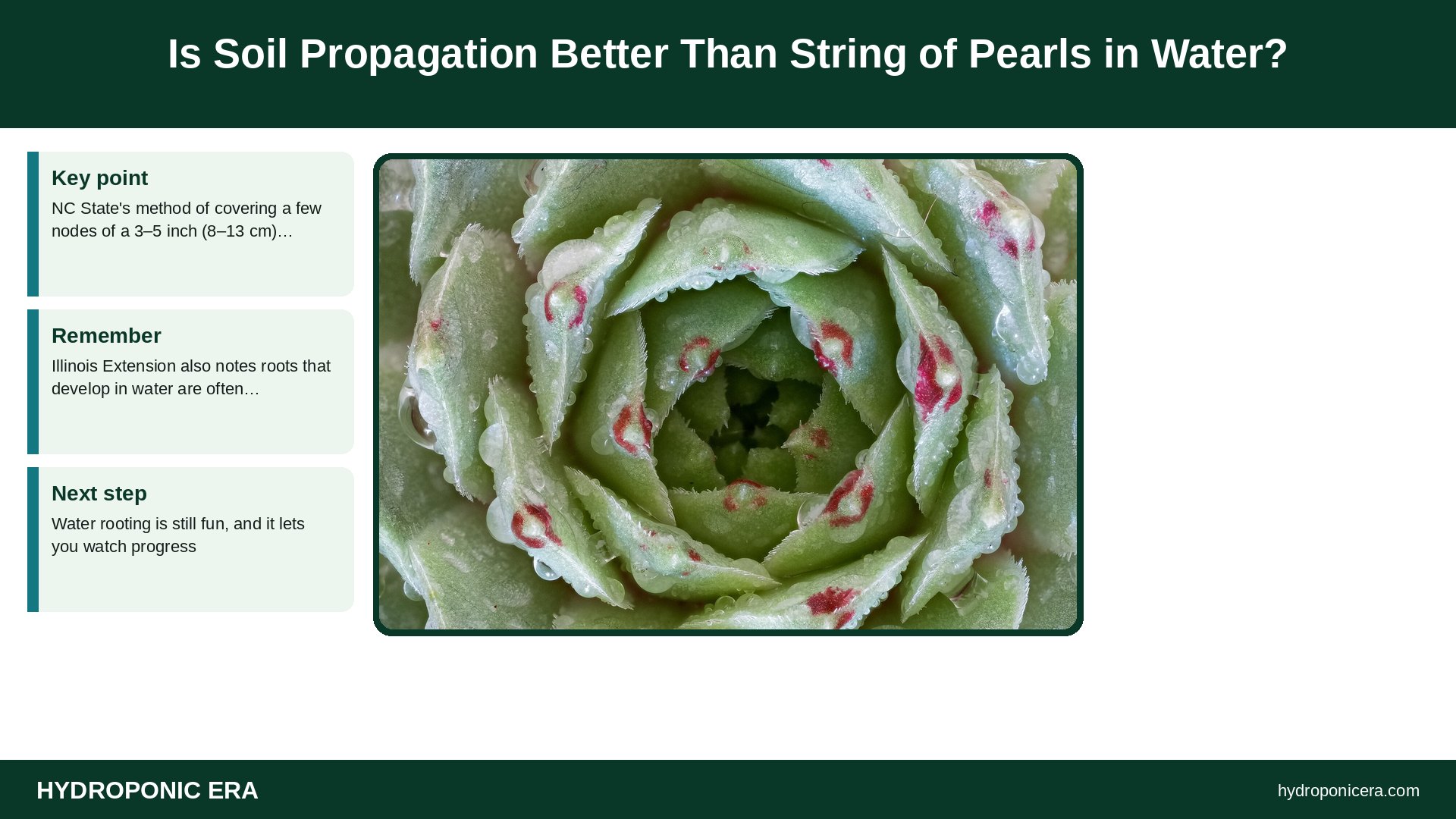
For most growers, yes. NC State’s method of covering a few nodes of a 3–5 inch (8–13 cm) cutting in potting mix is described as easy and quick, and roots formed in mix don’t need to adjust to a new medium. Illinois Extension also notes roots that develop in water are often weak and adapt less easily to potting mix. Water rooting is still fun, and it lets you watch progress.
Can a Single Pearl Grow a New Plant?
Occasionally. NC State describes dropping a leaf onto the soil as a slower and less reliable method. A strand with nodes is much faster.
How Do You Care for New String of Pearls Plants?
Follow NC State’s care basics:
- Light: Bright, indirect sunlight indoors.
- Water: It tolerates infrequent watering, but NC State says not to let it dry out completely, and overwatering causes root rot.
- Temperature: 70–80°F (21–27°C) in summer and cooler 50–60°F (10–16°C) in winter.
- Frost: Bring outdoor plants in before the first fall frost.
Why Should You Propagate Older String of Pearls?

NC State notes these plants tend to die back after several years and recommends propagating by stem cuttings instead of trying to revive an older plant. Take strands from the healthiest growth and start a fresh pot every couple of years.
Is String of Pearls Toxic?
Yes. NC State lists it as toxic to humans and pets, with low severity: eating the leaves can cause vomiting and diarrhea, and sap can irritate skin. The toxic principle is pyrrolizidine alkaloids. Keep jars and hanging baskets out of reach.
How Do You Make a Fuller Pot From Cuttings?
Root several strands at once, then pot them together. Lay five or six rooted pieces around the pot’s edge and one or two in the center, pinning nodes against the mix. NC State notes the plant roots wherever stems contact soil, so pinned strands keep filling in. A fuller pot also dries more evenly than a sparse one.
Can String of Pearls Live in Water Permanently?
No. It’s a dry-climate succulent adapted to infrequent watering, and constant water leads to rot. For plants that thrive in jars, see our list of plants that grow in water.
FAQs
Can I use tap water for string of pearls in water?
Usually, yes. Let chlorinated water sit overnight.
Should I use rooting hormone?
It’s not needed; the stems root readily.
Does string of turtles root the same way?
It’s a different plant (a peperomia), but stem pieces also root at nodes.
Can I root several strands in one glass?
Yes, if pearls stay dry.
What does a healthy root look like?
White, thin and firm.
Sources
- North Carolina State Extension — Curio rowleyanus (String of Pearls)
- University of Illinois Extension — Houseplant Propagation
- Photo credits (Wikimedia Commons, edited with titles): Curio rowleyanus syn. Senecio rowleyanus 2019-04-14 02 by Agnieszka Kwiecień, Nova (CC BY-SA 4.0); Ficus cuttings with roots in a bottle, White background by Biusch (CC BY-SA 3.0); Echeveria A7CR 02866-90 zsp by This Photo was taken by Timothy A. Gonsalves. Feel free to use my photos, but pl (CC BY-SA 4.0); Perlite1 by KENPEI (CC BY-SA 3.0); Basilikum (Ocimum basilicum) Stecklinge — Josef Schlaghecken by Schlaghecken Josef (CC BY-SA 4.0)