
How do you grow Swiss chard microgreens? Soak the seed 6–12 hours, sow it thickly on moist mix, cover lightly and keep it around 65–75°F (18–24°C) until it sprouts in about 5–7 days. Then give it bright light and harvest at 2–3 inches (5–8 cm), usually 16–25 days after sowing. Expect about 3–6 oz (85–170 g) per tray.
Key takeaway: Swiss chard microgreens are slow but beautiful, with candy-colored stems. Soak or prime the seed, sow densely, and remove hard seed hulls before eating.
| Factor | Swiss chard microgreens | Source |
|---|---|---|
| Soak | 6–12 hours | University of Maryland |
| Days to germinate | 5–7 | UF/IFAS |
| Germination temperature | 65–75°F (18–24°C) ideal for most microgreens | UF/IFAS |
| Seeding rate | 3–5 Tbsp per tray | Mississippi State |
| Days to harvest | 16–25 | Mississippi State |
| Expected yield | 3–6 oz (85–170 g) per tray | Mississippi State |

Why Grow Swiss Chard Microgreens?
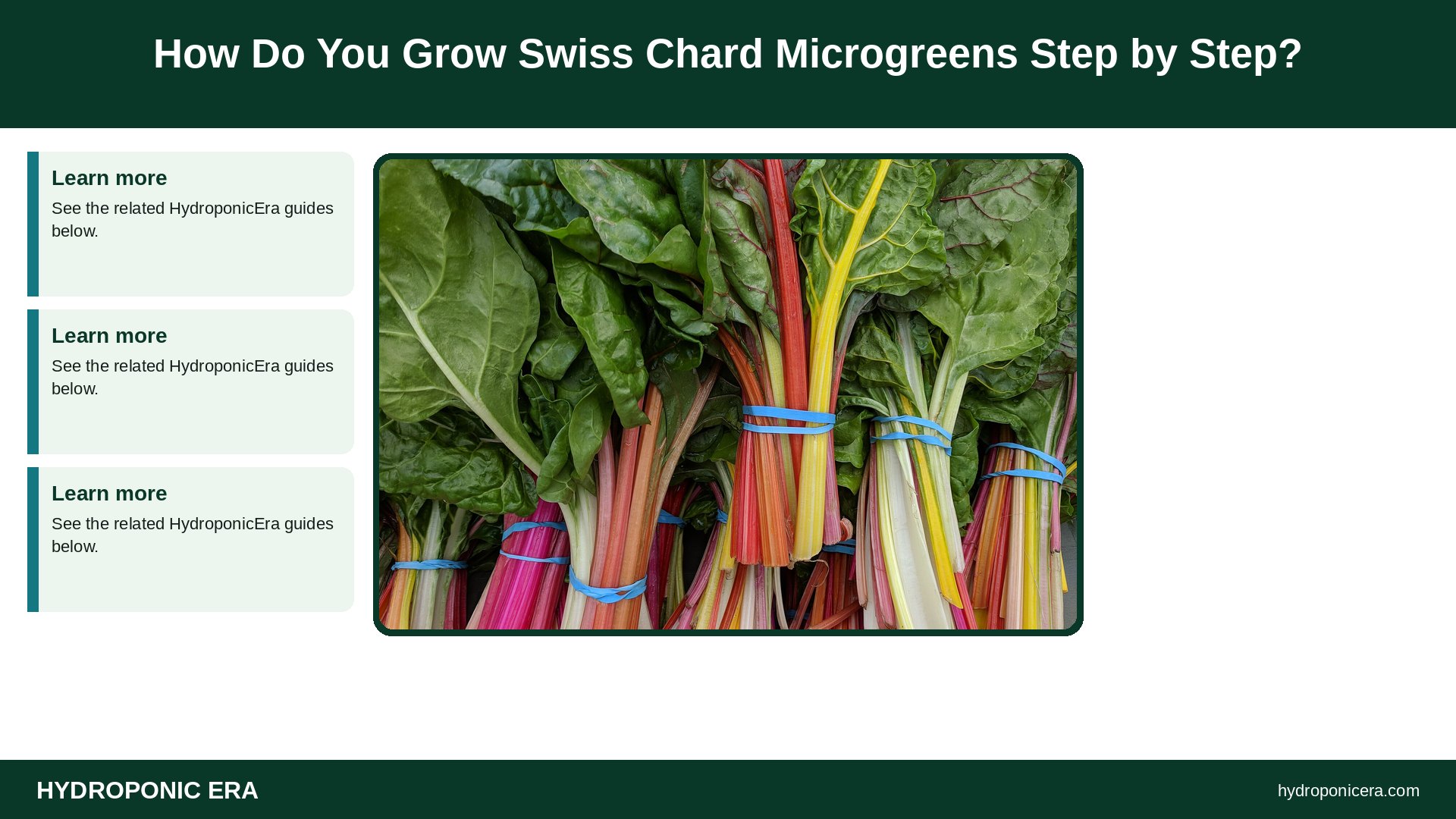
Color is the big draw. Mississippi State Extension highlights ‘Ruby Red’, with candy-apple red stems and red-veined leaves, and ‘Rainbow’ or ‘Bright Lights’, with gold, pink, orange, purple, red and white stems. The flavor is mild and earthy, similar to beet greens. University of Maryland Extension notes the amaranth family, which includes beets and Swiss chard, is especially well-suited to microgreens.
What Supplies Do You Need for Swiss Chard Microgreens?
- A shallow tray with drainage, such as a 10×20 inch (25×51 cm) flat
- Fine seed-starting mix or coco coir, about 1–1.5 inches (2.5–4 cm) deep
- Untreated Swiss chard seed, ideally bought in bulk, as Mississippi State advises
- A cover tray, spray bottle and grow light or bright window
Our hydroponic microgreens guide covers soil-free setups.
How Do You Grow Swiss Chard Microgreens Step by Step?
- Soak the seed 6–12 hours. Maryland lists Swiss chard among seeds that germinate faster after soaking.
- Fill and level the tray with pre-moistened mix.
- Sow densely, using Mississippi’s rate of 3–5 tablespoons per tray as a guide.
- Press seed into the surface and cover lightly with mix or vermiculite.
- Cover and keep dark at 65–75°F (18–24°C) until sprouts emerge.
- Uncover after germination, usually 5–7 days, and move under light.
- Bottom-water to keep leaves dry.
- Harvest at 2–3 inches (5–8 cm) by cutting just above the soil line.
Why Are Swiss Chard Microgreens Slow to Germinate?
Each chard “seed” is a corky fruit cluster with a hard outer coat. UF/IFAS Extension notes that beets, carrots and Swiss chard take longer to germinate than the many crops that sprout in about 2 days. Soaking softens the coat, and Mississippi State recommends priming chard seed to promote even germination. Cool temperatures slow things further; Oregon State lists chard’s optimum germination temperature at 85°F (29°C), with a useful range of 50–85°F (10–29°C).
Do You Need to Remove Swiss Chard Seed Hulls?
Yes. Mississippi State says chard seed hulls are hard and need to be removed before eating. Many hulls lift off as seedlings rise. Brush or shake the tray before harvest, then swish cut greens in cool water so remaining hulls sink or float away.
How Much Light Do Swiss Chard Microgreens Need?
University of Maryland Extension recommends about 16 hours of light per day, with fixtures typically 6–12 inches (15–30 cm) above the plants depending on intensity. Bright light deepens stem color. In low light, stems stretch and colors fade. See our light schedule guide.
When Should You Harvest Swiss Chard Microgreens?
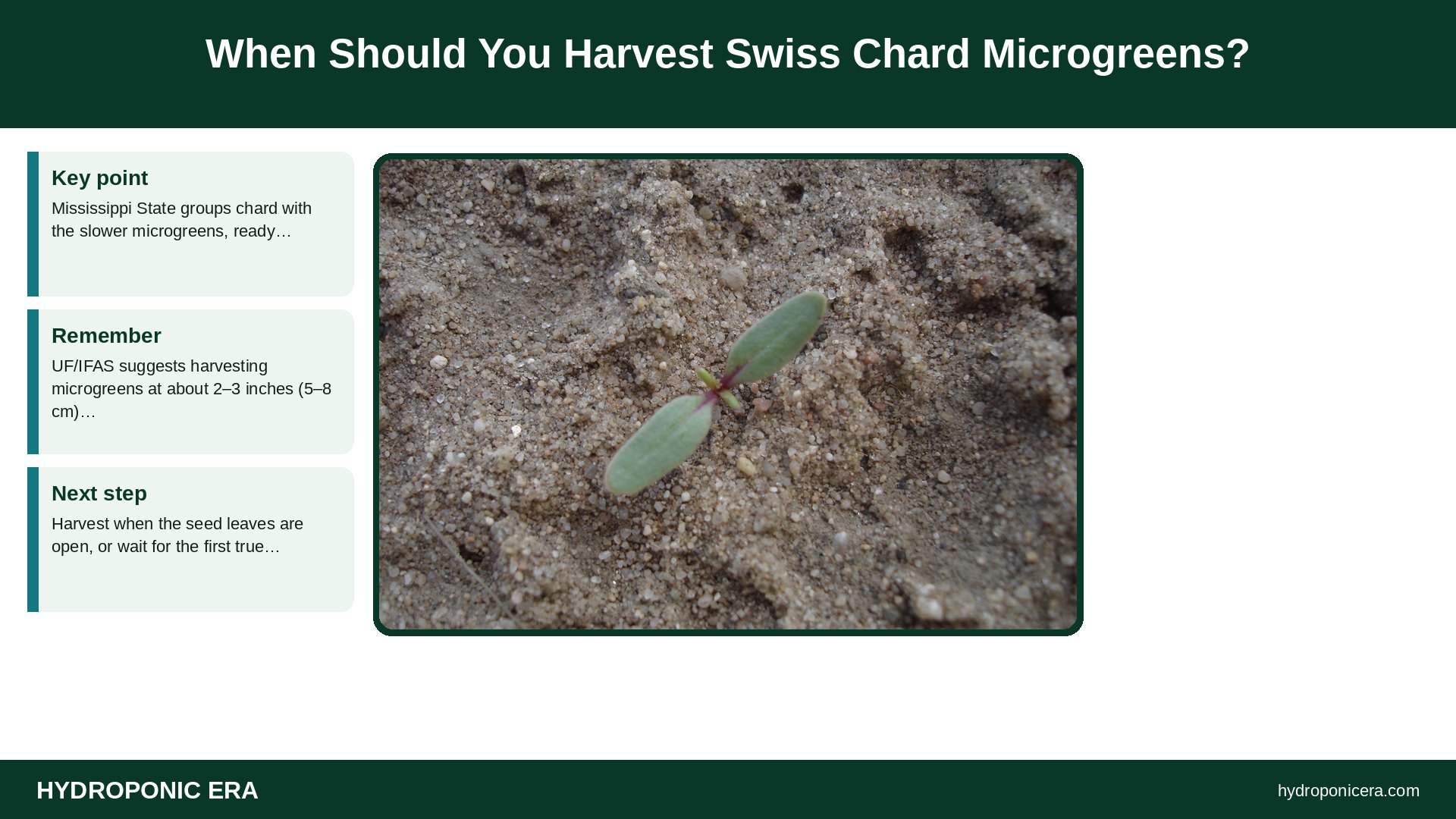
Mississippi State groups chard with the slower microgreens, ready about 16–25 days after sowing. UF/IFAS suggests harvesting microgreens at about 2–3 inches (5–8 cm) tall, ideally in the cool morning or evening, cutting with scissors just above the soil line. Harvest when the seed leaves are open, or wait for the first true leaf for more flavor.
How Much Do Swiss Chard Microgreens Yield?
Mississippi State lists an expected yield of 3–6 oz (85–170 g) per tray, similar to beet microgreens. That’s less than fast crops like radish, but the color makes up for it. See our full comparison in the herbs and microgreens cost worksheet if you’re tracking cost per ounce.
Can You Mix Swiss Chard Microgreens With Other Crops?
Only with similar-speed crops. Maryland Extension notes cabbage-family plants germinate and grow faster than beet-family plants, and UF/IFAS advises matching germination rates when mixing seeds in one tray. Pair chard with beets, or grow fast brassicas in a separate tray and combine them after harvest.
How Do You Prevent Mold on Swiss Chard Microgreens?

- Don’t over-soak; drain seeds well before sowing.
- Bottom-water; UF/IFAS warns to keep media moist but not wet to avoid damping-off.
- Run a small fan once uncovered.
- Sanitize trays between crops.
Our guide to damping-off explains seedling collapse.
Can You Grow Swiss Chard Microgreens Hydroponically?
Yes. Swap soil for a hemp, jute or fiber mat set in a tray of plain water. Microgreens draw on the energy stored in the seed, and Maryland Extension notes they don’t need fertilizer, though some hydroponic growers add a weak nutrient solution after the seed leaves open. Keep the mat damp, not flooded, and drain the reservoir if it smells sour. Because chard is slow, change the water every few days to keep it fresh. Fine mixes such as vermiculite also work as a light top cover.
What Are Common Swiss Chard Microgreens Problems?
| Problem | Likely cause | Fix |
|---|---|---|
| Patchy germination | Unsoaked seed, cold tray | Soak; warm to 65–75°F (18–24°C) |
| Leggy, pale stems | Weak light | Lower the light or extend hours |
| Fuzzy white growth | Root hairs or mold | Mold smells musty; improve airflow |
| Gritty bites | Seed hulls | Brush and rinse before eating |
White fuzz near the roots is often just root hairs, which look fuzzy and disappear when misted. Mold looks like cobwebs and spreads across leaves and stems. If light is the issue, our guide to leggy seedlings walks through fixes.
How Long Do Swiss Chard Microgreens Last?
UF/IFAS says harvested microgreens keep about 5–6 days in the refrigerator. Wash, spin dry and refrigerate in a covered container. Cut only what you need and leave the rest growing for a few more days.
How Do You Use Swiss Chard Microgreens in Food?
Use them raw so the color stays bright. Scatter them over salads, grain bowls, tacos, soups and eggs just before serving, or tuck them into sandwiches and wraps. Heat dulls the red and gold stems quickly, so add them at the end. Because the flavor is mild, they pair well with peppery radish or mustard microgreens grown in a separate tray.
FAQs
Are Swiss chard microgreens the same as beet microgreens?
They’re close relatives in the same family with similar flavor and growth.
Can I regrow chard microgreens after cutting?
Usually not; start a new tray.
Why are my stems pale?
Too little light; bright light boosts color.
Can I use garden chard seed?
Yes, if untreated.
How many seeds are in one chard seed?
Each corky cluster often contains more than one seed.
Sources
- Mississippi State University Extension — Microgreen Varieties for the Mississippi Gardener (Publication 2884)
- University of Maryland Extension — Growing Microgreens and Baby Greens Indoors
- UF/IFAS Extension Duval County (T. DelValle) — Growing Microgreens Can Be For Everyone
- Oregon State University Extension — Soil Temperature Conditions for Vegetable Seed Germination
- Photo credits (Wikimedia Commons, edited with titles): Blätter vom Roten Mangold (Chard) by August Geyler (CC BY-SA 4.0); Rainbow chard for sale at the Campbell farmers market by Grendelkhan (CC BY-SA 4.0); Beta vulgaris cotyledons by Tepeyac (CC BY-SA 3.0); Liping Kou observes microgreens by Peggy Greb (Public domain); 20170404-AMS-PJK-0484 (33725727291) by U.S. Department of Agriculture Preston Keres/Office of Communications-Photograph (Public domain)