
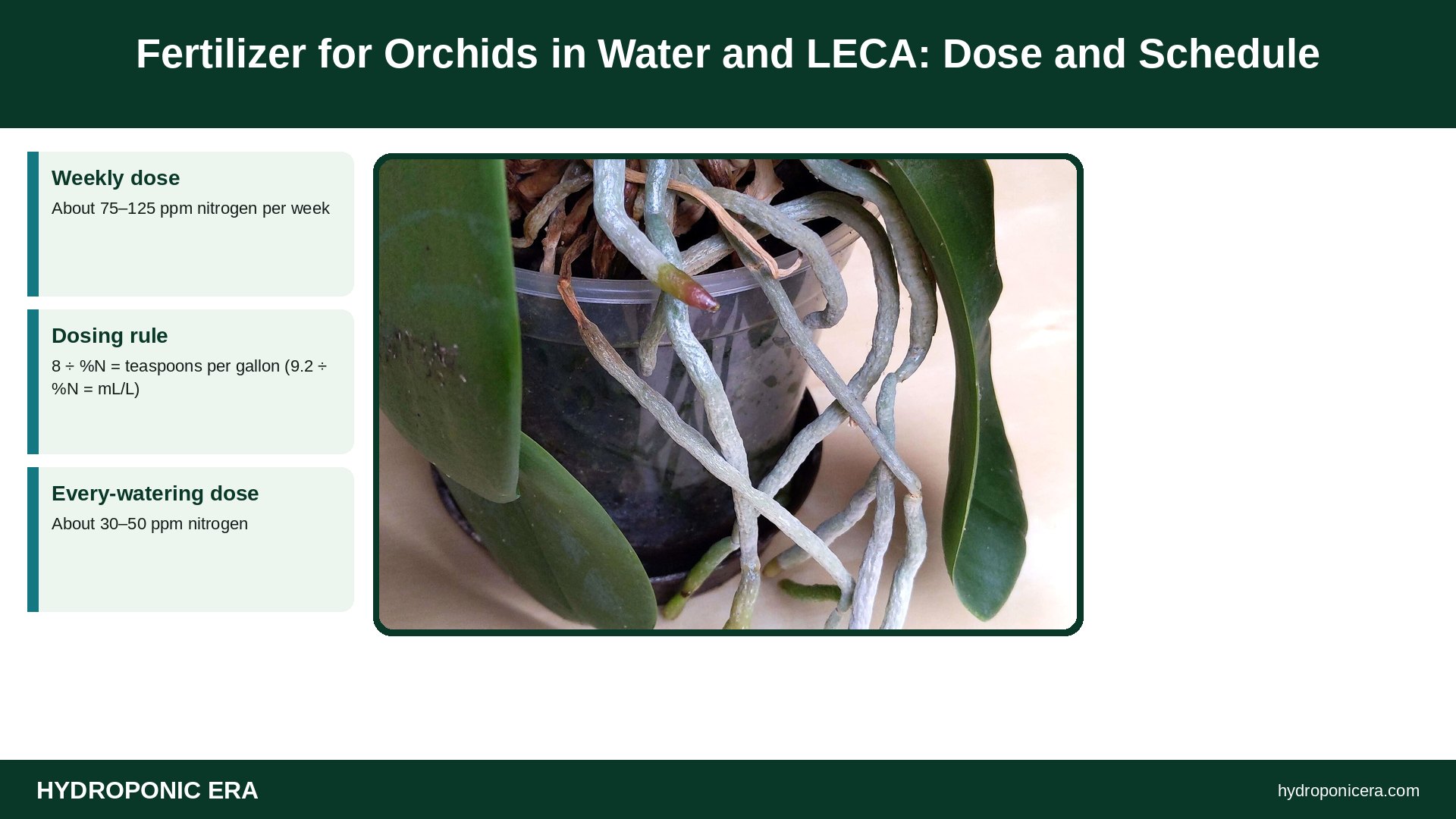
What is the best fertilizer for orchids in water? Use a complete, water-soluble orchid or balanced fertilizer at low strength. First Rays, a semi-hydroponic orchid grower, feeds about 30 to 50 ppm nitrogen at every watering, while the American Orchid Society suggests about 75 to 125 ppm nitrogen per week. For a 20 percent nitrogen formula, that is roughly 1/8 teaspoon per gallon (about 0.16 mL/L) each watering.
Key takeaway: Fertilizer for orchids in water should be weak, complete and regular. The American Orchid Society (AOS) gives a simple rule: divide 8 by the fertilizer’s nitrogen percentage to get teaspoons per gallon for about 75–125 ppm nitrogen per week. Semi-hydroponic grower First Rays feeds 30–50 ppm nitrogen every watering. Flush regularly and feed less when orchids rest in winter.
| Fact | What sources report | Source |
|---|---|---|
| Weekly dose | About 75–125 ppm nitrogen per week | AOS |
| Dosing rule | 8 ÷ %N = teaspoons per gallon (9.2 ÷ %N = mL/L) | AOS |
| Every-watering dose | About 30–50 ppm nitrogen | First Rays |
| Example | 30-10-10: about 1/4 tsp per gallon (0.3 mL/L) weekly | AOS |
| Winter | Feed resting orchids less; phalaenopsis keep growing | AOS |
| Pure water | Rain or RO water needs all nutrients supplied | AOS |
| Flushing | Many growers flush with plain water monthly | AOS |
What Is the Best Fertilizer for Orchids in Water?
A complete, water-soluble fertilizer with nitrogen, phosphorus, potassium and trace elements works best. The AOS says fertilizer is one of the least important parts of orchid care and advises picking a complete formula and using it sparingly and regularly. A balanced 20-20-20 or an orchid formula with calcium and magnesium suits most fertilizer for orchids in water routines.
Your water source matters. The AOS explains that hard tap water already carries calcium and salts, while rain or reverse osmosis water has almost nothing, so you must supply every nutrient. If you use pure water, choose a fertilizer that lists calcium and magnesium, or add a cal-mag supplement.
- Complete formula: N, P, K plus micronutrients.
- Pure water: pick a formula with calcium and magnesium.
- Avoid: heavy organic feeds, which can foul water and clay pebbles.
How Much Fertilizer for Orchids in Water Should You Use?
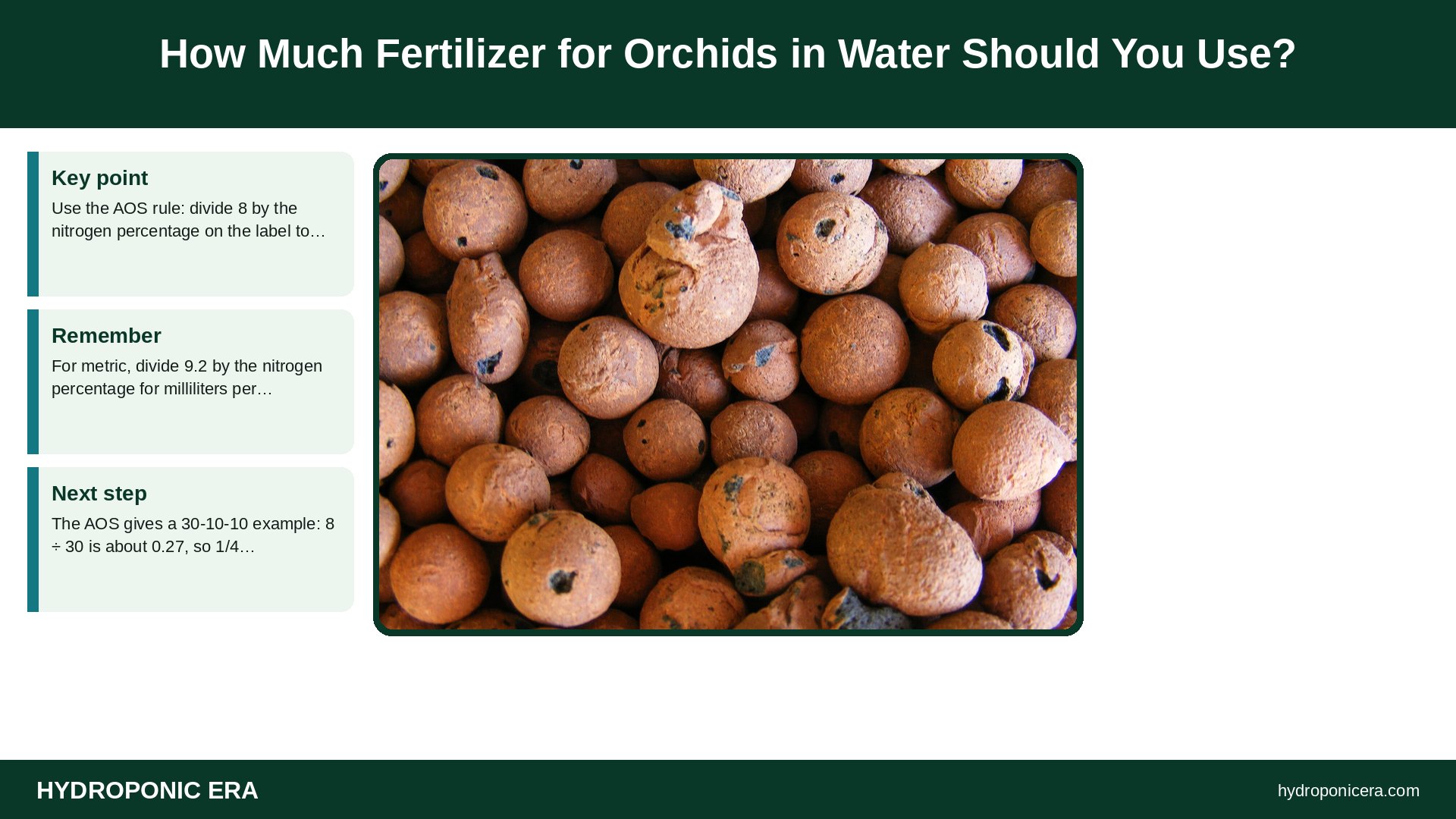
Use the AOS rule: divide 8 by the nitrogen percentage on the label to get teaspoons per gallon for about 75 to 125 ppm nitrogen per week. For metric, divide 9.2 by the nitrogen percentage for milliliters per liter. The AOS gives a 30-10-10 example: 8 ÷ 30 is about 0.27, so 1/4 teaspoon per gallon (about 0.3 mL/L) weekly.
- Find the nitrogen number, the first number on the label.
- Divide 8 by it to get teaspoons per gallon for weekly feeding.
- If you feed every watering, use about one-third to half of that.
- Mix fresh solution each time in clean water.
Using that math, a 20-20-20 formula at the weekly rate is 8 ÷ 20, or 0.4 teaspoon per gallon (about 0.46 mL/L by the AOS metric rule). At First Rays’ every-watering level of 30 to 50 ppm nitrogen, that drops to roughly 1/8 to 1/6 teaspoon per gallon (about 0.16 to 0.22 mL/L).
How Often Should You Apply Fertilizer for Orchids in Water?
Apply fertilizer for orchids in water weekly or at every watering, at low strength. The AOS says many books recommend weekly feeding with a monthly plain-water flush, and that many growers use continuous liquid feed with a dilute solution every watering. First Rays feeds dilute solution at every watering in its semi-hydroponic pots. Dilute, frequent feeding is closer to how epiphytic orchids get nutrients in nature.
- Weekly feeding: about 75–125 ppm N, flush monthly.
- Every watering: about 30–50 ppm N.
- Monthly only: the AOS says use a higher concentration.
What Strength of Fertilizer for Orchids in Water Is Safe?
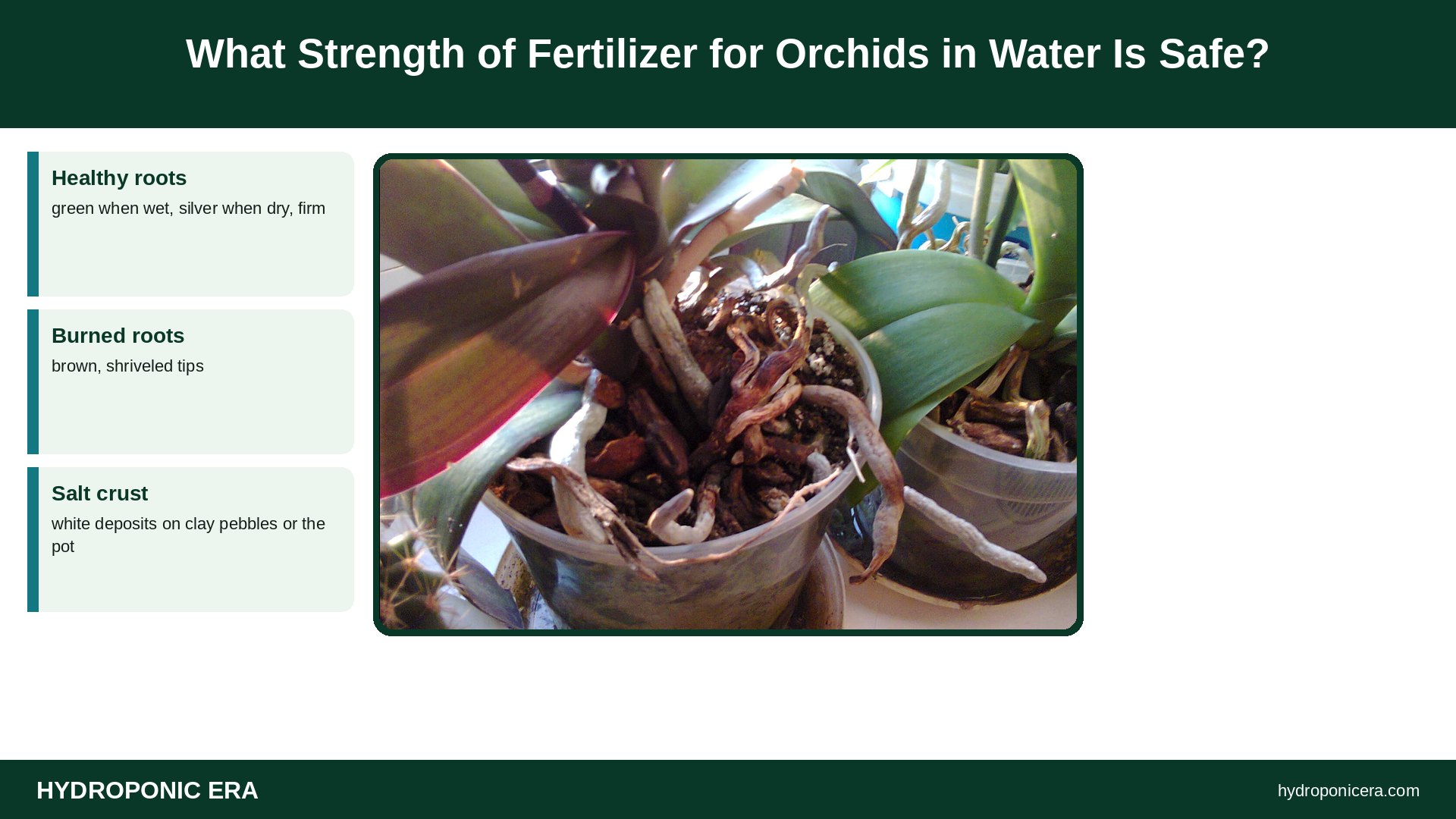
Weak fertilizer for orchids in water is safe. Orchid roots are covered in a spongy layer called velamen that burns easily when salts build up. The AOS suggests about 75 to 125 ppm nitrogen weekly, and First Rays feeds just 30 to 50 ppm at every watering in semi-hydroponics. If root tips turn brown or crusty white deposits appear, cut the dose and flush.
- Healthy roots: green when wet, silver when dry, firm.
- Burned roots: brown, shriveled tips.
- Salt crust: white deposits on clay pebbles or the pot.
Full water culture, where roots sit in water much of the time, needs the gentlest feeding of all. Our guide to water culture orchids explains the soak-and-dry cycle.
How Does Fertilizer for Orchids in Water Work in LECA?
In LECA or other clay pebbles, the pebbles do not hold nutrients the way bark does. The AOS notes inorganic media such as clay pebbles and charcoal may adsorb some salts, but those salts are generally not available to the plant later. First Rays fills each pot quickly to the top with dilute fertilizer at every watering, which flushes old solution and refreshes the reservoir.
- Mix fertilizer at about 30–50 ppm nitrogen.
- Pour it quickly through the pot until it overflows the holes.
- Let it drain to the reservoir level.
- Repeat before the pebbles dry out.
First Rays reports no noticeable salt buildup with this method. Our semi-hydroponics with LECA guide covers pot setup.
How Often Should You Flush Fertilizer for Orchids in Water?
Flush at least once a month if you feed weekly. The AOS says many growers feed weekly and flush with plain water monthly. If you feed at every watering with a dilute solution, as First Rays does, each watering already flushes the pot. Flush more often with hard water, which the AOS says adds salts on top of the fertilizer.
- Weekly feeding: plain water flush monthly.
- Every-watering feeding: each pour flushes the pot.
- Hard water: flush more often or switch to rain or RO water.
Should You Change Fertilizer for Orchids in Water in Winter?
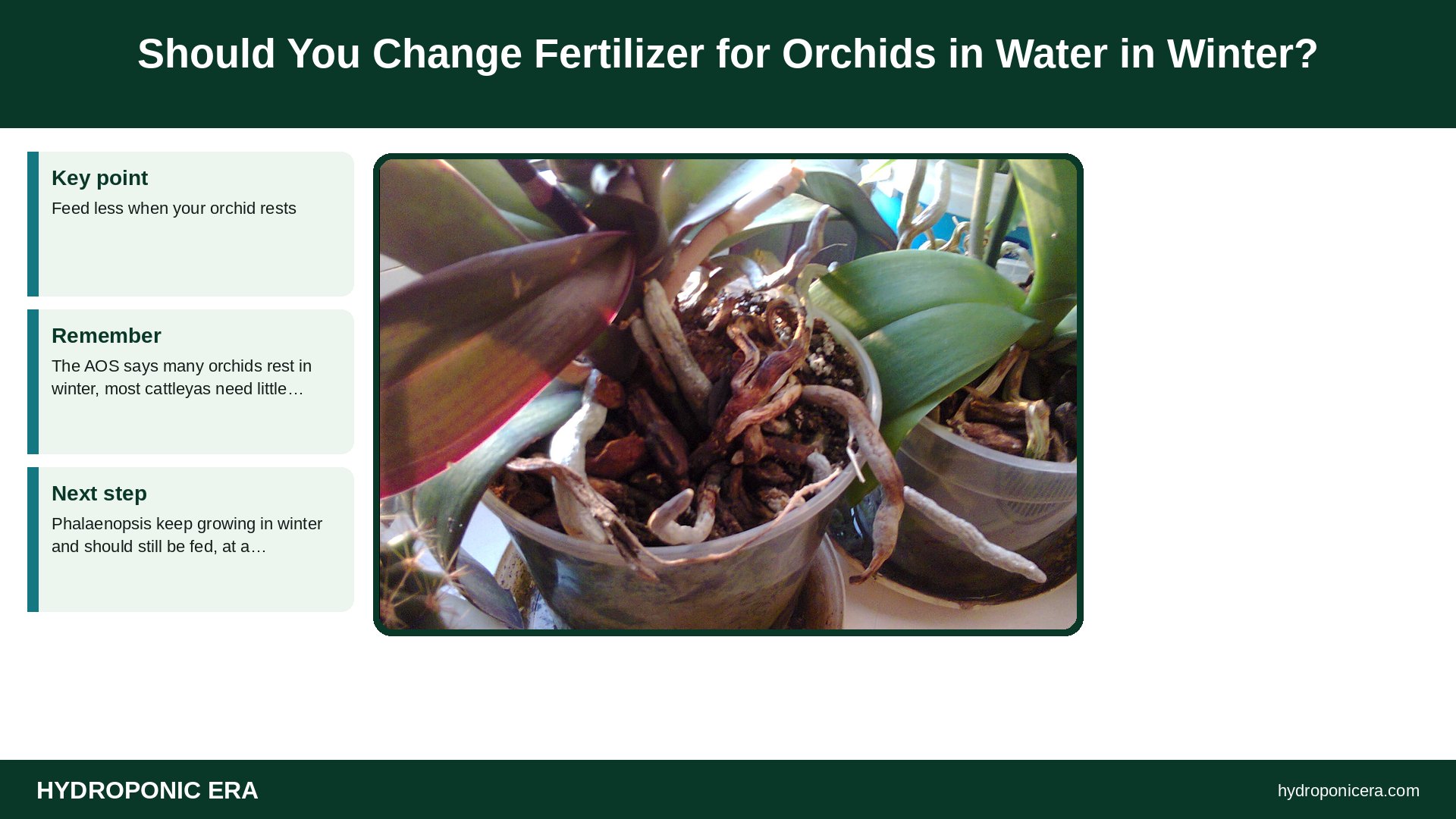
Feed less when your orchid rests. The AOS says many orchids rest in winter, most cattleyas need little or no fertilizer then, and winter-dormant types such as catasetums should get no fertilizer. Phalaenopsis keep growing in winter and should still be fed, at a lower rate. Match fertilizer for orchids in water to how fast new roots and leaves are growing.
Good light keeps orchids growing in winter; see grow lights for orchids. And skip the ice cubes for orchids trick if your plant is already in water culture.
FAQ About Fertilizer for Orchids in Water
Can you use regular plant food for orchids in water?
Yes, if it is complete and diluted; the AOS stresses complete formulas.
How much fertilizer per gallon for orchids?
Divide 8 by the %N for teaspoons per gallon weekly, per the AOS.
Do orchids in water need fertilizer every time?
Not necessarily; weekly at low strength also works.
What ppm nitrogen do orchids need?
About 75–125 ppm weekly (AOS) or 30–50 ppm every watering (First Rays).
Should you fertilize orchids in winter?
Less for resting types; phalaenopsis still need some.
Why are my orchid root tips brown?
Often salt burn from strong fertilizer; dilute and flush.
Sources
- American Orchid Society — Fertilize Weakly Weekly
- American Orchid Society — Orchid Growing in a Nutshell
- First Rays Orchids — Semi-Hydroponics Basics
- Photo credits (Wikimedia Commons, edited with titles): Aerial roots by Nefronus (CC BY-SA 4.0); Hydroton by Lucis (CC BY-SA 3.0); Phalaenopsis cultivars – white colour – 3 by DenesFeri (CC BY-SA 4.0)