
What are the best grow lights for orchids? The best grow lights for orchids are bright, full-spectrum white LED or high-output fluorescent fixtures hung 6 to 12 inches (15 to 30 cm) above the leaves for 12 to 16 hours a day. Phalaenopsis and Paphiopedilum grow well near 1,000 foot-candles (about 10,800 lux), while Cattleya and Vanda need 2,000 to 4,000 foot-candles. Match light strength to the orchid you grow.
Key takeaway: The American Orchid Society says light is the single most important factor in growing plants, and its Phalaenopsis guide says artificial lighting can easily be provided. Iowa State University Extension recommends high-output, full-spectrum fluorescent or LED grow lights for orchids at 6 to 12 inches (15 to 30 cm) above the foliage for at least 14 hours daily.
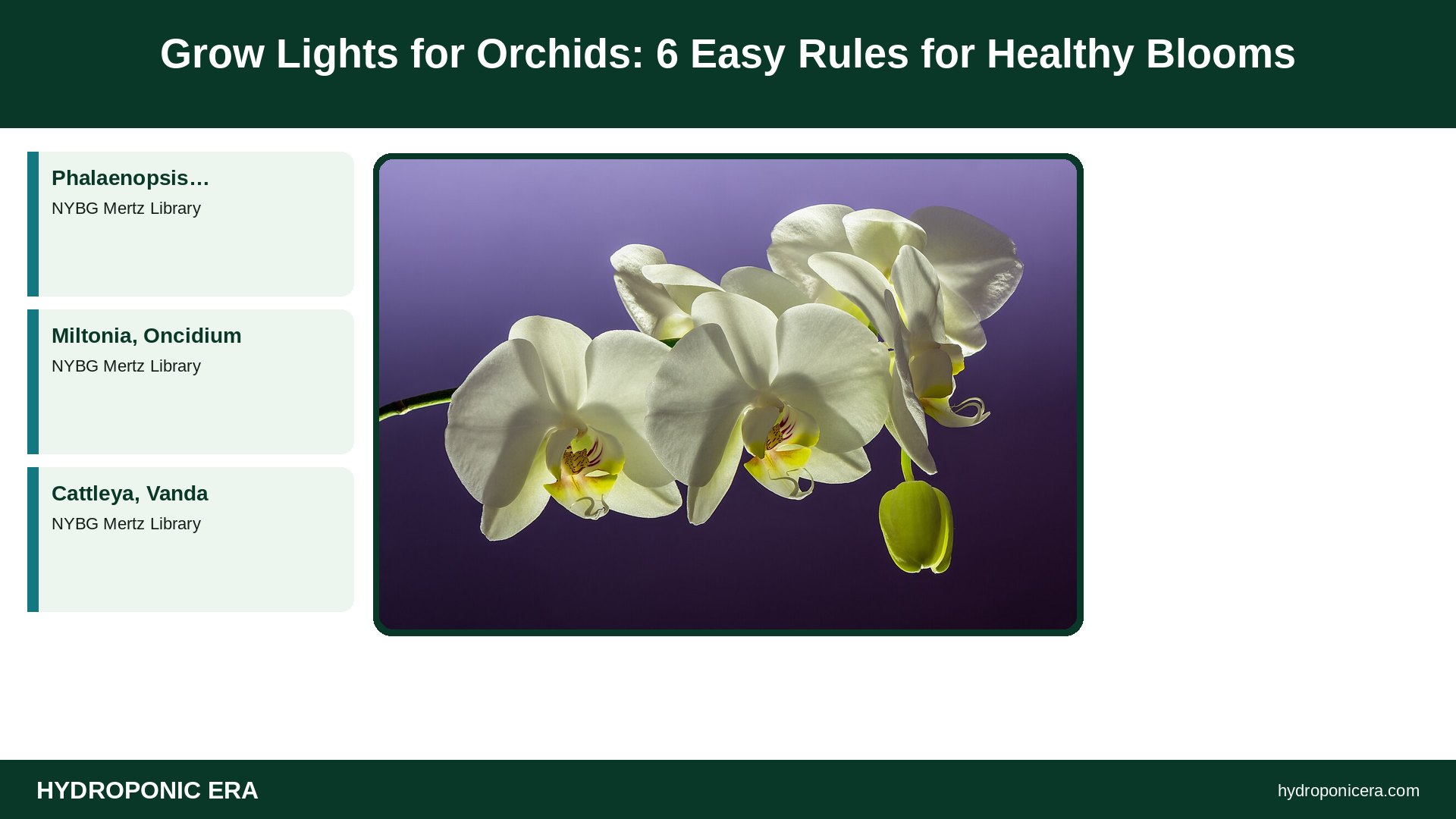
| Orchid group | Light target | Source |
|---|---|---|
| Phalaenopsis, Paphiopedilum | About 1,000 fc (≈10,800 lux) | NYBG Mertz Library |
| Miltonia, Oncidium | 1,500–2,000 fc (≈16,100–21,500 lux) | NYBG Mertz Library |
| Cattleya, Vanda | 2,000–4,000 fc (≈21,500–43,000 lux) | NYBG Mertz Library |
| Fixture distance | 6–12 in (15–30 cm) | Iowa State University Extension |
| Hours per day | 12–16 (Phalaenopsis) | American Orchid Society |
What Type of Grow Lights for Orchids Work Best?
Bright, full-spectrum light. The American Orchid Society advises more than 1,600 lumens per bulb with a color rendering index (CRI) of 95 or higher, and says growers can get away with any bulb rated CRI 90 or above. Iowa State University Extension recommends high-output, full-spectrum fluorescent or LED fixtures. The AOS also notes that any grow light works, since photosynthesis is universal.
- LED: cheap to run, diodes stay cooler, light spreads less.
- Fluorescent: wide spectrum, diffuses well, keep leaves off tubes.
- Incandescent: generally too weak unless 200-watt bulbs.
- High-pressure sodium: hot; AOS lists it as greenhouse only.
How Much Light Do Orchids Need Under Grow Lights?
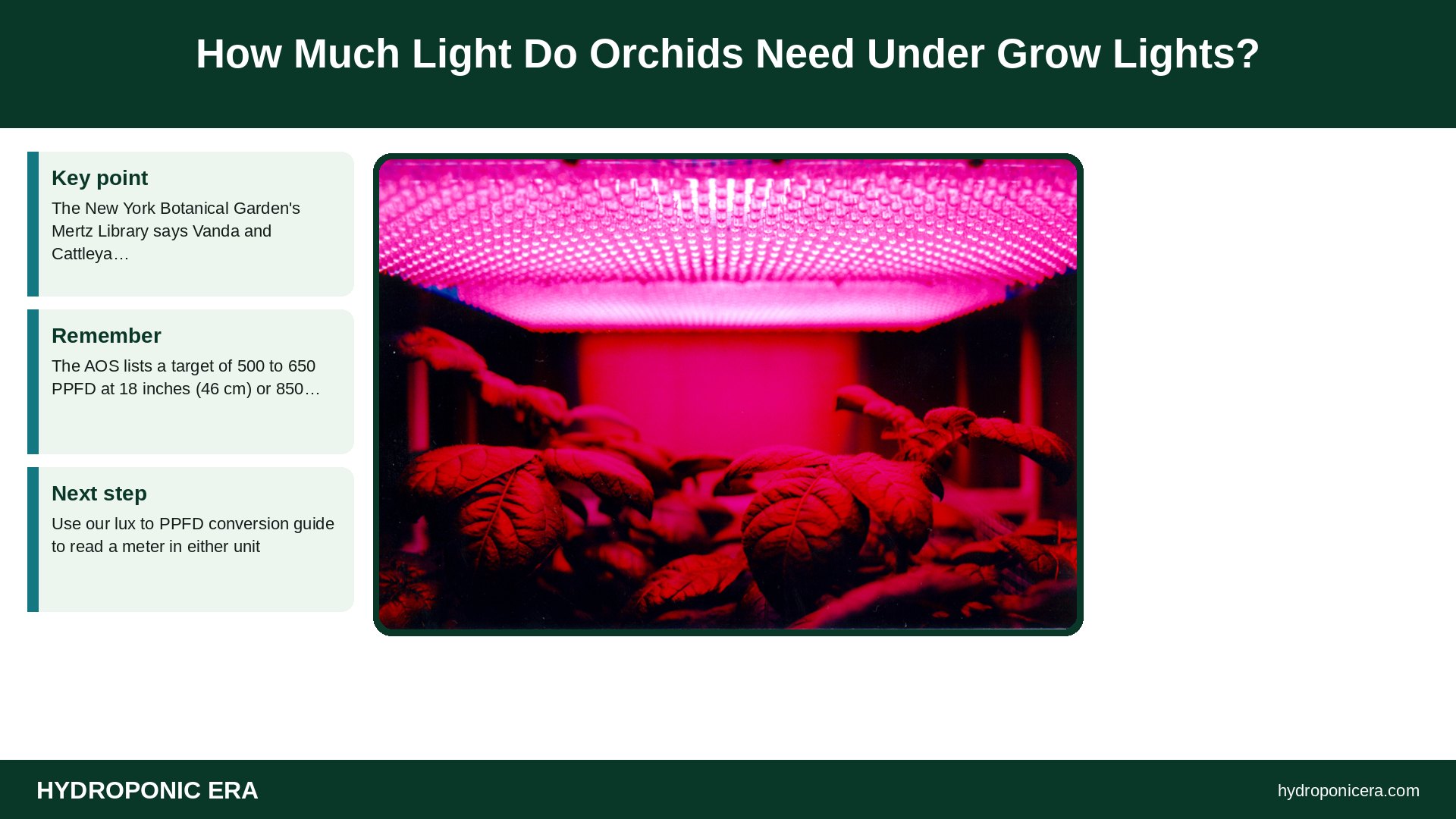
It depends on the genus. The New York Botanical Garden’s Mertz Library says Vanda and Cattleya have high light needs of 2,000 to 4,000 foot-candles, Miltonia and Oncidium need 1,500 to 2,000, and Phalaenopsis and Paphiopedilum grow well around 1,000 foot-candles. The AOS lists a target of 500 to 650 PPFD at 18 inches (46 cm) or 850 to 1,100 PPFD at 12 inches (30 cm).
Use our lux to PPFD conversion guide to read a meter in either unit.
How Far Should Grow Lights for Orchids Be From the Leaves?
About 6 to 12 inches (15 to 30 cm). Iowa State University Extension gives that range for orchids under artificial light, and the AOS Phalaenopsis guide places fluorescent tubes or equivalent LED bulbs 6 to 12 inches (30 cm) above the leaves. Light weakens quickly with distance, which the AOS explains with the Inverse Square Law, so a few inches change intensity a lot.
- Start at 12 inches (30 cm).
- Watch leaf color for two to three weeks.
- Lower the light if leaves turn dark green.
- Raise it if leaves bleach or feel hot.
The AOS warns that LEDs can cause “laser burns” if leaves sit too close. Our guide on whether LED grow lights get hot explains why.
Why Measure Grow Lights for Orchids Instead of Trusting the Box?
Because fixtures are sold by lumens, not plant light. In an AOS Orchids magazine article, Fred Bergman explains that lighting makers list lumens because foot-candles depend on lamp spacing, distance, reflectors and position along the tube. He cites readings of 1,085 foot-candles 6 inches (15 cm) below four enhanced white tubes and 789 at 12 inches (30 cm), and notes reports that 1,000 foot-candles grew and bloomed many orchids.
- Buy an inexpensive light meter or use a phone app as a guide.
- Measure at leaf height, in the center and at the edges.
- Move orchids that need more light to the center.
- Recheck after changing the height of your grow lights for orchids.
Our canopy PPFD measuring guide shows a simple routine.
How Many Hours Should Grow Lights for Orchids Run?
Usually 12 to 16 hours. The American Orchid Society’s Phalaenopsis guide recommends 12 to 16 hours a day to follow natural day length. Iowa State suggests at least 14 hours daily under supplemental light. An AOS lighting article describes a basement grower running lights 12 to 13 hours in autumn and winter and 14 to 15 hours in spring and summer. Use a timer for consistency.
How Do You Know if Grow Lights for Orchids Are Bright Enough?
Read the leaves. Iowa State University Extension says orchids that lack light turn dark green and will not flower, while a medium, grassy green color shows adequate light. The AOS Phalaenopsis guide adds a simple test for natural light: no shadow should show when you hold your hand one foot (30 cm) above the leaves.
- Dark green, no blooms: too little light.
- Medium grassy green: about right.
- Bleached or scorched patches: too close or too strong.
Can You Grow Orchids Hydroponically Under Grow Lights?
Yes, in semi-hydro or water culture setups, with the same light targets. The Iowa State guide notes that light affects water and fertilizer needs, so a brighter setup dries media faster. Our water culture orchids guide covers the root side. Keep fans gentle, since Iowa State warns that too much airflow dries plants quickly.
FAQ About Grow Lights for Orchids
Do grow lights for orchids need to be full spectrum?
AOS recommends a CRI of 90 to 95+ for a sunlike spectrum.
How far should an LED be from a Phalaenopsis?
About 6 to 12 inches (15 to 30 cm).
How many foot-candles do Phalaenopsis need?
Around 1,000 foot-candles, per NYBG.
Can grow lights burn orchids?
Yes; AOS warns of LED “laser burns” up close.
How many hours a day should orchids be under lights?
12 to 16 hours for Phalaenopsis, per AOS.
Do grow lights for orchids need a timer?
A timer keeps the 12 to 16 hour schedule the same every day.
Will orchids rebloom under grow lights?
Too little light stops flowering; adequate light helps.
Sources
- American Orchid Society — Growing Under Lights
- American Orchid Society — Phalaenopsis culture sheet (PDF)
- American Orchid Society, Orchids magazine — Artificial Lighting Systems (PDF)
- Iowa State University Extension — Growing Orchids Indoors
- New York Botanical Garden Mertz Library — Light requirements for orchids
- Photo credits (Wikimedia Commons, edited with titles): Phalaenopsis Cultivar White 01 by Uoaei1 (CC BY-SA 4.0); LED panel and plants by NASA Marshall Space Flight Center (Public domain); Flickr – brewbooks – Orchid in our Indoor Garden by brewbooks from near Seattle, USA (CC BY-SA 2.0)