
Is dehumidifier water safe for plants? Dehumidifier water is generally fine for ornamental plants if the unit and tank are clean. The Royal Horticultural Society says condensed water from dehumidifiers suits many ornamentals, especially soft-water plants like orchids. It is low in minerals, much like distilled water, but it can pick up metals, dust and microbes from coils and tanks. Extension experts advise caution on food crops.
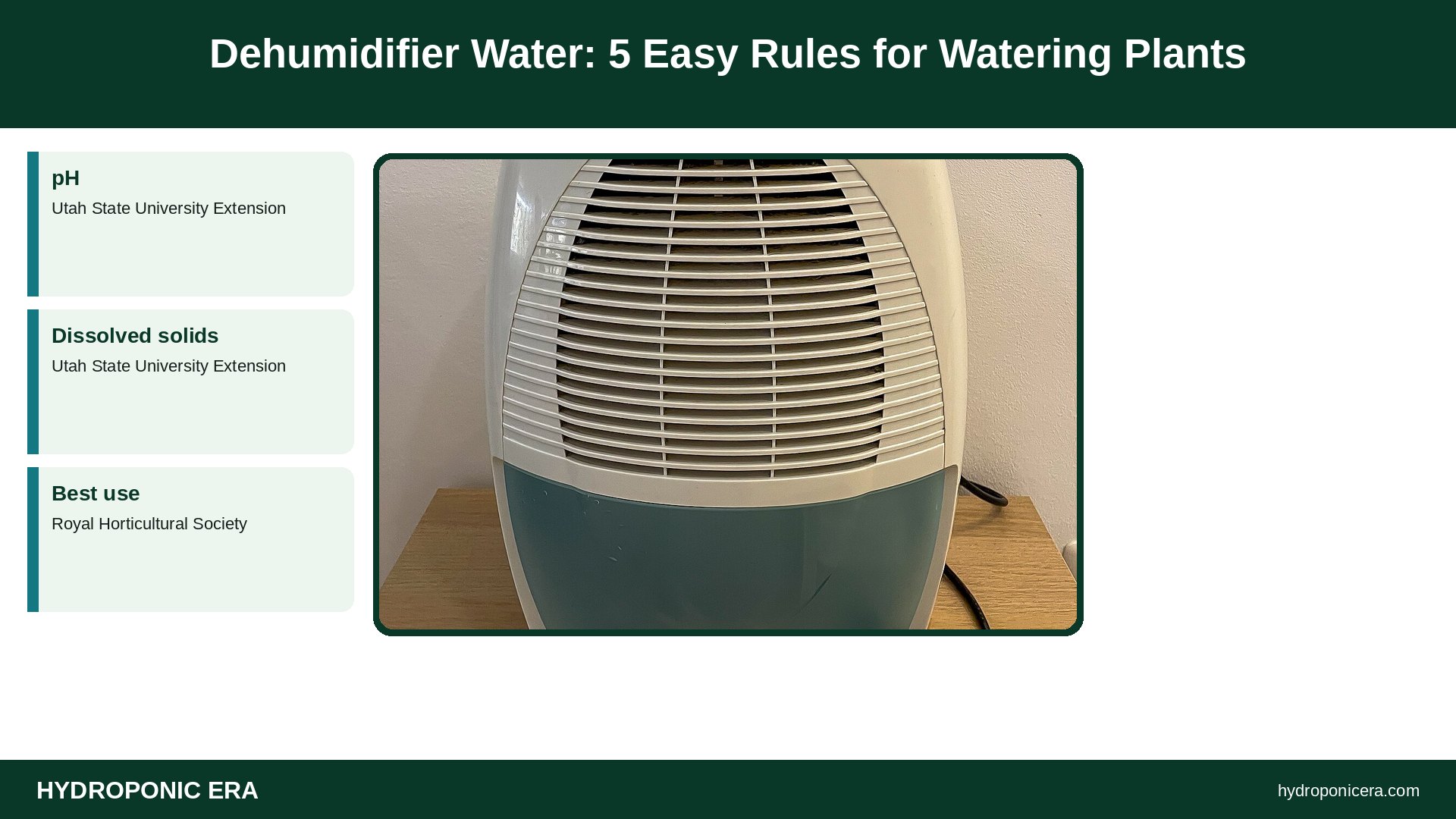
Key takeaway: Dehumidifier water forms the same way air conditioner condensate does: humid air hits a cold coil and water drips into a pan or tank. Utah State University Extension reports that AC condensate is neutral in pH, with total dissolved solids of 15 to 100 ppm. That makes it soft, low-mineral water, with a few hygiene cautions before it touches plants.
| Factor | What sources report | Source |
|---|---|---|
| pH | Neutral | Utah State University Extension |
| Dissolved solids | 15–100 ppm (AC condensate) | Utah State University Extension |
| Best use | Many ornamentals; soft-water plants | Royal Horticultural Society |
| Risks | Metals, dust, bacteria, fungus | Ask Extension (Tennessee expert) |
| Rare risk | Legionella; use drip, not spray | Utah State University Extension |
What Is Dehumidifier Water?
It is condensed water vapor from room air. The Royal Horticultural Society describes water from dehumidifiers and tumble dryers as condensed water. An Ask Extension expert explains that condensate starts as essentially distilled water on the coils, then runs over the coil metal and into a collection pan, where bacteria and dust can accumulate. So purity depends on the machine.
Is Dehumidifier Water Safe for Houseplants?
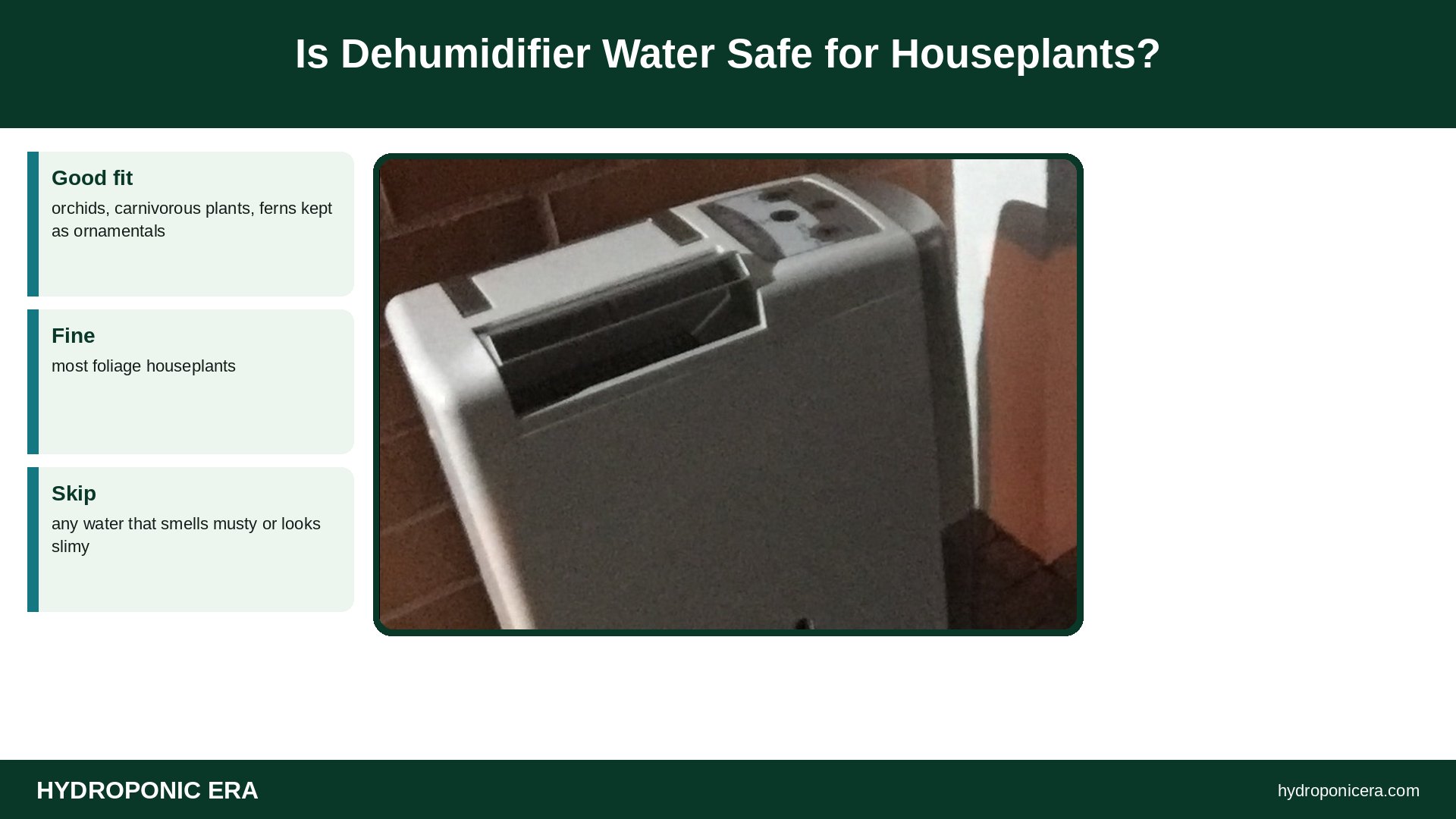
For most ornamentals, yes. The RHS says condensed water from dehumidifiers is suitable for many ornamental plants, and that orchids, carnivorous plants and other soft-water plants benefit from rainwater or condensed water. Because it has few dissolved minerals, it will not add the hard-water crust that tap water can leave on pots and media.
- Good fit: orchids, carnivorous plants, ferns kept as ornamentals.
- Fine: most foliage houseplants.
- Skip: any water that smells musty or looks slimy.
Our water culture orchids guide shows a soft-water setup.
Is Dehumidifier Water Safe for Vegetables?
Be cautious. An Ask Extension expert writes that condensate can carry bacteria, fungus, dust and small amounts of heavy metal and chemicals from the device, and says it is not recommended for drinking. That expert found no documentation that condensate is necessarily contaminated, but considered it prudent to use it on non-edible plants. For food crops, clean tap or rainwater is the simpler choice.
Can You Use Dehumidifier Water in Hydroponics?
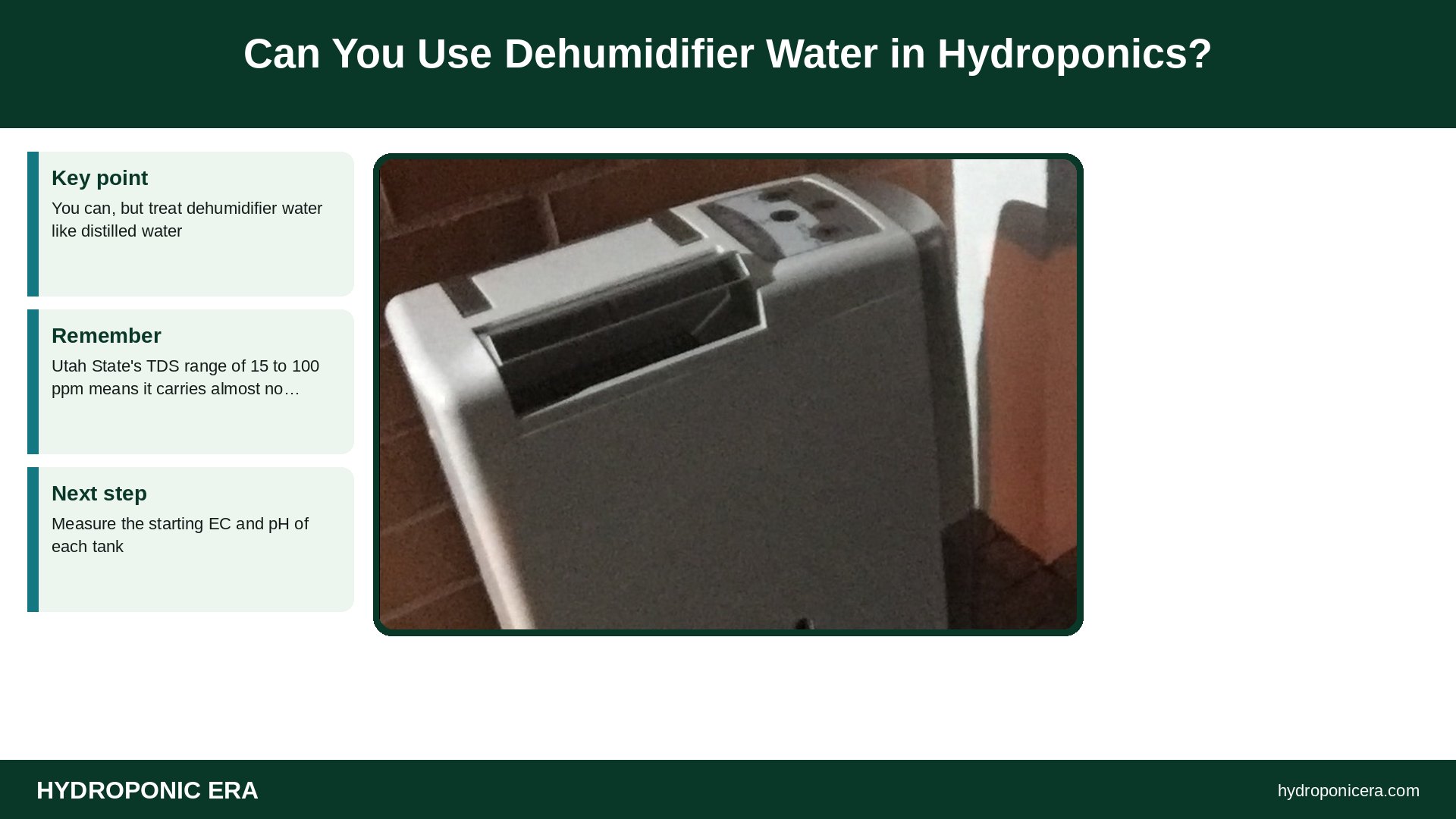
You can, but treat dehumidifier water like distilled water. Utah State’s TDS range of 15 to 100 ppm means it carries almost no calcium or magnesium, so a full nutrient with Cal-Mag is needed. Measure the starting EC and pH of each tank. A low baseline is useful because you control every mineral, as our source water baseline guide explains.
- Filter out debris through a clean cloth.
- Measure starting EC and pH.
- Add a complete nutrient with calcium and magnesium.
- Adjust pH after mixing.
Compare it with distilled water for hydroponics.
How Does Dehumidifier Water Compare to Rainwater and Softened Water?
It is closest to rainwater. The RHS calls rainwater the best option for garden watering and groups condensed water with it for soft-water plants. Softened water is different: the RHS explains that softeners swap calcium and magnesium for sodium, which can build up in soil and reduce nutrient availability, so it is fine short term but not recommended long term. Dehumidifier water adds no sodium.
- Rainwater: RHS’s first choice for watering.
- Dehumidifier water: soft and low in minerals, if the unit is clean.
- Softened water: short-term use only, per the RHS.
Our rainwater for hydroponics guide covers collection and testing.
How Much Water Does a Dehumidifier Produce?
It depends on the machine and the room. Output rises with humidity and falls in dry air, and every model lists a daily capacity on its label. For scale, Utah State University Extension reports that a 2-ton central air conditioner can produce 20 to 25 gallons (76 to 95 L) of condensate per day in summer. A portable unit usually makes far less, so check the rated capacity on yours.
How Do You Make Dehumidifier Water Safer for Plants?
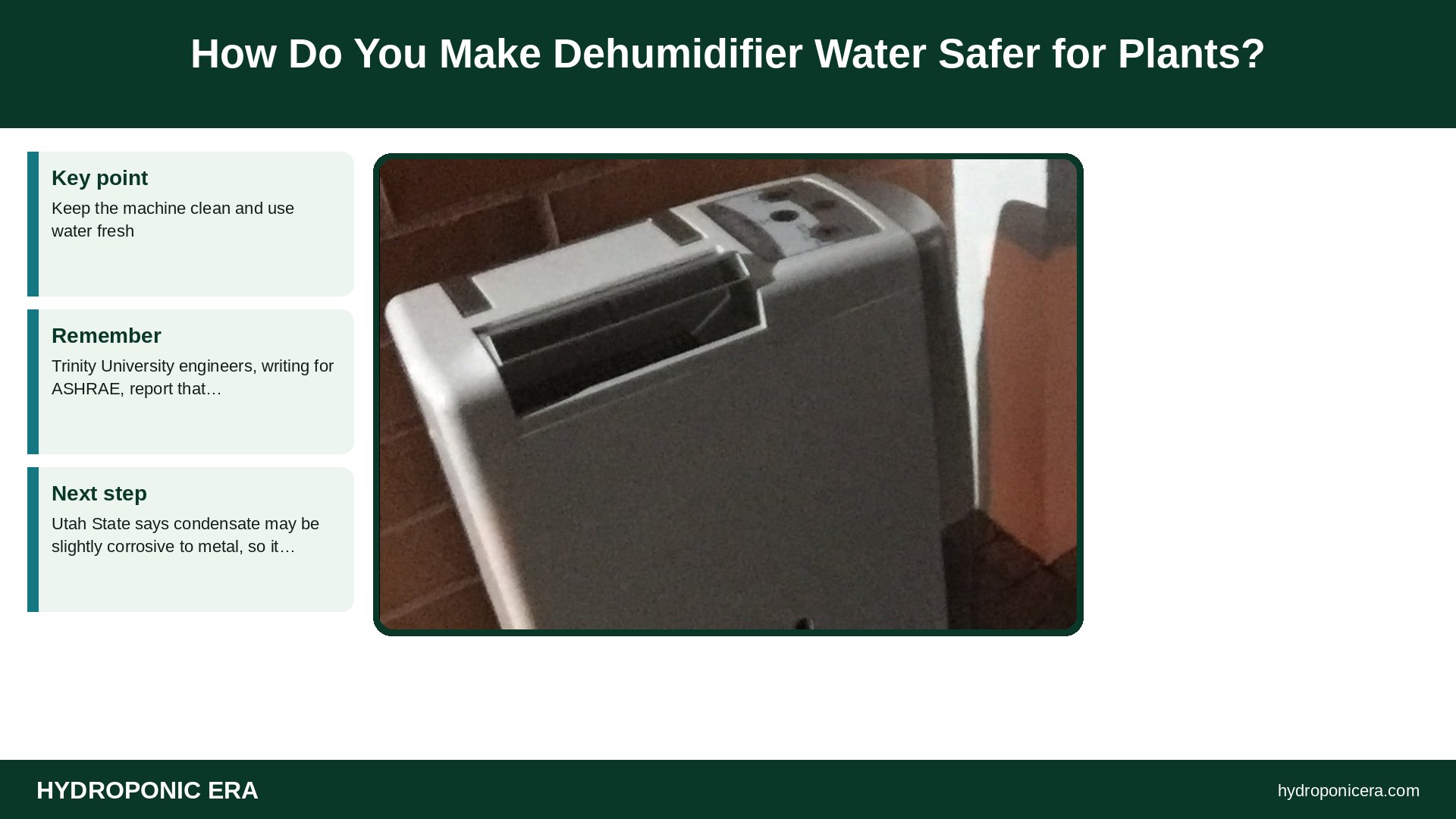
Keep the machine clean and use water fresh. Trinity University engineers, writing for ASHRAE, report that condensate from properly maintained large air-handling units is high-quality water, and that system design and maintenance affect its quality. Utah State says condensate may be slightly corrosive to metal, so it recommends plastic pipes for collection.
- Empty the tank daily.
- Wash the tank and filter as the manual directs.
- Store dehumidifier water in a clean, covered plastic container.
- Use it within a day or two.
- Water at soil level, not by spraying leaves.
Can Condensate Pick Up Metals From the Machine?
It can. In the Ask Extension answer, a Tennessee expert explains that condensate runs over copper coils that are usually assembled with lead-based solder, then into a collection pan that may be galvanized, where bacteria and dust can build up. The expert found no documentation that condensate is necessarily contaminated with heavy metals, but the possibility is why food crops call for caution.
- Metal sources: coil solder and galvanized pans.
- Biological sources: dust, bacteria and fungus in the pan.
- Best defense: a clean unit and non-edible plants.
Does Dehumidifier Water Carry Legionella?
Rarely, but it is possible. Utah State University Extension notes that in rare events AC condensate may contain Legionella bacteria. It says drip irrigation, which avoids spraying particles, is the safer way to apply condensate. Avoid misters or spray bottles filled with dehumidifier water, especially indoors.
FAQ About Dehumidifier Water
Is dehumidifier water distilled?
Close, but it can pick up metals, dust and microbes.
Can I water orchids with dehumidifier water?
Yes; the RHS says orchids benefit from condensed water.
Is dehumidifier water better than softened water?
Yes for plants; it adds no sodium, unlike softened water.
Can I drink dehumidifier water?
No; Ask Extension says it is not recommended.
What is the pH of dehumidifier water?
AC condensate is neutral, per Utah State.
Does dehumidifier water need nutrients?
Yes; it has almost no minerals.
How long can I store dehumidifier water?
Use it fresh, within a day or two.
Sources
- Royal Horticultural Society — Collecting, storing and reusing water
- Utah State University Extension — Nontraditional Water Sources
- Ask Extension — AC condensate used for watering
- Trinity University (ASHRAE Journal) — Quality of Condensate from Air-Handling Units
- Photo credits (Wikimedia Commons, edited with titles): Air dehumidifier with a European plug by Photograph by Mike Peel (www.mikepeel.net). (CC BY-SA 4.0); A Dehumidifier by V.B.Speranza (CC BY-SA 4.0)