
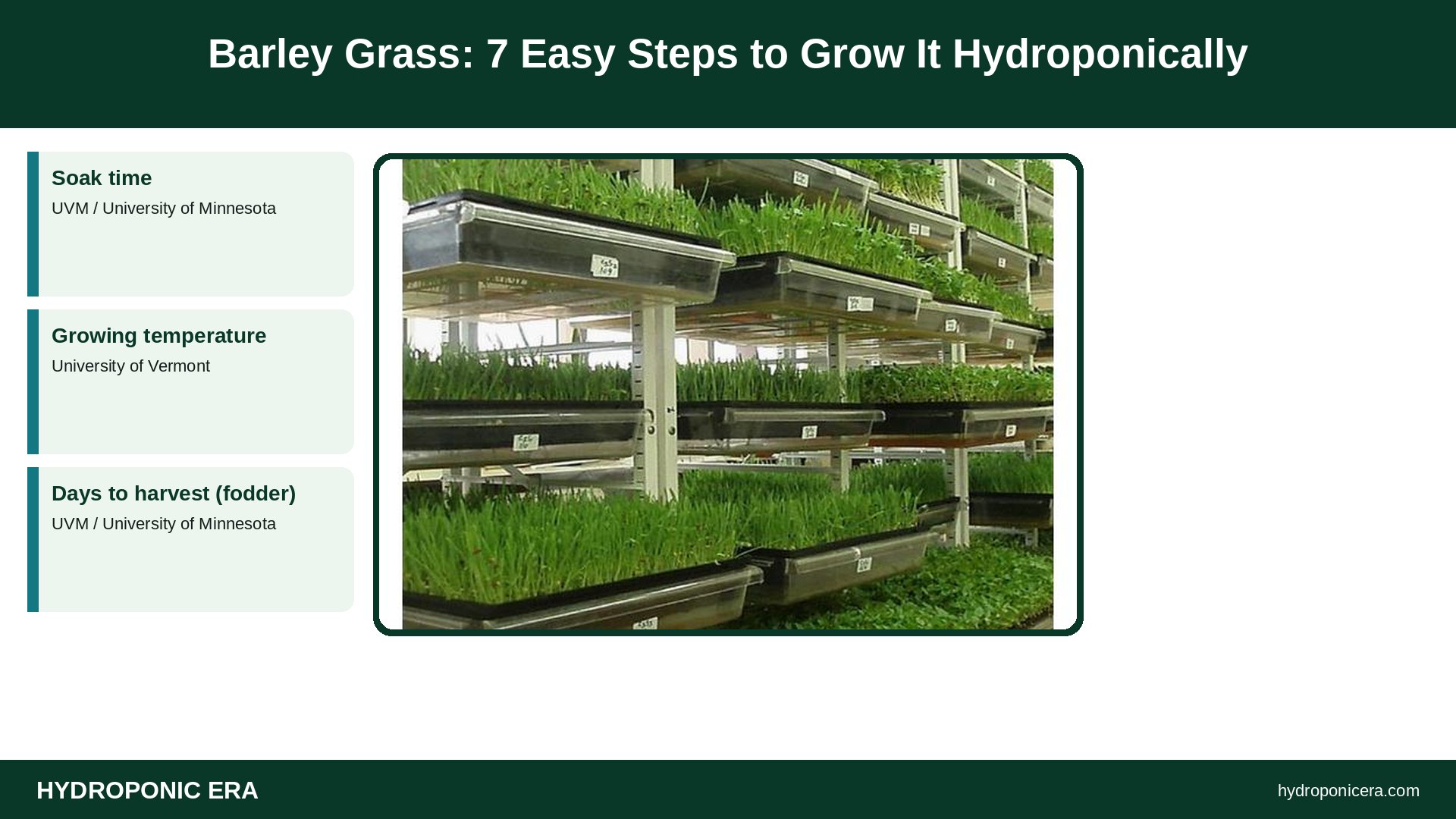
How do you grow barley grass hydroponically? Soak clean, untreated barley seed for about 8 to 12 hours, spread it thickly in a tray, and keep it moist at 60 to 70°F (16 to 21°C). Barley grass forms a mat of shoots and roots in 6 to 8 days without soil. Harvest young shoots as microgreens for people, or feed the whole mat to animals as fodder. Clean trays well, because mold is the main problem.
Key takeaway: University of Vermont Extension describes barley as the typical grain for hydroponic fodder: soaked for 8 to 12 hours, then grown in trays at 60 to 70°F (16 to 21°C) for 6 to 8 days. Penn State Extension lists barley among the cereals grown as microgreens. The same simple tray method gives barley grass for the kitchen, pets or livestock.
| Step | What sources report | Source |
|---|---|---|
| Soak time | 8–12 hours (UVM); 12–24 hours (UMN) | UVM / University of Minnesota |
| Growing temperature | 60–70°F (16–21°C) | University of Vermont |
| Days to harvest (fodder) | 6–8 days; 7-day sprouts common | UVM / University of Minnesota |
| Watering | 2–3 times daily | University of Minnesota |
| Water content | 80% or higher | University of Vermont |
| Main risk | Mold | University of Vermont |
What Is Barley Grass?
Barley grass is the young green shoot of barley (Hordeum vulgare) grown from seed for a week or two. Penn State Extension says microgreens are also produced by sprouting cereals such as barley, oat, wheat and corn, harvesting single shoots with their first leaves by cutting right above the growing medium. Grown longer and fed with roots attached, the same crop is called barley fodder.
If you grow wheat instead, our guide to how to grow wheatgrass covers the close cousin of barley grass.
What Seed Should You Buy for Barley Grass?
Clean, untreated seed. Penn State Extension recommends seed with good germination that has not been treated with chemicals or coated, and that is sold for sprouts and microgreens under food safety standards. The University of Minnesota stresses mold-free seed for fodder. Seed of unknown origin may not meet these standards, so buy from a sprouting seed supplier when the barley grass is for your kitchen.
- For people: barley seed sold for sprouting or microgreens.
- For animals: clean, mold-free seed from a trusted feed supplier.
- Avoid: treated, coated or dusty seed.
How Long Should You Soak Barley Grass Seed?
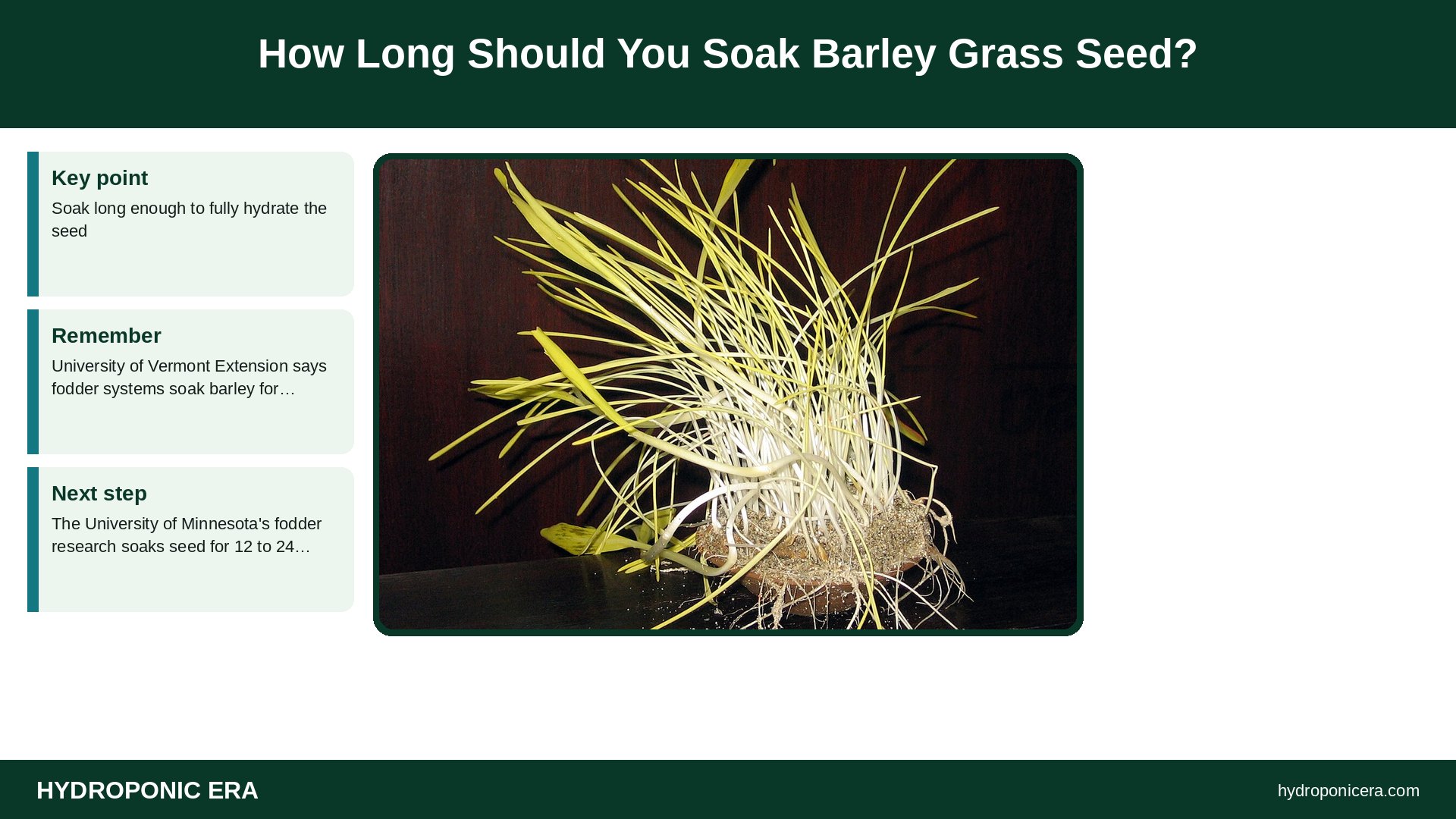
Soak long enough to fully hydrate the seed. University of Vermont Extension says fodder systems soak barley for about 8 to 12 hours. The University of Minnesota’s fodder research soaks seed for 12 to 24 hours before spreading it on trays. Start with clean seed: the University of Minnesota says it is essential to begin with seed that is free from mold.
- Rinse seed until the water runs clear.
- Soak 8 to 12 hours in clean water.
- Drain well before spreading.
- Use seed sold untreated for sprouting.
How Do You Grow Barley Grass in Trays?
Spread soaked seed in an even layer and keep it damp but not flooded. The University of Minnesota fodder system waters trays two or three times daily for seven days. University of Vermont Extension says barley fodder grows at 60 to 70°F (16 to 21°C), with or without artificial light, for 6 to 8 days. Trays need drainage so water does not pool around the seed.
- Tray: shallow, with drain holes.
- Temperature: steady 60 to 70°F (16 to 21°C).
- Water: 2 to 3 light waterings a day.
- Light: optional for fodder; useful for greener microgreens.
When Is Barley Grass Ready to Harvest?
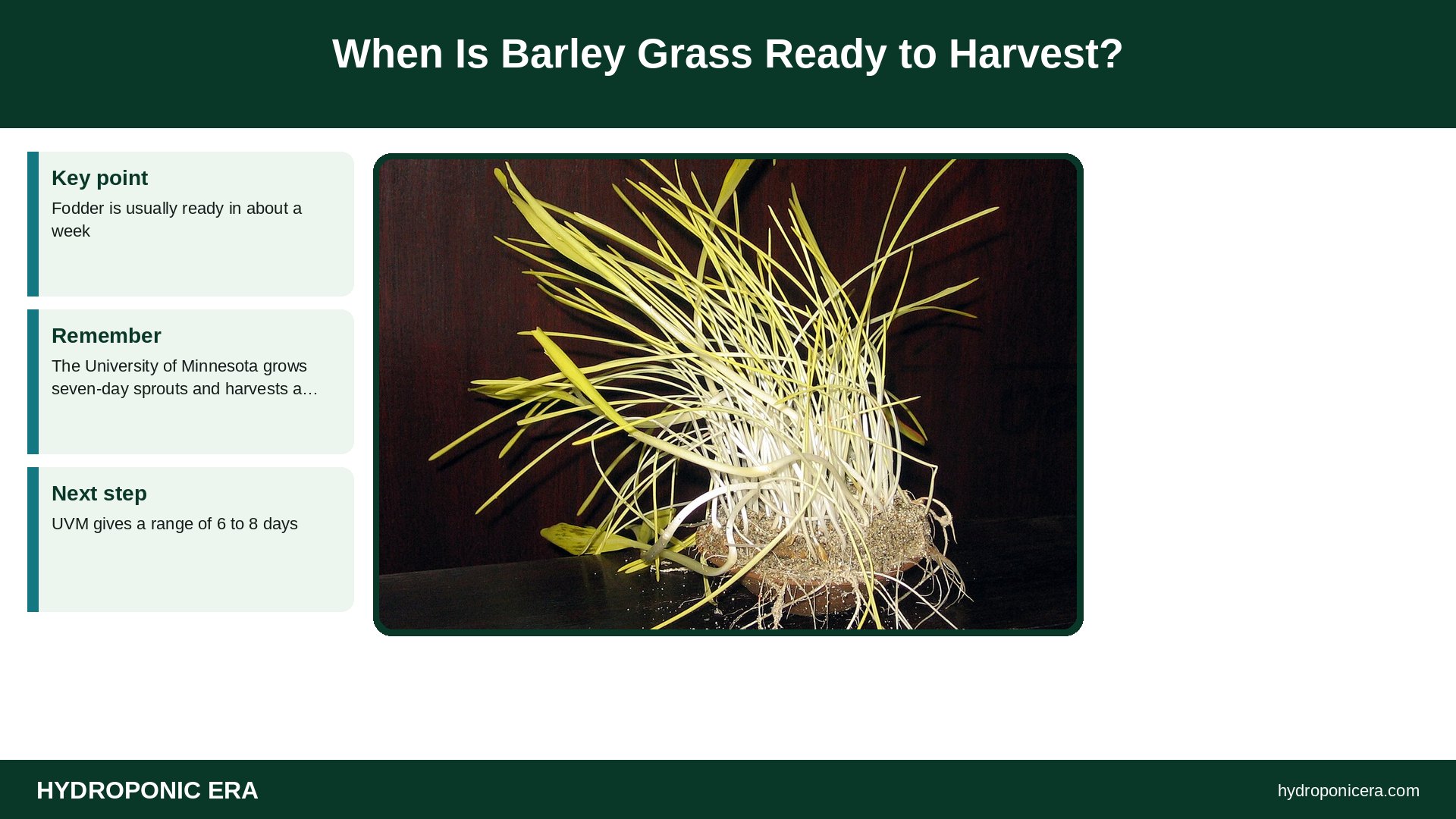
Fodder is usually ready in about a week. The University of Minnesota grows seven-day sprouts and harvests a set of trays every day, reseeding new trays for a steady supply. UVM gives a range of 6 to 8 days. For microgreens, Penn State says to cut shoots right above the growing medium. Taste a few shoots and harvest while they are tender.
Our guide to harvesting microgreens explains clean cutting and storage.
How Do You Prevent Mold on Barley Grass?
Sanitation is the answer. University of Vermont Extension says almost every study it reviewed mentioned mold as a drawback of fodder systems, because the warm, moist conditions that sprouts need also suit mold. It says moldy fodder can mean lost feed and ill or even dead animals, and that sanitation is key. Organic farms must use sanitizers approved by their certifier.
- Start with clean, mold-free seed.
- Wash and sanitize trays between every crop.
- Keep air moving around the trays.
- Do not overwater or let water stand.
- Throw out any tray that smells sour or shows fuzzy growth.
Is Barley Grass Good Fodder for Animals?
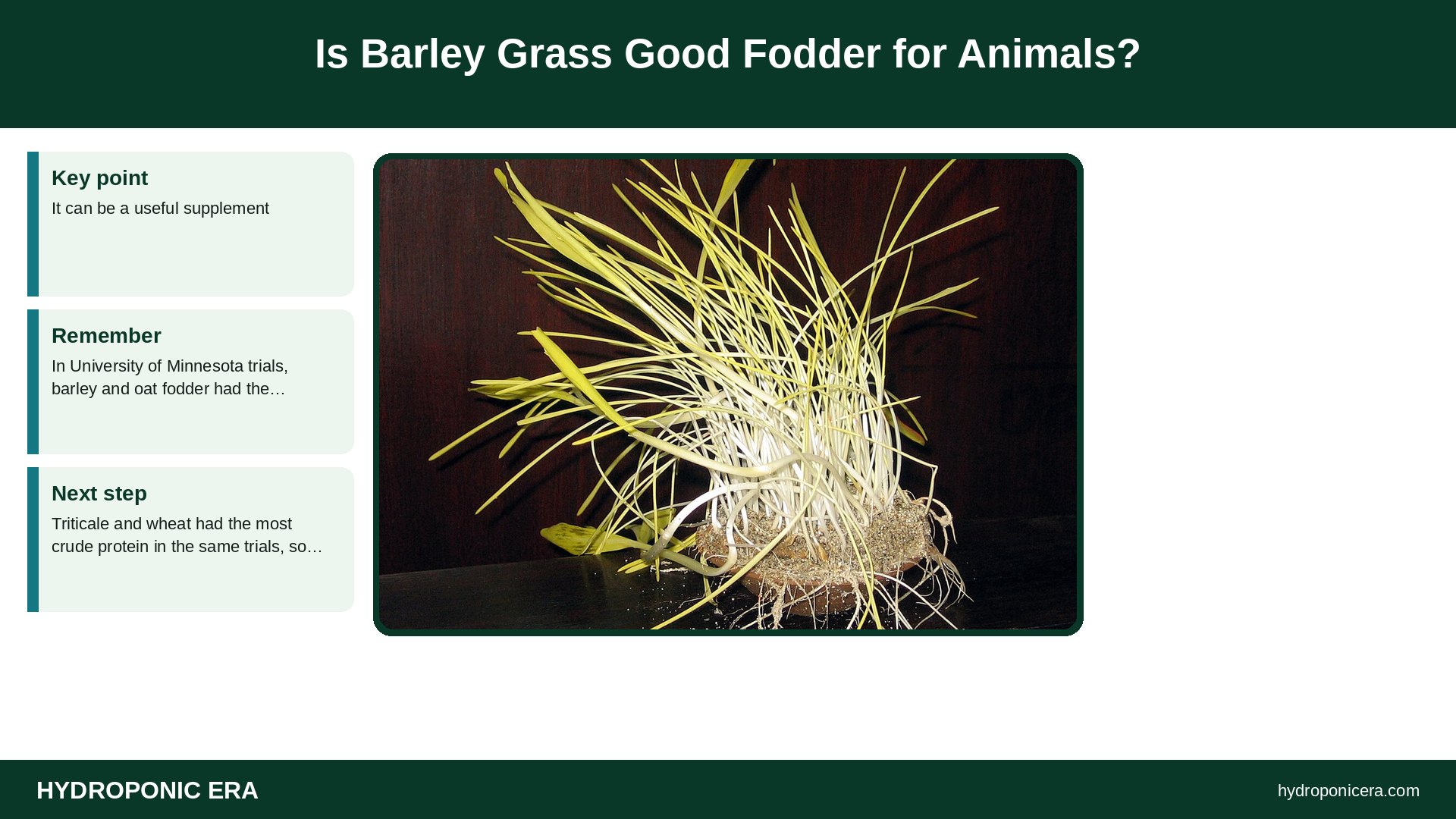
It can be a useful supplement. In University of Minnesota trials, barley and oat fodder had the greatest neutral detergent fiber, and barley fodder had the highest calcium percentage of the grains tested.
Triticale and wheat had the most crude protein in the same trials, so barley grass is not the top choice on every measure, and the best grain depends on what the ration lacks.
University of Vermont Extension notes that fodder is 80% or more water, so compare it to other feeds on a dry matter basis, not fresh weight.
Read our guide to hydroponic fodder for chickens and livestock before changing any animal’s diet.
Does Barley Grass Use Much Water?
Very little compared with a field crop. University of Vermont Extension cites research showing fodder systems need only about 2 to 3% of the water required by field crops, and that barley fodder had the best water use efficiency among the sprouted grains studied. Labor is the bigger cost, at one to four hours a day for farm-scale systems in some studies.
FAQ About Barley Grass
How fast does barley grass grow?
About 6 to 8 days to a full mat, per UVM.
Does barley grass need light?
UVM says fodder can grow with or without artificial light.
Can I eat barley grass as microgreens?
Yes; Penn State lists barley among cereal microgreens.
Why does my barley grass smell sour?
Likely mold or bacteria; discard it and sanitize trays.
Can I reuse barley grass roots?
No; start each tray with fresh seed.
Is barley grass the same as wheatgrass?
No; they come from different cereal grains.
Sources
- University of Vermont Extension — Fodder Systems on the Certified Organic Dairy Farm
- University of Minnesota West Central Research and Outreach Center — Fodder Production Systems
- Penn State Extension — The ABCs of Microgreens
- Photo credits (Wikimedia Commons, edited with titles): Green-fodder-of-different-crops-ready-for-harvest by Ghazi N. Al-Karaki, M. Al-Hashimi (CC BY 4.0); Nalaswan barley shoots by Kamal Ratna Tuladhar (CC BY-SA 3.0)