
What is decoupled aquaponics? Decoupled aquaponics splits a farm into two loops: a recirculating fish system and a separate hydroponic system, joined by a one-way valve. Fish water flows to the plant reservoir only when needed, so each loop can run at its own pH, temperature and nutrient level. New Mexico State University says this avoids the compromise of single-loop designs.
Key takeaway: In a classic single-loop system, the same water serves fish, nitrifying bacteria and plants, so none of them gets ideal conditions. Decoupled aquaponics, also called a double-recirculating or multi-loop system, gives each side its own water cycle. It costs more to build and run, so it suits commercial farms better than most backyard setups.
| Factor | Single-loop | Decoupled aquaponics |
|---|---|---|
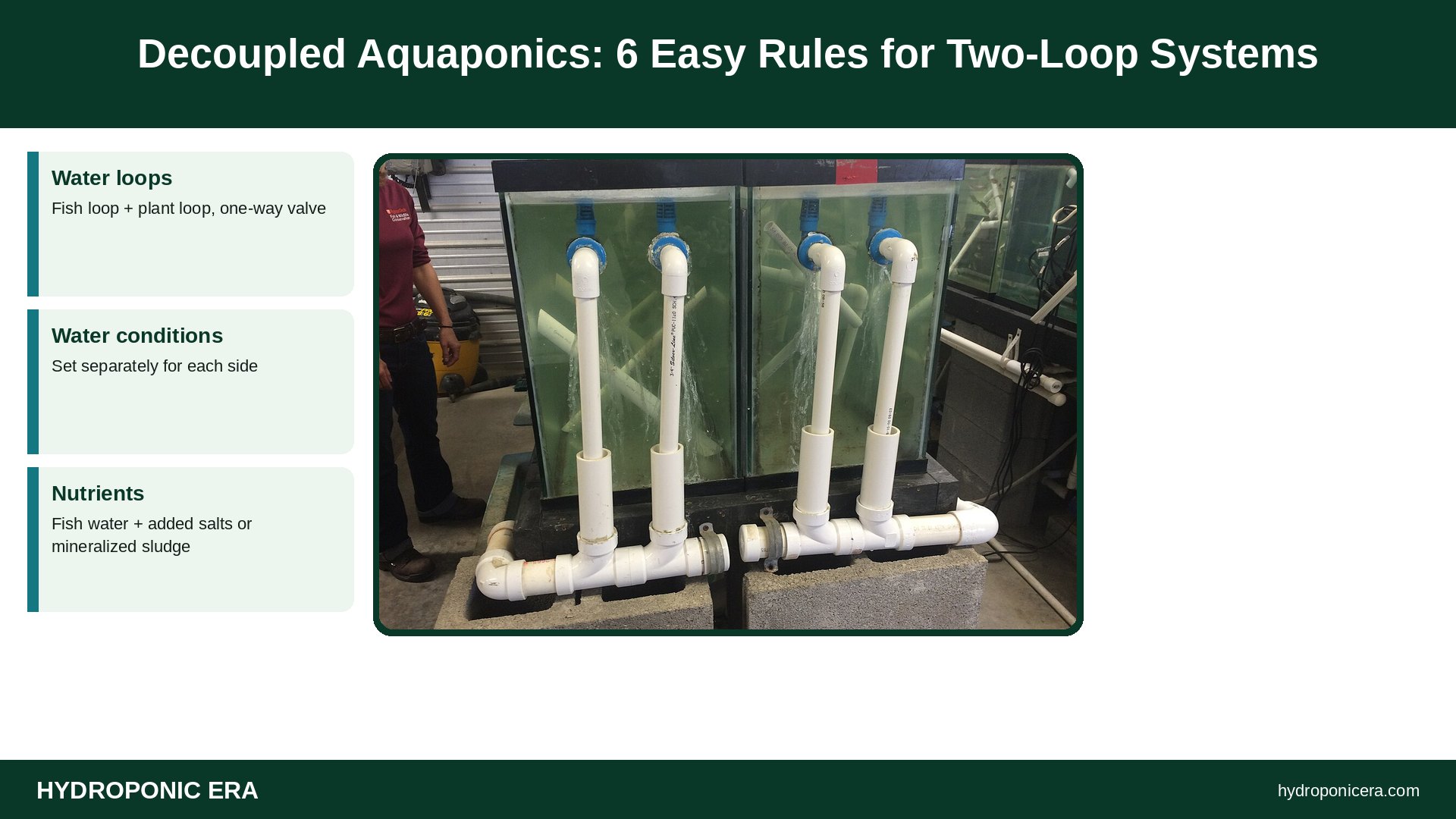
| Water loops | One shared loop | Fish loop + plant loop, one-way valve |
| Water conditions | Compromise for fish, plants, bacteria | Set separately for each side |
| Nutrients | Fish waste only | Fish water + added salts or mineralized sludge |
| Salt treatment for fish | Not possible (harms plants) | Possible in the fish loop |
| Best fit (NMSU) | Hobby, lettuce, herbs | Commercial, fruiting crops |
How Does Decoupled Aquaponics Work?
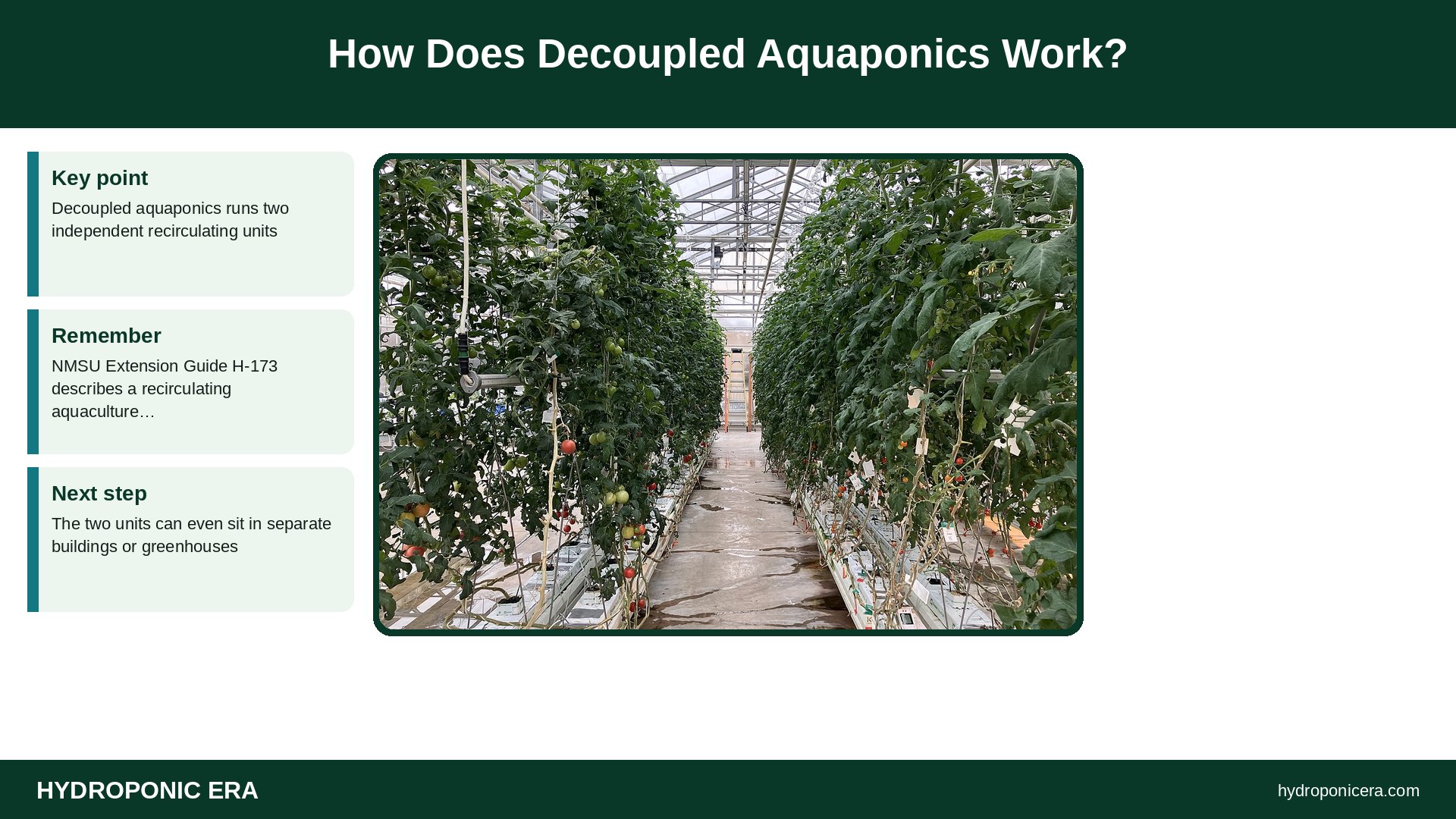
Decoupled aquaponics runs two independent recirculating units. NMSU Extension Guide H-173 describes a recirculating aquaculture system (RAS) for fish and a hydroponic unit for plants, connected by a one-way valve that moves fish water to a hydroponic reservoir as needed. The two units can even sit in separate buildings or greenhouses.
The original prototype, ASTAF-PRO, was tested in Germany with tilapia and tomatoes. Kloas and colleagues (2015) explain that fish water entering the plant reservoir can be optimized as fertilizer for the crop, while water the plants transpire is condensed by air conditioning and returned to the fish side.
What Is the Difference Between Coupled and Decoupled Aquaponics?
The difference is whether water returns from plants to fish. In coupled (single-loop) aquaponics, water flows from the fish tanks through filters into the grow beds and straight back. In decoupled aquaponics the valve only lets water go one way, so plant-side adjustments never reach the fish. Our aquaponics system types guide compares common single-loop layouts.
- Coupled: one loop; fish, bacteria and plants share the same water.
- Decoupled: two loops; fish water moves to plants on demand.
- Shared goal: reuse fish waste as plant nutrients.
Why Decouple an Aquaponics System?
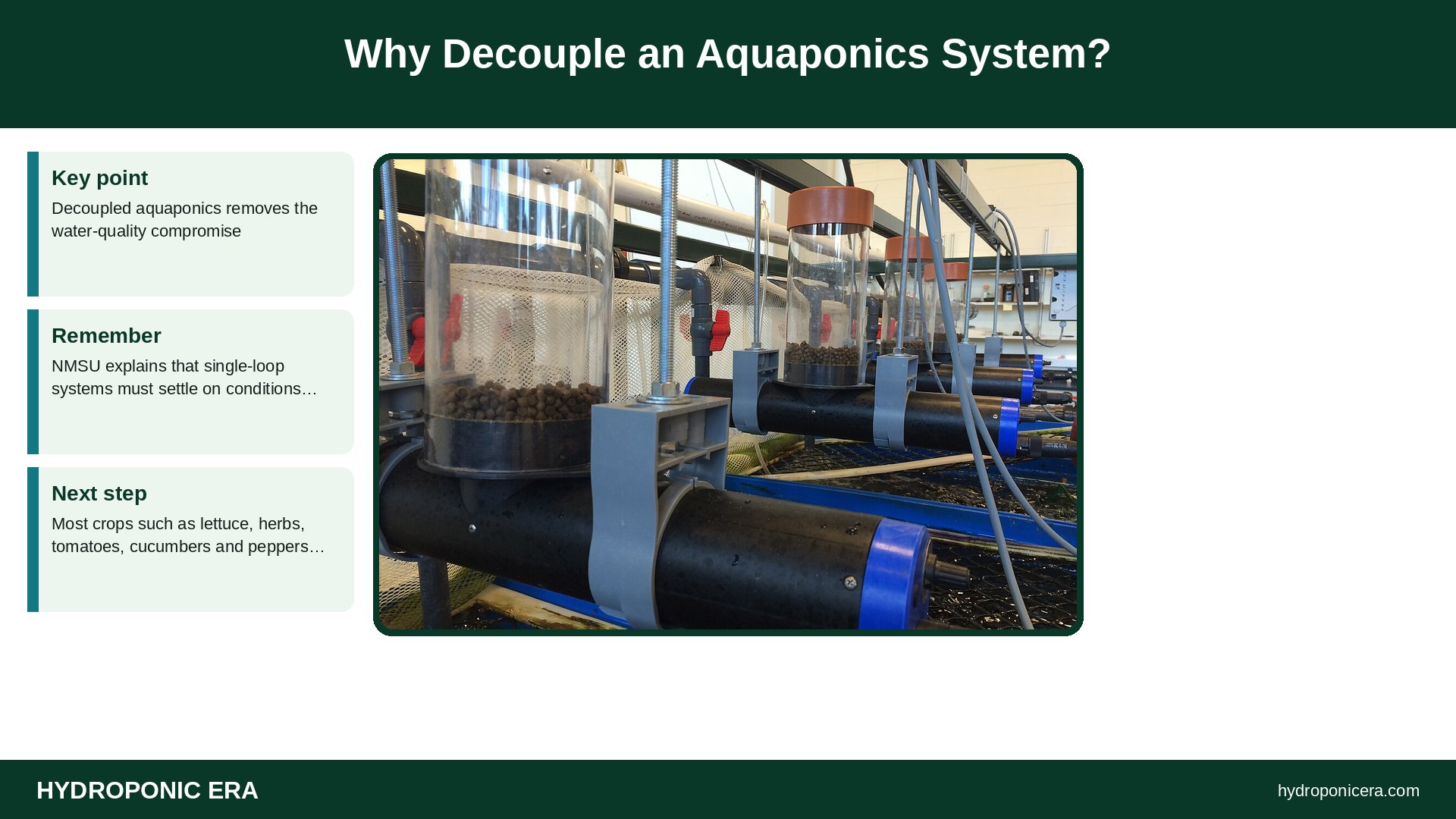
Decoupled aquaponics removes the water-quality compromise. NMSU explains that single-loop systems must settle on conditions acceptable to fish, plants and bacteria but suboptimal for each. Most crops such as lettuce, herbs, tomatoes, cucumbers and peppers grow best between 65 and 80°F (18–27°C), which is why many single-loop growers pair them with warm-water tilapia.
Two loops let a grower run cold-water fish such as trout, salmon or walleye beside warm-water plants. NMSU adds that common fish treatments become possible again: adding salt against parasites or nitrite toxicity is ruled out in single-loop systems because most plants cannot tolerate it.
Does Decoupled Aquaponics Increase Yields?
Early results are promising, but evidence is limited. NMSU notes there are few side-by-side studies of single-loop and decoupled systems, and none at commercial scale. In the study it cites (Kloas et al., 2015), fruit yield was 36% higher in decoupled aquaponics, while fish production was comparable. Kloas’s team also reported tilapia productivity similar to a standard RAS.
- Plants: nutrient recipe tailored to high-demand crops.
- Fish: water held at fish-ideal pH and temperature.
- Risk: a fish-side problem no longer crashes the plants.
How Does Decoupled Aquaponics Save Water?
It reuses water that a normal fish farm would dump. Kloas and colleagues write that conventional RAS replaces 6 to 12% of rearing volume with fresh water daily, and NMSU says some RAS discharge 10% or more of total volume every day. In decoupled aquaponics that discharge feeds the plants, and condensed plant water returns to the fish.
What Is Remineralization in Decoupled Aquaponics?
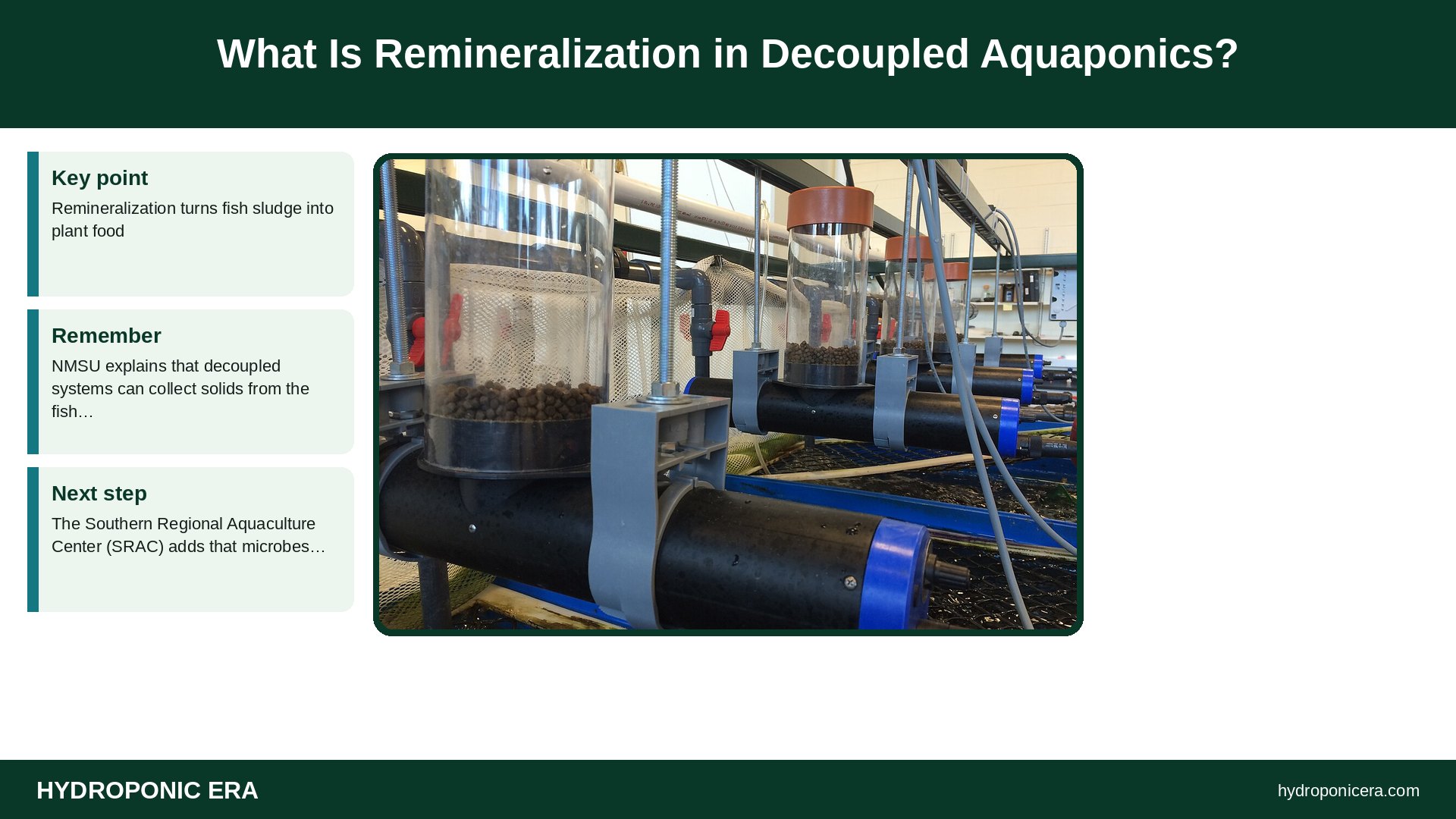
Remineralization turns fish sludge into plant food. NMSU explains that decoupled systems can collect solids from the fish side and break them down so iron, phosphorus, potassium and calcium become available to plants. The Southern Regional Aquaculture Center (SRAC) adds that microbes decomposing solids release inorganic nutrients, and too few solids means more supplementation. See our aquaponics mineralization guide.
- Capture settleable solids from the fish loop.
- Digest them in a separate mineralization tank.
- Feed the nutrient-rich liquid to the hydroponic reservoir.
- Top up remaining nutrients with hydroponic salts.
NMSU says reusing effluent this way can make the system a zero-discharge facility.
What Are the Disadvantages of Decoupled Aquaponics?
Cost and complexity are the main drawbacks. NMSU states that decoupled systems need more capital, space, technical expertise and management than single-loop systems. Because fish water alone does not build up enough nutrients, hydroponic nutrient salts must be added to the plant tank, which adds expense. Two loops also mean two sets of pumps, sensors and water tests.
- Higher build cost: extra reservoir, valve and pumps.
- More management: two water chemistries to track.
- Added inputs: hydroponic fertilizer for the plant loop.
Is Decoupled Aquaponics Right for Home Growers?
Usually not. NMSU concludes that for small-scale production, hobby growers, or systems growing low-nutrient crops like lettuce and herbs, single-loop systems are probably easier, more appropriate and more economical. Decoupled aquaponics fits commercial farms growing fruiting crops or cold-water fish. For backyard scale, start with our aquaponics vs hydroponics comparison.
Does Decoupling Help With Food Safety?
It can. NMSU lists better prospects for Good Agricultural Practices (GAP) and food safety certification as a benefit, because fish and produce areas can be housed separately, easing concerns about fish effluent touching vegetables. Our commercial aquaponics overview covers other steps farms take before selling produce.
FAQ About Decoupled Aquaponics
What is decoupled aquaponics?
Two loops, fish and plants, joined by a one-way valve.
Is decoupled aquaponics better than single-loop?
For commercial fruiting crops often yes; for hobby greens, single-loop is simpler.
Does decoupled aquaponics need fertilizer?
Yes; NMSU says hydroponic salts must be added.
Can you raise trout with warm-water crops?
Yes; decoupling allows cold-water fish beside warm-water plants.
Can you salt the fish tank in decoupled aquaponics?
Yes, because salty water stays in the fish loop.
Who invented decoupled aquaponics?
German researchers tested the ASTAF-PRO prototype (Kloas et al., 2015).
Sources
- New Mexico State University Extension — Decoupled Aquaponics: A Comparison to Single-loop Aquaponics (H-173)
- Kloas et al., Aquaculture Environment Interactions (2015) — A new concept for aquaponic systems to improve sustainability
- Southern Regional Aquaculture Center — Aquaponics: Integrating Fish and Plant Culture (SRAC 454)
- Photo credits (Wikimedia Commons, edited with titles): Recirculating Aquaculture System 1 by Narek75 (CC BY-SA 4.0); NC Greenhouse Nursery Tomatoes in Aquaponics by Gogerr (CC BY-SA 4.0); Recirculating Aquaculture System 10 by Narek75 (CC BY-SA 4.0)