
The three main aquaponics system types are media beds, deep water culture (raft) and nutrient film technique (NFT). Media beds are gravel- or clay-filled beds that filter water and grow almost any plant, making them the best choice for beginners and home gardens. Raft systems float plants on boards over aerated troughs and are the standard for commercial lettuce and herbs. NFT runs a thin film of water through pipes or channels and suits small leafy greens in tight spaces. Vertical towers, aquarium kits and hybrid or decoupled systems are variations on these.
Key takeaway: Start with a media bed if you’re new or want to grow fruiting crops; choose raft for steady lettuce and herb production; choose NFT or towers when space or weight is limited and you can add separate filters.
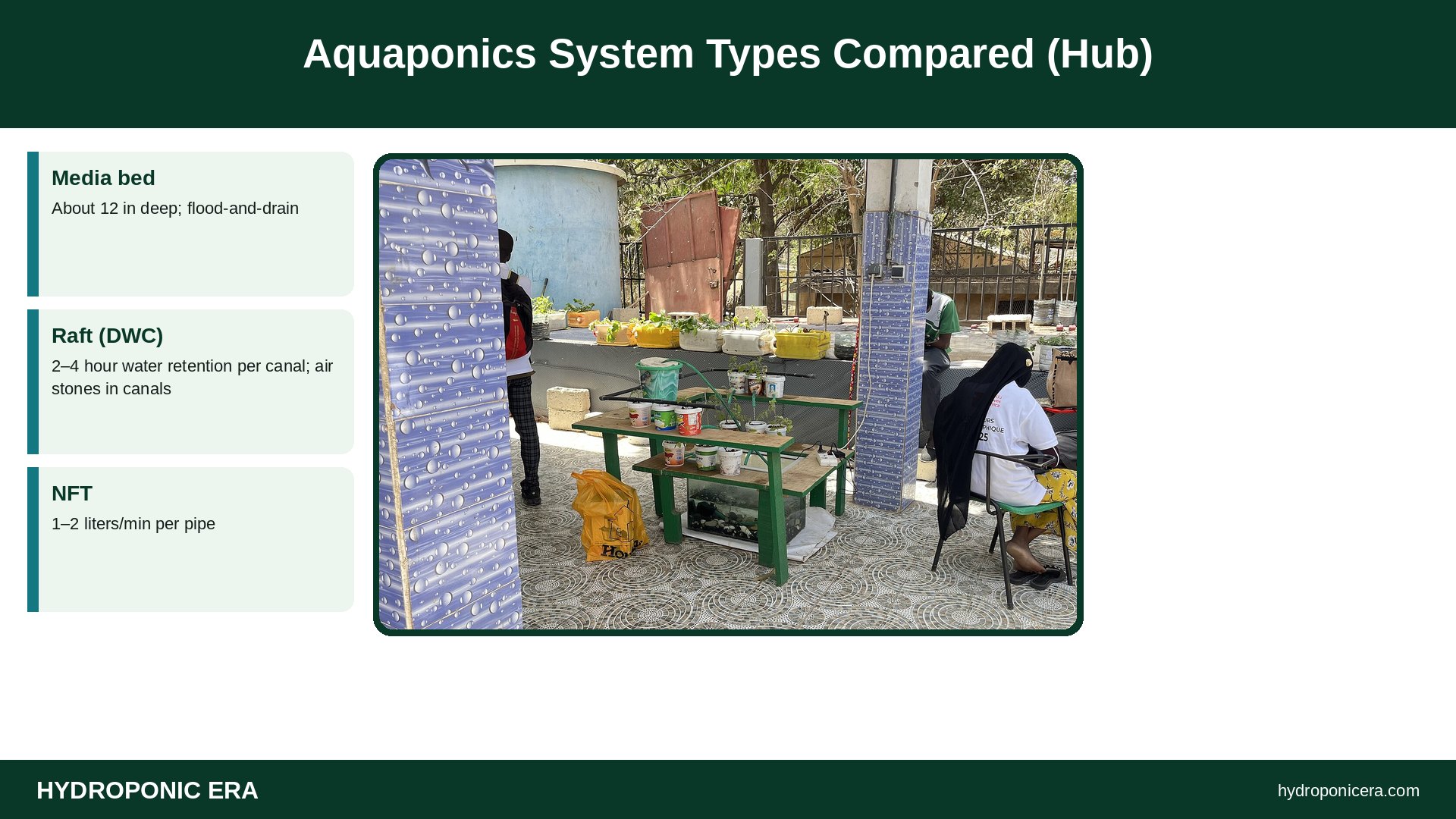
Aquaponics System Types Compared
| Type | Filtration | Best crops | Skill level | FAO design notes |
|---|---|---|---|---|
| Media bed | Built in (bed filters solids and hosts bacteria) | Everything, incl. fruiting and some roots | Beginner | About 12 in deep; flood-and-drain |
| Raft (DWC) | Separate solids filter and biofilter | Lettuce, herbs, greens | Intermediate | 2–4 hour water retention per canal; air stones in canals |
| NFT | Separate solids filter and biofilter | Lettuce, herbs, strawberries | Intermediate to advanced | 1–2 liters/min per pipe |
| Vertical tower | Separate filters | Greens, herbs, strawberries | Intermediate | Works like vertical NFT |
| Aquarium kit | Small media tray | Herbs, small greens | Beginner | Learning and decor |
Media Bed Systems
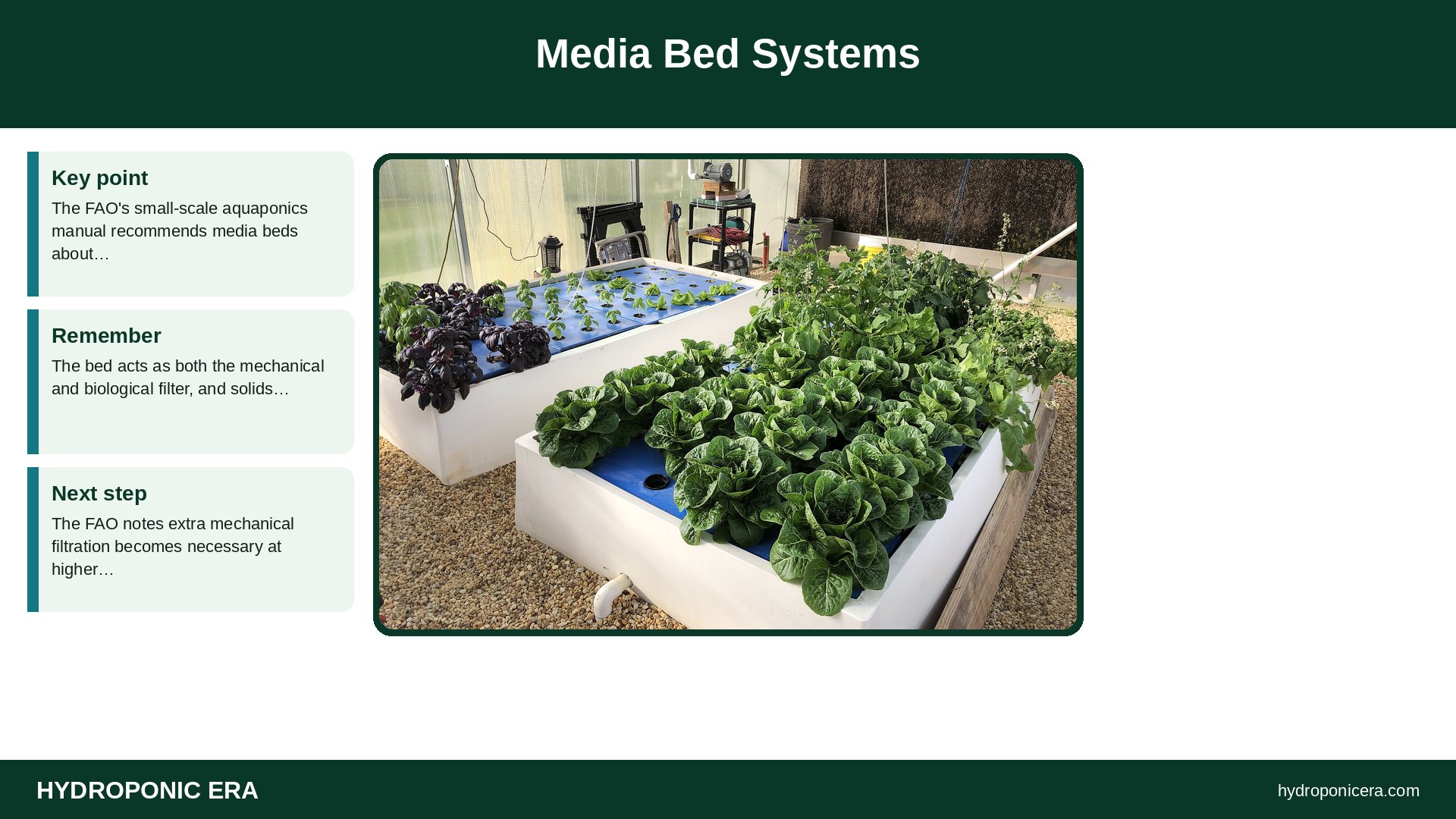
The FAO’s small-scale aquaponics manual recommends media beds about 12 inches (30 cm) deep, filled with high-surface media such as expanded clay or volcanic gravel, and wetted by flood-and-drain or other irrigation. The bed acts as both the mechanical and biological filter, and solids trapped in the media mineralize into plant nutrients. The FAO notes extra mechanical filtration becomes necessary at higher fish densities (around 15 kg of fish per cubic meter of water). Bell siphons automate flood and drain cycles. Media beds are the most forgiving of the aquaponics system types and grow the widest range of plants.
See aquaponics media bed, aquaponics bell siphon and IBC aquaponics.
Deep Water Culture (Raft) Systems
In raft systems, plants sit in net cups in floating boards over long troughs of aerated water. The FAO recommends a retention time of 2–4 hours for each canal and air stones in both the biofilter and plant canals. SRAC’s aquaponics fact sheet describes the University of the Virgin Islands raft system, which harvested 148 lettuce crops in three years and is a common model for commercial farms. The large water volume buffers temperature and water quality. See aquaponics raft system and DWC raft foam board.
Nutrient Film Technique (NFT)
NFT runs a shallow stream of water along the bottom of pipes or channels with plants in holes along the top. The FAO recommends 1–2 liters per minute for each grow pipe and pipe lengths of up to about 12 meters (40 feet), noting deficiencies can appear toward the end of longer pipes. NFT has very low evaporation and makes use of vertical space, but the FAO calls it more complicated and expensive than media beds, and warns that big root systems (tomatoes, mint) clog pipes. See aquaponics NFT vs DWC and NFT flow rate and slope.
Vertical, Aquarium and Hybrid Systems
- Vertical towers: stacked pockets fed from the sump. See aquaponics vertical tower.
- Aquarium systems: a grow tray over a 10–40 gallon tank. See aquarium aquaponics.
- Hybrid systems: a media bed as biofilter plus rafts or towers for greens.
- Decoupled systems: fish and plant loops separated so each runs at its own pH and nutrient level; common in research and some commercial farms.
Shared Components in All Aquaponics System Types
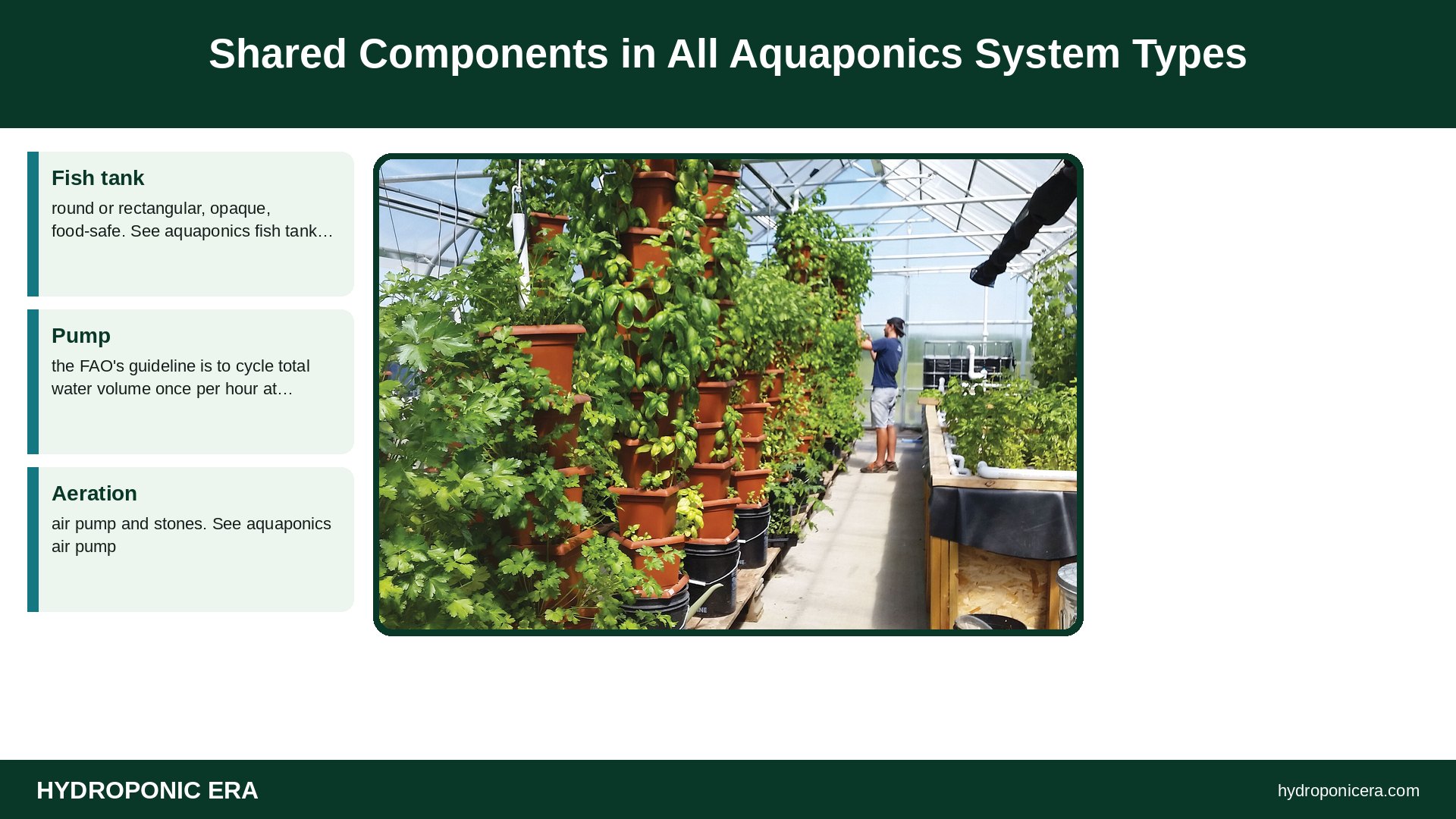
- Fish tank: round or rectangular, opaque, food-safe. See aquaponics fish tank size.
- Pump: the FAO’s guideline is to cycle total water volume once per hour at low stocking and twice per hour when densely stocked. See aquaponics pump size.
- Aeration: air pump and stones. See aquaponics air pump.
- Solids removal and biofilter (separate in raft and NFT). See aquaponics solids filter and aquaponics biofilter.
- Sump: the low point where water collects. See aquaponics sump tank.
- Mineralization for captured solids. See aquaponics mineralization.
How to Choose Among Aquaponics System Types
| If you want… | Choose |
|---|---|
| The simplest first system | Media bed or aquarium kit |
| Tomatoes, cucumbers, peppers | Media bed (or Dutch buckets on a media system) |
| Weekly lettuce for sale | Raft |
| Greens on a wall or balcony | NFT or towers |
| Lowest maintenance per plant | Media bed |
| Best scale-up path | Raft with separate filtration |
Most home growers find media beds easiest, and many add a raft or tower later. For costs, see aquaponics cost; for crops, see aquaponics best plants.
Common Mistakes When Picking a System
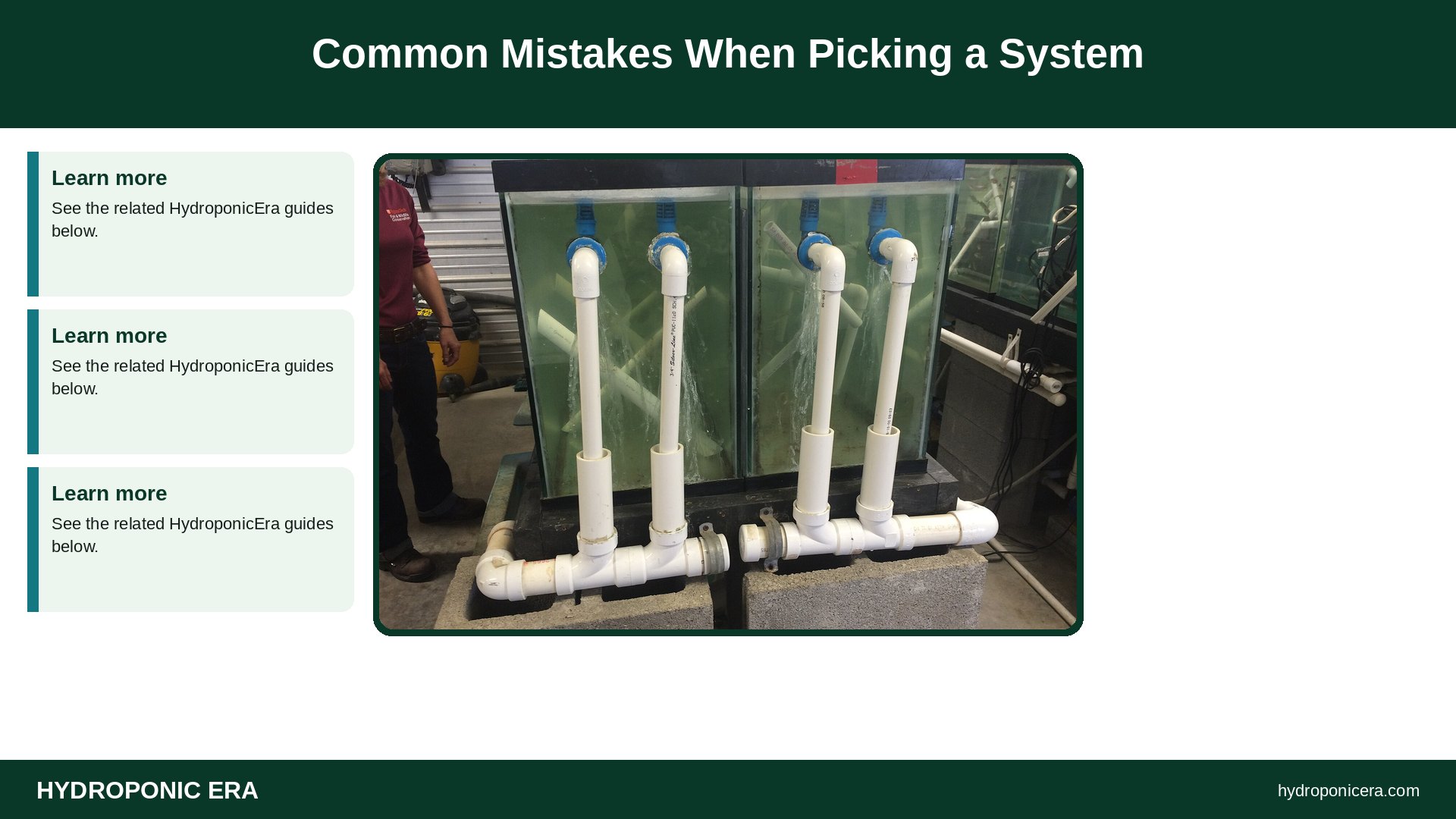
- Building NFT or towers without solids filtration.
- Making media beds too shallow for fruiting crops.
- Undersizing aeration in raft canals.
- Choosing a system for crops your fish can’t feed. See fish to plant ratio.
- Skipping a backup plan for power cuts. See aquaponics power outage.
Indoor vs Outdoor Considerations
Indoors, weight and humidity matter: media beds are heavy, while NFT and towers are lighter. Outdoors and in greenhouses, raft systems’ large water volume buffers temperature swings. In cold climates, any of the aquaponics system types benefit from a greenhouse. See aquaponics greenhouse and DIY indoor aquaponics system.
Aquaponics System Types by Budget and Space
| Situation | Best fit | Why |
|---|---|---|
| First system, small budget | Media bed | Simple, filters solids, grows almost anything |
| Lots of lettuce to sell | Deep water culture | Uniform greens, easy harvest, stable water temperature |
| Limited floor space | NFT or vertical towers | Light weight, stacked growing |
| Classroom or apartment | Small media bed over an aquarium | Low cost, easy to watch |
| Mixed crops at scale | Hybrid (media + raft) | Media for fruiting crops, rafts for greens |
The FAO small-scale manual calls media bed units the most popular design for small-scale aquaponics and suitable for beginners, mainly because the media works as both a mechanical and a biological filter. Raft and NFT units need separate filters for solids and nitrifying bacteria, which adds cost and work but suits larger production. Whatever you choose among aquaponics system types, start with fish and plants you can manage daily, and scale once your water tests are stable. See aquaponics biofilter and aquaponics solids filter.
FAQs
What are the main aquaponics system types?
Media bed, deep water culture (raft) and NFT.
Which aquaponics system is best for beginners?
Media beds.
Which is best for lettuce?
Raft systems.
Do raft and NFT systems need filters?
Yes, separate solids filtration and biofiltration.
Can I combine systems?
Yes; hybrid media bed and raft setups are common.
How deep should a media bed be?
About 12 inches.
Sources
- FAO — Small-scale aquaponic food production
- Southern Regional Aquaculture Center — SRAC 454: Aquaponics—Integrating Fish and Plant Culture
- University of Hawaii CTAHR — Construction of Automatic Bell Siphons for Backyard Aquaponic Systems
- Photo credits (Wikimedia Commons, edited with titles): AQUAPONIE by Hopeballa (CC BY-SA 4.0); Deepwater Aquaponics Floating Rafts Growing Lettuce, Basil and Arugula by Alabama Extension (CC0); Intermediate Bulk Container (fcm) by Photograph: Frank C. Müller, Baden-Baden (CC BY-SA 4.0); Vertical Tower Aquaponic System by Heather Husen (CC BY-SA 4.0); Recirculating Aquaculture System 1 by Narek75 (CC BY-SA 4.0)