
The best raft foam board for deep water culture is rigid polystyrene about 1–2 inches thick, either extruded (XPS) or expanded (EPS) bead board, cut to fit the tank with a small gap at the edges and drilled with holes sized for your net pots. For lettuce, space holes about 6–8 inches apart; for herbs, 4–6 inches; for baby greens, 2–3 inches. Commercial growers use purpose-made polystyrene rafts, while home growers often use insulation board, which works but should be food-contact or unfaced, rinsed well and kept out of direct heat.
Key takeaway: Choose a plain, unfaced raft foam board with no foil, film or flame-retardant coating on the wet side, make it thick enough to float rigidly and block light, and match hole spacing to the crop’s mature size.
| Crop | Hole spacing (center to center) | Typical net pot |
|---|---|---|
| Baby greens and microgreens | 2–3 in | 1–1.5 in |
| Herbs (basil, cilantro, parsley) | 4–6 in | 2 in |
| Leaf and butterhead lettuce | 6–8 in | 2 in |
| Romaine and large heads | 8–10 in | 2–3 in |
| Kale, chard, bok choy | 8–12 in | 2–3 in |

What a Raft Foam Board Does
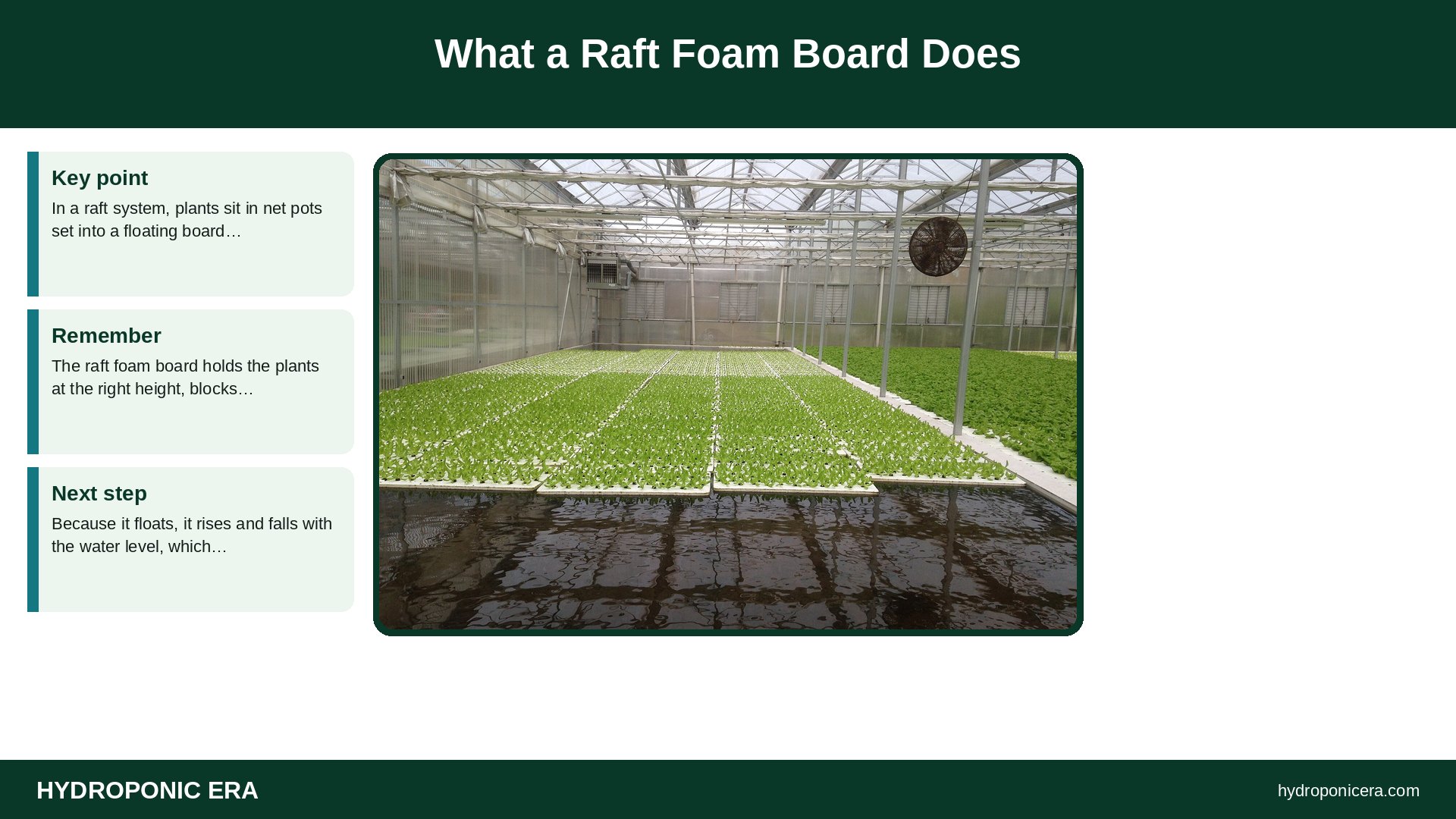
In a raft system, plants sit in net pots set into a floating board, with roots hanging into aerated nutrient solution below. The raft foam board holds the plants at the right height, blocks light from the water so algae can’t grow, and insulates the surface. Because it floats, it rises and falls with the water level, which keeps the crowns at a constant height. UF/IFAS describes small floating systems like this as one of the simplest ways to grow lettuce. See deep water culture for beginners.
Choosing a Raft Foam Board Material
- Commercial polystyrene rafts: made for hydroponics, with molded holes and smooth surfaces that are easy to clean. Best for larger systems.
- Extruded polystyrene (XPS): dense, smooth and strong. Often sold as blue, pink or green insulation board. Choose boards without plastic film or foil facing.
- Expanded polystyrene (EPS) bead board: cheaper and lighter, but the beads can shed and the surface is harder to sanitize.
- Polyiso boards: avoid; most have foil facing and are not meant to sit in water.
Insulation boards are not food-grade products, so many growers wrap or paint the top and sides with a food-safe coating, rinse boards well before use, and replace them when they crumble. See safe materials for DIY hydroponics.
How Thick Should a Raft Foam Board Be?
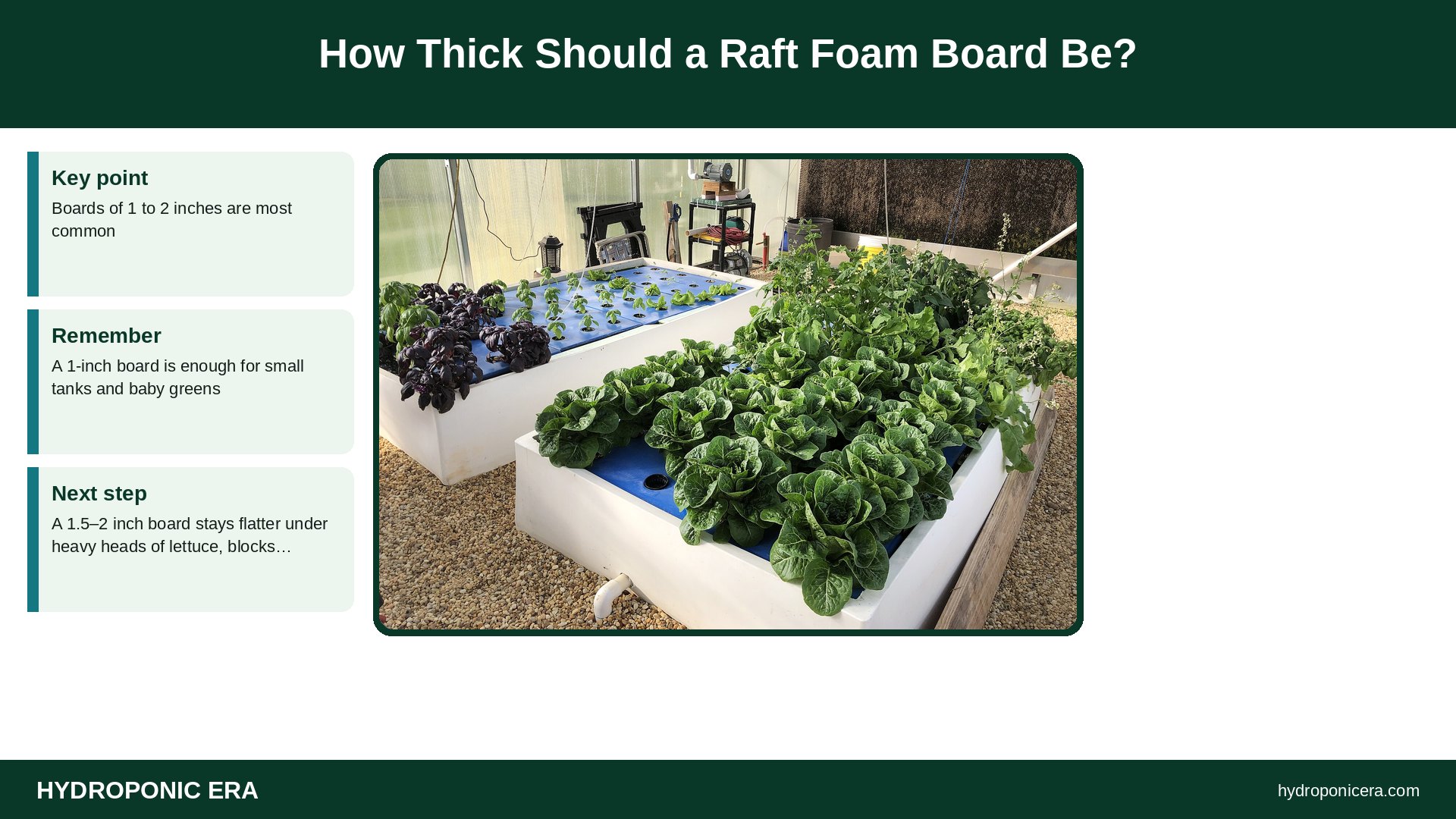
Boards of 1 to 2 inches are most common. A 1-inch board is enough for small tanks and baby greens. A 1.5–2 inch board stays flatter under heavy heads of lettuce, blocks more light and gives net pots a deeper seat. Thicker boards also float higher, so make sure roots can still reach the water at transplant, or keep the water level close to the bottom of the net pots for the first week.
Cutting the Raft Foam Board to Size
- Measure the inside of the tank and subtract about 1/4 to 1/2 inch on each side so the board moves freely as water level changes.
- Score with a sharp utility knife along a straightedge, then snap or finish the cut.
- For large tanks, use several smaller rafts so you can lift one out without disturbing the rest.
- Smooth rough edges with sandpaper so bits of foam don’t fall into the water.
Drilling Holes for Net Pots

Use a hole saw slightly smaller than the rim of the net pot so the pot sits snug and doesn’t fall through. A 2-inch net pot usually fits a 1-7/8 inch hole. Mark a grid first using the spacing chart above, and stagger the rows in a triangle pattern to fit more plants. Drill slowly from one side, then finish from the other to avoid tearing the foam. See net pot sizes and hole spacing.
Hole Spacing on a Raft Foam Board
Tight spacing gives more plants but smaller heads; wide spacing gives bigger heads but fewer per board. For a home DWC bin, 6–8 inches between lettuce holes is a good balance. Commercial growers often transplant into tight spacing first and then move plants to wider rafts as they grow, which uses space more efficiently. See plant spacing for home systems.
Blocking Light and Algae
Any light that gets past the board feeds algae. Cover unused holes with a cap or a small square of foam, and keep the board sized close to the tank. If the board is thin or light-colored, light may pass through; add a second layer or paint the underside black. A white top reflects light and stays cooler under lamps. See algae in reservoirs.
Cleaning and Reusing Rafts

After harvest, pull plants and roots, scrape off debris, and wash the raft foam board with warm, soapy water. Rinse, then sanitize with a dilute disinfectant labeled for horticultural use, rinse again and dry in the shade. Replace boards that crack, crumble or soak up water, because rough surfaces hold pathogens. See cleaning and sterilizing.
Aeration Under the Raft
A floating raft cuts air exchange at the water surface, so roots depend on an air pump and stones for oxygen. Space air stones evenly under the raft area and keep the water cool. See dissolved oxygen and air pump sizing.
Common Raft Foam Board Mistakes
- Using foil-faced or coated insulation that peels in water.
- Cutting the raft too tight so it jams as the water drops.
- Drilling holes too big so net pots fall through.
- Spacing lettuce too close, which leads to small, rotting heads.
- Leaving unused holes open to light.
Feeding Plants in a Raft System
Lettuce in rafts grows well at about EC 1.2–1.8 mS/cm and pH 5.8–6.2. See hydroponic lettuce EC and best lettuce varieties.
Raft Foam Board Sizes for Common Tanks
Home growers often build DWC beds from storage totes, stock tanks or lined wooden frames. A 4 by 8 foot sheet of insulation is the usual starting point, and it can be cut into smaller rafts that fit most tanks. For a 27-gallon tote, one raft about 15 by 24 inches holds roughly six to eight lettuce plants at 6–8 inch spacing. For a lined 4 by 8 foot bed, cut two to four rafts so each is easy to lift for harvest and cleaning. Label each raft with its planting date so you can rotate harvests.
Keeping the Raft Foam Board Cool
Under strong lights or sun, the top of a dark board can get hot and warm the water below. A white or light gray top surface reflects light and stays cooler, which helps keep the solution in the 65–72°F range that lettuce prefers.
FAQs
What foam is safe for a DWC raft?
Plain, unfaced polystyrene board or commercial hydroponic rafts.
How thick should a raft be?
About 1–2 inches; thicker boards stay flatter and block more light.
How far apart should holes be for lettuce?
About 6–8 inches center to center.
What size hole for a 2-inch net pot?
About 1-7/8 inches so the rim sits snug.
Can I reuse foam rafts?
Yes, if they are cleaned and still smooth and intact.
Why are my roots not reaching the water?
Raise the water level until roots grow longer, or use a thinner board.
Sources
- UF/IFAS Extension — Growing Lettuce in Small Hydroponic Systems
- Cornell CEA — Cornell CEA Lettuce Handbook
- University of Kentucky — Hydroponic Lettuce Production in Controlled Environments
- Photo credits (Wikimedia Commons, edited with titles): Deepwater Aquaponics Floating Rafts Growing Lettuce, Basil and Arugula by Alabama Extension (CC0); Deep water culture by ArcadiYay (CC BY-SA 4.0); Deepwater Aquaponics Floating Rafts Growing Lettuce, Basil and Arugula by Alabama Extension (CC0); Romaine lettuce by Rainer Zenz (CC BY-SA 3.0); Aquarium-air-pump by User:Corydoras-adolfoi (CC BY-SA 4.0)