
An aquaponics vertical tower grows plants in stacked pockets or columns fed by fish water pumped from a sump. Water trickles down past the roots and drains back to the fish tank or sump, so you can grow dozens of lettuce, herb or strawberry plants in a few square feet. Towers are space-efficient, but they depend on excellent solids filtration, a separate biofilter, reliable pumps and even light on all sides. They suit leafy greens and herbs; large fruiting plants are poor fits.
Key takeaway: Build or buy an aquaponics vertical tower only if you’ll add a solids filter and biofilter before it, run the pump on a steady schedule, and plant compact crops such as lettuce, herbs and strawberries.
| Factor | Aquaponics vertical tower guideline |
|---|---|
| Best crops | Lettuce, herbs, pak choi, strawberries |
| Avoid | Tomatoes, cucumbers, large peppers, mint (roots clog) |
| Filtration | Solids filter plus separate biofilter (no media bed to do the job) |
| Flow | Steady trickle that wets every pocket |
| Light | Full sun or lights on all sides |
| Aeration | Air stones in fish tank and biofilter |
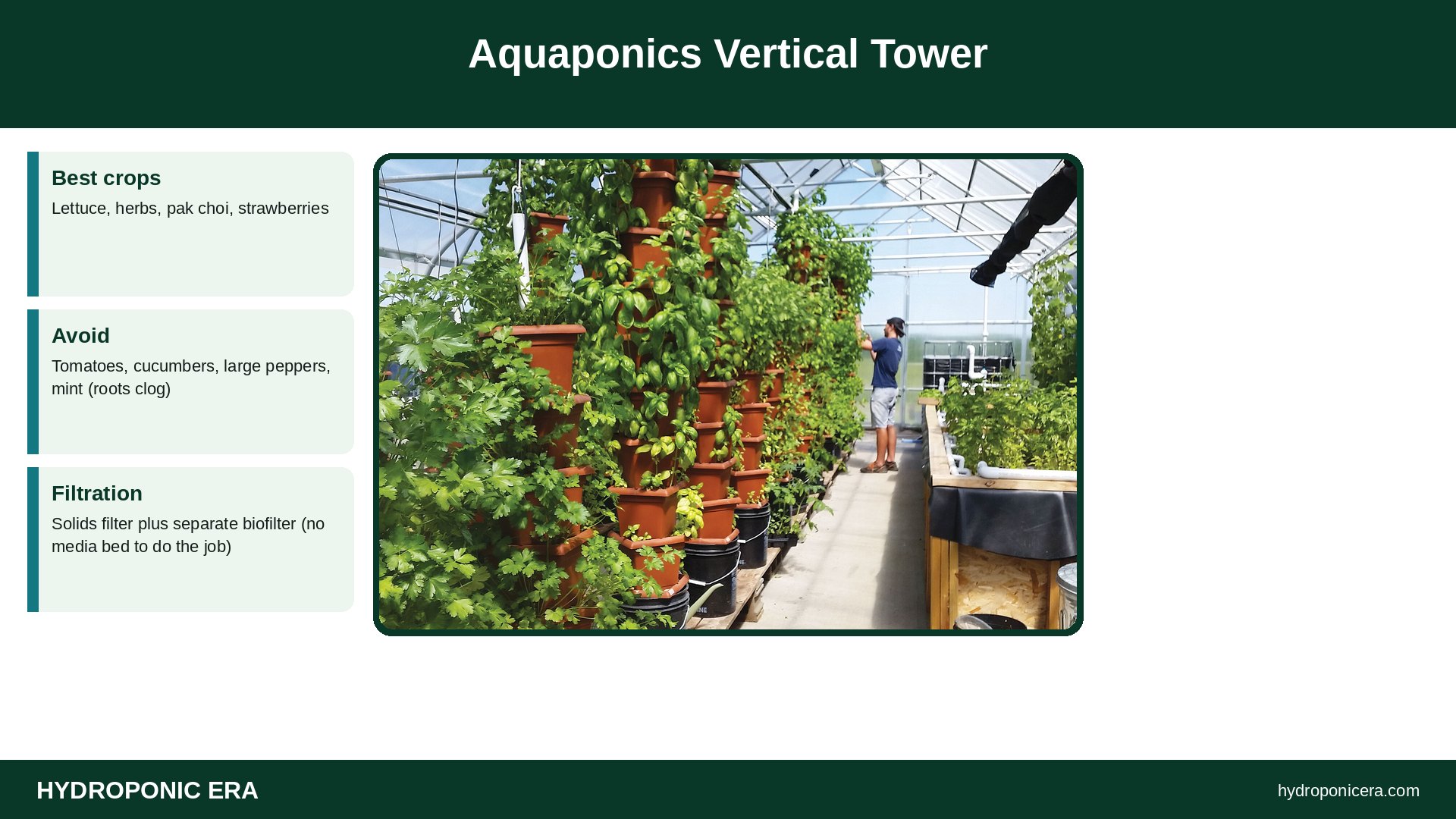
How an Aquaponics Vertical Tower Works

Water leaves the fish tank, passes through a solids filter and a biofilter, then collects in a sump. A pump lifts it to the top of each tower, where it spreads through the growing medium or wicking material and drips past the roots, collecting oxygen as it falls. It drains into a tray or gutter and flows back to the sump. Towers behave much like NFT: the FAO’s aquaponics manual notes NFT pipes can be arranged to use vertical space, walls and fences, and that NFT is especially useful in urban settings where space or weight is limited.
The difference from a media bed is filtration. The FAO explains that media beds act as both mechanical and biological filters, while NFT and DWC units need separate mechanical filtration and biofiltration to remove solids and convert ammonia to nitrate. Towers fall in the second group. See aquaponics solids filter and aquaponics biofilter.
Types of Aquaponics Vertical Tower
- Stacked pots: food-grade pots stacked on a center pipe, filled with light media such as coco or perlite.
- Column towers: a pipe with planting holes and a mat or media inside. See DIY hydroponic tower.
- Vertical NFT: horizontal pipes stacked on a wall or A-frame. See A-frame hydroponics.
- Wall gardens: pocket panels fed by a drip line. See hydroponic wall garden.
Building an Aquaponics Vertical Tower System
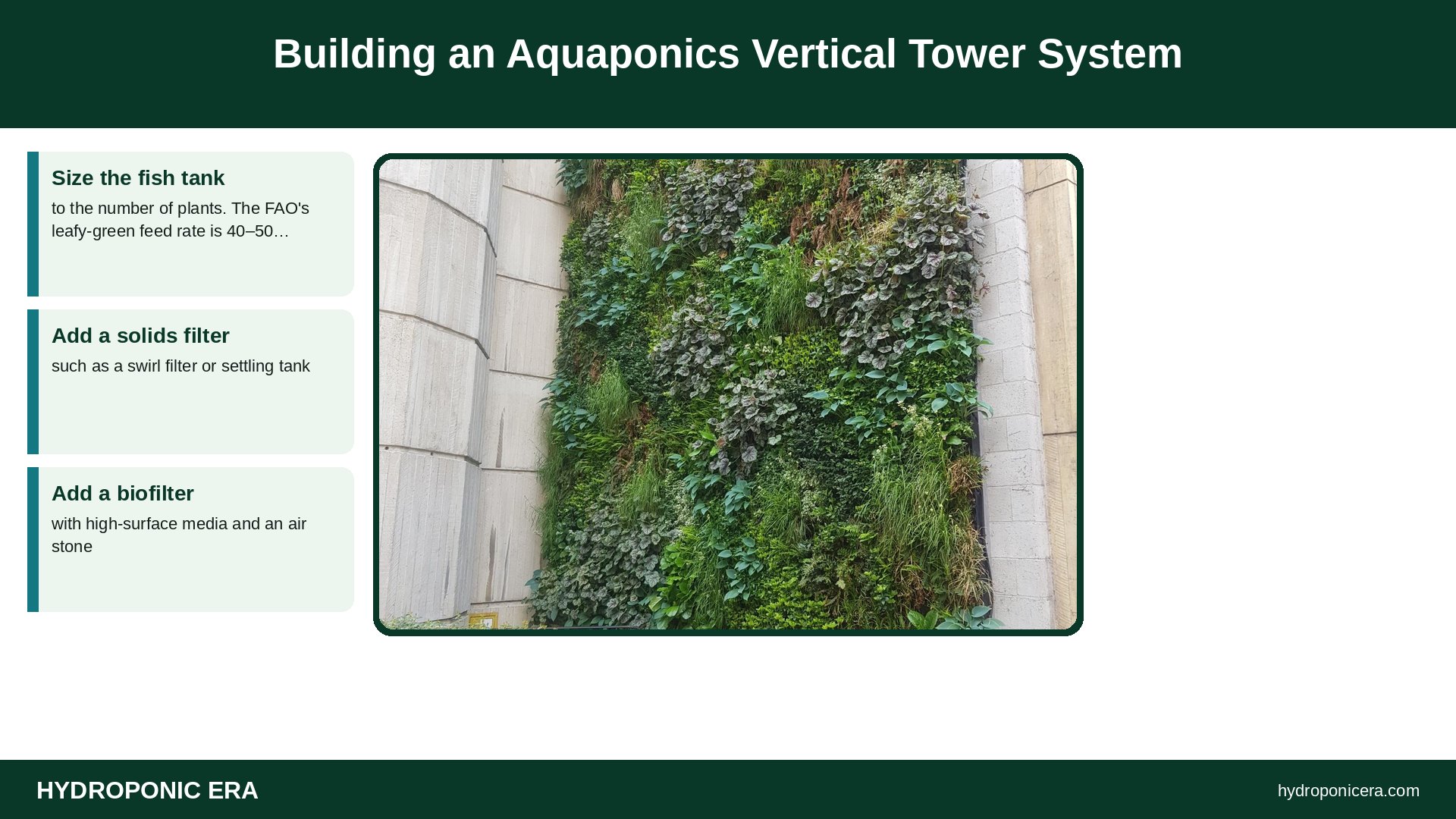
- Size the fish tank to the number of plants. The FAO’s leafy-green feed rate is 40–50 grams of feed per square meter of growing area per day; estimate tower area as the floor space the plants would occupy if laid flat.
- Add a solids filter such as a swirl filter or settling tank.
- Add a biofilter with high-surface media and an air stone.
- Install a sump as the low point. See aquaponics sump tank.
- Choose a pump rated for the tower height plus the system turnover. See aquaponics pump size.
- Use food-safe materials for towers, pots and tubing. See safe plastics.
- Cycle the system fully before adding fish. See aquaponics cycling.
Flow, Pump Timing and Oxygen
The FAO’s commonly cited guideline is to cycle the total water volume once or twice per hour, depending on stocking density. Towers usually run continuously or on short, frequent cycles during the day, because each plant sits in very little medium and dries out fast. Falling water adds oxygen to roots, but the fish tank still needs air stones. A pump failure dries a tower within hours, so keep a backup pump and battery air pump. See aquaponics power outage and aquaponics dissolved oxygen.
Best Plants for an Aquaponics Vertical Tower
| Plant | Fit | Notes |
|---|---|---|
| Lettuce | Excellent | Compact, fast; see aquaponics lettuce |
| Basil, parsley, chives | Excellent | See aquaponics herbs |
| Pak choi, kale (baby) | Good | Harvest young |
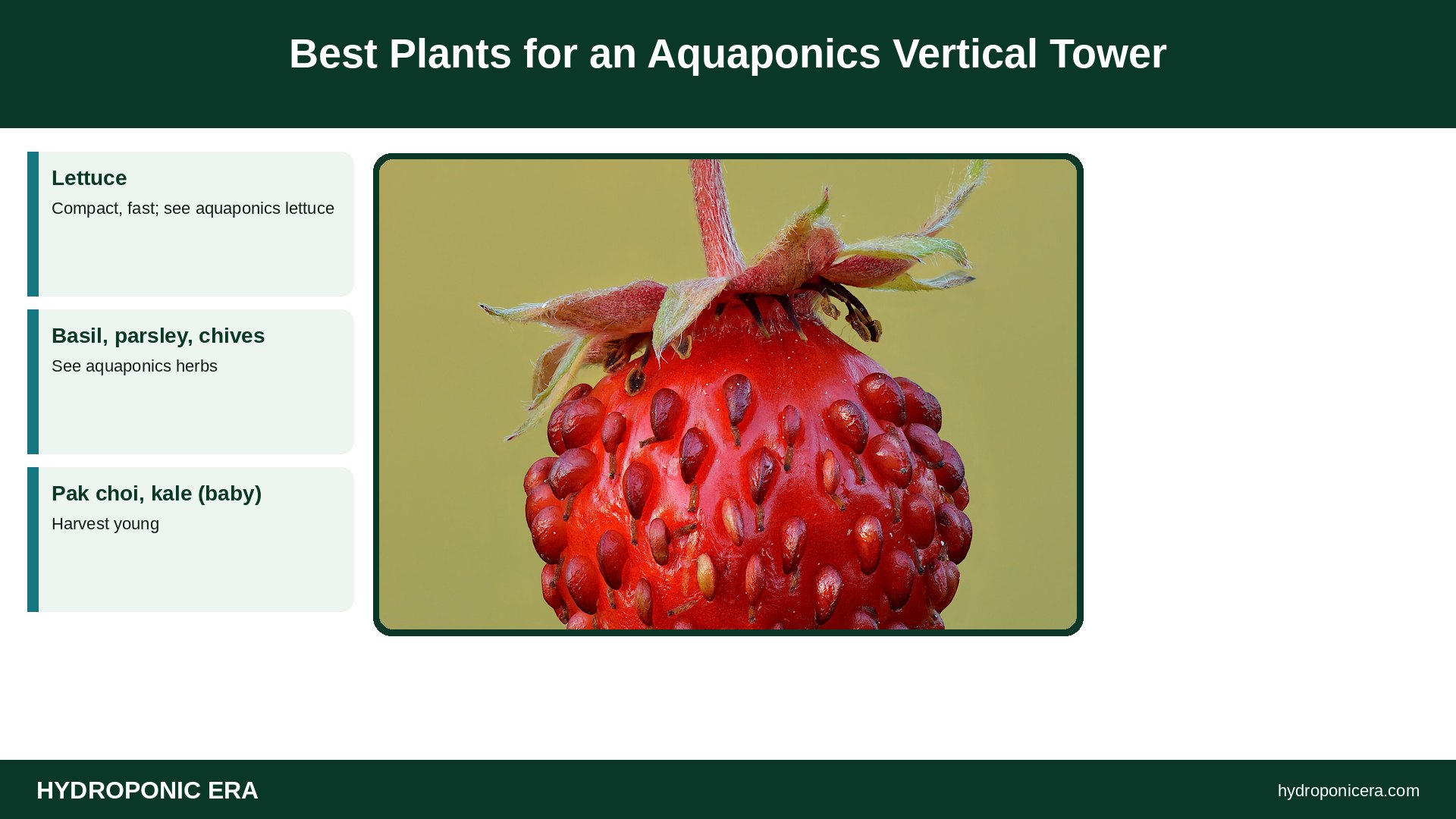
| Strawberries | Good | Fruit hangs clean; see aquaponics strawberries |
| Mint | Poor | Roots can clog pockets |
| Tomatoes, cucumbers | Poor | Too big; use media beds |
Light for Towers
Vertical growing creates shade. Outdoors, run towers north to south and space them so they don’t shade each other; rotate them if they’re portable. Indoors, use vertical LED bars or lights on several sides, because a single overhead light leaves lower pockets dim. Expect plants near the top to grow faster unless light is even.
Common Aquaponics Vertical Tower Problems

- Clogged emitters or pockets: fine solids reaching the tower. Improve filtration and clean the top distributor weekly.
- Dry top or bottom pockets: uneven flow; adjust the distributor or flow rate.
- Pale plants: too few fish for the plant count, or low iron. See aquaponics iron deficiency.
- Algae on towers: light hitting wet surfaces; use opaque materials.
- Ammonia rising: biofilter too small for the fish load. See aquaponics ammonia spike.
- Roots in the drain: trim roots at each harvest.
Aquaponics Vertical Tower vs Media Bed
A media bed is simpler: it filters solids, hosts bacteria and holds big plants. An aquaponics vertical tower uses less floor space and makes harvesting greens easy, but it needs separate filters, more plumbing and closer monitoring. Many growers combine both: a media bed acts as the biofilter and grows tomatoes, while towers on the same sump grow lettuce and herbs. See aquaponics media bed and hydroponic tower garden.
Maintenance Routine
- Daily: check flow at the top of every tower and fish behavior.
- Weekly: test pH, ammonia, nitrite and nitrate; clean the solids filter.
- Every harvest: trim roots and rinse pockets.
- Monthly: clean distributors, pump intake and air stones.
Aquaponics Vertical Tower Startup Checklist
- Cycle the fish system fully before planting towers. See aquaponics cycling.
- Install a solids filter ahead of the towers so waste doesn’t clog emitters.
- Run the pump for a day with no plants to check for leaks and even flow.
- Plant greens and herbs first; add strawberries after the system is stable.
- Test pH weekly and watch new leaves for iron shortage. See aquaponics iron deficiency.
A well-built aquaponics vertical tower saves floor space, but it depends on clean water and steady flow more than any other design.
FAQs
Does an aquaponics vertical tower need a filter?
Yes; solids and biofiltration must happen before the tower.
What grows best in an aquaponics tower?
Lettuce, herbs, pak choi and strawberries.
Can I grow tomatoes in a tower?
Not well; use media beds for big fruiting plants.
Should the pump run all the time?
Usually continuously or in short, frequent cycles during the day.
How many plants per fish?
Use 40–50 g feed per square meter of leafy growing area per day as a guide.
Are towers good for beginners?
They’re more complex than media beds; start simple if you’re new.
Sources
- FAO — Small-scale aquaponic food production
- Southern Regional Aquaculture Center — SRAC 454: Aquaponics—Integrating Fish and Plant Culture
- Virginia Cooperative Extension — Hydroponic Production of Edible Crops: NFT Systems
- Photo credits (Wikimedia Commons, edited with titles): Vertical Tower Aquaponic System by Heather Husen (CC BY-SA 4.0); Gerstein Science Information Centre aeroponics towers by Jason Zhang (CC BY-SA 3.0); St Edmund Hall Living Wall by Harry Princethorpe (CC BY-SA 4.0); Fragaria vesca fruit – Keila by Ivar Leidus (CC BY-SA 4.0); Recirculating Aquaculture System 1 by Narek75 (CC BY-SA 4.0)