
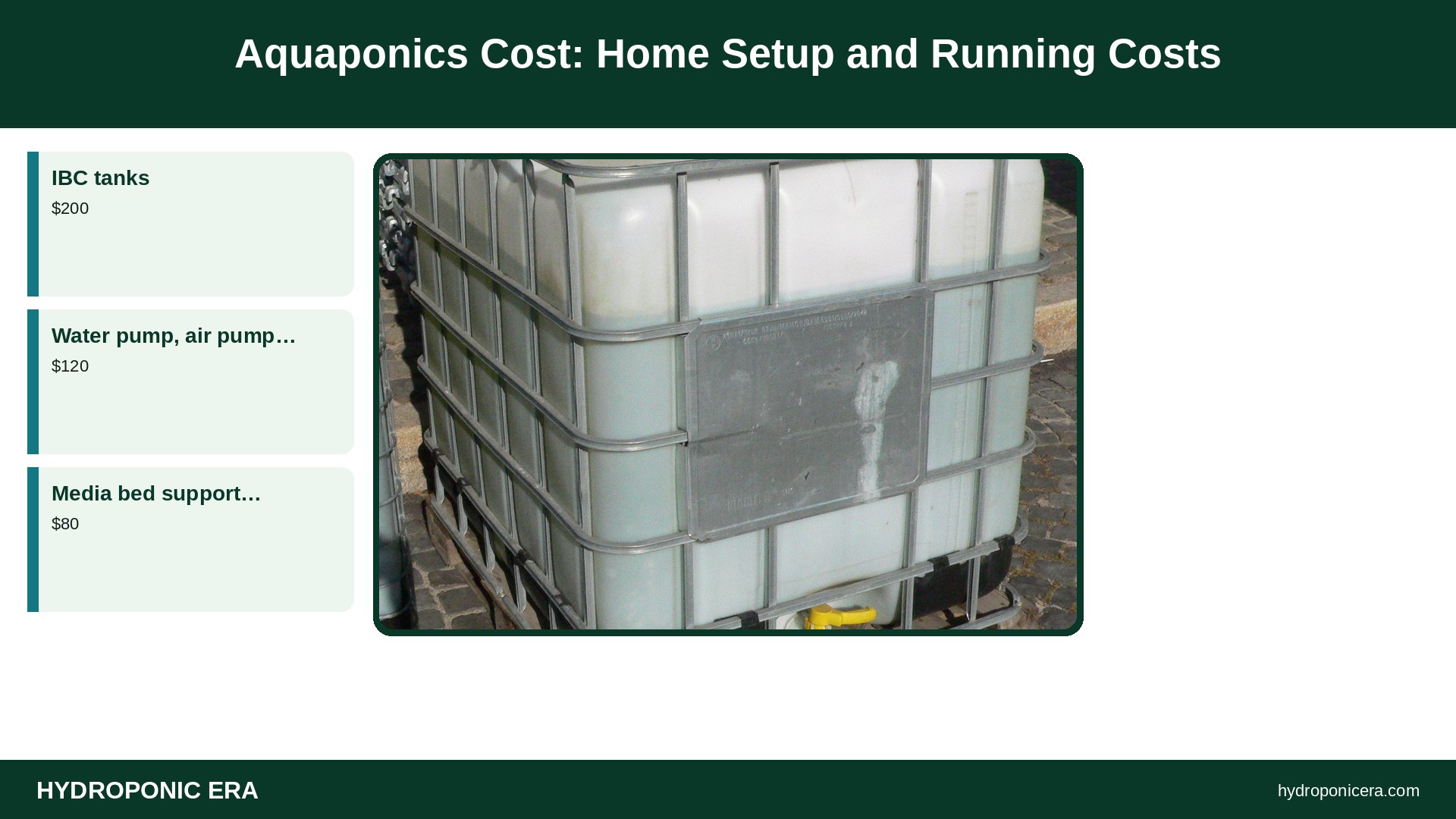
Aquaponics cost for a small home system is mainly the setup: tanks, pumps, plumbing, media, and support structure. FAO’s aquaponics manual priced a small media bed unit with a 264-gallon (1,000 L) fish tank and about 32 square feet (3 m²) of grow space at about $700 in materials, using IBC totes.
FAO’s running costs for that unit came to about $26 per month, with fish feed the biggest line. In the US, electricity for a 35-watt pump and air setup uses about 25 kWh a month, roughly $4.50 at the US average residential price of about 18 cents per kWh reported by the EIA for 2026. Your costs will vary by size, materials, and whether you build or buy a kit.
Key takeaway: Budget for the build, then for feed, fingerlings, seedlings, power, and testing every month.
| FAO capital cost item (1,000 L unit) | FAO estimate (USD) |
|---|---|
| IBC tanks | $200 |
| Water pump, air pump, connections | $120 |
| Media bed support (blocks, planks) | $80 |
| Volcanic gravel | $120 |
| Plumbing | $80 |
| Miscellaneous (net, tape, shade) | $100 |
| Total | $700 |
Aquaponics Cost to Build
FAO’s estimate is for a DIY system built from IBC totes and local materials, and FAO notes the figures are guidelines only. US prices for new totes, gravel, and pumps may differ, and buying ready-made tanks, grow beds, or a kit adds cost. FAO also notes the fish tank alone can be up to 20% of the cost of a unit. See IBC aquaponics and DIY indoor aquaponics.
Monthly Aquaponics Cost to Run
FAO’s monthly running costs for the same unit, using prices from Israel in 2013:
- Seedlings: 35 per month, $3.50
- Fingerlings: 5 per month, $5.00
- Electricity: 25 kWh, $2.50 at 10 cents/kWh
- Water: 450 liters (about 120 gallons), $1.20
- Fish feed: 4.5 kg (about 10 lb), $11.25
- Miscellaneous (test kits, pH adjusters): $3.00
- Total: about $26.45 per month
FAO says to swap in local prices. For the US, electricity at the 2026 EIA average of about 18 cents per kWh would be about $4.50 per month for the same 25 kWh.
Electricity: Calculate Yours
FAO’s example: a 30-watt water pump plus a 5-watt air pump running 24 hours a day for 30 days uses about 25 kWh. Formula: watts × 24 × 30 ÷ 1,000 = kWh per month. Multiply by your utility’s rate. Heaters, lights, and fans add much more. See aquaponics pump size.
Fish Feed: The Biggest Running Cost
FAO’s unit used 150 g (about 5.3 oz) of feed per day. Feed scales with grow area: FAO’s ratio is 40–50 g per m² per day for leafy greens and 50–80 g for fruiting crops. More plants mean more fish and more feed. See aquaponics fish food and fish to plant ratio.
What FAO’s Unit Produced
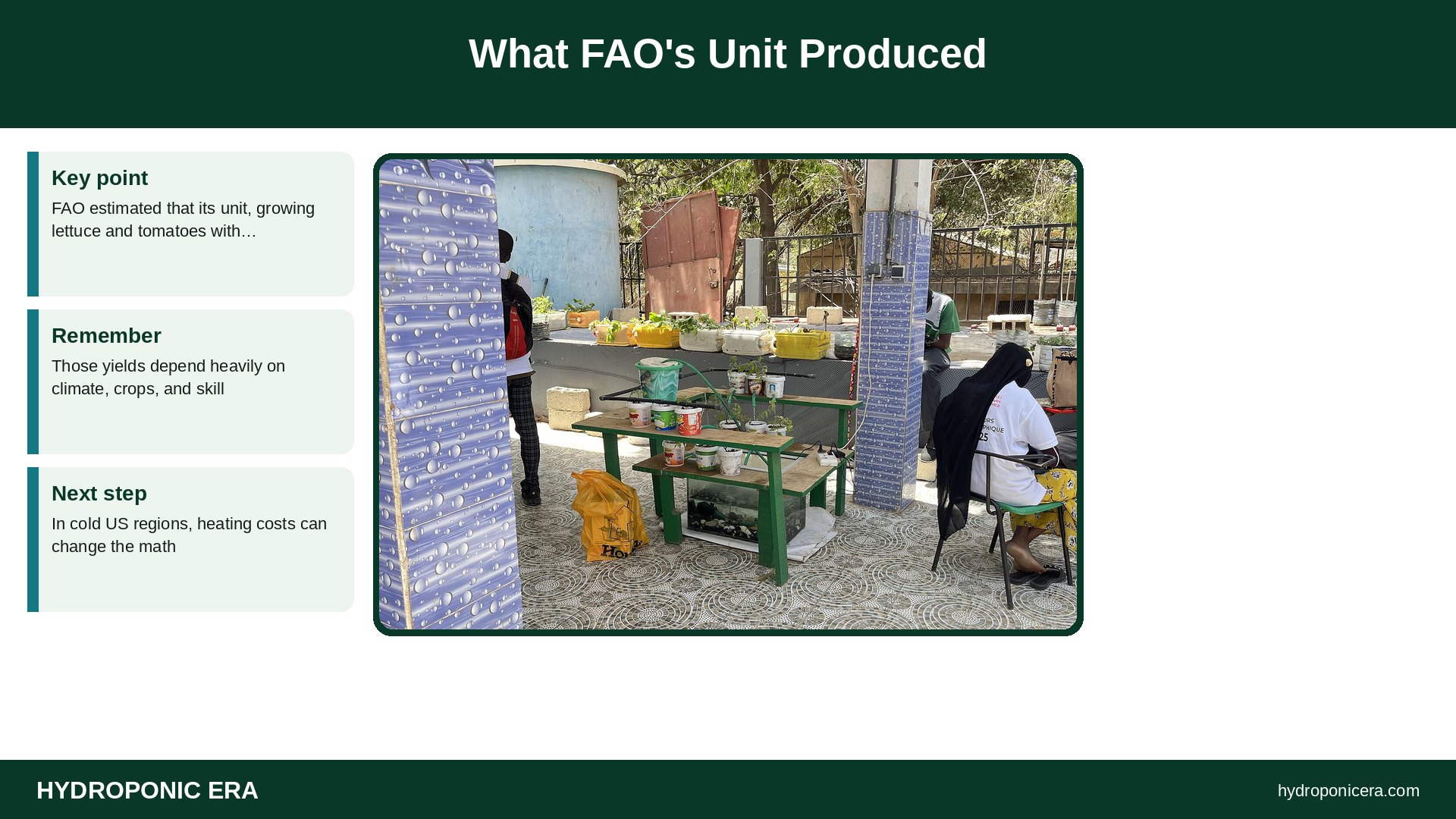
FAO estimated that its unit, growing lettuce and tomatoes with tilapia, could produce in a year about 360 heads of lettuce, 54 kg (about 119 lb) of tomatoes, and 30 kg (about 66 lb) of fish, assuming year-round water at 73–79°F (23–26°C). Those yields depend heavily on climate, crops, and skill. In cold US regions, heating costs can change the math. See aquaponics winter.
Hidden Costs to Plan For
- Test kits for pH, ammonia, nitrite, and nitrate.
- Backup air pump and battery backup.
- Heaters or greenhouse heating in winter.
- Grow lights for indoor systems.
- Iron, calcium, and potassium supplements.
- Replacement pumps every few years.
- Permits, if your state requires them for your fish. See aquaculture permits.
Ways to Cut Aquaponics Cost
- Use food-grade IBC totes or barrels.
- Build media bed supports from blocks and lumber.
- Use efficient pumps and wide pipes to reduce power.
- Grow your own seedlings.
- Supplement feed with duckweed for tilapia or carp. See duckweed fish food.
- Place the system to use natural light and heat.
Aquaponics Cost vs Hydroponics
FAO lists higher startup costs than hydroponics as an aquaponics weakness. See aquaponics vs hydroponics.
Aquaponics Cost Payback
FAO’s example shows a unit can pay back its build cost over time if the vegetables and fish produced replace food you would otherwise buy. FAO stresses these numbers are guidelines; local prices, crops, and climate change the result. Leafy greens and herbs often bring the fastest payback at home because they’re expensive to buy and quick to grow. Track your harvest weight and what the same produce costs at your store to see your real aquaponics cost per pound.
Aquaponics Cost by System Type
- Media bed: lowest cost and simplest; FAO’s $700 example. Gravel or clay media is a major cost.
- Raft (DWC): needs a solids filter, biofilter, and more aeration, adding cost.
- NFT: pipes are cheap, but you need filtration and a reliable pump.
- Indoor systems: add grow lights, which can cost more to run than pumps.
Aquaponics Cost for a Kit
Ready-made kits save time and come with matched parts, but cost more than DIY for the same size. Check what’s included: tank, grow bed, pump, media, plumbing, and lights. Compare by grow area and tank volume, not price alone, and add the cost of fish, test kits, and feed.
Track Your Real Aquaponics Cost
Keep a log of every purchase and your monthly electric bill before and after the system. After a few months, you’ll know your real aquaponics cost per month and can decide whether to expand. See pump sizing to keep power use down.
Aquaponics Cost of Fish Feed by Growing Area
Fish feed is the main ongoing input, and FAO ties it to plant area: about 40–50 g of feed per square meter per day for leafy greens and 50–80 g for fruiting vegetables. A 100-square-foot (about 9.3 m²) bed of greens needs roughly 370–465 g (13–16 oz) of feed per day, or about 25–30 lb per month. Multiply by your local price per pound of 32% protein feed, the standard FAO uses in its calculations, to estimate monthly feed cost. Bigger beds mean more feed, so size the system to the harvest you need.
FAQs: Aquaponics Cost
How much does a home aquaponics system cost?
FAO priced a 1,000 L DIY unit at about $700 in materials; kits and US prices vary.
How much does aquaponics cost to run?
FAO estimated about $26 per month for a small unit, mostly fish feed.
How much electricity does aquaponics use?
FAO’s small unit used about 25 kWh per month.
Is aquaponics cheaper than buying vegetables?
It depends on crops, climate, and local prices.
What is the biggest running cost?
Fish feed, in FAO’s example.
Sources
- FAO — Small-scale aquaponic food production (Appendix 7)
- US EIA — Average price of electricity to ultimate customers
- Photo credits (Wikimedia Commons, edited with titles): Intermediate Bulk Container (fcm) by Photograph: Frank C. Müller, Baden-Baden (CC BY-SA 4.0); Medals weighed in digital scale by Kpubkalanami (CC BY-SA 4.0); Fish Feed Pellets by Narek75 (CC BY-SA 4.0); AQUAPONIE by Hopeballa (CC BY-SA 4.0); Ennis – Market Place – Farmers’ Market – Vegetable Stand – geograph.org.uk – 3038450 by Joseph Mischyshyn (CC BY-SA 2.0)