
Aquaponics vs hydroponics comes down to trade-offs. Hydroponics is simpler to start, gives precise control over nutrients, and usually costs less to set up. Aquaponics produces fish and vegetables from one input, fish feed, and avoids mineral fertilizer, but needs more knowledge, a longer startup, and compromises between fish and plant needs. FAO’s aquaponics manual lists higher startup costs than hydroponics and the need to understand fish, bacteria, and plants as aquaponics’ main weaknesses. It also notes aquaponics systems are extremely water efficient and produce two products. Choose hydroponics for simplicity and maximum plant control; choose aquaponics if you want fish too and enjoy managing a living system.
Key takeaway: Hydroponics for easy, precise growing; aquaponics for fish plus vegetables and fertilizer-free production.
| Factor | Hydroponics | Aquaponics |
|---|---|---|
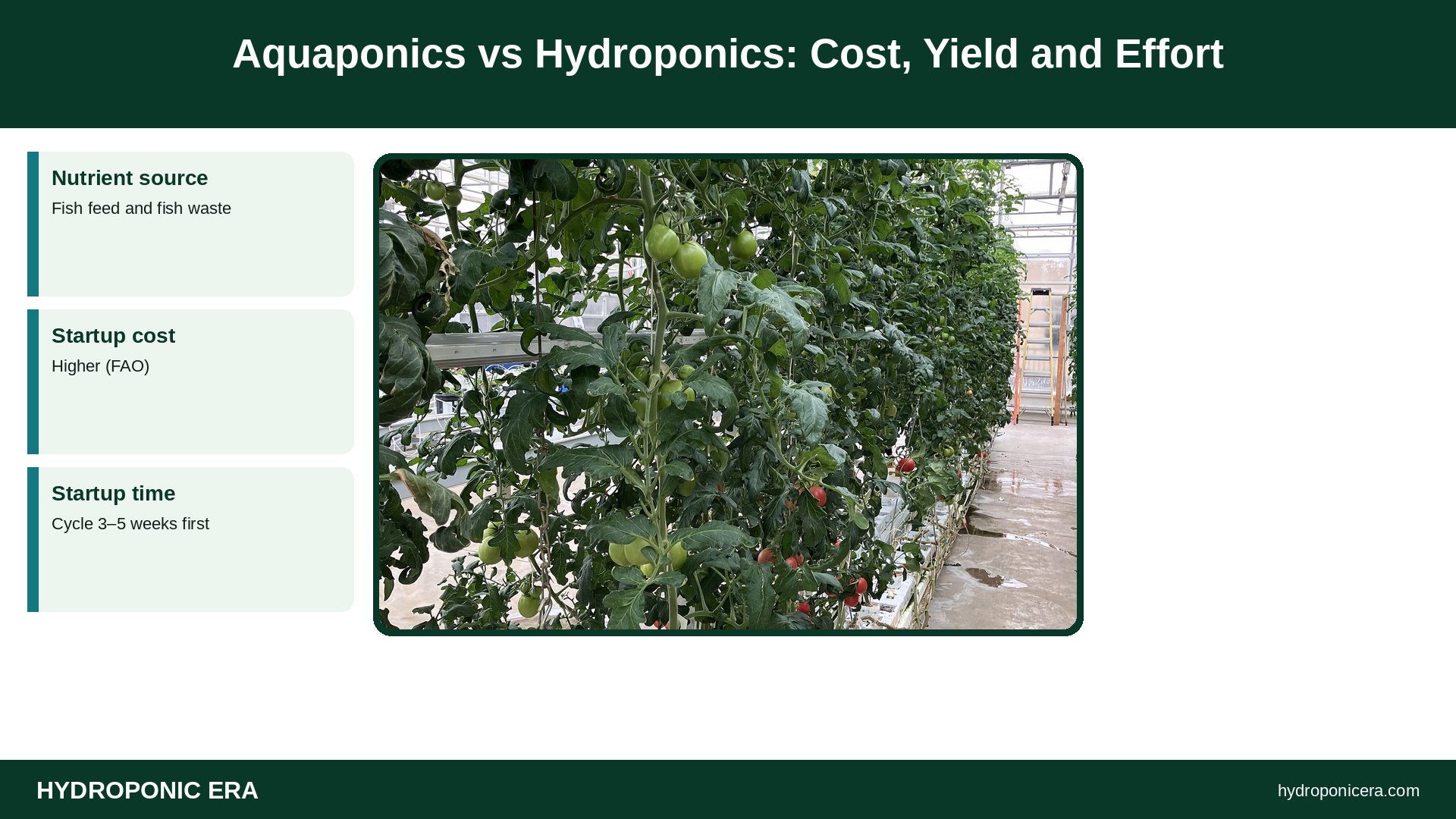
| Nutrient source | Mineral nutrients | Fish feed and fish waste |
| Startup cost | Lower | Higher (FAO) |
| Startup time | Plant right away | Cycle 3–5 weeks first |
| pH | About 5.5–6.5 | About 6–7 (compromise) |
| Nutrient control | Precise | Indirect, via feed |
| Outputs | Plants | Plants and fish |
| Waste | Spent nutrient solution to dispose of | Little waste (FAO) |
| Knowledge needed | Plants and nutrients | Fish, bacteria, and plants |
How Each System Works
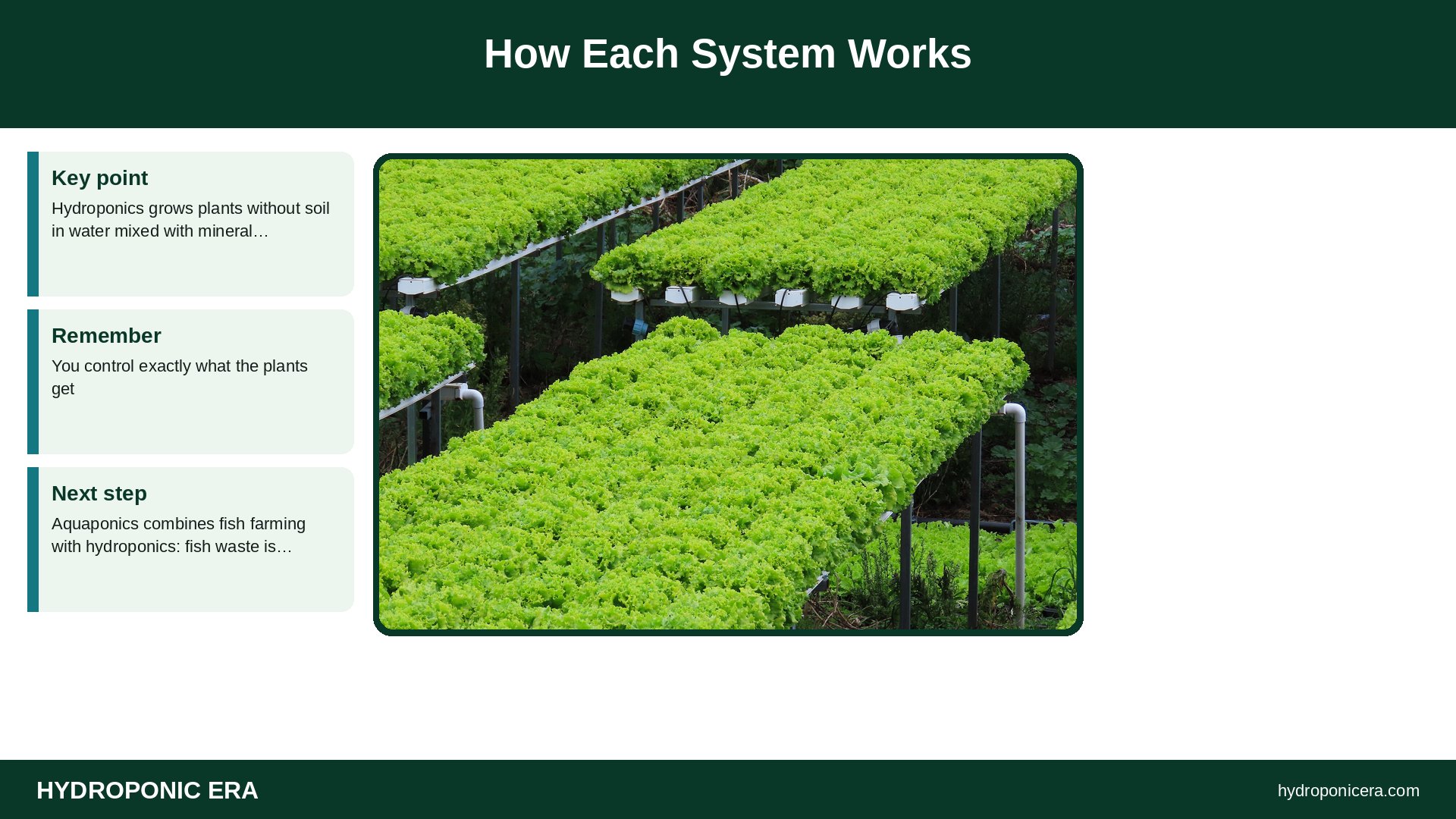
Hydroponics grows plants without soil in water mixed with mineral nutrients. You control exactly what the plants get. Aquaponics combines fish farming with hydroponics: fish waste is converted by nitrifying bacteria into nitrate for plants, and plants clean the water for fish. FAO describes it as producing two agricultural products from one nitrogen source, the fish feed. See nitrifying bacteria.
Aquaponics vs Hydroponics: Cost
FAO lists expensive initial startup costs compared with hydroponics as an aquaponics weakness. You need fish tanks, filtration, and aeration in addition to grow beds. FAO’s small-scale media bed unit, with a 264-gallon (1,000 L) tank and about 32 square feet (3 m²) of grow space, came to about $700 in materials in FAO’s estimate. Hydroponics has ongoing nutrient costs; aquaponics has ongoing feed and fingerling costs. See cost to start home hydroponics.
Aquaponics vs Hydroponics: Yield
Both can grow high yields of leafy greens. Hydroponics has the edge for heavy feeders and fruiting crops, because you can tune nutrients exactly. Aquaponics often runs short of iron, potassium, and calcium, which FAO says must be supplemented. Aquaponics adds fish, but FAO notes commercial operations in the West often earn up to 90% of their revenue from plants.
Aquaponics vs Hydroponics: Effort
- Hydroponics: mix nutrients, check pH and EC, change the solution periodically.
- Aquaponics: feed fish daily, test ammonia, nitrite, nitrate, and pH, manage solids, and watch fish health. FAO says a working knowledge of fish, bacteria, and plants is needed.
Aquaponics doesn’t need regular full water changes, but it is less forgiving if the fish get sick or the power fails.
pH and Water Quality

Hydroponic growers usually run pH around 5.5–6.5 for maximum nutrient uptake. Aquaponics must compromise at 6–7 for fish, plants, and bacteria. That higher pH can reduce iron availability, which is one reason iron deficiency is common. See aquaponics pH and aquaponics iron deficiency.
Pest and Disease Control
Hydroponics growers have more pest control options. In aquaponics, many pesticides are toxic to fish, so you’re limited to fish-safe methods like insect netting, sticky traps, and beneficial insects. On the other hand, FAO notes aquaponics doesn’t use chemical pesticides or fertilizers.
Water Use
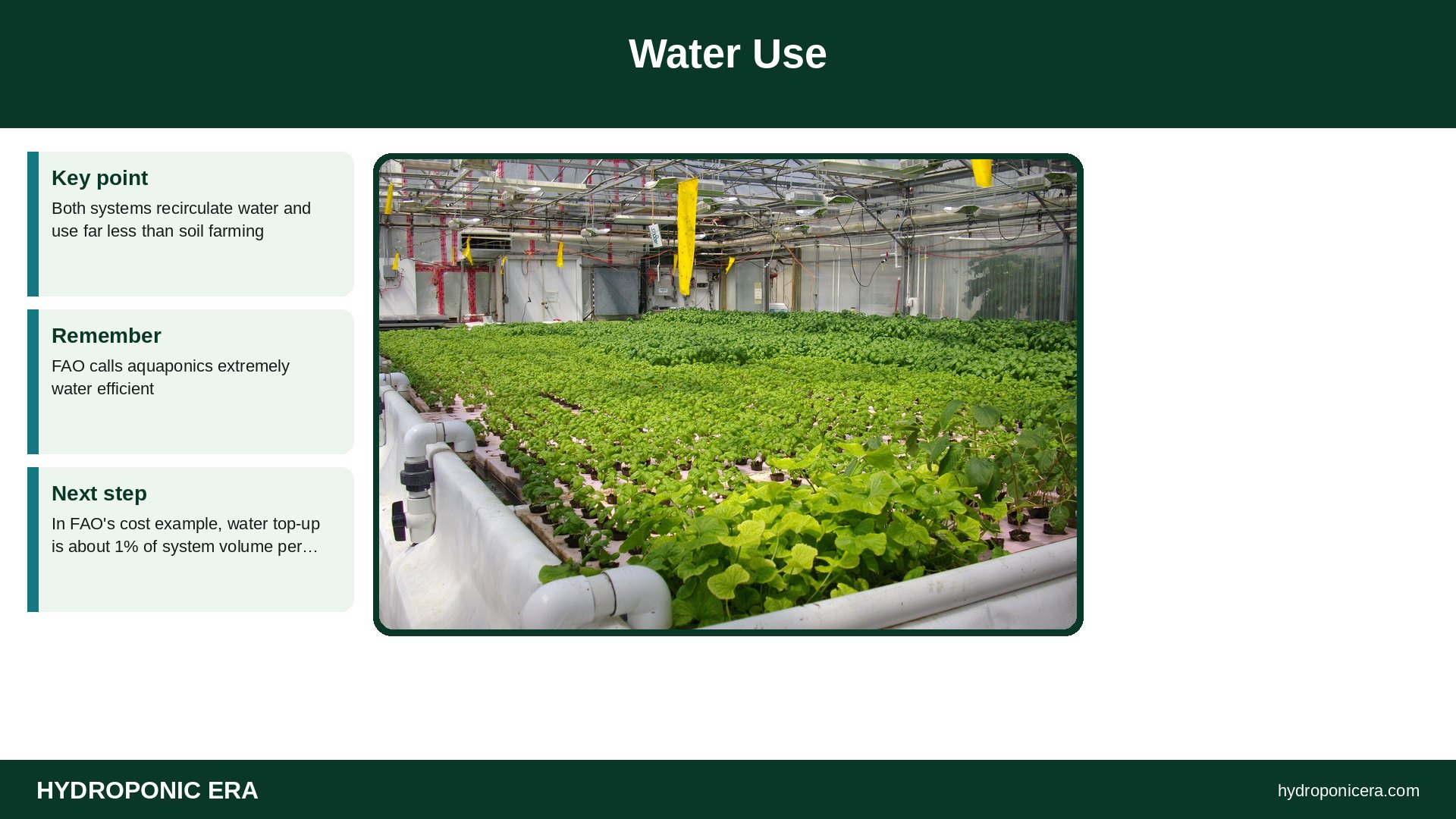
Both systems recirculate water and use far less than soil farming. FAO calls aquaponics extremely water efficient. In FAO’s cost example, water top-up is about 1% of system volume per day.
Which Should You Choose?
- Choose hydroponics if you want the simplest start, maximum plant control, or are growing fruiting crops indoors. See hydroponics vs soil.
- Choose aquaponics if you want fish, enjoy managing an ecosystem, or prefer avoiding mineral fertilizer. See best fish for aquaponics.
Check your state’s fish rules before starting aquaponics. See aquaculture permit basics.
Aquaponics vs Hydroponics for Home Growers
For a balcony, kitchen, or small indoor space, hydroponics is usually easier: a single reservoir, a pump, and a nutrient bottle. Aquaponics vs hydroponics at home becomes closer when you have a garage, basement, or backyard with room for a fish tank and filters, and when you’d enjoy keeping fish. Many people start with hydroponics and add aquaponics later once they’re comfortable with pH and plant care.
Aquaponics vs Hydroponics for Small Farms
FAO notes most commercial aquaponics revenue comes from plants, so selling fish is a bonus, not the core business. Commercial aquaponics also brings aquaculture permits and fish processing rules. Hydroponic farms avoid fish regulations but must manage nutrient solution disposal. In both, market access and labor matter more than the system choice. See fish farming for beginners.
Aquaponics vs Hydroponics: Nutrient Control
In hydroponics, you can raise potassium for tomatoes or nitrogen for lettuce by changing the nutrient mix. In aquaponics, nutrients depend on fish feed, so adjustments are slower: change the feed rate, add iron, or use potassium and calcium buffers as FAO suggests. That’s the biggest practical difference in aquaponics vs hydroponics for experienced growers.
Aquaponics vs Hydroponics: Startup Time
A hydroponic system can be planted on day one. An aquaponics system needs cycling first, which FAO says takes 3–5 weeks, before the bacteria can handle fish waste. See aquaponics cycling.
Aquaponics vs Hydroponics: Risk
In hydroponics, a pump failure risks the plants. In aquaponics, it risks fish, bacteria, and plants together. Backup aeration matters more in aquaponics.
Aquaponics vs Hydroponics: Feeding Plants Through Fish
In hydroponics you add nutrients directly; in aquaponics, plants are fed through fish feed. FAO gives a feed rate ratio of about 40–50 g of fish feed per square meter of growing area per day for leafy greens and 50–80 g for fruiting vegetables, noting fruiting crops need about one-third more nutrients. In US terms, that’s roughly 3.7–4.6 g per square foot per day for greens. This ratio is the core design rule of aquaponics and has no equivalent in hydroponics, where you simply mix the nutrient strength you want.
FAQs: Aquaponics vs Hydroponics
Which is better, aquaponics or hydroponics?
Neither overall. Hydroponics is simpler; aquaponics produces fish too.
Which is cheaper to start?
Hydroponics. FAO lists higher startup costs for aquaponics.
Which grows more?
Both grow leafy greens well; hydroponics offers more control for fruiting crops.
Is aquaponics organic?
FAO calls it organic-like, but certification rules vary.
Which is easier for beginners?
Hydroponics, because there are no fish to manage.
Sources
- FAO — Small-scale aquaponic food production
- Photo credits (Wikimedia Commons, edited with titles): Solanum lycopersicum in aquaponics at the NC Greenhouse Nursery by Gogerr (CC BY-SA 4.0); Hydroponic lettuce @ Plaine des Cafres 03 by Rémih (CC BY-SA 4.0); Oreochromis-niloticus-Nairobi by Bjørn Christian Tørrissen (CC BY-SA 3.0); 2009-03-30 Lettuce roots by Ildar Sagdejev (Specious) (CC BY-SA 4.0); CDC South Aquaponics Raft Tank 1 2010-07-17 by Bryghtknyght (CC BY 3.0)