
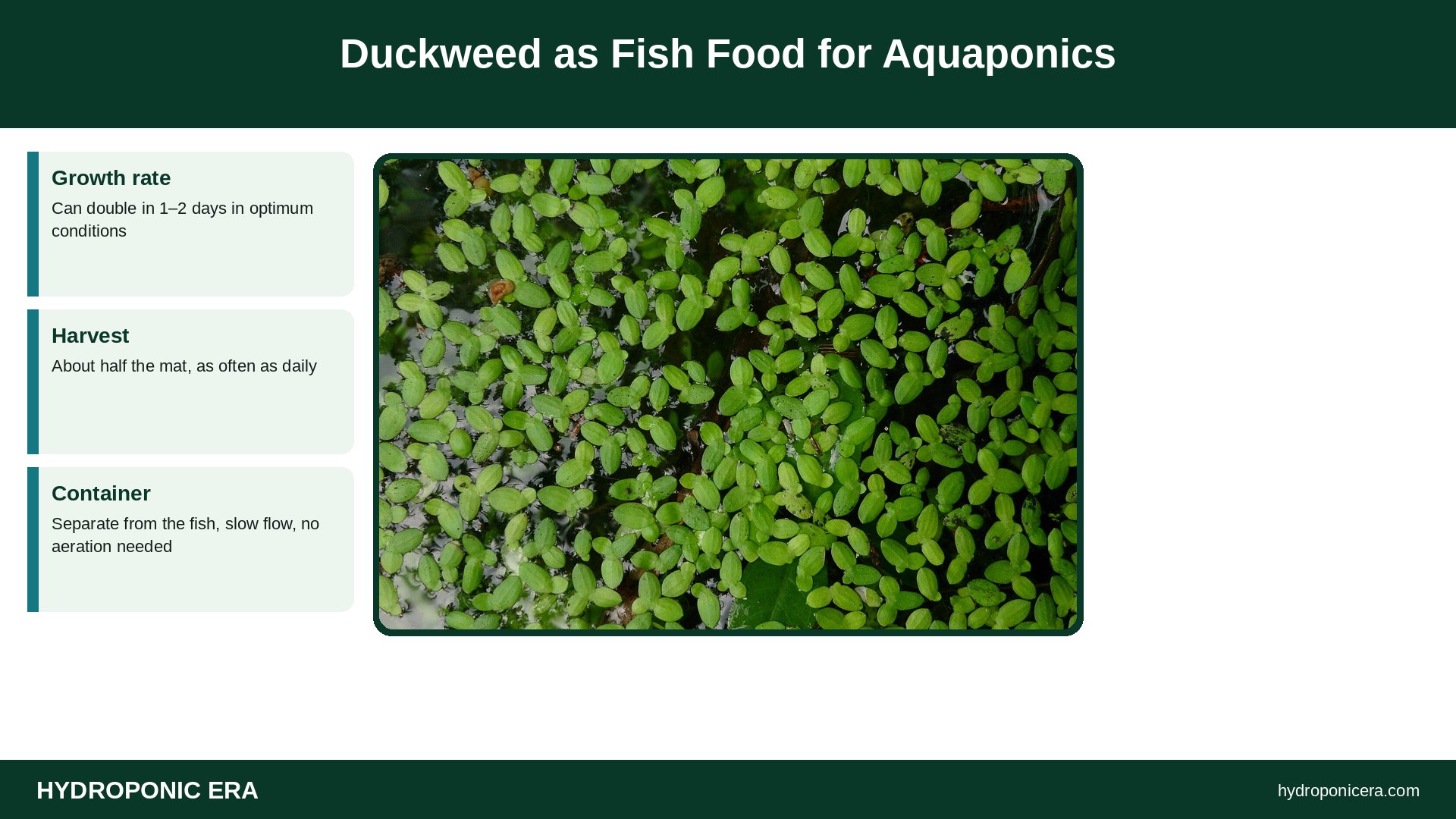
Duckweed fish food is a cheap, homegrown supplement for herbivorous and omnivorous fish such as tilapia, carp, koi, and goldfish. FAO’s aquaponics manual describes duckweed as a fast-growing floating plant rich in protein that can double its mass every 1–2 days in good conditions, so about half can be harvested daily. FAO advises growing it in a separate container, with slow water flow and no aeration, because fish would eat the whole stock if it grew in their tank. It’s a supplement to complete pellets, not a full replacement, and it works especially well placed on the return line, where it cleans up nutrients before water goes back to the fish.
Key takeaway: Grow duckweed in its own shallow tub, harvest about half often, and feed it alongside pellets to tilapia, carp, koi, or goldfish.
| Factor (FAO) | Detail |
|---|---|
| Growth rate | Can double in 1–2 days in optimum conditions |
| Harvest | About half the mat, as often as daily |
| Container | Separate from the fish, slow flow, no aeration needed |
| Light | Full sun or partial shade |
| Best fish | Tilapia and carp (koi and goldfish are carp-family fish) |
| Storage | Surplus can be frozen in bags |
| Nitrogen | Doesn’t fix nitrogen; protein comes from system nutrients |
Why Use Duckweed Fish Food?
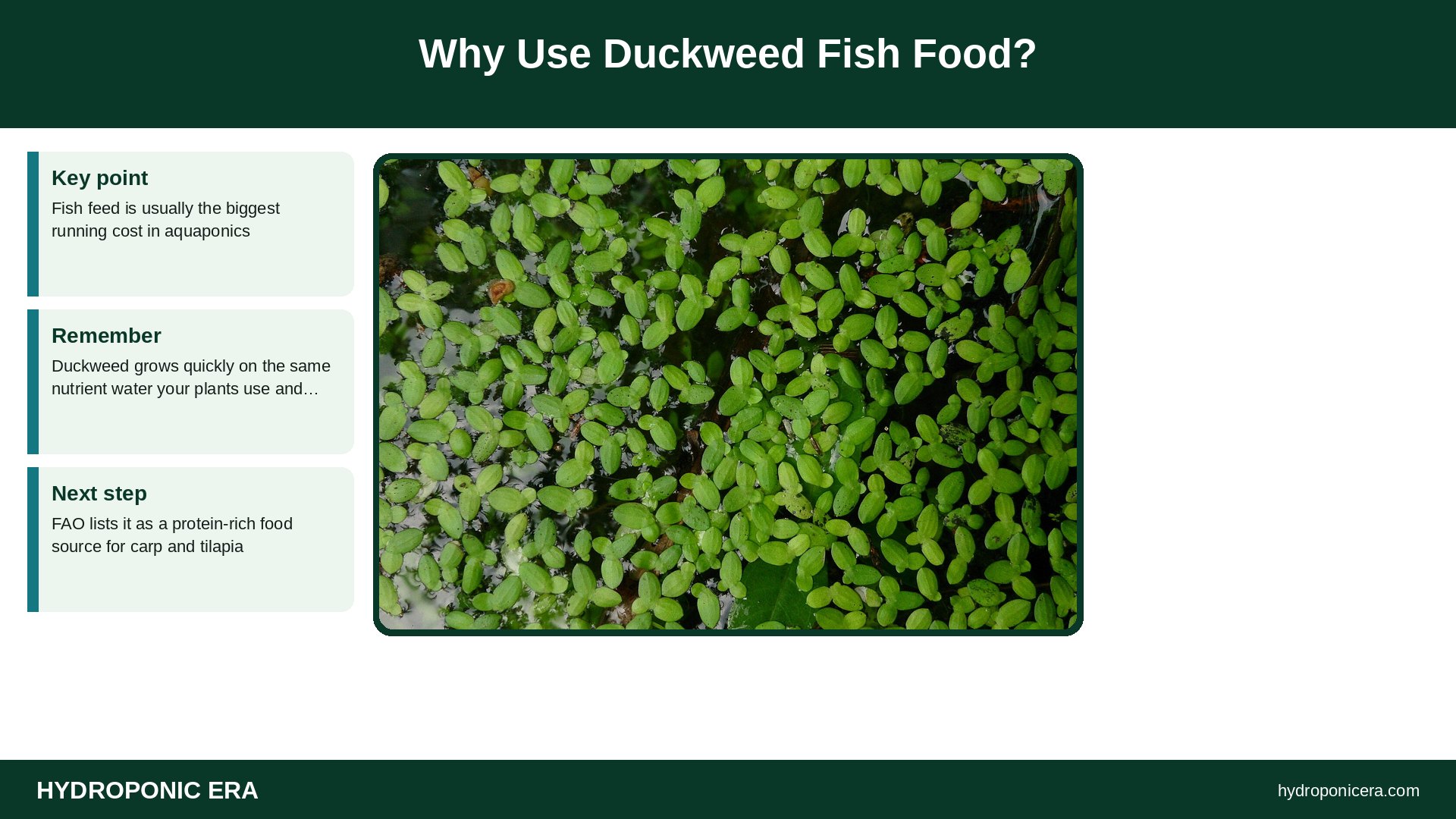
Fish feed is usually the biggest running cost in aquaponics. Duckweed grows quickly on the same nutrient water your plants use and gives fish fresh green food. FAO lists it as a protein-rich food source for carp and tilapia. It also has a water-cleaning role: FAO suggests placing the duckweed container on the return line between grow beds and fish tank, so nutrients that escape the beds feed the duckweed and the cleanest possible water returns to the fish.
What Duckweed Can’t Do
FAO notes duckweed doesn’t fix nitrogen from the air. All its protein comes from fish feed or other inputs already in the system. That means it recycles nutrients rather than adding new ones. Fresh duckweed is mostly water, so fish need large amounts to get much nutrition. Use it to stretch pellets, not replace them. Carnivorous fish like trout and perch won’t benefit much.
Duckweed vs Azolla
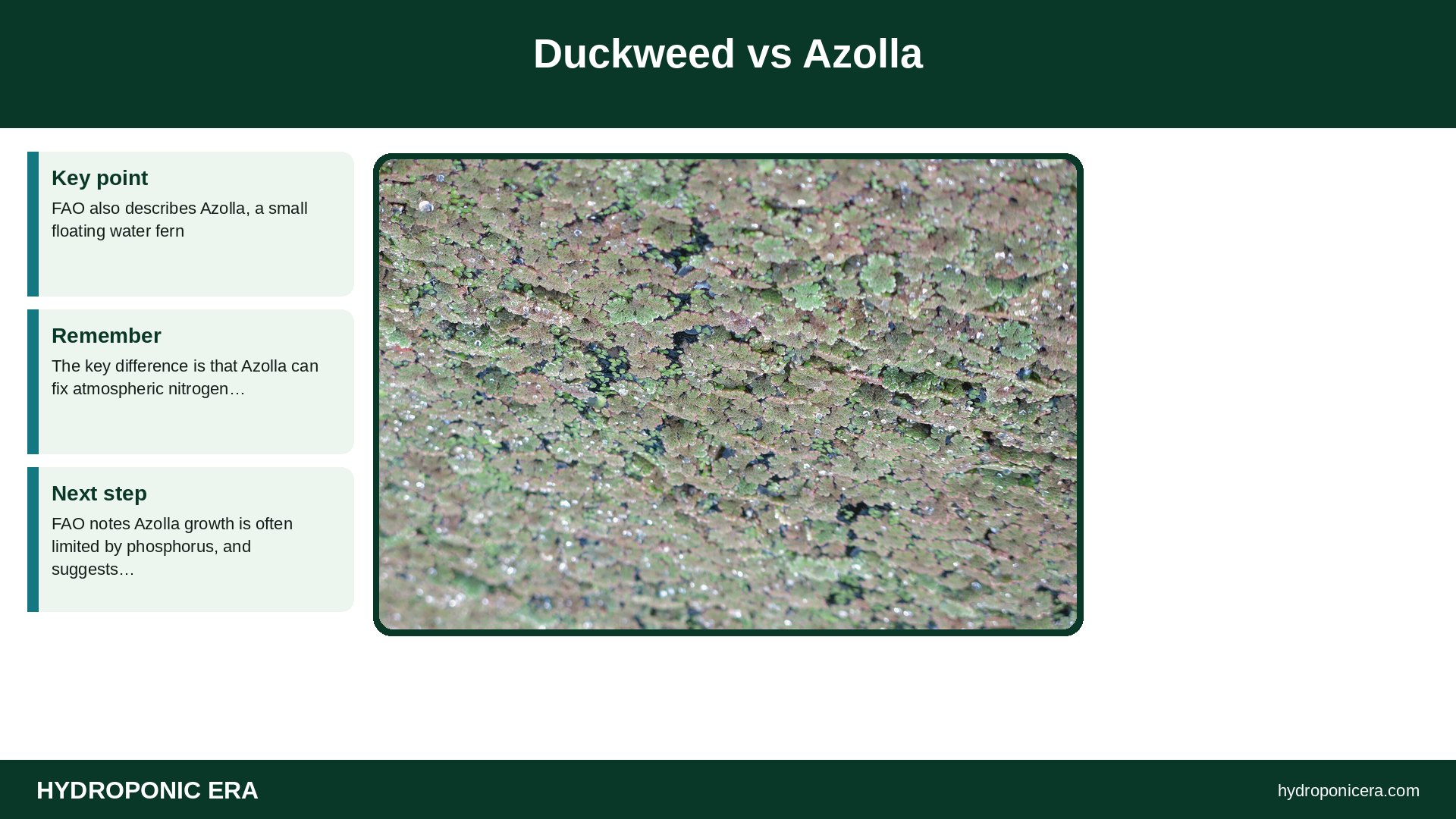
FAO also describes Azolla, a small floating water fern. The key difference is that Azolla can fix atmospheric nitrogen through a partnership with the bacterium Anabaena azollae, so it adds protein from the air. FAO notes Azolla growth is often limited by phosphorus, and suggests an extra source such as compost tea if you grow it intensively. Like duckweed, it should grow in a separate container with slow flow. Check your state’s invasive plant rules before buying any Azolla species.
How to Grow Duckweed Fish Food
- Pick a container: a shallow tub, stock tank, or trough. A larger surface area matters more than depth.
- Connect it to the system: feed it a slow trickle of system water, ideally on the return line from the grow beds, per FAO.
- Keep flow gentle: FAO says aeration isn’t needed and water should flow slowly. Strong currents push the mat to one side and break it up.
- Light: FAO says sun-exposed or half-shaded spots both work.
- Seed it: start with a starter culture from a reputable supplier and rinse it to avoid snails and pests.
- Harvest often: scoop about half the mat when it covers the surface.
See how to grow duckweed for more detail.
Feeding Duckweed Fish Food to Your Fish
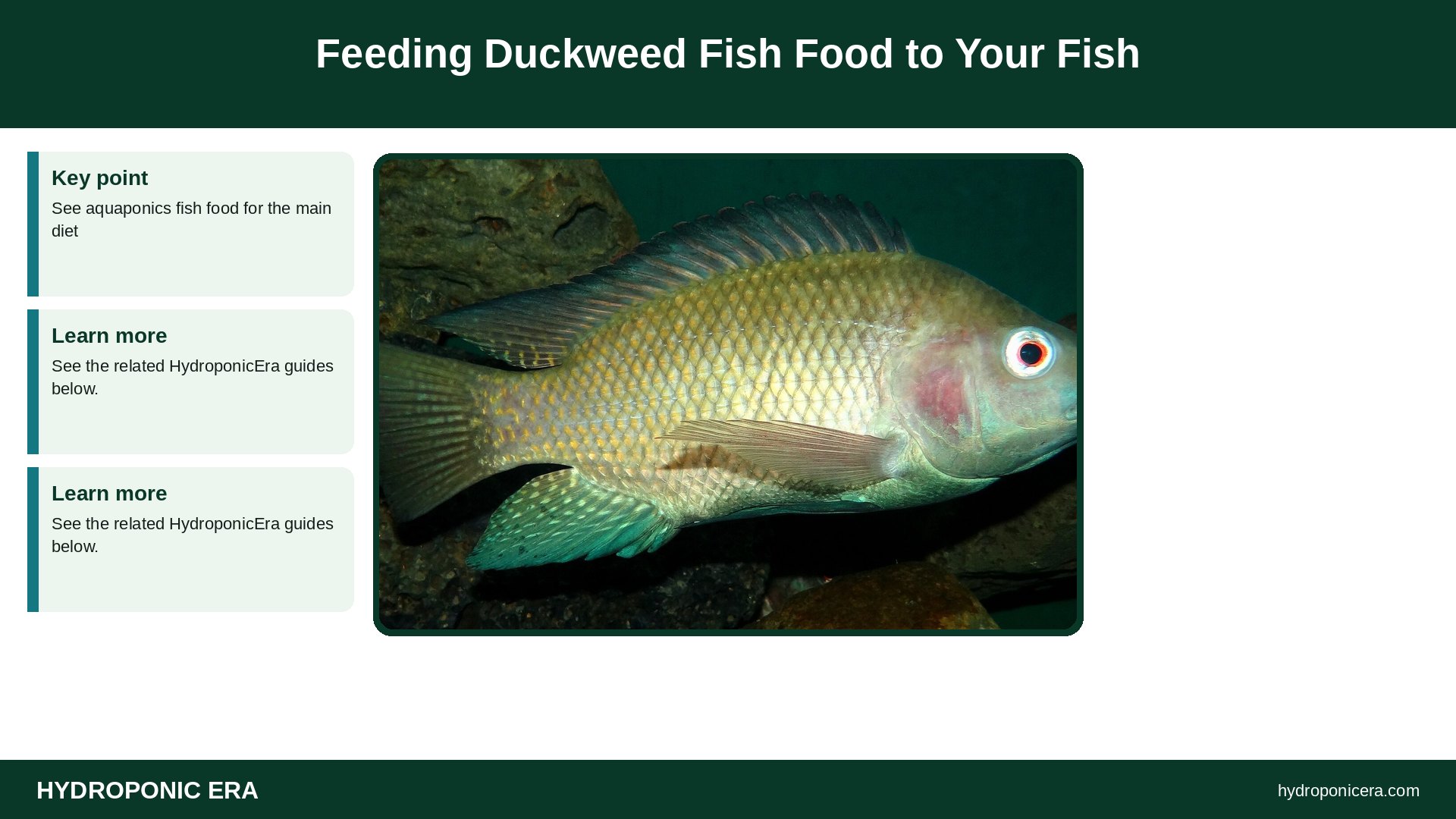
- Rinse harvested duckweed and feed it fresh.
- Offer what fish eat quickly; remove leftovers so they don’t rot.
- Keep feeding complete pellets as the main diet.
- Freeze surplus in bags for later, as FAO suggests.
- Expect tilapia and koi to strip it quickly.
See aquaponics fish food for the main diet.
Keep Duckweed Out of Places It Doesn’t Belong
Duckweed spreads easily on boots, nets, and birds. Keep it contained and don’t dump it into ponds or ditches. It can also clog grow bed drains and pumps, so screen the overflow from the duckweed tub. In a fish tank, it can cover the surface, block light, and reduce gas exchange if fish don’t eat it.
Duckweed Fish Food Safety
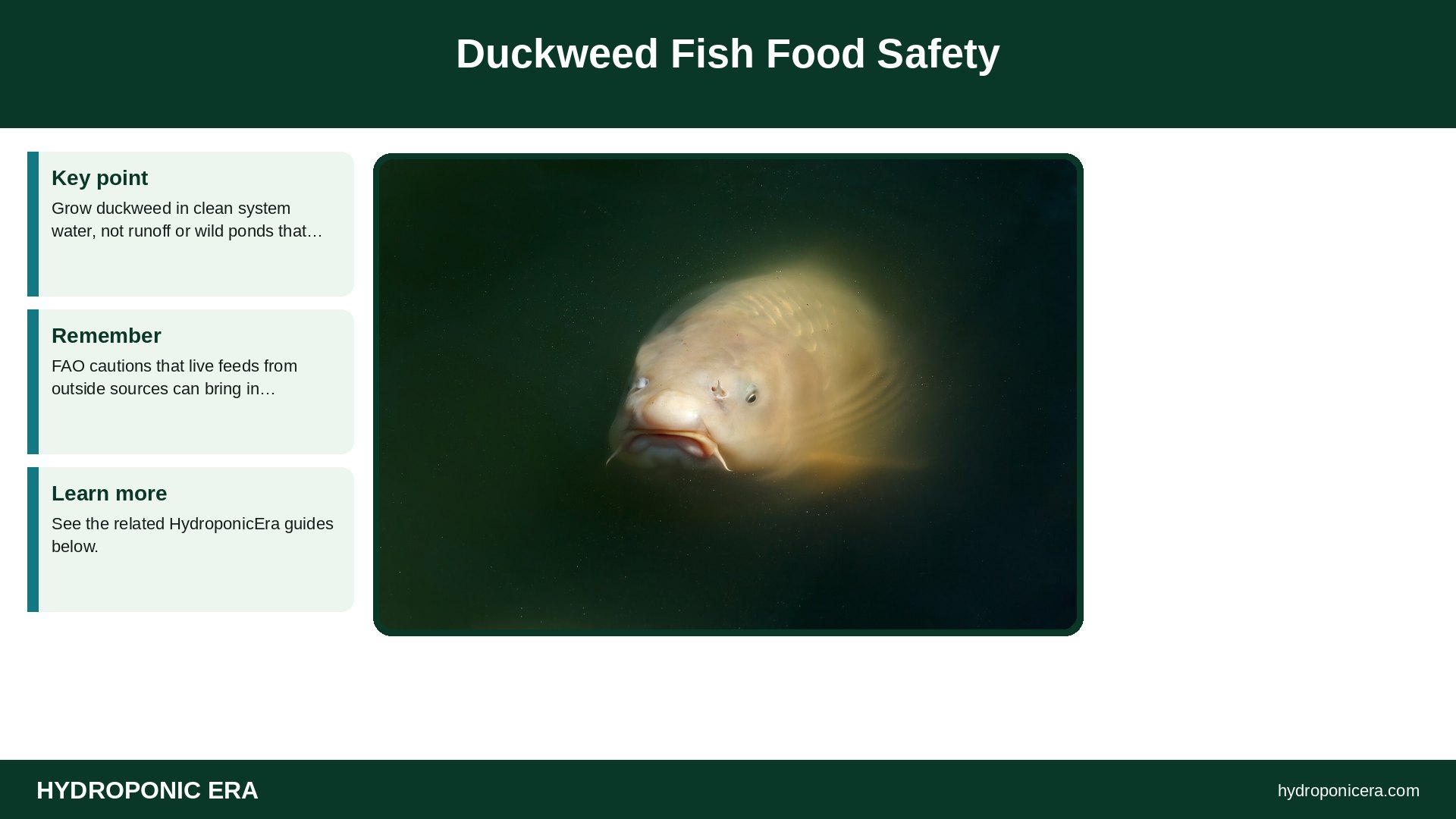
Grow duckweed in clean system water, not runoff or wild ponds that may carry pollutants or parasites. FAO cautions that live feeds from outside sources can bring in contamination and parasites, so use a clean starter culture.
Is Duckweed Fish Food Worth It?
For tilapia, carp, koi, and goldfish, yes as a cheap supplement and a nutrient polisher. For trout, perch, and other carnivores, use it for water quality, not as food. Track pellet use and fish growth to see what it saves you. See tilapia aquaponics and koi aquaponics.
How Much Duckweed Fish Food to Grow
Because fresh duckweed fish food is mostly water, you need a lot of surface area to replace a meaningful share of pellets. Start small, with a tub or two, and measure how much your fish eat in a few minutes. If the mat covers the tub before you can use it, harvest about half, as FAO suggests, and freeze the extra. If fish strip it in seconds and the tub can’t keep up, add more surface area rather than overharvesting, which slows regrowth.
Duckweed Fish Food Problems and Fixes
- Slow growth: too little light, cold water, or low nutrients; move to the return line from the fish tank.
- Mat breaking apart: flow too strong; slow the inlet.
- Yellow fronds: often low nitrogen or iron in the water.
- Snails and pests: rinse new starter cultures and inspect them.
- Clogged drains: screen the duckweed tub outlet.
Which Fish Eat Duckweed Fish Food?
FAO names tilapia and carp as fish suited to duckweed. Koi and goldfish are carp-family fish and readily eat it. Grass carp also eat it, but many US states restrict grass carp. Catfish and bluegill are mostly carnivorous or omnivorous and may nibble, but duckweed fish food won’t be a major part of their diet. See best fish for aquaponics.
Storing Duckweed Fish Food
Fresh duckweed is best fed the same day. FAO notes the surplus can be frozen in bags, which lets you build a stock during summer for cooler months when growth slows. Drain it well before freezing and portion it into daily amounts so you thaw only what the fish will eat.
FAQs: Duckweed Fish Food
Is duckweed fish food good for tilapia?
Yes for tilapia and carp-family fish, as a supplement to pellets.
How fast does duckweed grow?
FAO says it can double in 1–2 days in optimum conditions.
Can duckweed grow in the fish tank?
FAO advises a separate container, or the fish will eat it all.
Does duckweed need aeration?
No. Slow water flow is enough, per FAO.
Can I freeze duckweed?
Yes, FAO notes surplus can be frozen in bags.
Sources
- FAO — Small-scale aquaponic food production
- Photo credits (Wikimedia Commons, edited with titles): Common Duckweed (Lemna minor) by Mokkie (CC BY-SA 3.0); Common Duckweed (Lemna minor) by Mokkie (CC BY-SA 3.0); Floating duckweed by BeanieAll (CC BY-SA 4.0); Oreochromis-niloticus-Nairobi by Bjørn Christian Tørrissen (CC BY-SA 3.0); Koi in a garden pond in Tuntorp 3 by W.carter (CC BY-SA 4.0)