
Commercial aquaponics can be profitable, but most farms are not yet. In the largest survey of commercial operations (Love et al., 2015, 257 respondents), only 31% said they were profitable in the previous 12 months. Profitable farms were more likely to treat aquaponics as their main job, have more experience, sell at least $5,000 a year, be in warmer USDA zones 7–13, and also sell non-food products such as workshops, consulting or supplies. Plan around high-value crops like herbs and leafy greens, a confirmed local market and a realistic budget before you build.
Key takeaway: In commercial aquaponics, plants usually earn the money and fish support the system. Start small, prove your market, then scale.
| Factor linked to profit (Love et al., 2015) | Odds of profit vs. others |
|---|---|
| Aquaponics is primary income | 5.79× higher odds |
| Located in USDA zones 7–13 | 4.17× higher odds |
| Gross sales of $5,000 or more | 3.58× higher odds |
| Greater aquaponics knowledge | 2.37× higher odds |
| Sells non-food products or services | 2.13× higher odds |

What Commercial Aquaponics Looks Like

Love et al. surveyed 257 commercial operations; 81% were in the US and the rest in 22 other countries, and the median start year was 2010. Tilapia was the most common fish (69% of respondents), followed by ornamental fish (43%), catfish (25%), perch (16%), bluegill (15%), trout (10%) and bass (7%). Surveyed farms reported 538 full-time workers, 242 part-time workers and 1,720 unpaid workers or volunteers, a warning sign for anyone budgeting paid labor. In a follow-up summary, the survey authors noted that most farms reported profitability only above roughly $50,000 in yearly gross sales. See aquaponics system types and hobby vs commercial.
Commercial Aquaponics Economics: The UVI Example
The University of the Virgin Islands (UVI) system is the best documented commercial aquaponics design. SRAC Publication 454 reports enterprise budgets for six production units:
| Item | Tilapia + lettuce | Tilapia + basil |
|---|---|---|
| Annual return to risk and management (profit) | $185,248 | $693,726 |
| Plant break-even price | $6.15/case (sold at $20) | $0.75/lb (sold at $10) |
| Tilapia break-even price | $1.47/lb (sold at $2.50) | |
SRAC is careful to say these figures reflect a small, high-price island market where over 95% of vegetables and nearly 80% of fish are imported. The basil budget is not realistic for that market, because 108,000 people can’t absorb 66,000 pounds of basil a year. Construction, electricity, water, labor and land costs also vary widely, so SRAC warns against sweeping generalizations. The lesson is that niche markets and high-value crops drive profit. See aquaponics cost.
Why Herbs and Greens Pay Best
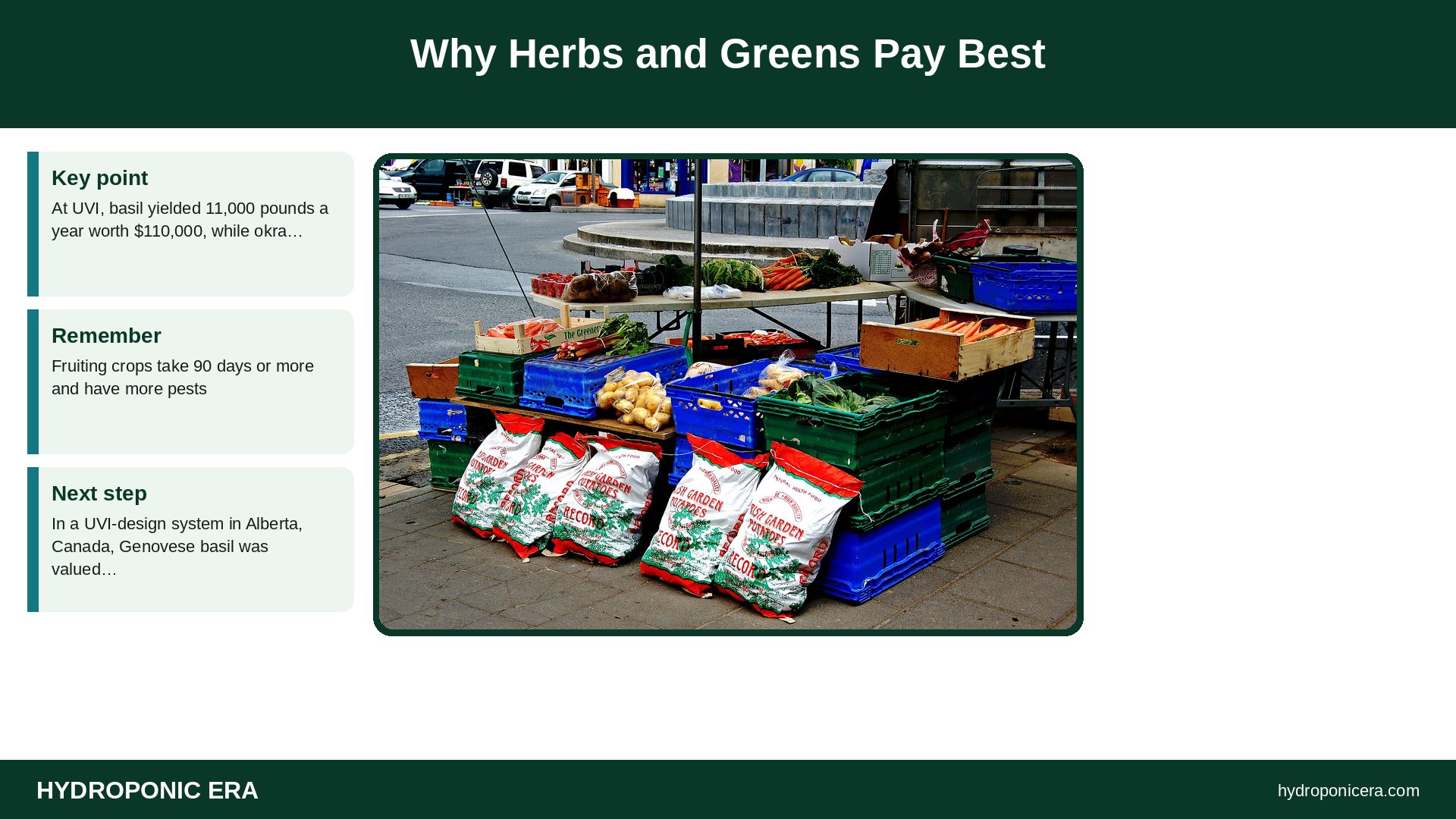
At UVI, basil yielded 11,000 pounds a year worth $110,000, while okra yielded 6,400 pounds worth $6,400 in the same system, according to SRAC 454. Fruiting crops take 90 days or more and have more pests. In a UVI-design system in Alberta, Canada, Genovese basil was valued at $186.64 per square foot per year versus $6.90 for tomatoes and $8.90 for cucumbers at Calgary wholesale prices. Lettuce, which takes 3–4 weeks and can be harvested weekly with staggered planting, is the steady base crop. See aquaponics herbs, aquaponics lettuce and crop selection.
Fish: Supporting Revenue, Not the Main Profit
Tilapia is the standard fish because it grows fast in warm water and tolerates crowding. UVI harvests one of its fish tanks every week across six units, which supports steady fish sales and a steady nutrient supply. But fish sale prices are close to commodity levels in many US markets, so plan fish mainly as the nutrient engine. Check state rules first: some states restrict tilapia and require aquaculture permits. See tilapia aquaponics, is tilapia legal and aquaculture permits.
7 Proven Steps to Start a Commercial Aquaponics Farm

- Learn on a small system first. Knowledge was one of the strongest profit factors. See aquaponics daily maintenance.
- Find buyers before building. Restaurants, grocers, CSAs and farmers markets. See selling locally.
- Write a business plan with conservative yields and prices. See business plan.
- Choose climate wisely. Warm zones lowered heating costs in the survey; otherwise budget for a greenhouse. See aquaponics greenhouse.
- Check permits and food safety rules. See aquaponics food safety.
- Add non-food income: tours, workshops, consulting or system sales, which the survey linked to profit.
- Track every cost and adjust crops by margin. See record keeping.
Funding and Regulations
USDA programs such as Farm Service Agency microloans may help new growers, and some grants support urban agriculture. Produce sales may fall under the FDA Produce Safety Rule depending on sales volume, and fish sales often need separate state licenses. See USDA farm loans, grants and liability questions.
Common Commercial Aquaponics Mistakes

- Building big before proving the market.
- Counting on fish sales for profit.
- Underestimating labor, heating and electricity. See why vertical farms fail.
- Growing low-value fruiting crops in expensive greenhouse space.
- No backup power or alarms, risking a total fish loss. See aquaponics power outage.
Is Commercial Aquaponics Worth It?
It can be when the farm is run as a real business with local premium buyers, high-value crops and extra income streams. The data suggest most small farms struggle, so test your market and skills with a pilot system before taking on debt. For many growers, a hybrid model of produce plus education or system sales is the most reliable path. See farm profit.
Commercial Aquaponics Budget Checklist
- Capital costs: greenhouse or building, tanks, filters, pumps, plumbing, backup power.
- Operating costs: fish feed, fingerlings, seeds, electricity, heating, water, packaging, insurance.
- Labor: daily care, harvest, packing, delivery and sales. Price your own time.
- Revenue: conservative yields and prices from real buyer quotes, not best-case numbers.
- Break-even: calculate cost per pound or per case, as SRAC did for the UVI system.
A clear budget is the single best tool for deciding whether commercial aquaponics fits your site. Update it every month with real numbers. See cost tracking.
FAQs
Is commercial aquaponics profitable?
Some farms are; only 31% reported profit in a 257-farm survey.
What crop makes the most money?
Culinary herbs like basil, then leafy greens.
What fish do commercial farms use most?
Tilapia, raised by 69% of surveyed farms.
How much revenue do farms need to profit?
Most reported profit only above about $50,000 in yearly sales.
Do I need a permit?
Often yes for fish; check your state agency.
Should I start with a greenhouse?
Only after a pilot proves your market and skills.
Sources
- Love, D.C. et al. (2015) — Commercial aquaponics production and profitability: Findings from an international survey, Aquaculture 435:67–74
- Global Water Forum (Johns Hopkins CLF authors) — Water use and economics of small-scale commercial aquaponics
- SRAC Publication 454 — Recirculating Aquaculture Tank Production Systems: Aquaponics
- FAO — Small-scale aquaponic food production
- Photo credits (Wikimedia Commons, edited with titles): Lettuce Closeup Greenhouse Phuktal Zanskar Jun24 A7CR 00442 by This Photo was taken by Timothy A. Gonsalves. Feel free to use my photos, but pl (CC BY-SA 4.0); CDC South Aquaponics Raft Tank 1 2010-07-17 by Bryghtknyght (CC BY 3.0); Ennis – Market Place – Farmers’ Market – Vegetable Stand – geograph.org.uk – 3038450 by Joseph Mischyshyn (CC BY-SA 2.0); Oreochromis-niloticus-Nairobi by Bjørn Christian Tørrissen (CC BY-SA 3.0); Deepwater Aquaponics Floating Rafts Growing Lettuce, Basil and Arugula by Alabama Extension (CC0)