
The best microgreens to grow for most beginners are radish, broccoli, kale, mustard, arugula, red cabbage, pea shoots and sunflower. They sprout reliably, need no soaking (except peas and sunflower), and are ready in about 8–14 days. If you want the most nutrition per bite, add red cabbage, cilantro and amaranth. If you want speed, start with radish and arugula. Save slow crops like basil, beet and cilantro for after you’ve had a few easy wins.
Key takeaway: Start with fast, forgiving brassicas (radish, broccoli, kale, mustard). Weigh your seed, give a short dark period, then bright light, and harvest when the first true leaves appear.
| Microgreen | Seed per 10 x 20 in (25 x 51 cm) tray* | Days to harvest* | Flavor | Difficulty |
|---|---|---|---|---|
| Radish (Red Arrow) | 24.5 g | 8 | Spicy | Very easy |
| Broccoli | 13 g | 12.5 | Mild | Very easy |
| Kale (Red Russian) | 10 g | 13.5 | Mild, nutty | Easy |
| Mustard (Garnet Giant) | 8 g | 12.5 | Spicy | Easy |
| Arugula | 10 g | 14 | Peppery | Easy |
| Red cabbage | 10.5 g | 13.5 | Mild | Easy |
| Amaranth (Garnet Red) | 7.5 g | 17 | Earthy | Moderate |
| Cilantro | 26 g | 20 | Cilantro | Slow |
*Averages from Johnny’s Selected Seeds’ 2017 yield trial of 29 varieties, harvested at the first true leaf. Your numbers will vary with seed lot, temperature and light.
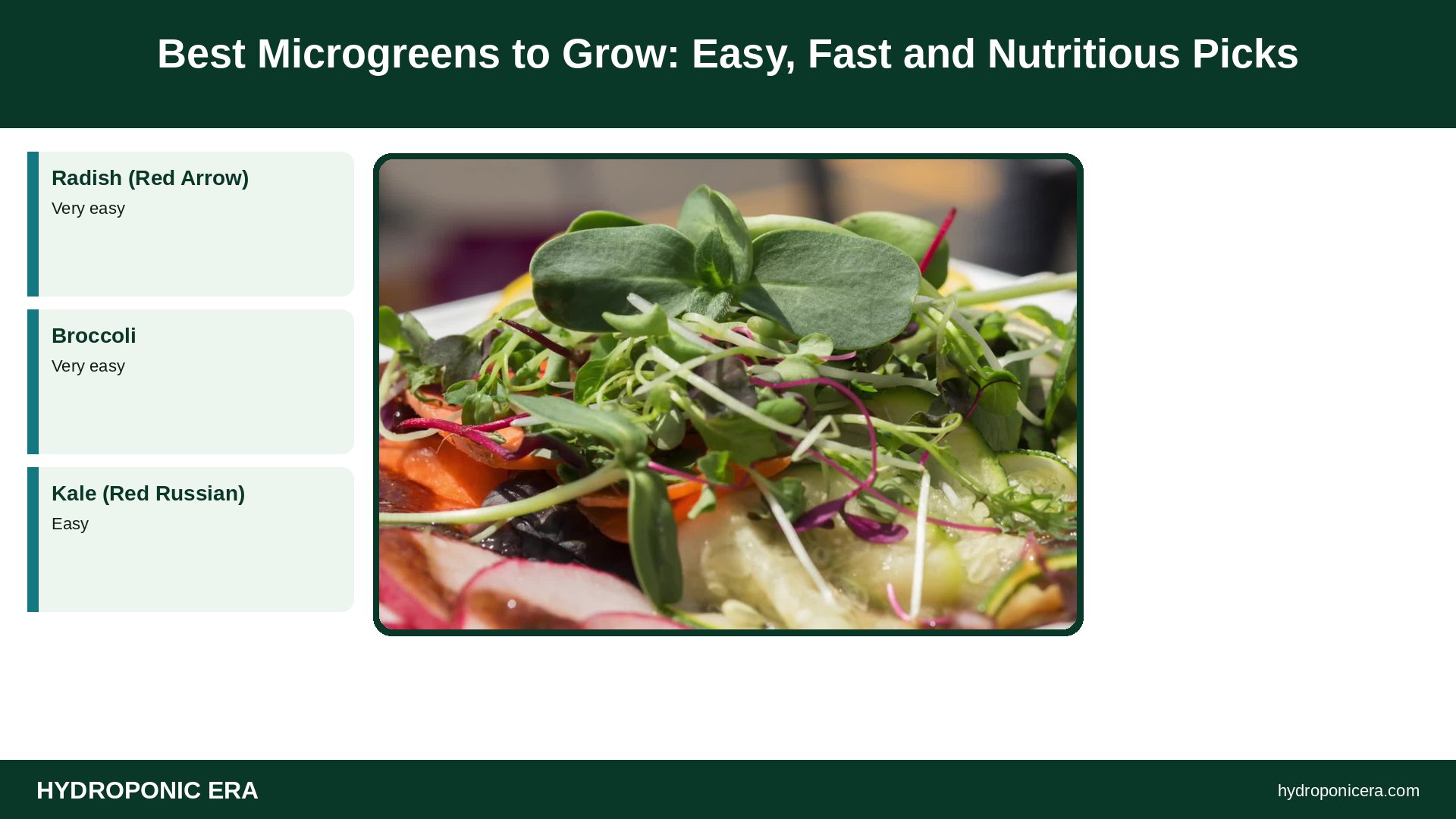
How We Picked the Best Microgreens to Grow
We ranked crops on four things that matter at home: how reliably they germinate, how fast they’re ready, how much they yield per tray, and how much nutrition and flavor they deliver. The data come from university extension guides and seed trials, not guesswork. Penn State Extension notes that microgreens are harvested at about 1.5–3 inches (4–8 cm) tall and can take as little as 7 and up to 21 days from seeding to harvest, depending on the crop and growing conditions.
Best Microgreens to Grow for Beginners
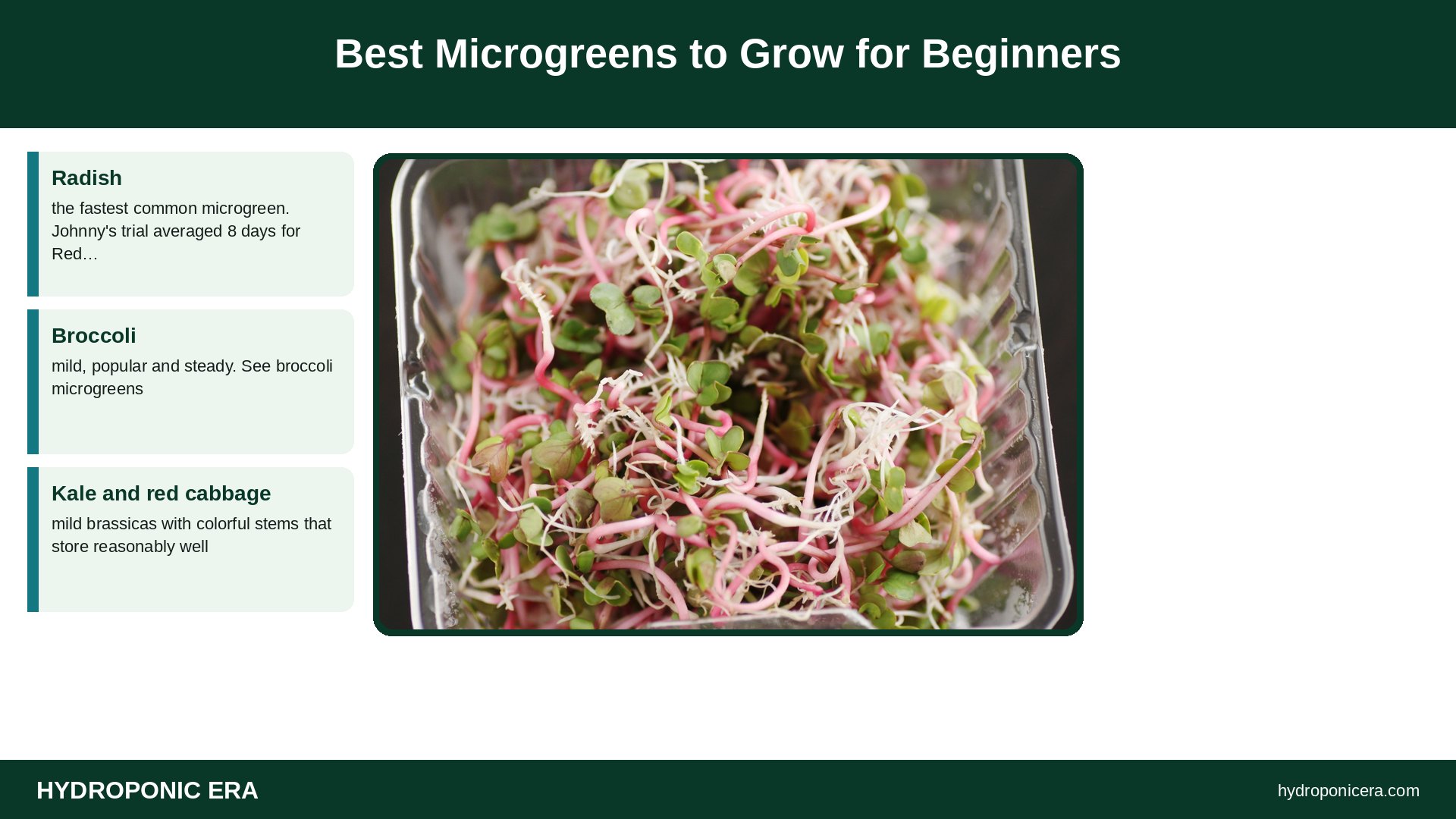
- Radish: the fastest common microgreen. Johnny’s trial averaged 8 days for Red Arrow and Daikon. See radish microgreens.
- Broccoli: mild, popular and steady. See broccoli microgreens.
- Kale and red cabbage: mild brassicas with colorful stems that store reasonably well.
- Mustard and arugula: spicy, quick, and very productive. Penn State’s Red Rain mustard averaged 0.44 lb (201 g) per tray, the highest in its list.
- Pea shoots and sunflower: larger seeds that need soaking, but they give big, crunchy harvests. See pea shoots and sunflower microgreens.
The University of Maryland Extension says cabbage-family plants germinate in about 36 hours at 72°F (22°C), which is why brassicas are the classic first tray.
Best Microgreens to Grow for Nutrition
A USDA Agricultural Research Service team led by Gene Lester measured vitamins and carotenoids in 25 commercial microgreens (Xiao et al., 2012). Red cabbage had the most vitamin C, cilantro the most carotenoids, garnet amaranth the most vitamin K, and green daikon radish the most vitamin E. On average, the microgreens had about five times more vitamins and carotenoids than mature leaves of the same plants. Vitamin C ranged from 20 to 147 mg per 100 g of fresh weight, so the crop you choose matters.
Best Microgreens to Grow for Speed and Yield

| Goal | Best picks | Evidence |
|---|---|---|
| Fastest harvest | Radish, arugula | USU lists arugula at 6–8 days and radish at 8–12 |
| Highest yield per tray | Tokyo Bekana, mustard, hon tsai tai | Johnny’s: Tokyo Bekana 15 oz (425 g); Penn State: Red Rain mustard 0.44 lb (201 g) |
| Lowest seed cost per tray | Arugula, kale, cilantro | USU estimates $0.17–$0.37 seed cost per tray |
| Bold color | Red cabbage, amaranth, beet | Purple or red stems and leaves |
Seed costs and yields shift with seed lot and price changes, so treat these as starting points and track your own trays. See microgreens cost worksheet.
Slow Microgreens Worth Growing Later
Johnny’s groups slow-growing vegetable microgreens at 16–25 days and some herbs at 26–30 days. Basil averaged 19–25.5 days in its trial, cilantro 20 days, beet 17 days and amaranth 17 days. They’re worth it for flavor and color, but they tie up trays longer and sit damp longer, which raises mold risk. See basil microgreens and microgreens mold.
How to Grow Any of the Best Microgreens
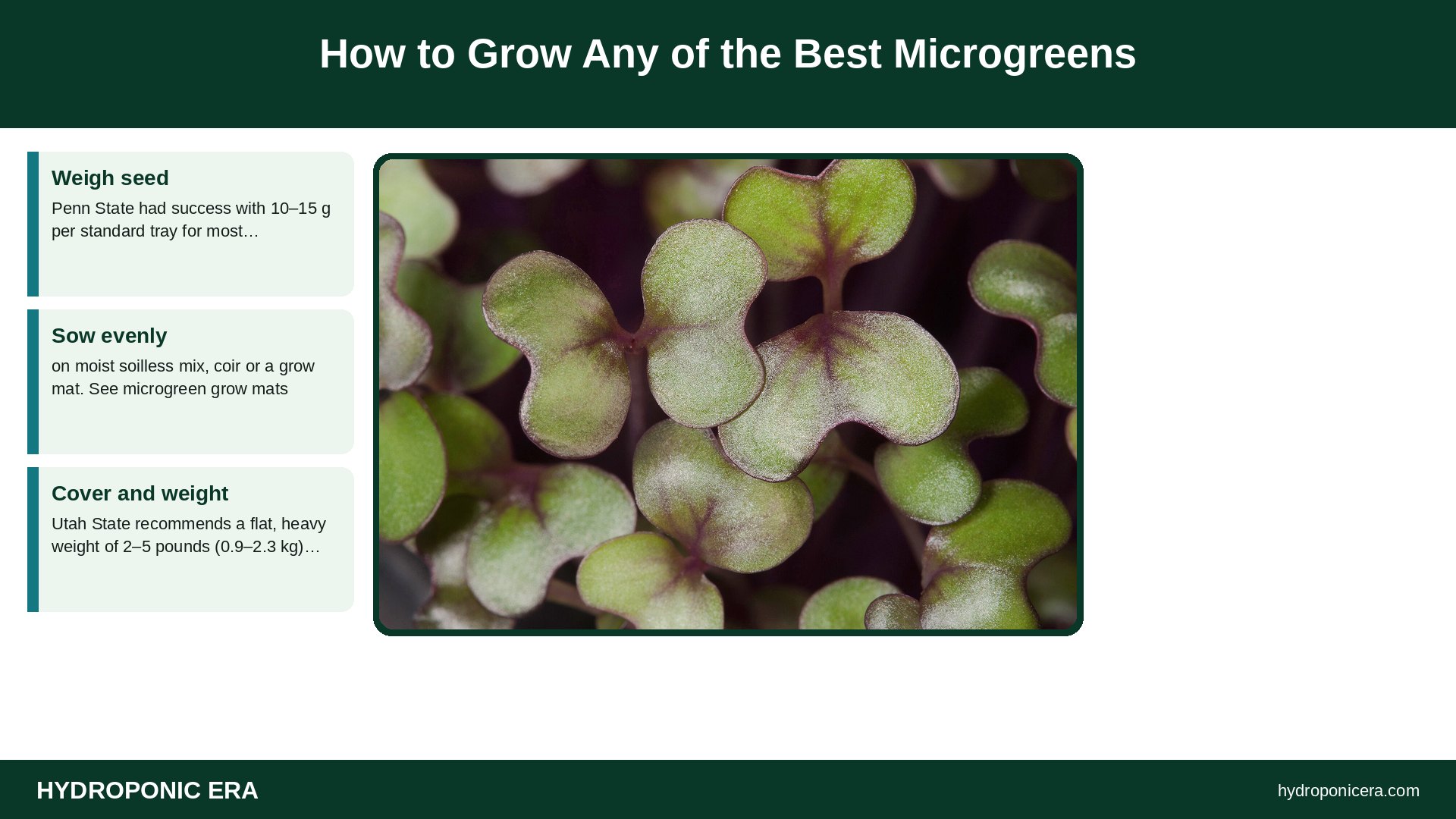
- Weigh seed. Penn State had success with 10–15 g per standard tray for most small-seeded types.
- Sow evenly on moist soilless mix, coir or a grow mat. See microgreen grow mats.
- Cover and weight. Utah State recommends a flat, heavy weight of 2–5 pounds (0.9–2.3 kg) on top during the first part of the dark period.
- Keep it warm. USU maintains 74°F (23°C) during germination, 72°F (22°C) with lights on and 68°F (20°C) with lights off.
- Light it. USU runs grow lights 18 hours a day; Maryland suggests about 16 hours, with lights 6–12 inches (15–30 cm) above the foliage.
- Bottom water to keep leaves dry and add a gentle fan.
- Harvest with clean scissors once true leaves start. See how to harvest microgreens.
Seeds to Avoid or Treat With Care
Penn State advises using organic or untreated seed, because the seed coat of some microgreens stays on the seedling and can be eaten. Never use seed treated with fungicide. Buy seed sold for microgreens or sprouting, in bulk if you plan to grow often; Maryland notes that tiny packets can cost 30 times more per seed than quarter-pound bags.
Best Microgreens to Grow Hydroponically

Every crop on this list can be grown on hemp, jute or coir mats with plain water or a weak nutrient solution. Virginia Tech’s guide notes microgreens are commonly grown in NFT, ebb-and-flow and aeroponic systems in vertical farms. Penn State has grown them in clear water, though some trays showed iron deficiency symptoms, so a dilute feed with 50–100 ppm nitrogen can help. See how to grow microgreens hydroponically.
A Simple 4-Tray Starter Plan
- Tray 1: radish for a quick win in about a week.
- Tray 2: broccoli or kale for a mild everyday green.
- Tray 3: spicy mix of mustard and arugula, which grow at similar speeds.
- Tray 4: red cabbage for color and vitamin C.
Sow one or two trays each week to keep a steady supply, and keep notes on seed weight, days to harvest and yield. Once these are easy, move on to the slower, higher-value crops.
Best Microgreens to Grow by Goal: Quick Picks
| Your goal | Best microgreens to grow | Why |
|---|---|---|
| First tray ever | Radish, broccoli | Big, fast seed; forgiving; ready in about a week and a half |
| Most food per tray | Pea shoots, sunflower | Large seeds produce heavy, crunchy shoots |
| Most color | Red cabbage, amaranth, beet | Purple or red stems and leaves |
| Spicy flavor | Mustard, arugula, cress | Peppery, mustard-oil flavors |
| Herb flavor | Basil, cilantro | Slower, but taste like the mature herb |
Many growers start with two of the best microgreens to grow for beginners, such as radish and broccoli, then add one new crop each week. That way you learn each crop’s habits without risking several trays at once. Keep notes on seed weight, days in the dark and harvest weight; after a month you’ll know which of the best microgreens to grow fit your taste, light and schedule. See radish microgreens, broccoli microgreens and how to harvest microgreens.
FAQs
What is the easiest microgreen to grow?
Radish and broccoli are the easiest for most beginners.
What microgreen grows fastest?
Radish and arugula, often in about 6–10 days.
Which microgreens are most nutritious?
In USDA research, red cabbage, cilantro, garnet amaranth and green daikon radish led different nutrient groups.
Do microgreens need fertilizer?
Not much; seeds carry most of what they need, though a weak feed can help on mats.
Can I grow microgreens without grow lights?
Yes, in a bright south-facing window, but growth is less uniform.
Can I mix microgreens in one tray?
Only crops with similar growth speeds, such as mustard and arugula.
Sources
- Johnny’s Selected Seeds — Micro Greens Yield Trial 2017
- Penn State Extension — Growing Microgreens
- Utah State University Extension — Grow Your Own Microgreens
- University of Maryland Extension — Growing Microgreens and Baby Greens Indoors
- Xiao, Lester et al. (2012) — Assessment of Vitamin and Carotenoid Concentrations of Emerging Food Products: Edible Microgreens
- Virginia Cooperative Extension — Introduction to Microgreen Production in Indoor Vertical Farms and Greenhouses
- Photo credits (Wikimedia Commons, edited with titles): 20160617-AMS-LSC-9000 (61-sec.) (27334710733) by U.S. Department of Agriculture (Public domain); 11 microgreens by Stacy Spensley (CC BY 2.0); Mikrolistki – brokuł i rzodkiewka na tacach plastikowych by Teogenesis (CC BY-SA 4.0); Red Cabbage Microgreens by Peggy Greb (Public domain); Sunflower microgreens 01 by Pannet (CC BY 4.0)