
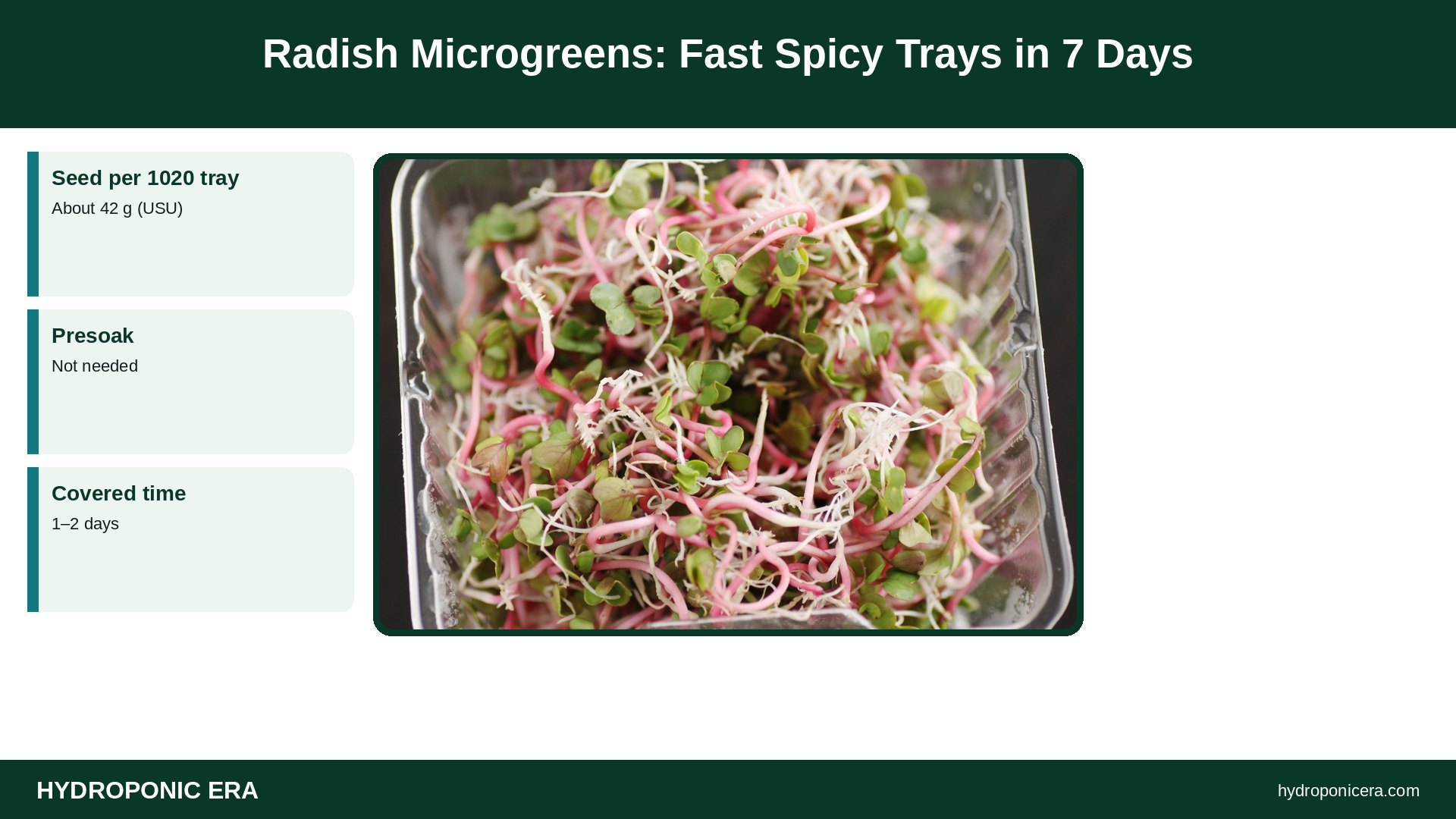
Radish microgreens are among the fastest and easiest microgreens: sow about 42 grams of seed on a moist 1020 tray (Utah State University Extension’s home rate), keep it covered for 1–2 days, then grow under light and harvest at 8–12 days, when the heart-shaped seed leaves are open. No soak is needed. They taste spicy and crisp, and colored varieties such as ‘Rambo’ (purple) and ‘Hong Vit’ (pink stems) make some of the prettiest trays you can grow.
Key takeaway: No soak, sow evenly, 1–2 days dark, strong light, and harvest before true leaves for the best flavor and texture.
| Step | Guideline |
|---|---|
| Seed per 1020 tray | About 42 g (USU) |
| Presoak | Not needed |
| Covered time | 1–2 days |
| Temperature | About 74°F to germinate, 68–72°F after |
| Light | Up to 18 hours a day |
| Harvest | 8–12 days |
| Flavor | Peppery, nutty, crisp |
Why Radish Microgreens Are a Great First Crop
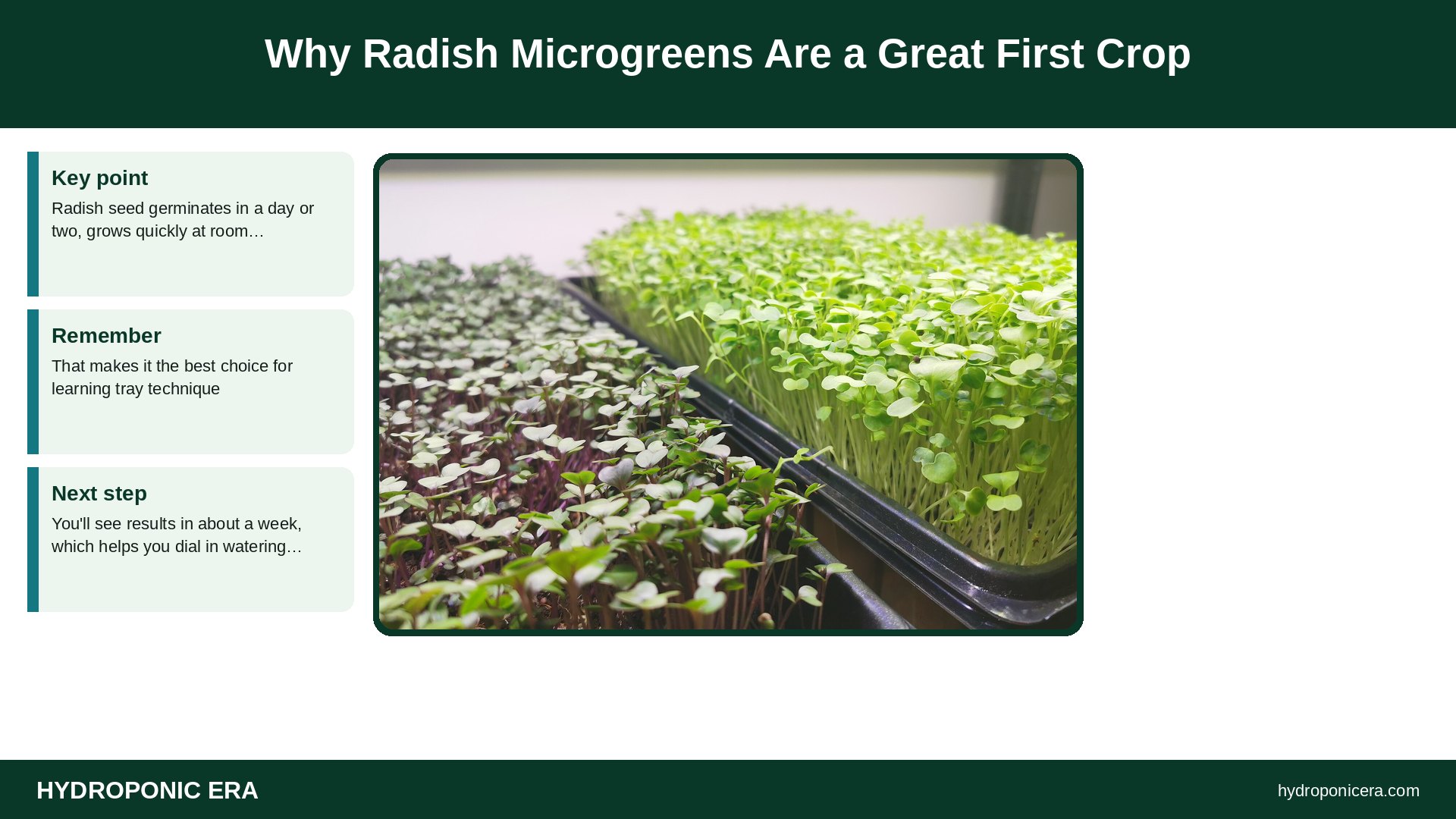
Radish seed germinates in a day or two, grows quickly at room temperature, and rarely fails. That makes it the best choice for learning tray technique. You’ll see results in about a week, which helps you dial in watering, light, and harvest timing before moving on to slower crops like basil.
Radish microgreens also sell well. Chefs use them for color and bite on tacos, sandwiches, sushi, and salads.
Best Radish Varieties
- ‘Champion’ or ‘Daikon’: green leaves, white stems, mild spice, very fast.
- ‘Rambo’ or purple radish: deep purple leaves and stems.
- ‘Hong Vit’ or ‘China Rose’: green leaves with bright pink stems.
- ‘Triton’: purple leaves with pink stems.
- Mixes: blends give a colorful tray.
Buy untreated seed sold for microgreens. Utah State lists both champion and purple radish at the same seeding rate.
How to Grow Radish Microgreens Step by Step
- Prepare the tray. Fill a 1020 tray with drainage holes with about 1 inch of moist coco coir or seed-starting mix, or lay a hemp or felt mat.
- Sow. Scatter seed evenly. Shake the tray gently to spread clumps.
- Mist. Mist seeds lightly to settle them.
- Cover and weight. Place another tray on top with 2–5 pounds of weight for about a day.
- Uncover. At 1–2 days, when seedlings lift the top tray, remove it.
- Grow under light. Water from below and keep a fan running.
- Harvest. Cut at 8–12 days.
See how to grow microgreens hydroponically for tray basics.
Light for Radish Microgreens
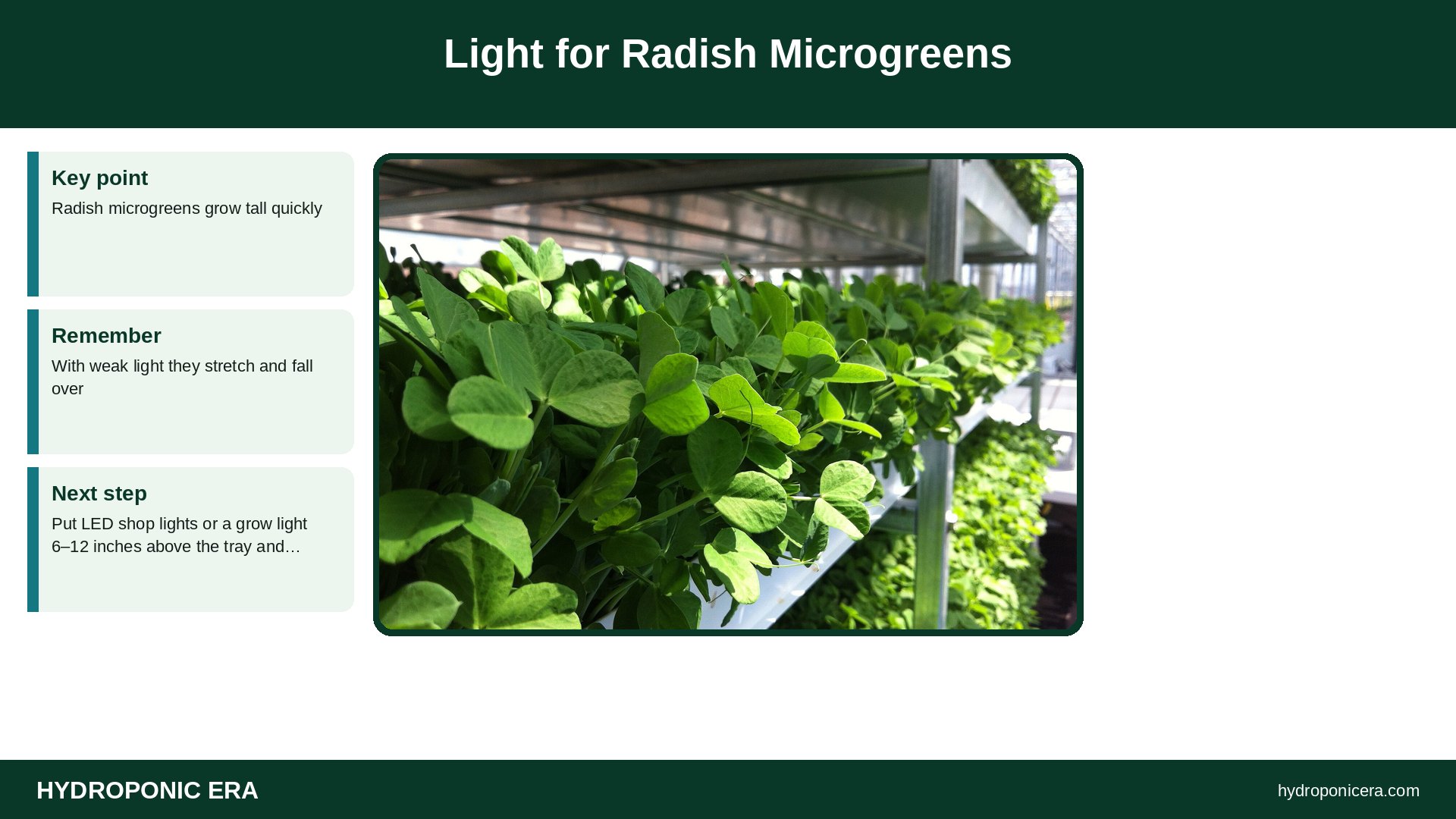
Radish microgreens grow tall quickly. With weak light they stretch and fall over. Put LED shop lights or a grow light 6–12 inches above the tray and run them up to 18 hours a day, as Utah State suggests. Purple and pink varieties color up best under strong light; in dim light they look greenish.
Watering Radish Microgreens
Water from below once the trays are uncovered. Set the growing tray in a solid tray with about 1/2 inch of water for a few minutes, then lift it out to drain. Overwatering is the main cause of mold and rot. The medium should feel like a wrung-out sponge. See sunflower microgreens for the same bottom-watering method on a larger seed.
Root Hairs vs Mold
Radish seedlings grow many fine, white root hairs on their roots, especially in the first few days. New growers often mistake them for mold. Root hairs are evenly spread around the roots and disappear when misted. Mold looks like a spider web across the seeds and medium, keeps its shape when misted, and often smells musty. See white fuzz on roots.
When to Harvest Radish Microgreens
Harvest when the seed leaves are fully open and before true leaves appear, usually at 8–12 days. At this stage stems are crisp and flavor is bright. Later, the greens get more fibrous and the spice can become harsh. Cut just above the medium with sharp scissors or a knife. Radish microgreens don’t regrow.
Do Radish Microgreens Need Nutrients?
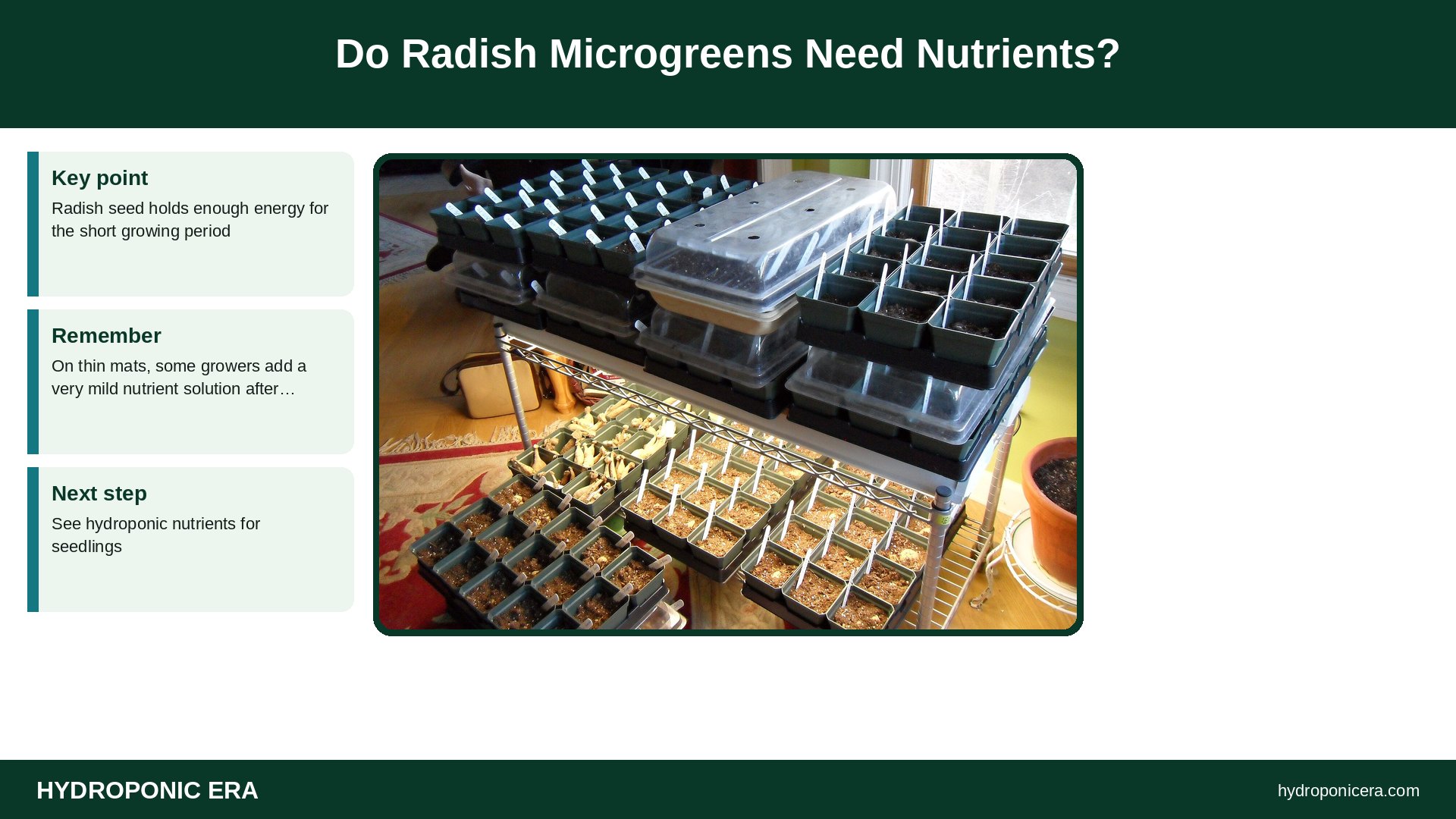
No. Radish seed holds enough energy for the short growing period. Plain water works fine. On thin mats, some growers add a very mild nutrient solution after day 4 for greener leaves. If you do, keep it weak. See hydroponic nutrients for seedlings.
Common Problems
- Leaning stems: the light is off to one side or too weak.
- Yellow leaves: the tray stayed covered too long or light is weak.
- Seed hulls stuck to leaves: brush them off or rinse after cutting.
- Mold patches: too much water, too dense, or no airflow.
- Bitter or harsh flavor: harvested too late.
Storage and Shelf Life
Cut radish microgreens dry, cool them quickly, and store them in a sealed container with a paper towel at 35–40°F. They keep about 5–10 days. The University of Maryland suggests rinsing, patting dry, and refrigerating, and notes trays can be washed and reused. See hydroponic food safety.
Seeding Density and Yield
Too thin and you’ll get a sparse tray; too thick and mold risk climbs. Start at the USU rate of about 42 grams per 1020 tray and adjust by a few grams per tray until you like the density. A good tray yields roughly 6–10 ounces. USU estimated seed cost at under a dollar per tray for champion radish in early 2026.
Growing Radish Microgreens Year-Round
Radishes grow in any season indoors. In summer, warm rooms speed growth by a day or two but increase mold risk, so increase airflow. In winter, a cool room slows them slightly. Sow a new tray every 3–4 days for a continuous supply. See continuous harvest planning.
Using Radish Microgreens in the Kitchen
Radish microgreens add crunch and a peppery kick to tacos, avocado toast, ramen, sushi rolls, and grain bowls. Purple and pink varieties make simple dishes look restaurant-ready. Because heat dulls their bite and wilts them, add them just before serving. Mix them with milder microgreens such as broccoli or pea for a balanced salad.
If you want a milder flavor, harvest a day or two earlier. If you want more spice, let them grow until the first true leaf just begins to show.
FAQs
How long do radish microgreens take?
About 8–12 days.
Should I soak radish seeds?
No, it isn’t needed.
How much seed per tray?
About 42 grams for a 1020 tray.
Are radish microgreens spicy?
Yes, with a peppery bite like a radish.
Do radish microgreens regrow?
No. Sow a new tray.
Is the white fuzz mold?
Usually it’s root hairs; mist to check.
Sources
- Utah State University Extension — Grow Your Own Microgreens
- University of Maryland Extension — Growing Microgreens and Baby Greens Indoors
- University of Illinois Extension — Growing Microgreens
- Photo credits (Wikimedia Commons, edited with titles): 11 microgreens by Stacy Spensley (CC BY 2.0); Mikrolistki – brokuł i rzodkiewka na tacach plastikowych by Teogenesis (CC BY-SA 4.0); Lufa Farms Microgreens in Trays by Lufa Farms (CC BY-SA 2.0); Lufa Farms Microgreens in Trays by Lufa Farms (CC BY-SA 2.0); Dahlias started indoors by F. D. Richards from Clinton, MI (CC BY-SA 2.0)