
Is Limnophila sessiliflora legal to grow in the US? Generally no, not without permits. Limnophila sessiliflora (ambulia or Asian marshweed) is on the US Federal Noxious Weed list in 7 CFR 360.200. Florida lists it as a Class II prohibited aquatic plant, and UF/IFAS says it is invasive in Texas, Georgia and Florida. US aquarists should choose a legal, non-invasive stem plant instead.
Key takeaway: Limnophila sessiliflora is an easy, fast, feathery stem plant from Asia that Tropica once sold as “Ambulia.” In the US it is a Federal Noxious Weed, so moving it between states needs federal permits, and Florida bans its sale. UF/IFAS warns it regrows from fragments and forms dense stands. US hobbyists should pick a legal alternative such as native hornwort.
| Fact | What sources report | Source |
|---|---|---|
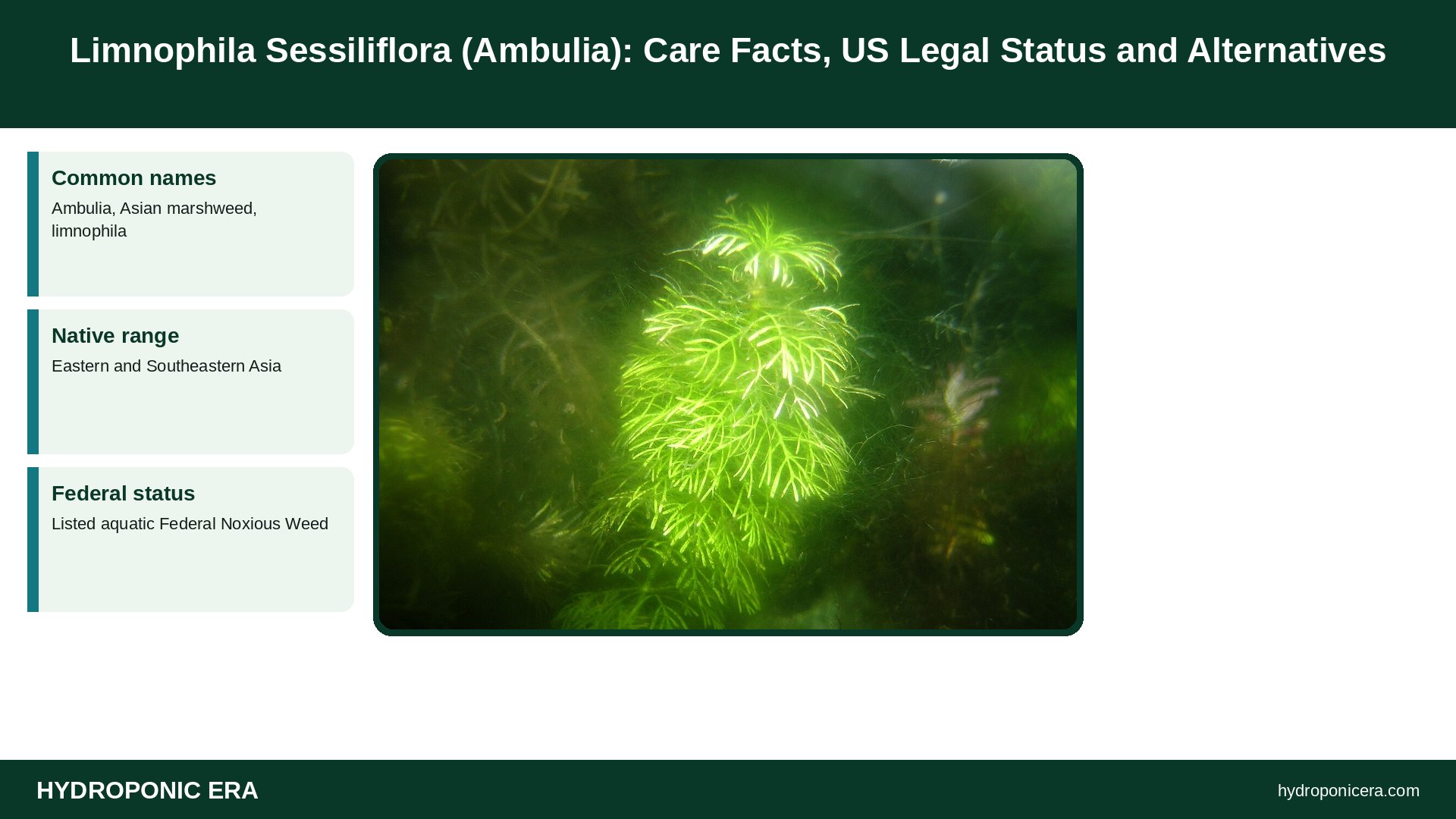
| Common names | Ambulia, Asian marshweed, limnophila | Tropica, UF/IFAS |
| Native range | Eastern and Southeastern Asia | UF/IFAS, Tropica |
| Federal status | Listed aquatic Federal Noxious Weed | 7 CFR 360.200 |
| Florida status | Class II prohibited; sale and distribution banned | FDACS |
| Invasive in | Texas, Georgia and Florida; regulated in 5 states | UF/IFAS |
| Wild growth | Stems to 12 ft (3.7 m); regrows from fragments | UF/IFAS |
| Aquarium traits | Low light, low CO2, fast; up to 16 in (40 cm) | Tropica |
What Is Limnophila Sessiliflora?
Limnophila sessiliflora is a submerged to emergent aquatic herb with whorls of finely divided, feathery leaves. UF/IFAS says it is native to Eastern and Southeastern Asia. Tropica describes it as a pretty, undemanding plant from Southeast Asia that used to be called “Ambulia,” with stems that grow fast up to 16 in (40 cm) tall in a tank.
In the wild, UF/IFAS reports stems up to 12 feet (3.7 m) long, small blue to violet flowers above the water and capsules that can hold up to 300 seeds. It looks a lot like Cabomba, and Tropica even calls it a good alternative to Cabomba because it needs less light.
- Look: bright green, feathery whorls on soft stems.
- Growth: fast, with runners across the bottom in good conditions.
- Problem: the same vigor makes it invasive outdoors.
Is Limnophila Sessiliflora Legal in the United States?
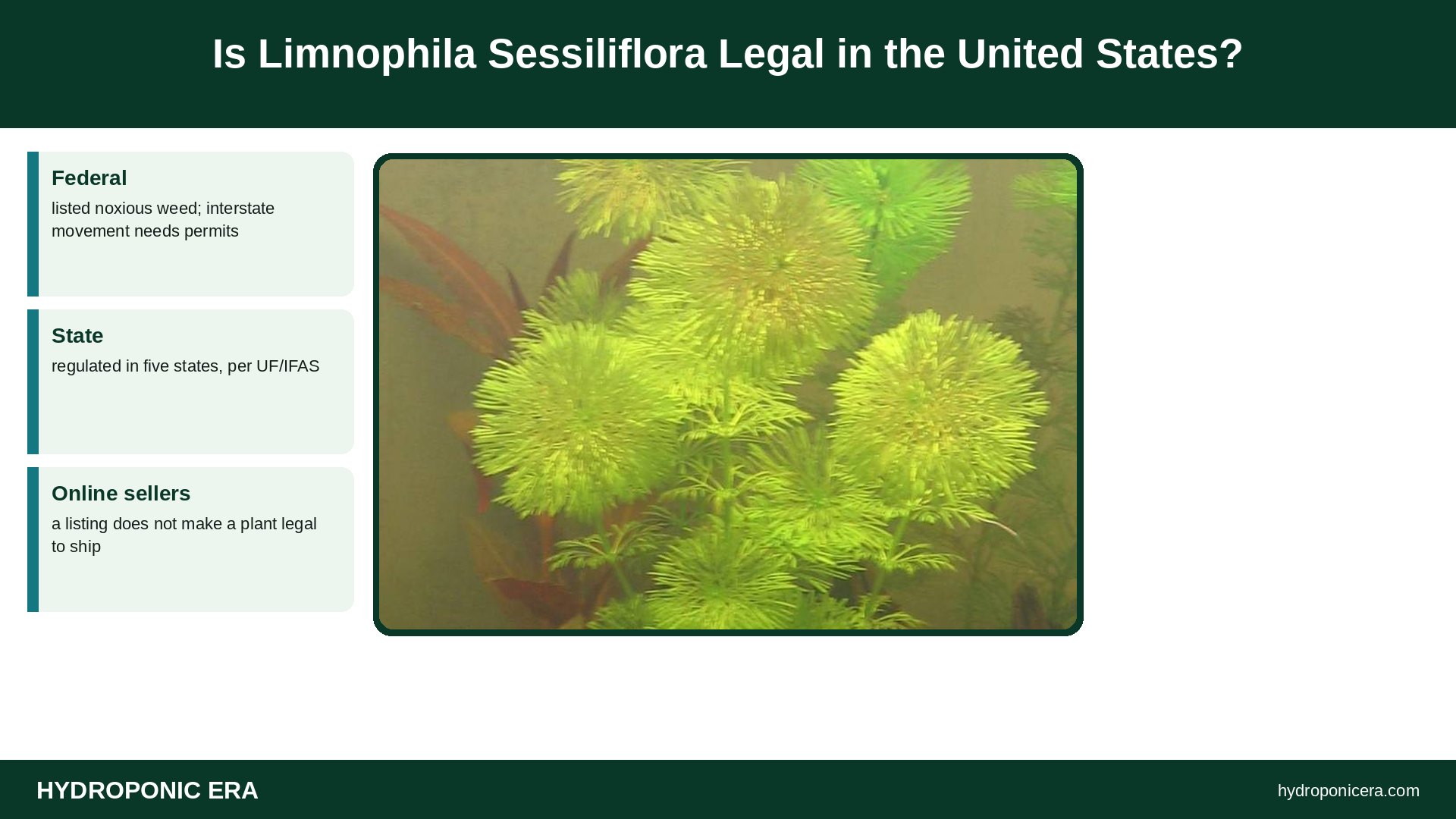
It is federally regulated. The list of aquatic Federal Noxious Weeds in 7 CFR 360.200 includes Limnophila sessiliflora (ambulia). FDACS notes that, because ambulia is on the Federal Noxious Weed List, federal permits for interstate movement may be required. Buying it from another state or shipping cuttings to friends can break federal rules.
UF/IFAS adds that besides the federal listing, it is regulated in five states, including Florida. Rules change, so check with your state department of agriculture and the USDA APHIS permit staff before keeping any listed plant.
- Federal: listed noxious weed; interstate movement needs permits.
- State: regulated in five states, per UF/IFAS.
- Online sellers: a listing does not make a plant legal to ship.
What Are Florida’s Rules on Limnophila Sessiliflora?
Florida is strict. FDACS lists ambulia as a Class II prohibited aquatic plant under Rule 5B-64 of the Florida Administrative Code. Anyone who transports, cultivates, collects or possesses it needs a permit, it may be grown only as registered nursery stock for export out of state, and selling or distributing it in Florida is prohibited.
Florida also lists water lettuce and hygro (Hygrophila polysperma) as Class II plants. If you live in Florida, check the state list before buying any aquarium plant.
Why Is Limnophila Sessiliflora Invasive?
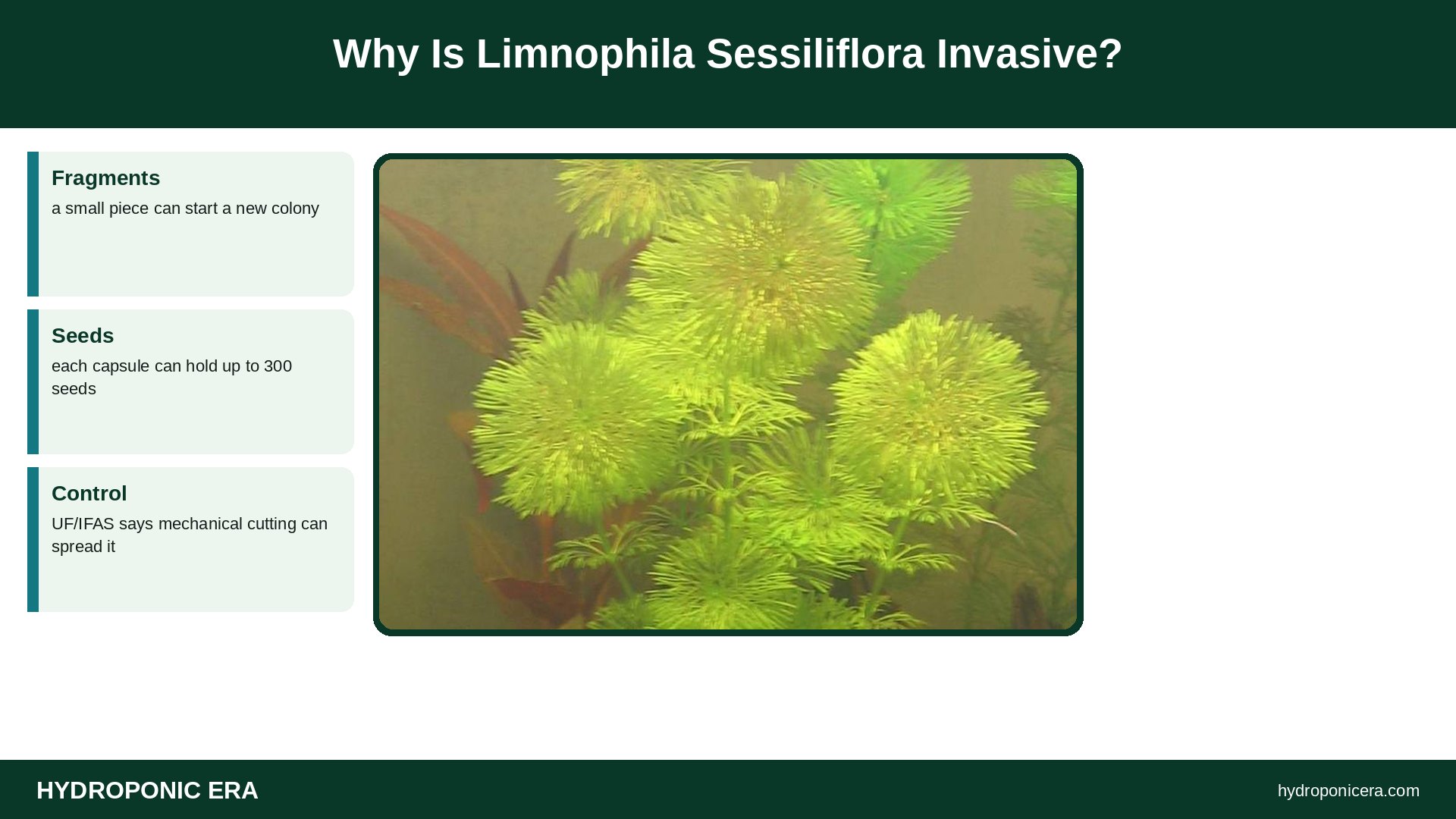
It spreads fast and regrows from fragments. UF/IFAS says high seed germination and regrowth from pieces let it form dense stands from the bottom to the top of the water column. Infestations can outcompete native plants, reduce oxygen and cause fish kills, and clog irrigation and flood-control canals. It is also a major weed in rice fields in Asia.
UF/IFAS says it was first recorded in Florida in Hillsborough County in 1961 and likely escaped cultivation; it has been documented in the aquarium trade. Boats, trailers and livewells carrying fragments are the main way it reaches new lakes.
- Fragments: a small piece can start a new colony.
- Seeds: each capsule can hold up to 300 seeds.
- Control: UF/IFAS says mechanical cutting can spread it.
How Does Limnophila Sessiliflora Grow in an Aquarium?
Where it is legally held, it is an easy plant. Tropica rates it low for both light and CO2 and says stems grow 1 to 1.5 in (3 to 4 cm) wide. It often grows leggy in poor light, which CO2 can partly correct, and in good conditions it sends out runners across the bottom. Tropica says it looks best planted in groups.
These traits are why it was a beginner favorite and why it spreads so easily if dumped. This article does not recommend buying it in the US; the details are here so you can identify it.
What Are Legal Alternatives to Limnophila Sessiliflora?
Choose a plant that is legal in your state and not invasive locally. Hornwort, also called coontail (Ceratophyllum demersum), is a good feathery option; UF/IFAS lists it as native to Florida. It floats or can be planted, grows quickly and needs little light. Our guides to hornwort and anacharis cover care, but check state rules for anacharis, which is regulated in some areas.
- Hornwort: native feathery stems, low light, no CO2.
- Other stem plants: check your state list for Rotala, Ludwigia and others before buying.
- Floaters: see floating plants for aquariums.
How Should You Dispose of Limnophila Sessiliflora?
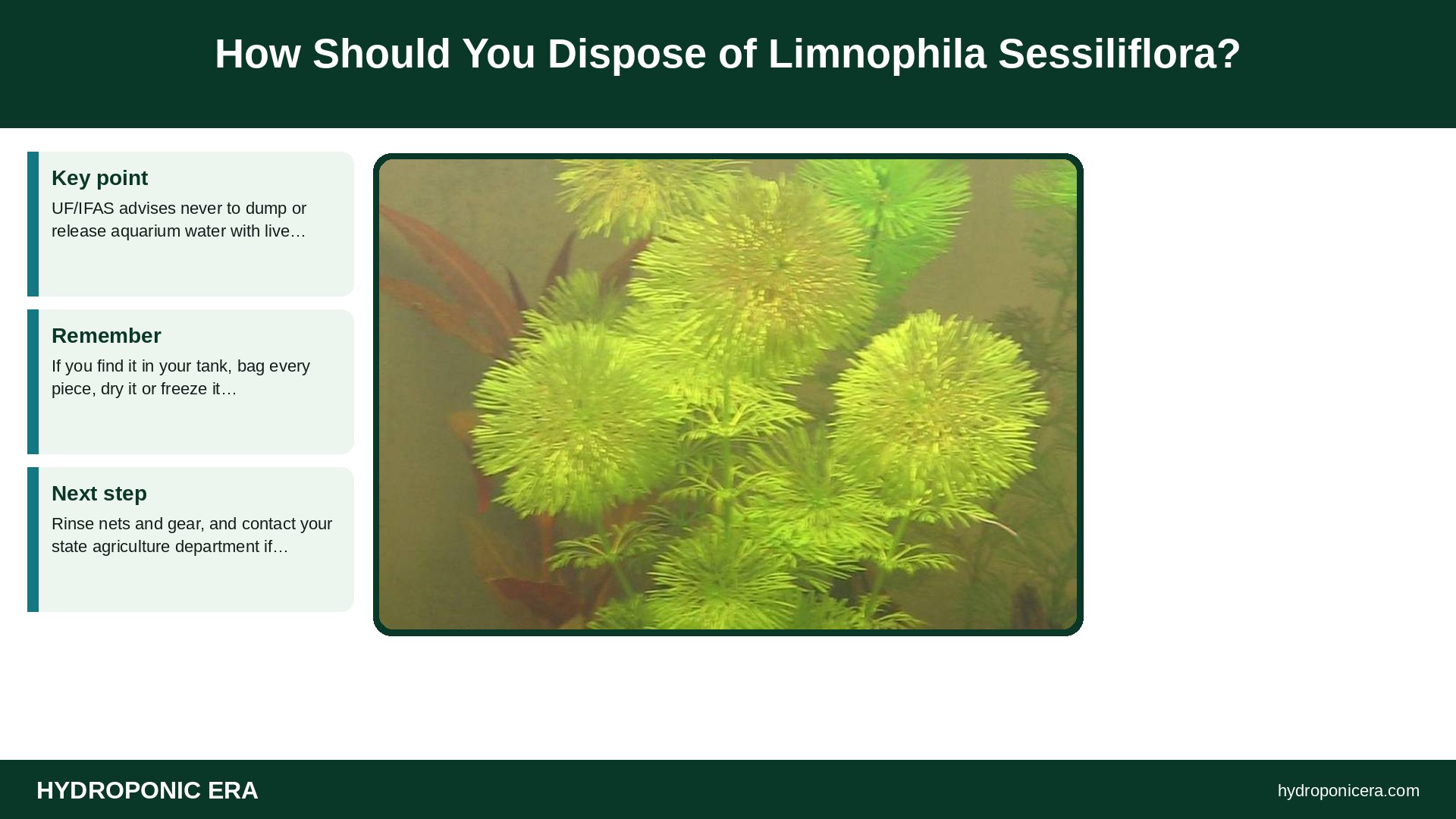
Never release it. UF/IFAS advises never to dump or release aquarium water with live plant material into waterways. If you find it in your tank, bag every piece, dry it or freeze it, then put it in the trash, not the compost. Rinse nets and gear, and contact your state agriculture department if you have questions.
- Remove all stems and runners from the tank.
- Seal them in a plastic bag.
- Dry or freeze the bag for several days.
- Dispose of it in household trash.
FAQ About Limnophila Sessiliflora
Is ambulia illegal in the US?
It is a Federal Noxious Weed; interstate movement needs permits.
Can you sell ambulia in Florida?
No; FDACS prohibits sale and distribution in Florida.
Is Limnophila sessiliflora the same as Cabomba?
No; it looks similar but is a different plant.
What is a legal alternative?
Native hornwort (coontail) is a common choice.
Why is it invasive?
It regrows from fragments and forms dense stands.
Where is it native?
Eastern and Southeastern Asia, per UF/IFAS.
Sources
- eCFR — 7 CFR 360.200 Designation of noxious weeds
- University of Florida IFAS, Center for Aquatic and Invasive Plants — Limnophila sessiliflora
- Florida Department of Agriculture and Consumer Services — Class II Aquatic Plant Permits
- Tropica Aquarium Plants — Limnophila sessiliflora plant info/18812)
- University of Florida IFAS — Ceratophyllum demersum (coontail)
- Photo credits (Wikimedia Commons, edited with titles): -Limnophila sessiliflora- from Japan by S.Tanaka (Public domain); Limnophila sessiliflora by kajuko (CC BY-SA 3.0)