
What are the best floating plants for aquarium beginners? The best floating plants for aquarium beginners are Amazon frogbit, salvinia, red root floater, water sprite, Riccia, duckweed and water lettuce. Tropica rates frogbit, salvinia and red root floater as low-light plants that need little CO2. Floating plants shade algae, take up nutrients and give fry and surface fish cover.
Key takeaway: Pick floating plants for aquarium use by tank size and lid. Small rosettes like salvinia and red root floater suit most tanks, while frogbit and water lettuce need room above the water. Thin them weekly so at least part of the surface stays open for light and gas exchange, and never release them outdoors.
| Plant | Light | Best feature | Source |
|---|---|---|---|
| Amazon frogbit (Limnobium laevigatum) | Good light | Long roots shelter surface fish | Tropica |
| Salvinia (Salvinia minima) | Low | 1–3 cm floating fern; shades algae | Tropica |
| Red root floater (Phyllanthus fluitans) | Low | Leaves color up in strong light | Tropica |
| Water sprite (Ceratopteris thalictroides) | Medium | Very fast; bubble-nest cover | Flowgrow, Tropica |
| Riccia (Riccia fluitans) | Medium | Floating liverwort; fry cover | Tropica |
| Duckweed (Lemna) | Low to medium | Fast cover; hard to remove | Our guide |
| Water lettuce (Pistia) | High | Large rosettes for big tanks | Our guide |
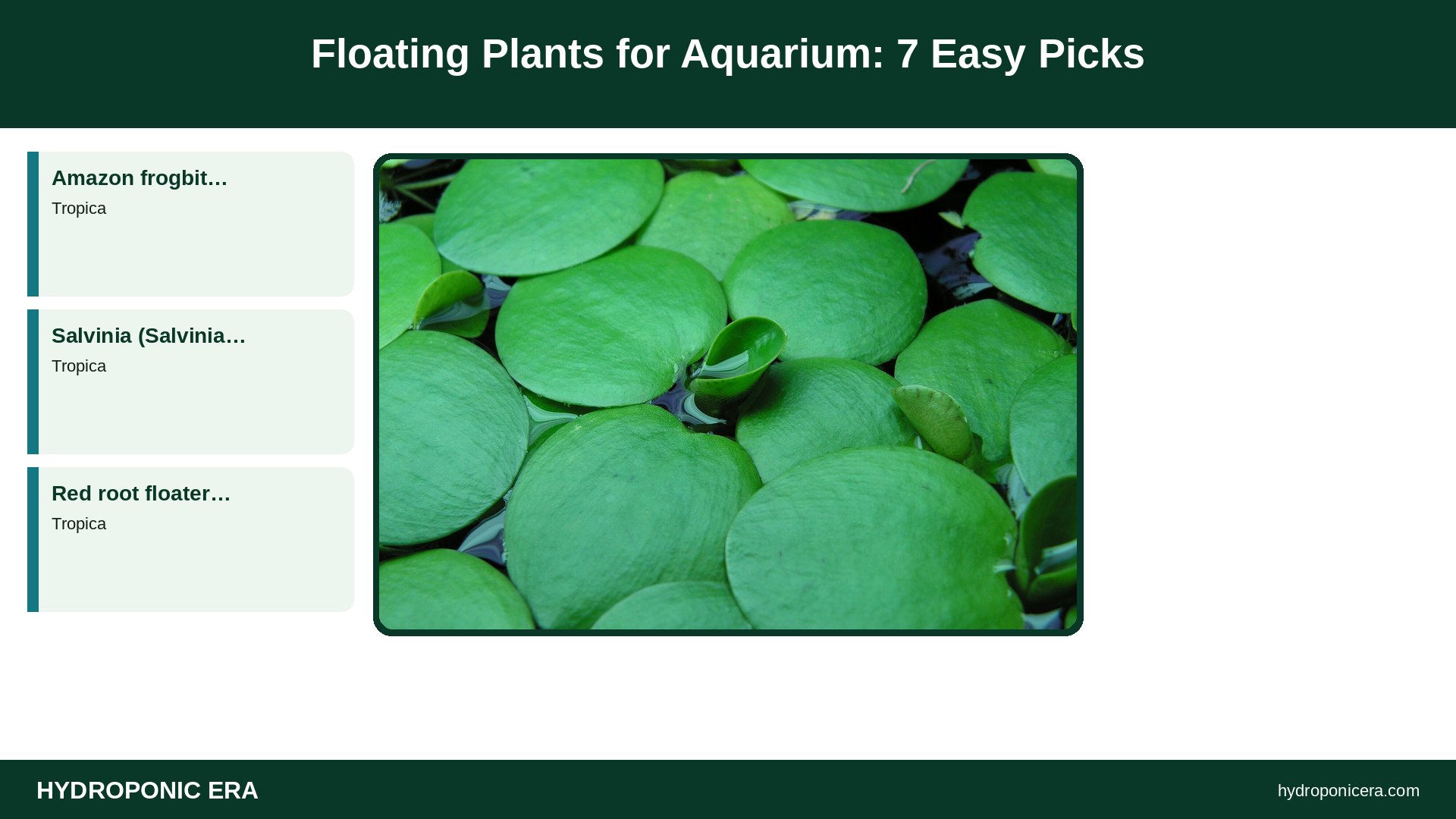
Why Add Floating Plants for Aquarium Tanks?
Floating plants for aquarium setups help by shading the water, using up nutrients and giving fish cover. Tropica says Salvinia minima helps prevent algae by shading parts of the aquarium, and water sprite helps prevent algae by consuming large amounts of nutrients. Frogbit roots shelter gouramis and other surface fish, and Riccia gives young fish good protection.
Floating plants for aquarium tanks also take nutrients straight from the water, so they show quickly when food runs short. Tropica notes frogbit grows much slower when nutrient levels drop, making it a good nutrient indicator. Pale salvinia leaves, it adds, signal a shortage of micronutrients.
Which Floating Plants for Aquarium Beginners Are Easiest?
Salvinia, red root floater and Amazon frogbit are among the easiest floating plants for aquarium beginners. Tropica lists salvinia and red root floater with low light and low CO2 demand, and frogbit as a medium grower that is ideal for open tanks. Water sprite is also simple, though Tropica notes CO2 may be needed to speed growth.
- Amazon frogbit: plants 2–6 in (5–15 cm) wide with long, fine roots. See our frogbit guide.
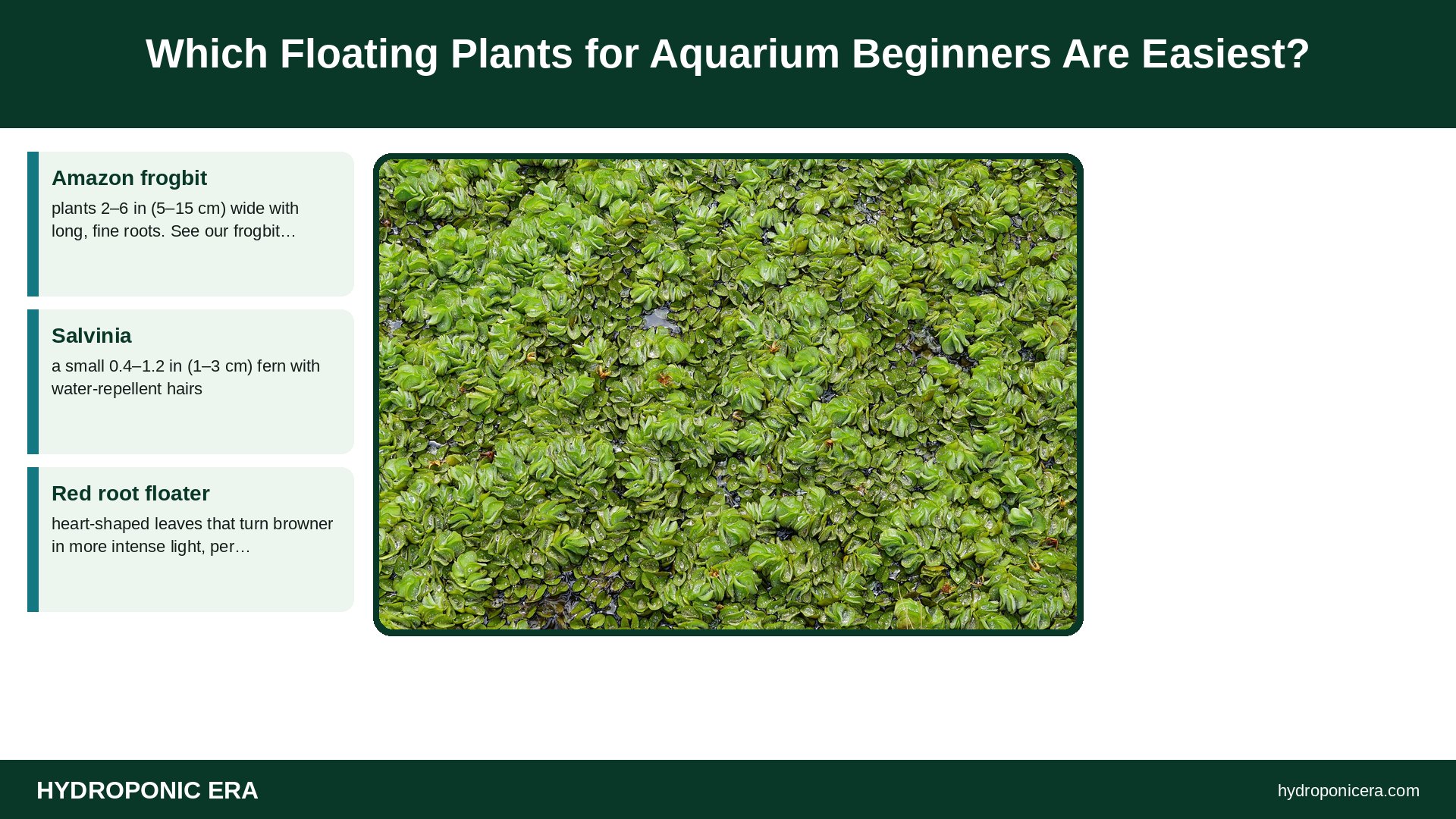
- Salvinia: a small 0.4–1.2 in (1–3 cm) fern with water-repellent hairs.
- Red root floater: heart-shaped leaves that turn browner in more intense light, per Tropica.
- Water sprite: Flowgrow says it is usually grown free-floating and labyrinth fish use it for bubble nests.
- Riccia: a liverwort that floats or can be tied to stone, though new shoots grow toward the surface.
- Duckweed: tiny and quick to spread; read our duckweed growing guide before adding it.
- Water lettuce: large rosettes better for big tanks or ponds; see our water lettuce guide.
Do Floating Plants for Aquarium Use Help With Nitrate?
Yes. Floating plants for aquarium tanks draw nutrients, including nitrogen, directly from the water, and Tropica describes water sprite as consuming large amounts of nutrients. Floating plants for aquarium nitrate control work best when they grow steadily, so keep light and fertilizer consistent. Remove extra growth regularly so the nutrients leave the tank with it.
In an aquarium aquaponics setup, they work alongside the plants growing on top of the tank.
How Do You Care for Floating Plants for Aquarium Tanks?
Care for floating plants for aquarium tanks by giving them light, a calm surface and regular thinning. Tropica notes frogbit makes new leaves above the water when light and nutrients are good, and may need thinning so plants below still get light. Strong filter outflow can push floaters underwater or into corners, so baffle the current if needed.
- Float new plants on a calm part of the surface.
- Keep the lid slightly raised or open so leaves are not scorched or soaked by condensation.
- Dose a liquid fertilizer if leaves turn pale.
- Remove extra plants every week or two.
- Leave at least part of the surface open.
For light choices, see our aquarium grow light guide.

Are Floating Aquarium Plants Invasive?
Some floating plants for aquarium use are invasive outdoors, so never release them. USGS lists Salvinia minima as established outside its native range in several US states, and notes its trade in water gardens and aquariums. Its relative giant salvinia (Salvinia molesta) is listed by the USDA as a noxious weed. Dispose of extra plants in the trash or compost, not waterways.
What are the easiest floating plants for aquarium tanks?
Salvinia and red root floater are among the easiest, with low light and low CO2 demand, per Tropica.
Do floating plants need special light?
Most do well under normal aquarium lighting. Tropica rates salvinia, red root floater and frogbit as low to medium light plants.
Why are my floating plants melting?
Common causes are wet leaves from condensation, strong current or low nutrients. Tropica says pale salvinia leaves suggest a micronutrient shortage.
Do floating plants reduce algae?
They can. Tropica says salvinia shades parts of the aquarium and water sprite consumes large amounts of nutrients.
How much of the surface should floating plants cover?
Leave part of the surface open so light reaches plants below, as Tropica advises when thinning frogbit.
Sources
- Tropica Aquarium Plants. Limnobium laevigatum/4761).
- Tropica Aquarium Plants. Salvinia minima/4767).
- Tropica Aquarium Plants. Phyllanthus fluitans/22848).
- Tropica Aquarium Plants. Riccia fluitans/4386).
- Flowgrow. Ceratopteris thalictroides.
- U.S. Geological Survey. Salvinia minima (water spangles).
- Photo credits (Wikimedia Commons, edited with titles): Limnobium laevigatum by Cardex (Public domain); Salvinia molesta 00904 by Vengolis (CC BY-SA 4.0); Phyllanthus fluitans 2010-06-20 01 by Agnieszka Kwiecień, Nova (CC BY-SA 4.0); Ceratopteris thalictroides by Show_ryu (CC BY-SA 3.0)