
Can you grow feverfew hydroponically? Yes. Feverfew hydroponics has been tested by researchers: a 2023 Horticulturae review notes that Dorais and colleagues grew feverfew in a floating raft system and harvested marketable raw material within four months. A University of Windsor thesis also studied hydroponic feverfew nutrition. Grow it in full sun or strong LED light with moderate nitrogen.
Key takeaway: Feverfew hydroponics is a good fit for an herb grower who wants a tidy, daisy-flowered medicinal plant indoors. Feverfew (*Tanacetum parthenium*) is a compact perennial, 1 to 3 ft (30 to 90 cm) tall, and research shows it grows in floating rafts. The main question is how nitrogen affects leaf yield and parthenolide.
| Factor | Feverfew Detail | Source |
|---|---|---|
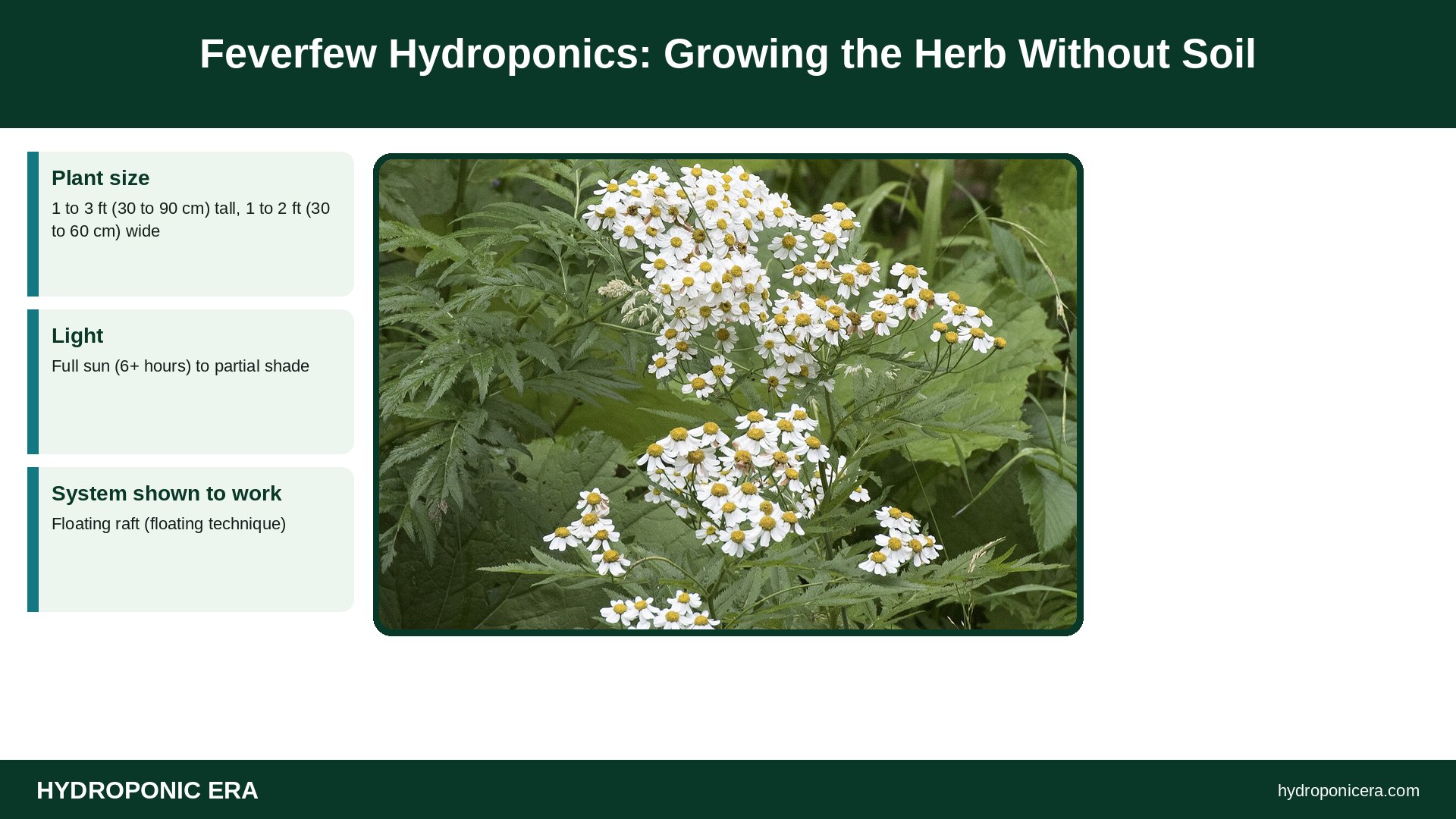
| Plant size | 1 to 3 ft (30 to 90 cm) tall, 1 to 2 ft (30 to 60 cm) wide | NC State Extension |
| Light | Full sun (6+ hours) to partial shade | NC State Extension |
| System shown to work | Floating raft (floating technique) | Horticulturae review, 2023 |
| Time to marketable harvest | Within four months in a floating system | Horticulturae review, 2023 |
| Nitrogen effect | More N raises biomass but lowers parthenolide concentration | Jakob et al., 2007 |
| Salt tolerance | Growth fell above 1 g NaCl per plant | Jakob et al., 2007 |
| Starting pH and EC | pH 5.8 to 6.5, EC 1.2 to 1.8 mS/cm | Our guidance |
Can You Grow Feverfew Hydroponically?
Yes. The Atherton and Li review in *Horticulturae* lists feverfew among medicinal flowers raised in a floating system by Dorais and colleagues in Canada, with marketable raw material harvested within four months. A University of Windsor thesis by Dana Simeunovic tested nutrient solutions and nitrogen levels for hydroponic feverfew in a greenhouse. That makes feverfew hydroponics a researched option.
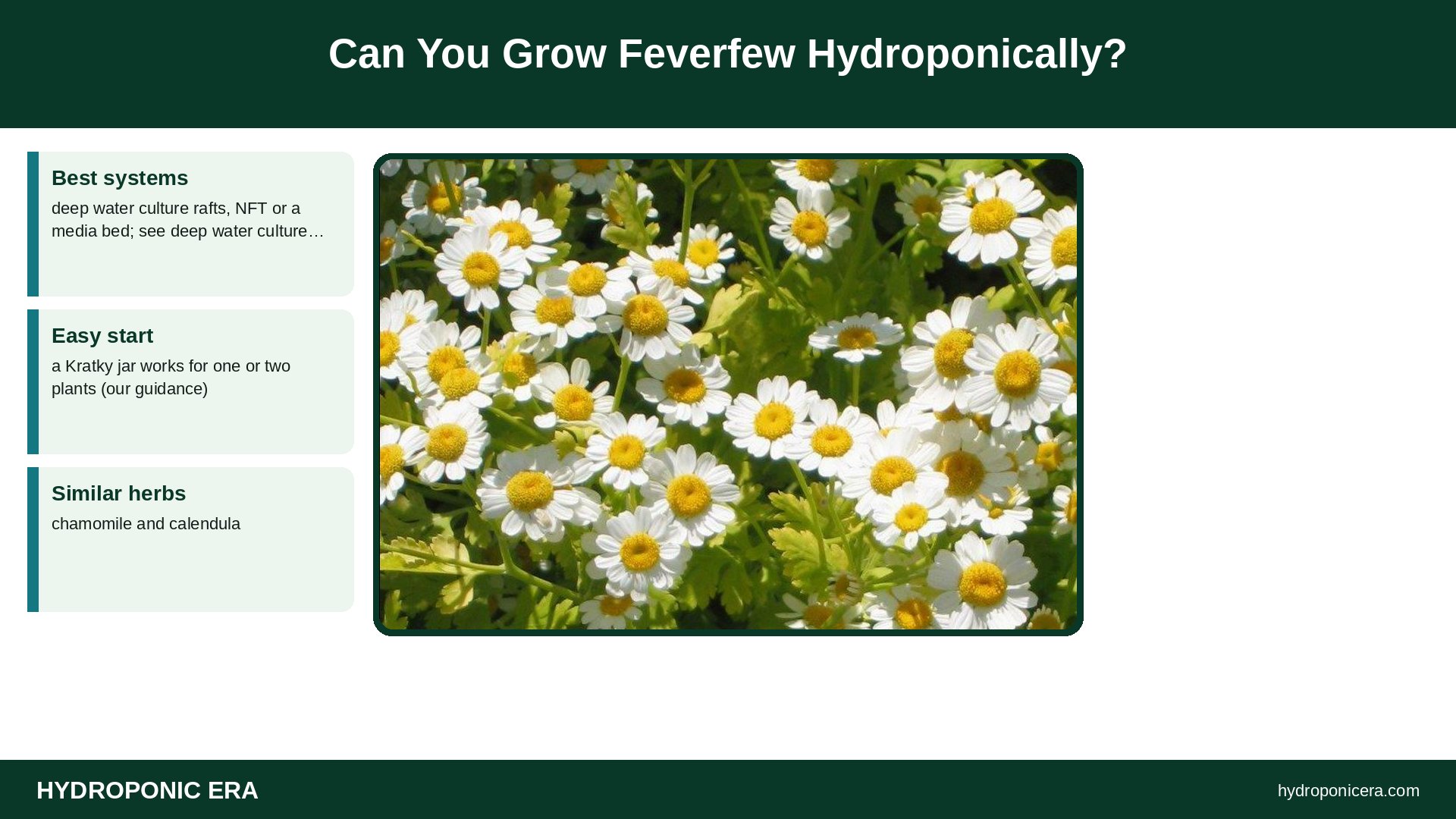
- Best systems: deep water culture rafts, NFT or a media bed; see deep water culture for beginners.
- Easy start: a Kratky jar works for one or two plants (our guidance).
- Similar herbs: chamomile and calendula.
What pH, EC and Temperature Does Hydroponic Feverfew Need?
No published study gives a single feverfew hydroponics recipe, so start with standard herb targets: pH 5.8 to 6.5 and EC 1.2 to 1.8 mS/cm (our guidance). NC State says feverfew tolerates acid to alkaline soils, so pH is forgiving. Keep air at 60 to 75°F (16 to 24°C); NC State notes it dislikes hot, humid southern summers.
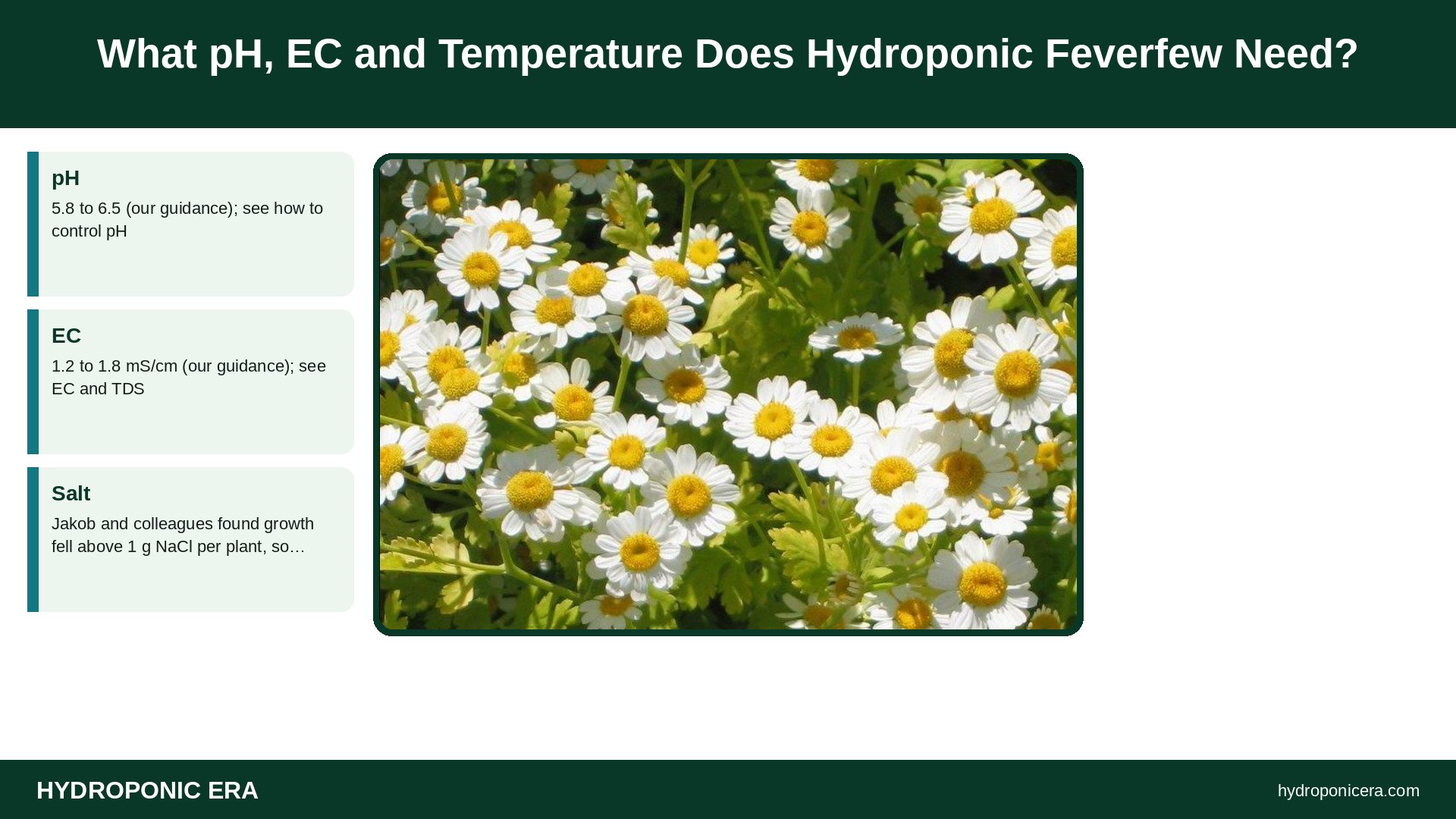
- pH: 5.8 to 6.5 (our guidance); see how to control pH.
- EC: 1.2 to 1.8 mS/cm (our guidance); see EC and TDS.
- Salt: Jakob and colleagues found growth fell above 1 g NaCl per plant, so avoid softened water.
- Potassium: biomass rose to an optimum of 2.5 g K per plant in their pot trial, then fell.
Feverfew hydroponics rewards steady, moderate feeding more than strong nutrient solution.
How Does Nitrogen in Feverfew Hydroponics Affect Parthenolide?
In German trials by Jakob, Bramm and Rühl, more nitrogen and water increased total biomass, mostly stems and flowers, while leaf mass did not rise further. Parthenolide is made only in leaves and flowers, not stems. Its concentration tended to fall at high nitrogen, but parthenolide yield per plant still rose because the plants were bigger.
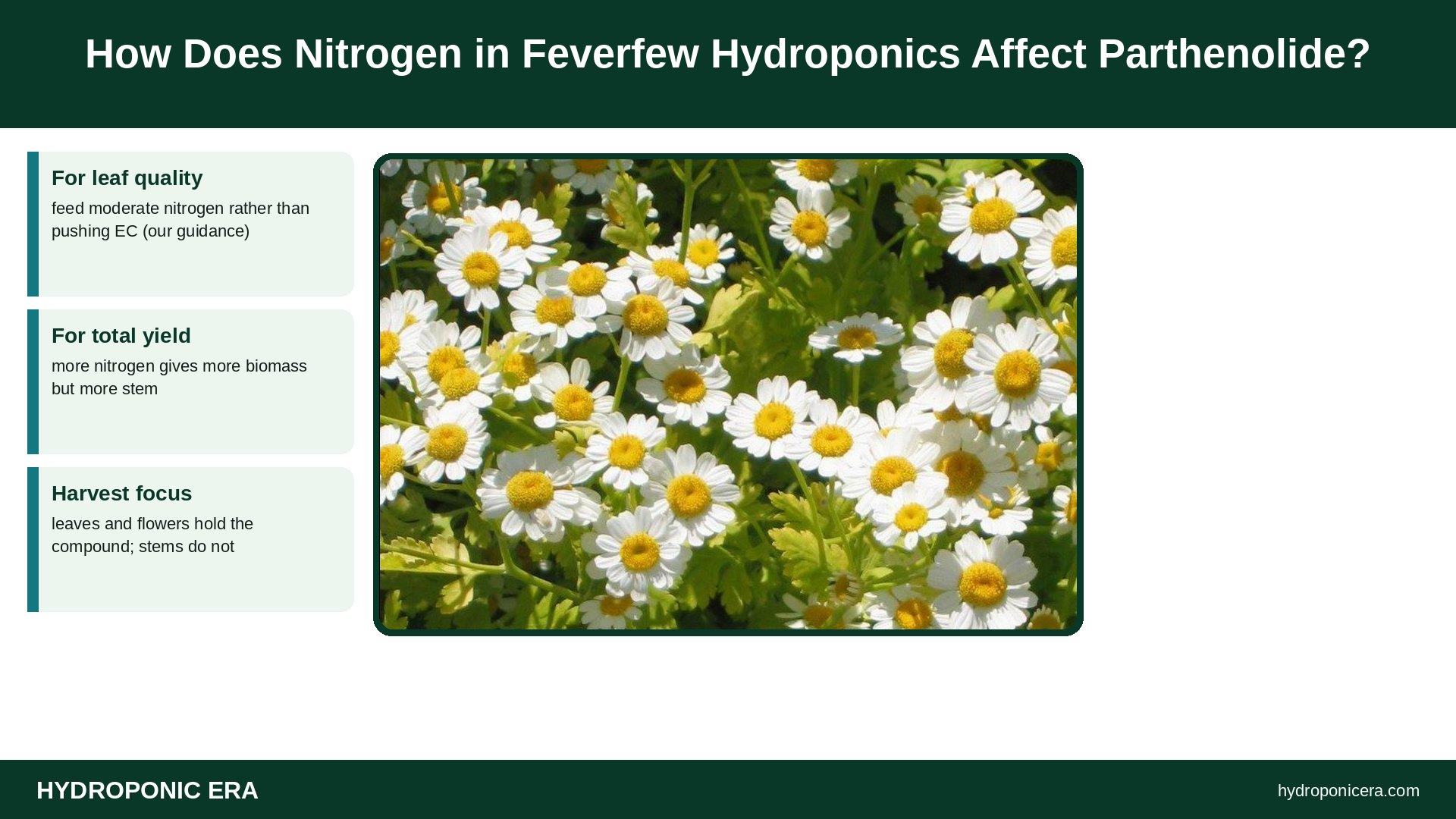
- For leaf quality: feed moderate nitrogen rather than pushing EC (our guidance).
- For total yield: more nitrogen gives more biomass but more stem.
- Harvest focus: leaves and flowers hold the compound; stems do not.
The Windsor thesis also tested nitrogen as a tool to manage leaf production and secondary compounds in feverfew hydroponics, plus leaf and flower-bud removal.
How Long Does Hydroponic Feverfew Take to Harvest or Bloom?
Expect a first leaf harvest in about 8 to 10 weeks from seed (our guidance) and a marketable crop within four months, as the Dorais floating-system work reported. NC State says feverfew blooms from June to September outdoors. In feverfew hydroponics under long days, flowering often starts sooner (our guidance); cut flowers to keep plants leafy.
- Sow the tiny seeds (1 to 2 mm, per NC State) on rockwool or plugs; see hydroponic germination methods.
- Move seedlings to the system once roots show.
- Harvest outer leaves regularly once plants are 6 to 8 in (15 to 20 cm) tall (our guidance).
- Deadhead spent blooms, as NC State advises, to stop self-seeding.
Which System Works Best for Feverfew Hydroponics?
Floating rafts have the clearest record for feverfew hydroponics, since that is the system the Dorais group used for marketable harvests. The 2023 review adds that floating systems suit fast crops but carry more disease risk over long runs, because the solution is not circulated or sterilized. Aerate well and replace solution regularly.
- Raft or DWC: proven for feverfew; add an air pump and air stone.
- NFT: fine for leaf harvests (our guidance).
- Media bed: gives support once plants reach 2 to 3 ft (60 to 90 cm).
What Problems Affect Feverfew in Hydroponics?
Feverfew hydroponics has few problems. NC State reports no serious diseases or pests but advises watching for spider mites. It lists feverfew as low-severity poisonous: the toxic principle is parthenin, and it can cause contact dermatitis. It is also flagged as a problem for dogs, cats and horses. Wear gloves when trimming and keep plants away from pets.
- Spider mites: see spider mites in hydroponics.
- Heat stress: NC State says it is intolerant of hot, humid climates.
- Skin rash: wear gloves when trimming.
- Medicinal use: talk to a healthcare provider before using feverfew as a remedy.
FAQ About Feverfew Hydroponics
Does feverfew grow well in hydroponics?
Yes; a floating system produced marketable material within four months.
What pH does feverfew need hydroponically?
Start at pH 5.8 to 6.5; NC State says it tolerates a wide soil pH range.
Does more fertilizer make feverfew stronger?
No; high nitrogen lowered parthenolide concentration in trials, though yield rose.
Can I grow feverfew from seed in hydroponics?
Yes; NC State lists seed and division for propagation.
Is feverfew safe for pets?
NC State flags it as a problem for dogs, cats and horses.
Which part of feverfew has parthenolide?
Leaves and flowers, not stems.
Sources
- Horticulturae (MDPI), Atherton and Li, 2023 — Hydroponic Cultivation of Medicinal Plants: Plant Organs and Hydroponic Systems
- University of Windsor, Simeunovic, 2002 — Cultivation of Medicinal Plants in Greenhouse Hydroponics
- Landbauforschung Völkenrode, Jakob, Bramm and Rühl, 2007 — Water and Nutrient Requirement of Tanacetum parthenium
- North Carolina Extension Gardener Plant Toolbox — Tanacetum parthenium (Feverfew)
- Photo credits (Wikimedia Commons, edited with titles): Tanacetum parthenium – Feverfew 01 by Zeynel Cebeci (CC BY-SA 4.0); Feverfew by Unknown (CC BY 2.5)