
Can you grow pineapple sage hydroponically? Yes. Pineapple sage hydroponics works well because the plant is fast growing and roots easily. UW-Madison Extension says its tip cuttings root in water without rooting hormone. It is a short-day plant, so under long grow-light days it stays leafy and will not bloom until nights lengthen.
Key takeaway: Pineapple sage hydroponics gives you fruity, edible leaves year-round. *Salvia elegans* is a tender perennial from Mexico and Guatemala that grows fast and roots easily from cuttings. Because it flowers only when days get short, your grow-light schedule decides whether you get leaves or scarlet blooms.
| Factor | Target | Source |
|---|---|---|
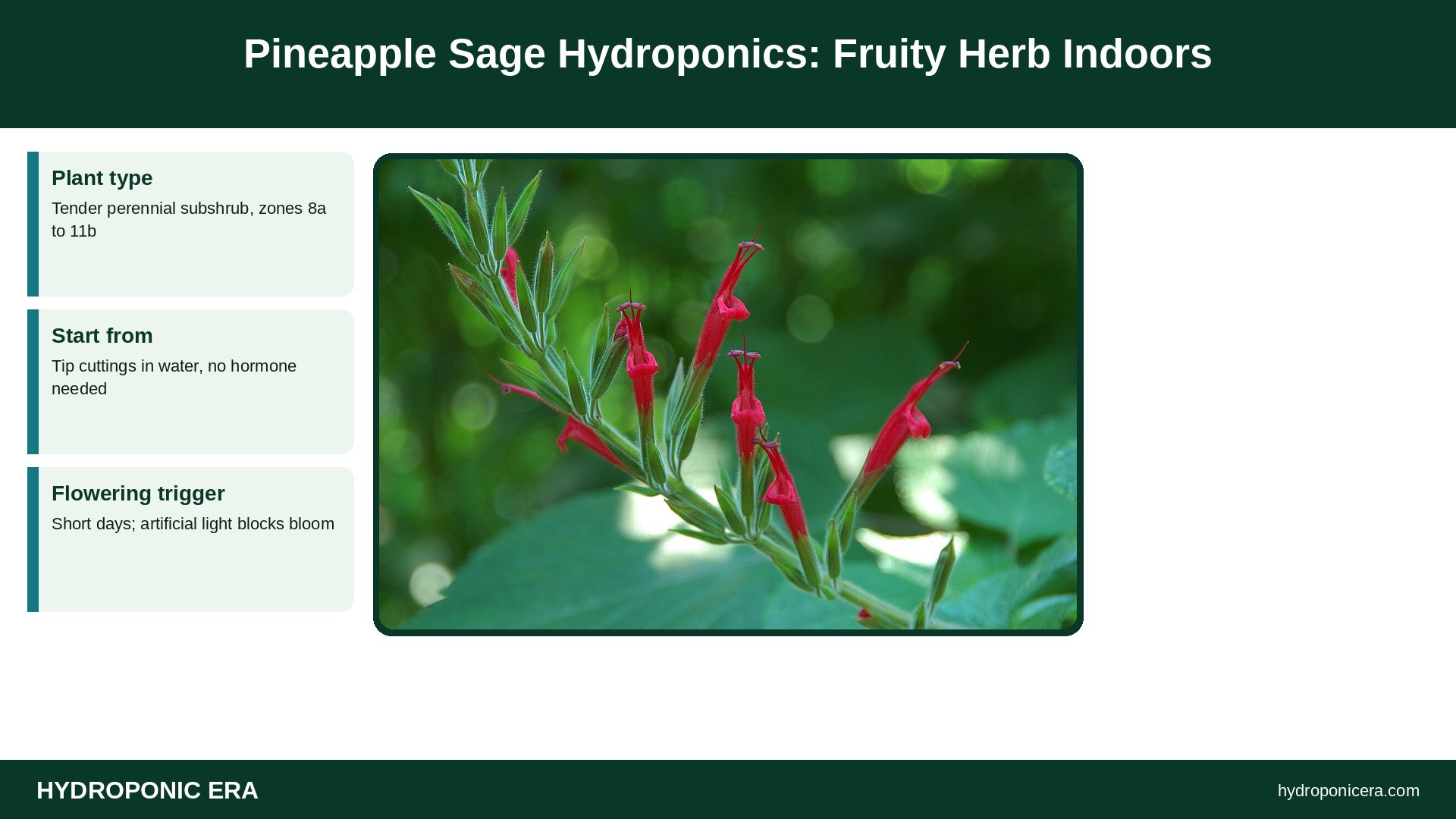
| Plant type | Tender perennial subshrub, zones 8a to 11b | UW-Madison Extension |
| Start from | Tip cuttings in water, no hormone needed | UW-Madison Extension |
| Flowering trigger | Short days; artificial light blocks bloom | UW-Madison Extension |
| Light | Full sun outdoors | UW-Madison; NC State |
| Moisture | Even moisture; leaves curl and drop when dry | UW-Madison; NC State |
| Size | 3 to 5 ft (0.9 to 1.5 m) tall outdoors | NC State Extension |
| pH and EC in hydroponics | pH 5.8 to 6.3; EC 1.2 to 1.8 mS/cm | Our guidance |
Can You Grow Pineapple Sage Hydroponically?
Yes. Pineapple sage hydroponics is one of the easier herb projects because the plant roots so readily. UW-Madison Extension says soft tip cuttings with just leaves root in water or most rooting media without hormone. They describe the plant as fairly fast growing. Our hydroponic sage guide covers its slower cousin.
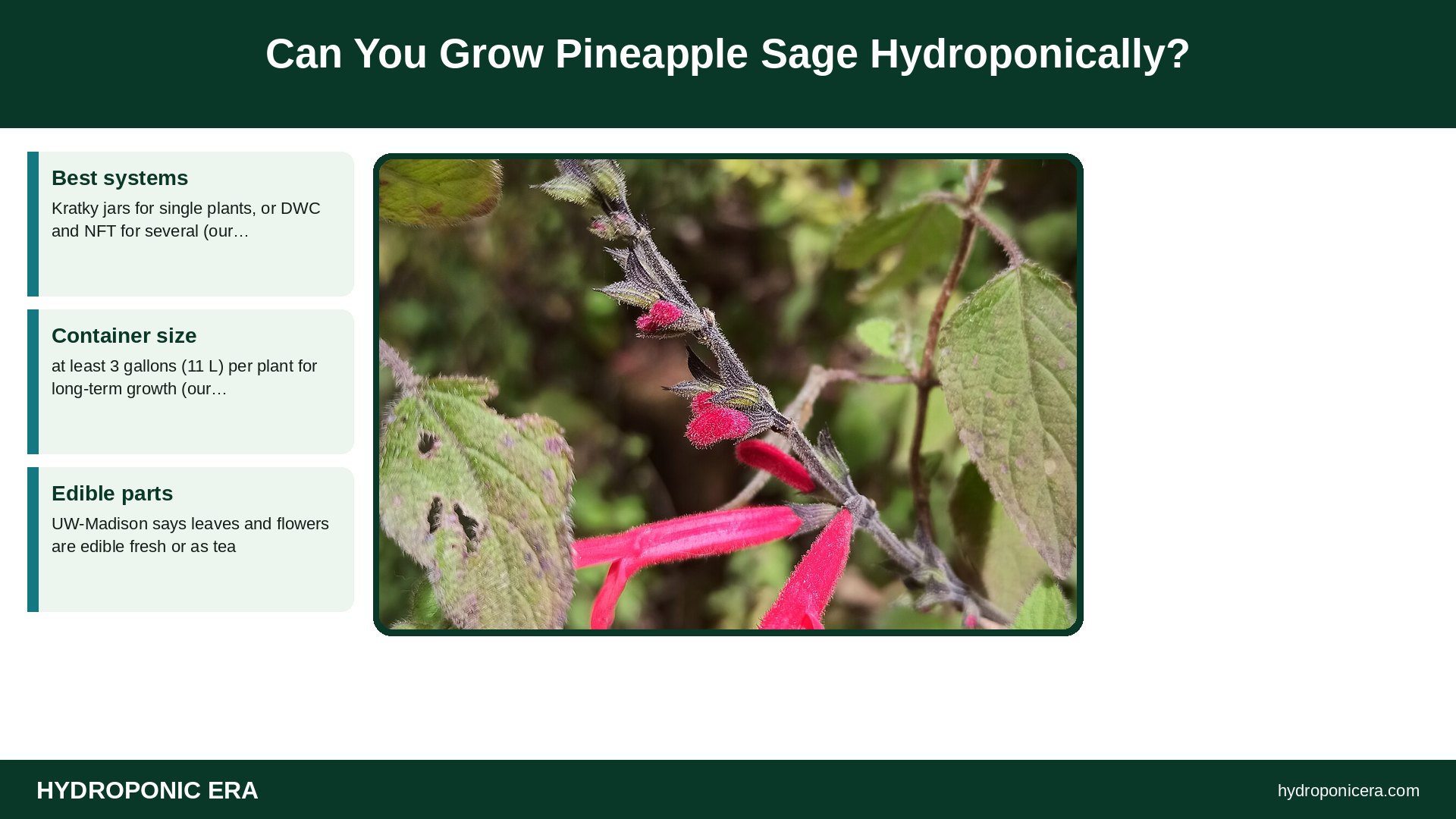
- Best systems: Kratky jars for single plants, or DWC and NFT for several (our guidance).
- Container size: at least 3 gallons (11 L) per plant for long-term growth (our guidance).
- Edible parts: UW-Madison says leaves and flowers are edible fresh or as tea.
NC State Extension does not recommend outdoor sowing from seed unless plants are started indoors, so cuttings are the faster route.
How Do You Root Pineapple Sage Cuttings in Water?
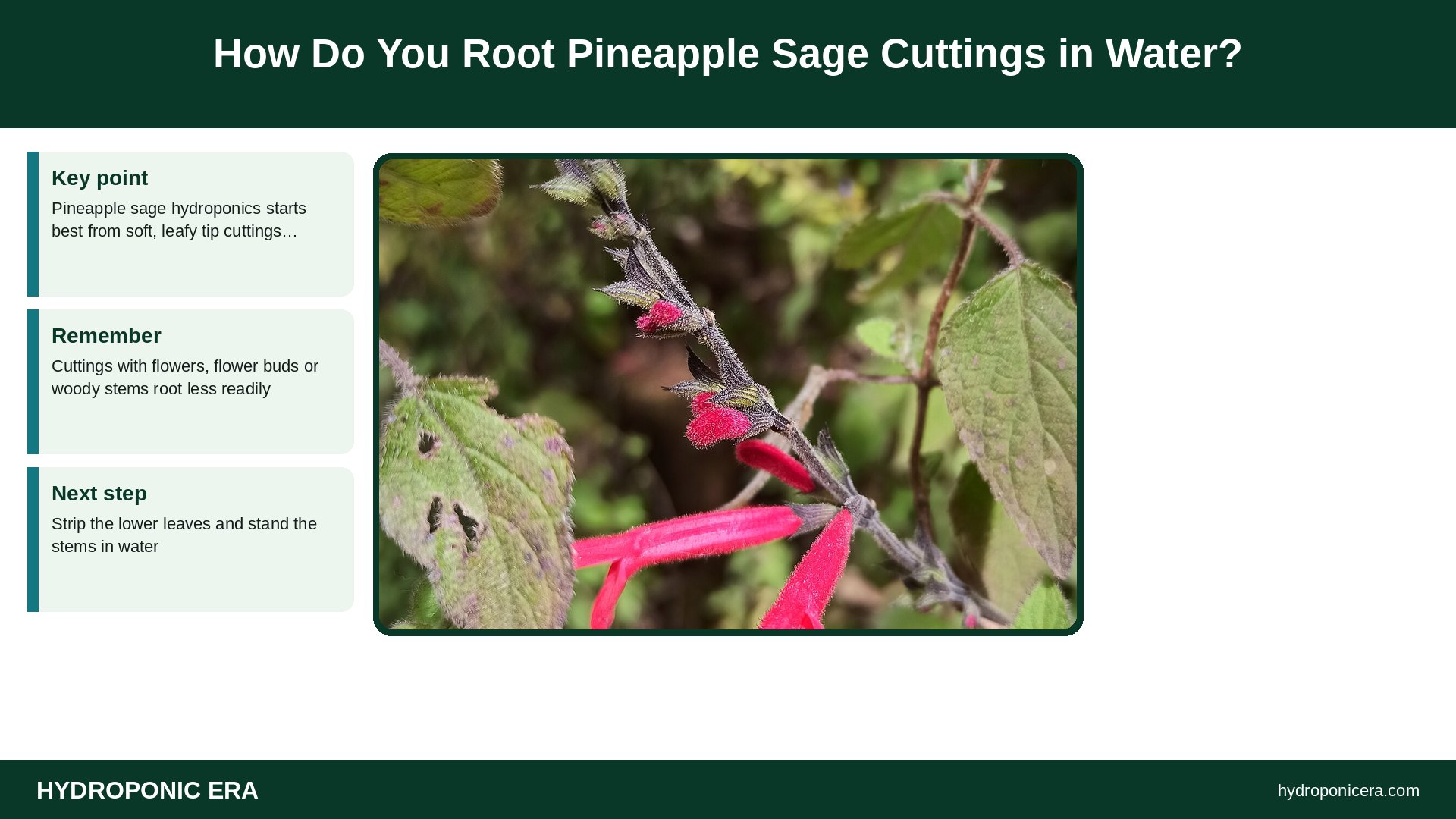
Pineapple sage hydroponics starts best from soft, leafy tip cuttings taken in spring or fall, as UW-Madison advises. Cuttings with flowers, flower buds or woody stems root less readily. Strip the lower leaves and stand the stems in water. Move them into net pots once roots reach 1 to 2 inches (2.5 to 5 cm) (our guidance).
- Cut 4 to 6 inch (10 to 15 cm) soft tips without flower buds.
- Remove leaves from the lower half.
- Stand in clean water in bright, indirect light.
- Change the water every few days.
- Transfer rooted cuttings to rockwool, clay pebbles or a net pot.
Our sage cuttings in water and salvia cuttings guides show the same steps with photos.
What pH, EC and Temperature Does Hydroponic Pineapple Sage Need?
No published study sets targets for pineapple sage hydroponics, so use typical herb ranges: pH 5.8 to 6.3, EC 1.2 to 1.8 mS/cm, and air at 65 to 80°F (18 to 27°C) (our guidance). UW-Madison says plants die back after a hard frost, so keep them above freezing. Even moisture matters, because leaves curl and drop when roots dry.
- pH: 5.8 to 6.3; see pH up and down.
- EC: 1.2 to 1.8 mS/cm; see nutrients for herbs.
- Water: keep roots evenly moist, never dry.
- Pests: UW-Madison warns of aphids, mealybugs and spider mites indoors.
What Problems Affect Pineapple Sage Hydroponics?
Most problems in pineapple sage hydroponics come from dry roots, pests or weak light. UW-Madison says leaves curl when the plant is dry and drop without even moisture. Indoors it is susceptible to aphids, mealybugs and spider mites, while NC State reports no significant problems outdoors. Leggy, pale growth usually means too little light (our guidance).
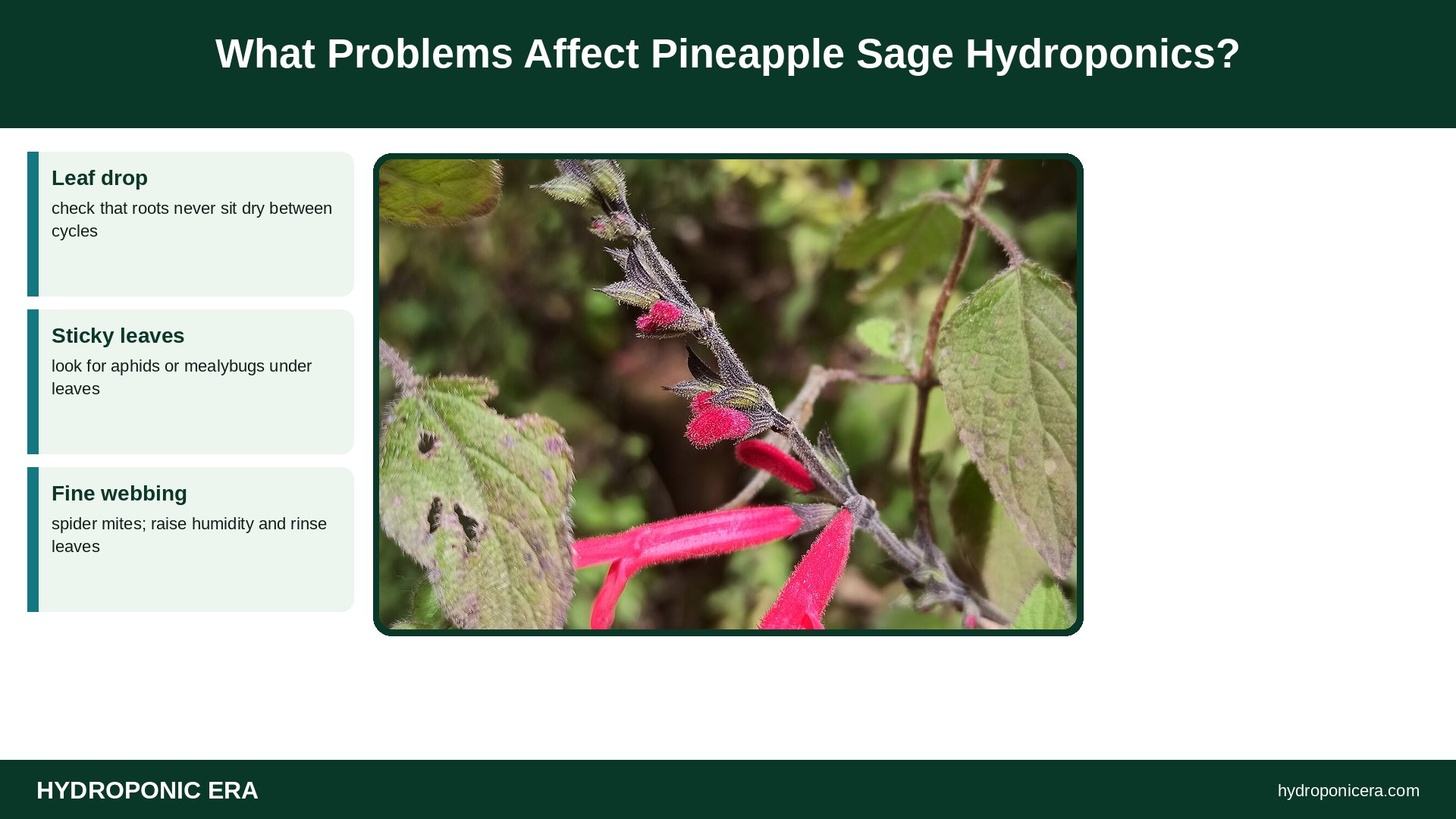
- Leaf drop: check that roots never sit dry between cycles.
- Sticky leaves: look for aphids or mealybugs under leaves.
- Fine webbing: spider mites; raise humidity and rinse leaves.
- Root browning: see root rot in hydroponics.
Why Is My Hydroponic Pineapple Sage Not Flowering?
Flowering is the most common surprise in pineapple sage hydroponics, because this is a short-day plant. UW-Madison Extension says it will not bloom where artificial lights, such as street lights, extend the fall day length. Under a typical 14 to 16 hour grow-light schedule, it stays vegetative. Where there is no frost, including indoors and in greenhouses, plants may keep flowering until spring once they start.
- For leaves: keep long days; you will get steady leafy growth.
- For flowers: cut lights to about 11 to 12 hours a day, with complete darkness at night (our guidance).
- Flower season: NC State notes outdoor blooming in late summer to early fall.
The scarlet, tubular flowers are edible and sweet. See our edible flowers guide for other options.
How Long Does Hydroponic Pineapple Sage Take to Harvest?
Pineapple sage hydroponics is quick to reward you. Rooted cuttings usually give a first light harvest in about 4 to 6 weeks (our guidance). UW-Madison advises snipping young, tender leaves in the morning as needed, and pinching young plants to produce more branching and denser growth. Remove old, woody shoots when new shoots appear.
- Pinch early: pinch tips when plants are 6 inches (15 cm) tall.
- Harvest often: take no more than one-third of the plant at once (our guidance).
- Support: UW-Madison notes tall stems break easily, so stake or trim them.
- Light: see how much light herbs need.
Which Pineapple Sage Varieties Suit Hydroponics?
Compact cultivars suit pineapple sage hydroponics best. UW-Madison lists ‘Golden Delicious’, which grows 1 to 3 feet (30 to 90 cm) tall with chartreuse leaves, and ‘Honey Melon’, ‘Scarlet Pineapple’ and ‘Tangerine’, which are propagated from cuttings. NC State also lists ‘Golden Delicious’. The species itself grows 3 to 5 feet (0.9 to 1.5 m) tall.
- ‘Golden Delicious’: compact and bright; good for small setups.
- ‘Tangerine’: citrus-scented leaves.
- ‘Honey Melon’: honeydew scent.
- Avoid confusion: NC State says scarlet sage (*Salvia coccinea*) lacks the fruity scent and is not generally regarded as edible.
FAQ About Pineapple Sage Hydroponics
Does pineapple sage root in water?
Yes; UW-Madison says tip cuttings root in water without hormone.
Why won’t my pineapple sage bloom indoors?
It is short-day; long light hours stop flowering.
Is pineapple sage edible?
Yes, both leaves and flowers.
Can I grow pineapple sage hydroponics from seed?
Yes, but cuttings are faster and keep the cultivar true.
How big does it get indoors?
Pinching keeps it compact; cultivars stay 1 to 3 feet (91 cm).
What pests affect it indoors?
Aphids, mealybugs and spider mites.
Sources
- University of Wisconsin–Madison Extension — Pineapple Sage, Salvia elegans
- North Carolina Extension Gardener Plant Toolbox — Salvia elegans (Pineapple Sage)
- Photo credits (Wikimedia Commons, edited with titles): Salvia elegans by Eric Hunt (CC BY 2.5); Salvia elegans – flower buds by Juan Carlos Fonseca Mata (CC BY-SA 4.0)