
How do you root sage cuttings? Take 4- to 6-inch (10 to 15 cm) sage cuttings from soft, non-flowering tips, cut just below a node, strip the lower leaves and insert them in moist, well-drained mix. University of Wisconsin Extension says softwood sage cuttings taken in summer root in moist mix, and rooting hormone is generally not necessary.
Key takeaway: Garden sage (Salvia officinalis) roots easily from soft new growth. Moist, well-drained mix is the method extension guides recommend; water works for soft tips but carries more rot risk. Keep cuttings bright, pot them once rooted, and replace old woody plants every few years.
| Step | What to do | Source |
|---|---|---|
| 1. Time it | Summer softwood or late-summer tips | UW Extension, UMD |
| 2. Cut | 4 to 6 in (10 to 15 cm) at a node, no flowers | Cornell, UF IFAS |
| 3. Strip | Leaves only on the top 1 to 2 in (2.5 to 5 cm) | Cornell |
| 4. Insert | Moist mix, vermiculite or perlite | Purdue |
| 5. Care | Bright spot; keep mix moist, not wet | Cornell, NC State |

When Should You Take Sage Cuttings?
Take sage cuttings from soft, flexible new growth, usually in summer. University of Wisconsin Extension recommends softwood stem cuttings taken in summer, and University of Maryland Extension notes that late-summer cuttings can be rooted, potted and moved indoors to a sunny spot for winter. Avoid old, woody stems, which root slowly.
UF IFAS Extension adds that flexible new growth roots more readily than woody stems, and that you should choose stems that are not flowering, because a stem busy making flowers puts less energy into roots.
How Do You Prepare Sage Cuttings?
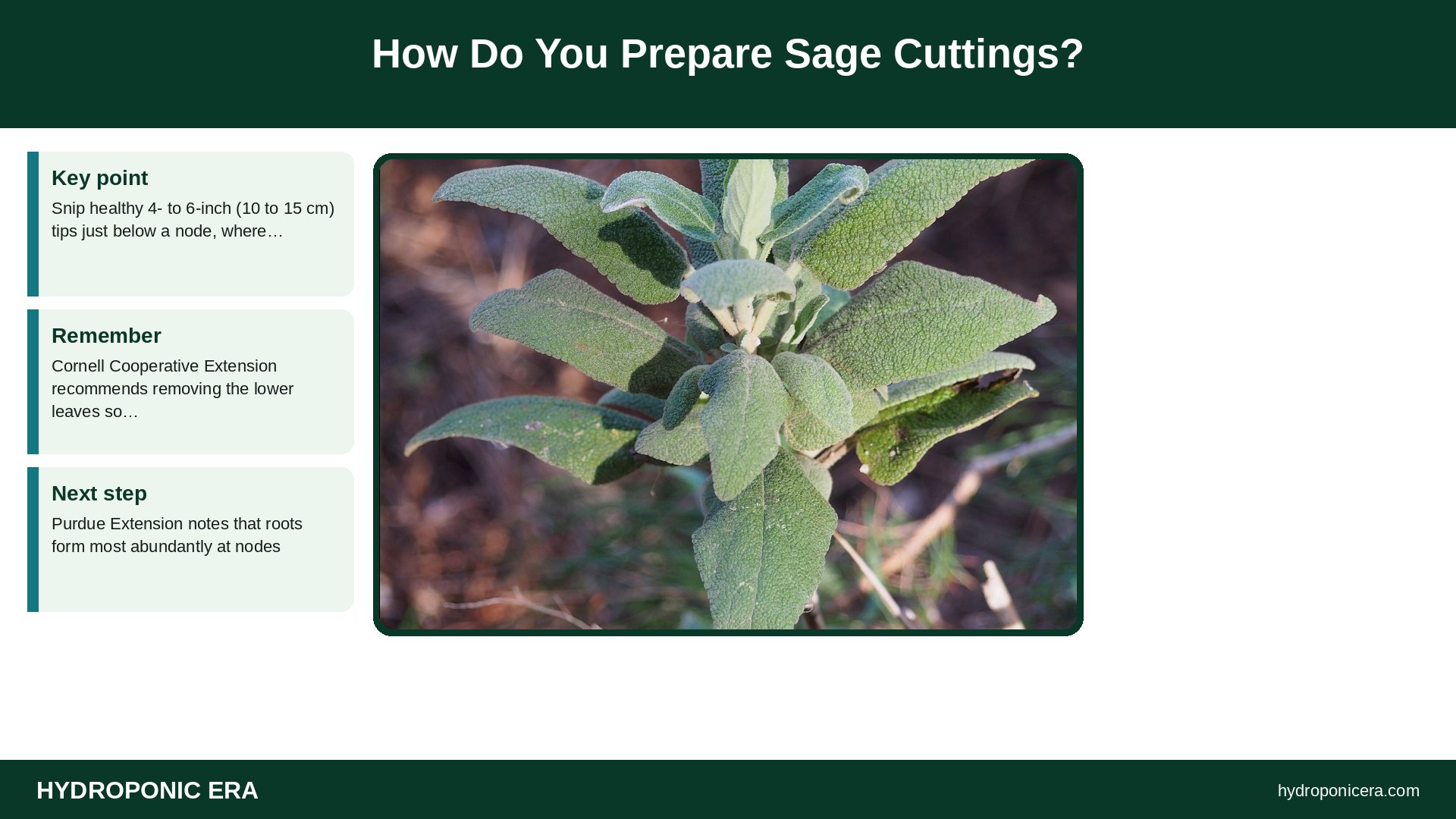
Snip healthy 4- to 6-inch (10 to 15 cm) tips just below a node, where leaves join the stem. Cornell Cooperative Extension recommends removing the lower leaves so foliage remains only on the top inch or two (2.5 to 5 cm). Purdue Extension notes that roots form most abundantly at nodes.
- Pick vigorous, non-flowering shoots from a healthy plant.
- Cut 4 to 6 in (10 to 15 cm) below a node with clean scissors.
- Strip leaves from the lower stem to expose nodes.
- Leave a few leaves at the top to feed the cutting.
- Plant right away so the cut end does not dry out.
Our hydroponic cuttings and cloning guide covers clean tools and cutting technique in more depth.
Should You Root Sage Cuttings in Water or Soil?
Moist, well-drained mix is the safer choice. University of Wisconsin Extension roots sage cuttings in moist, well-drained potting mix, and Purdue suggests soil mix, vermiculite or perlite. NC State Extension warns that sage is intolerant of wet soils and prone to root rot, so cuttings standing in water rot more easily.
| Method | Pros | Cons |
|---|---|---|
| Moist mix or perlite | Extension-backed; sturdy roots | Roots are hidden |
| Water jar | Easy to watch roots | Higher rot risk; roots must adapt to soil |
If you still want to try water, follow the same node rules, keep leaves above the waterline and change the water twice a week. Compare methods in water propagation vs soil propagation.
How Do You Plant Sage Cuttings in Mix?
Make a hole with a pencil, insert the stripped stem so only the leafy top sits above the surface, and firm the mix around it. Cornell Cooperative Extension advises spacing cuttings at least an inch or two (2.5 to 5 cm) apart, watering well, keeping them bright and checking every couple of days that the mix stays moist.
- Fill a pot with moist, well-drained mix or perlite.
- Poke a hole for each cutting with a pencil.
- Insert the stems and firm the mix gently.
- Water well and let excess drain away.
- Place in bright, indirect light and keep evenly moist.
Perlite drains fast, which suits sage. See our perlite propagation guide.

Do Sage Cuttings Need Rooting Hormone?
Usually not. University of Wisconsin Extension says rooting hormone is generally not necessary for sage. UF IFAS Extension explains that hormone is a synthetic version of auxin that can give slower herbs a nudge, so it may help if your cuttings come from firmer stems. Dip only the cut end.
Learn how it works in our rooting hormone guide.
How Long Do Sage Cuttings Take to Root?
Expect a few weeks. Cornell Cooperative Extension says herb cuttings take anywhere from a week to six weeks to root depending on the herb, and a UF IFAS activity guide allows 4 to 10 weeks. Warmth and bright light speed rooting. A gentle tug that meets resistance, or new top growth, means roots have formed.
- Good sign: fresh leaves at the tip and resistance to a tug.
- Slow rooting: cool room or woody stems.
- Wilting: low humidity; cover loosely with a clear bag.
- Blackened stem: too wet; reduce watering.
How Do You Care for Rooted Sage?
Move rooted sage cuttings into a pot or bed with full sun and very well-drained soil. NC State Extension recommends medium to dry soil and good air circulation to prevent root rot and powdery mildew. University of Maryland Extension notes that culinary sage should be replaced every 3 to 4 years as plants get woody.
| Need | Guideline | Source |
|---|---|---|
| Light | Full sun | NC State |
| Soil | Very well-drained, medium to dry | NC State, UMD |
| Water | When the top inch (2.5 cm) is dry | Purdue |
| Spacing | 18 to 24 in (46 to 61 cm) in the garden | UW Extension |
| Renewal | Replace every 3 to 4 years | UMD |
Growing sage indoors without soil is also possible; see how to grow sage hydroponically.

FAQ About Sage Cuttings
Can I grow sage from seed instead?
Yes, but UMD notes seed is slow, and UW Extension says named varieties do not come true from seed.
Can I root sage from grocery store sprigs?
Fresh, soft, non-flowering sprigs with nodes may root; older, dry stems rarely do.
Why are my sage cuttings rotting?
The mix is too wet. NC State notes sage is intolerant of wet soils.
What other ways can I propagate sage?
UW Extension lists layering in spring and fall and dividing large plants in spring.
Will my cutting be the same as the parent?
Yes. Cuttings are clones, which is why named sages are propagated this way.
Sources
- University of Wisconsin Extension. Sage, Salvia officinalis.
- NC State Extension Gardener Plant Toolbox. Salvia officinalis.
- University of Maryland Extension. Sage.
- Purdue University. Propagate herbs now for yearlong enjoyment.
- Cornell Cooperative Extension Orleans County. Propagate herbs now to enjoy all winter.
- UF IFAS Extension Leon County. Borrowed herbs: grow a garden from a friend’s clippings.
- UF IFAS. Herb propagation by cuttings (PDF).
- Photo credits (Wikimedia Commons, edited with titles): 20260614 Salvia officinalis 02 by Flocci Nivis (CC BY 4.0); Salvia officinalis Szałwia lekarska 2024-01-21 Malaga 02 by Agnieszka Kwiecień, Nova (CC BY-SA 4.0); Perlite as a medium for rooting of cuttings by Gmihail at Serbian Wikipedia (CC BY-SA 3.0 rs)