
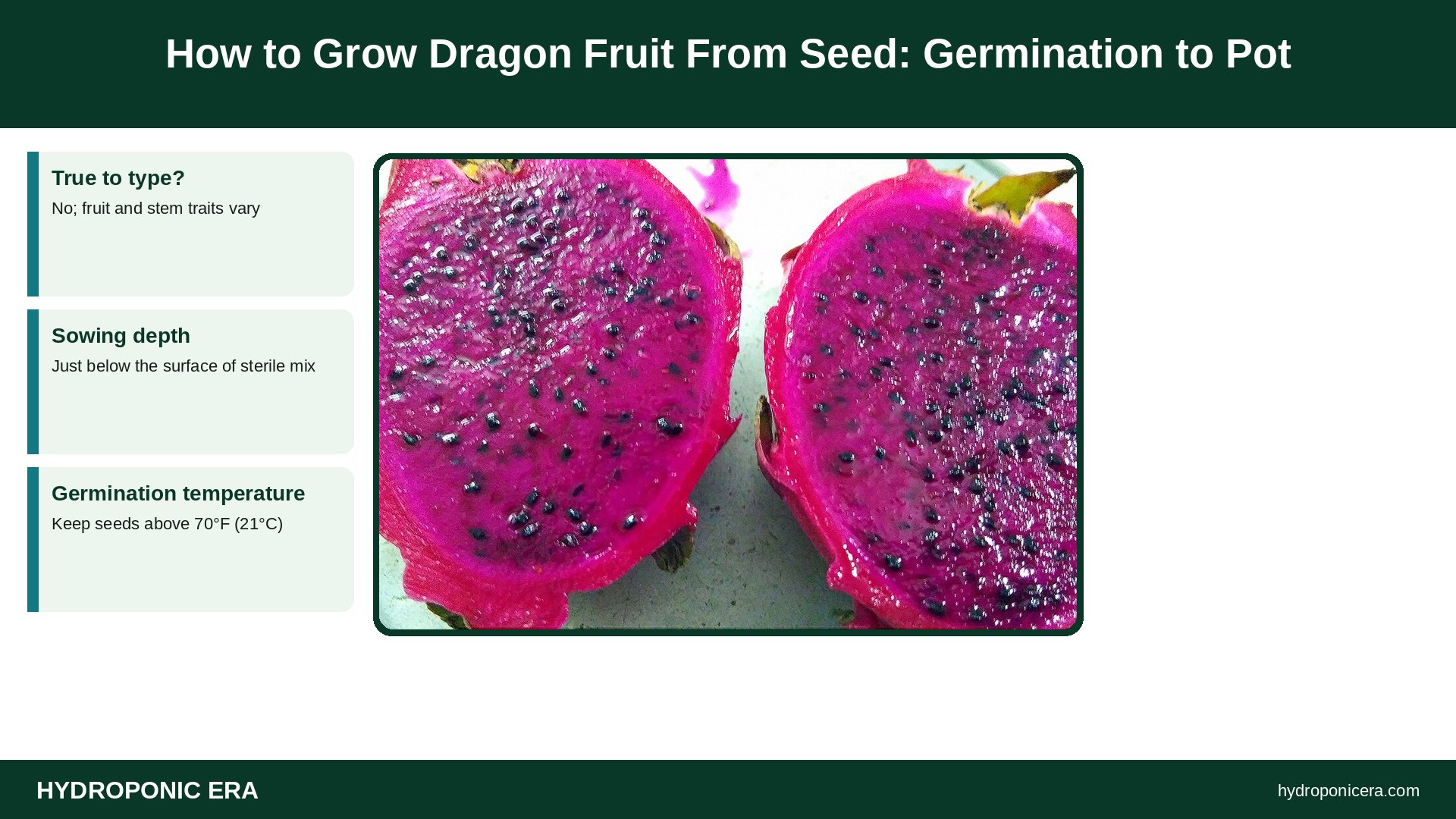
Can you grow dragon fruit from seed? Yes. You can grow dragon fruit from seed taken from a ripe store-bought fruit, but UF/IFAS warns seedlings vary in fruit and stem traits and may take up to 7 years to fruit. Sow cleaned seeds just below the surface of sterile mix above 70°F (21°C); fresh seeds often sprout within a week.
Key takeaway: To grow dragon fruit from seed, you only need a ripe pitaya, a tray of sterile mix and warmth. University of Florida IFAS Extension says pitaya grows from seed or cuttings, though cuttings are preferred for fast, true-to-type fruit. This guide covers seed prep, germination time, potting and the honest timeline to fruit.
| Step or Fact | Dragon Fruit From Seed | Source |
|---|---|---|
| True to type? | No; fruit and stem traits vary | UF/IFAS HS303 |
| Sowing depth | Just below the surface of sterile mix | UF/IFAS HS1349 |
| Germination temperature | Keep seeds above 70°F (21°C) | UF/IFAS HS1349 |
| Time to sprout (fresh seed) | Often within days to a week | Trade Winds Fruit |
| Time to sprout (dried seed) | 1 to 4 weeks, sometimes 8 | Trade Winds Fruit |
| Lab germination | Started day 5; 92% by day 30 | Embrapa (in vitro study) |
| Years to fruit from seed | Up to 7 years | UF/IFAS HS303 |
Can You Grow Dragon Fruit From Store-Bought Fruit Seeds?
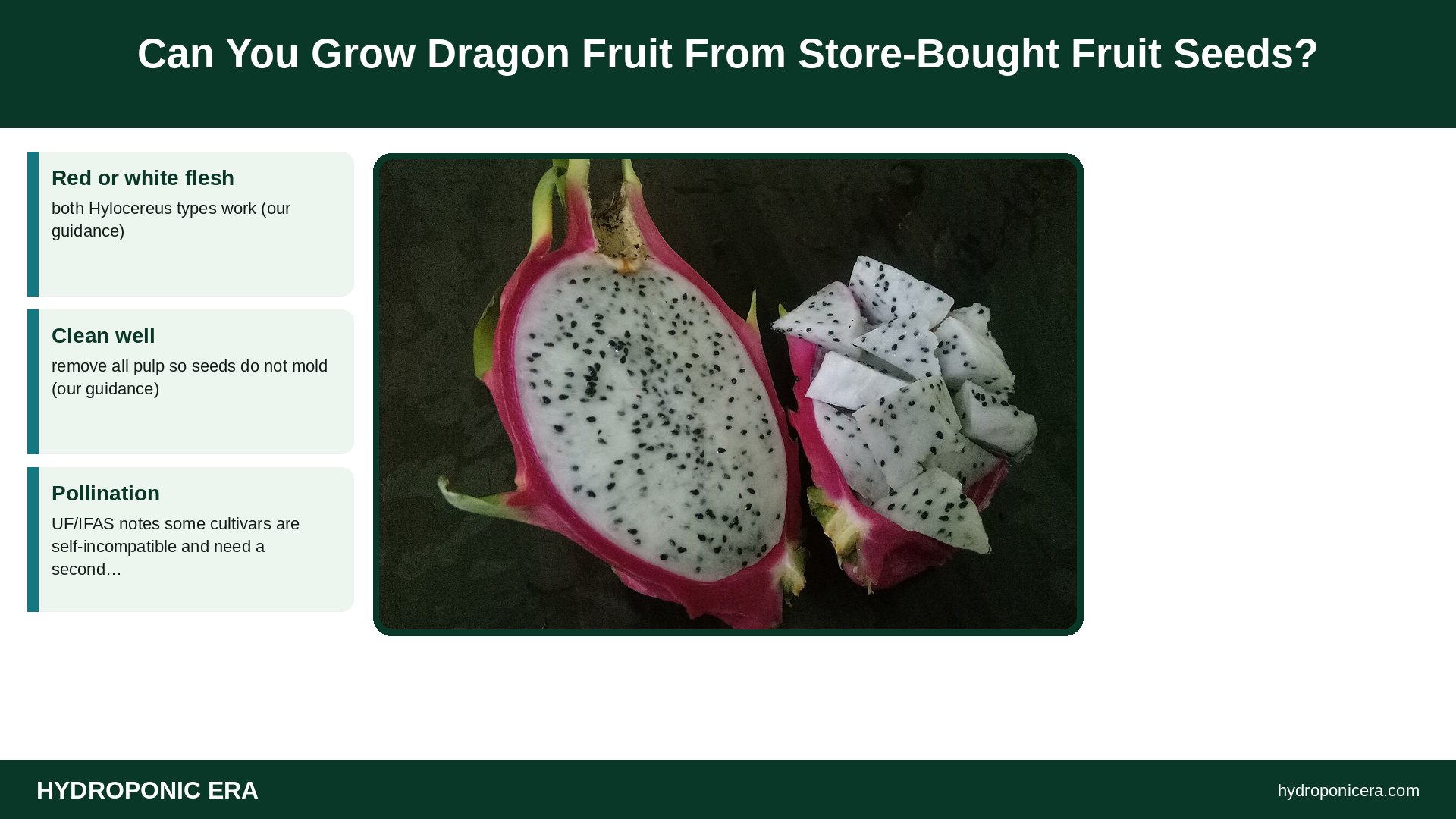
Yes. Each fruit holds hundreds of tiny black seeds embedded in the pulp, per UF/IFAS. Scoop some pulp, mash it in water, and rinse the seeds in a fine strainer. Fresh, undried seeds sprout fastest, according to seed supplier Trade Winds Fruit. Because seedlings vary, your plant may not match the fruit you ate.
- Red or white flesh: both Hylocereus types work (our guidance).
- Clean well: remove all pulp so seeds do not mold (our guidance).
- Pollination: UF/IFAS notes some cultivars are self-incompatible and need a second plant.
- Plant count: sow many seeds, since small seedlings are fragile.
How Do You Germinate Dragon Fruit Seeds, and How Long Does It Take?
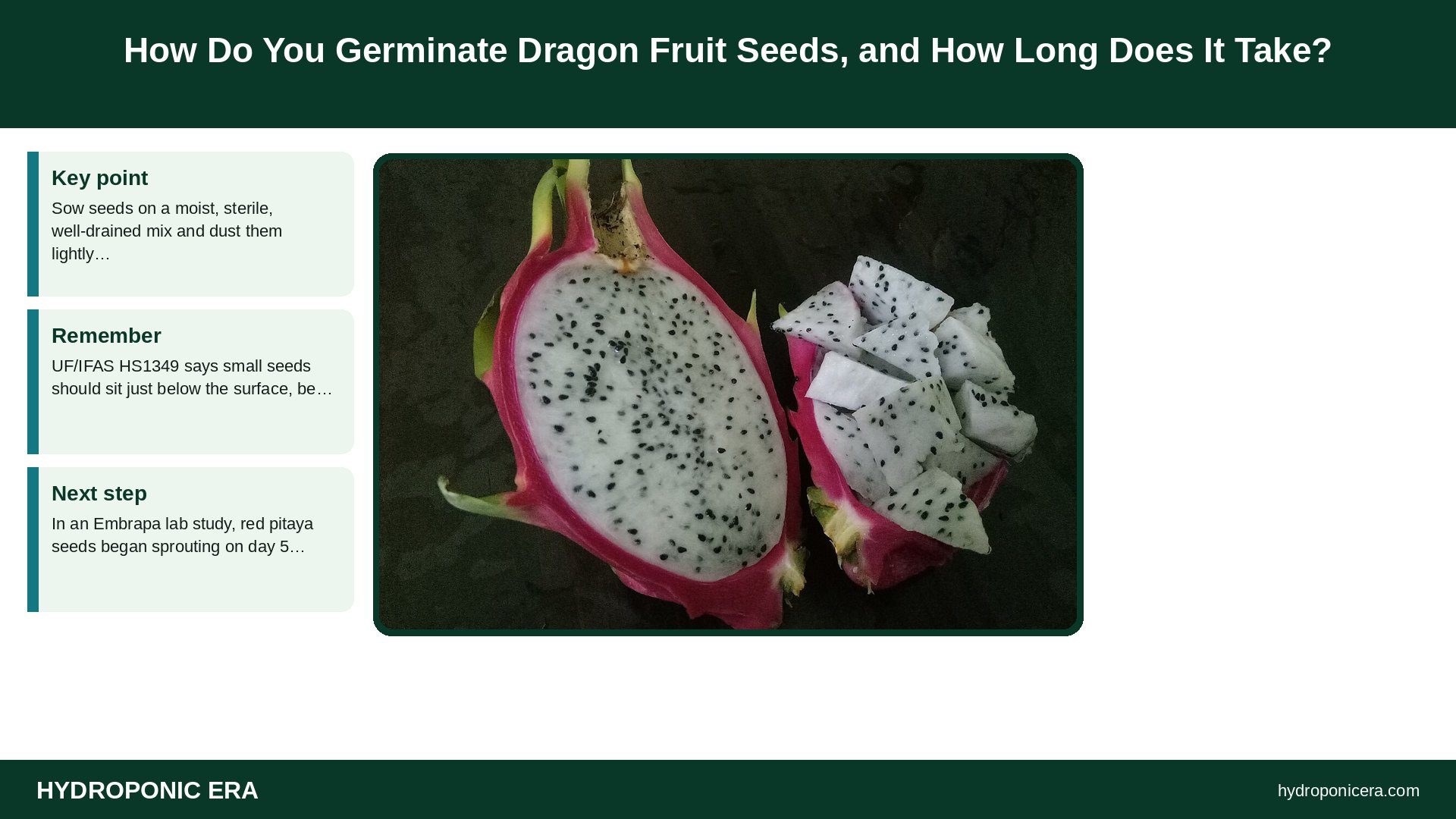
Sow seeds on a moist, sterile, well-drained mix and dust them lightly with more mix. UF/IFAS HS1349 says small seeds should sit just below the surface, be misted rather than poured on, sit in dappled sunlight and stay above 70°F (21°C). In an Embrapa lab study, red pitaya seeds began sprouting on day 5, reaching 92% by day 30.
- Fill a 3 to 4 in (7.5 to 10 cm) deep tray with seed mix.
- Scatter seeds on top and dust lightly with mix.
- Mist gently and cover with a clear dome (our guidance).
- Keep warm, above 70°F (21°C), in bright, indirect light.
- Expect sprouts in 1 to 4 weeks; dried seed can take up to 8.
Trade Winds Fruit warns that cool soil can delay or stop germination, so a seedling heat mat helps. To grow dragon fruit from seed reliably, keep the surface damp but never soggy.
Will Dragon Fruit Grown From Seed Ever Fruit?
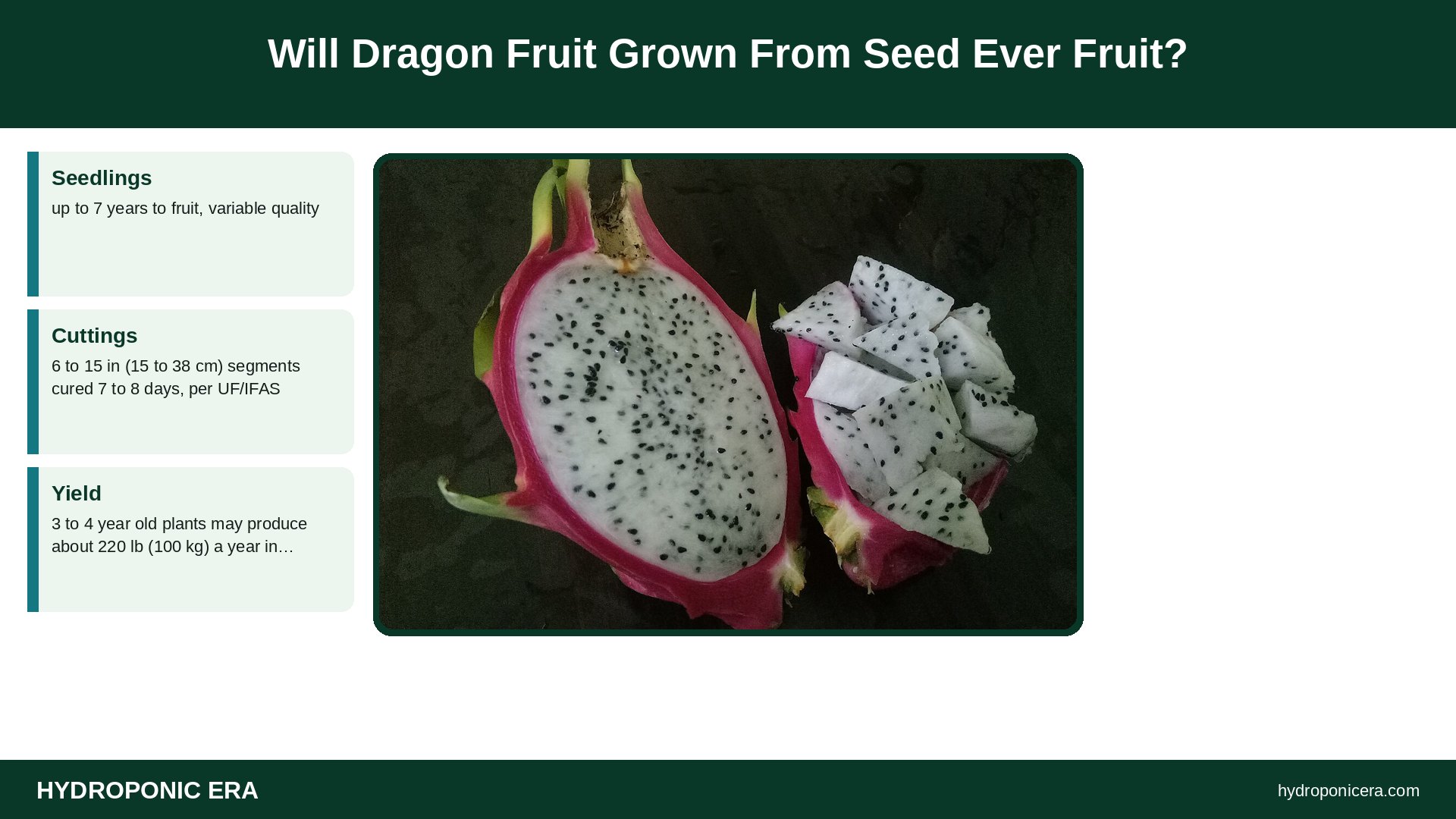
It can, but slowly. UF/IFAS says time from planting to fruit from seed may be up to 7 years, while stem cuttings often fruit within 6 to 9 months. Many people grow dragon fruit from seed for fun and an ornamental cactus, then add a cutting from a proven variety for fruit (our guidance).
- Seedlings: up to 7 years to fruit, variable quality.
- Cuttings: 6 to 15 in (15 to 38 cm) segments cured 7 to 8 days, per UF/IFAS.
- Yield: 3 to 4 year old plants may produce about 220 lb (100 kg) a year in Florida.
- Support: plants need a strong trellis or post.
How Do You Care for Dragon Fruit Seedlings?
Move seedlings to their own pots once roots establish, per UF/IFAS HS1349, and acclimate them slowly from shade to brighter light. Pitaya grows best at 65 to 77°F (18 to 25°C), can be harmed above 100°F (38°C), and may be damaged by long freezes at 31°F (−1°C). Water when the mix dries slightly (our guidance).
- Light: pitayas tolerate some shade but too much reduces fruit, per UF/IFAS.
- Sunburn: extreme sun can scorch stems in dry climates.
- Potting mix: use a fast-draining cactus mix (our guidance); see seed starting mix.
- Feeding: UF/IFAS waits about a month after planting before fertilizing.
Can You Grow Dragon Fruit Hydroponically?
Mature plants can be grown in soilless systems, and we cover it in dragon fruit hydroponics. For seedlings, start in plugs or peat pellets, then move them to free-draining media (our guidance). Indoors, hand pollination helps fruit set; see indoor pollination.
- Media: perlite or clay pebbles drain well (our guidance).
- Temperature: keep roots warm, near the 65 to 77°F (18 to 25°C) range.
- Germination tips: see hydroponic germination methods.
Treat it as a long, rewarding project when you grow dragon fruit from seed.
Should You Grow Dragon Fruit From Seed or From a Cutting?
Choose seed if you want many cheap plants, enjoy experimenting, or hope to find a new flavor. Choose a cutting if you want fruit soon and know the variety. UF/IFAS states asexual propagation is preferred, and cuttings grow very fast, about 1.2 in (3 cm) a day. Many growers grow dragon fruit from seed and also root a cutting (our guidance).
- Seed: low cost, high variety, slow.
- Cutting: true to type, fruit in months.
Either way, a warm, bright spot matters most when you grow dragon fruit from seed or cuttings.
FAQ About How to Grow Dragon Fruit From Seed
How long does it take to grow dragon fruit from seed to fruit?
Up to about 7 years, per UF/IFAS.
How long do dragon fruit seeds take to sprout?
Fresh seed often in a week; dried seed in 1 to 4 weeks.
Can I grow dragon fruit from seed indoors?
Yes; use a warm windowsill or grow light and sow very shallow.
Will the plant match the fruit I bought?
Not necessarily; seedlings vary.
Do I need two plants for fruit?
Some cultivars are self-incompatible, so two can help.
Is a cutting faster than seed?
Yes; cuttings often fruit in 6 to 9 months.
Sources
- University of Florida IFAS Extension — Pitaya (Dragonfruit) Growing in the Florida Home Landscape (HS303)
- University of Florida IFAS Extension — Tropical and Subtropical Fruit Propagation (HS1349)
- Embrapa Agroindústria Tropical — Seed Germination and Explant Types in In Vitro Propagation of Red Pitaya
- Trade Winds Fruit — Dragon Fruit (Hylocereus undatus) Germination Info
- Photo credits (Wikimedia Commons, edited with titles): Pitaya fruit cut in half by Rpwikidhua (CC BY-SA 4.0); Dragon Fruit cut by Shyamal by Shyamal Kumar Chaudhary (CC BY-SA 4.0)