
Quick Answer: hobby vs commercial hydroponics
hobby vs commercial hydroponics is a goals-and-obligations decision, not a personality test. Stay a hobbyist if you grow for household use, learning, and joy without sales promises. Move toward small commercial only when you can handle consistent production, buyer standards, food-safety routines, recordkeeping, and the legal/tax realities of selling food in your jurisdiction. Hydroponic hardware alone does not make a business. This guide uses decision trees and honest scope limits. It does not claim credentials, licenses, or fabricated financial outcomes for HydroponicEra or for you.
Read with start a small hydroponic farm, start a farm, and crop selection guide (draft sibling).
Key Takeaways
- Hobby systems optimize for learning and household harvests; commercial systems optimize for reliability, food safety, and customer delivery.
- UF/IFAS HS405 discusses hydroponic vegetable production as an industry shaped by markets and protected culture—commercial context differs from a kitchen tent.
- Virginia Tech SPES-467 frames cleaning, sanitizing, water quality, and surface hygiene as core edible-production concerns when food is sold.
- UVM hydroponic/aquaponic cleaning guidance supports SOP thinking for produce safety—not optional polish.
- UMass hydroponic systems notes highlight greenhouse environment control as a major part of production—commercial quality depends on climate, not only nutrients.
- Oklahoma State’s hydroponics overview lists operational advantages; advantages become obligations when customers depend on you.
- If you cannot name your buyer, your packing standard, and your cleaning SOP, you are not ready to sell weekly.
Related HydroponicEra guides
- Hydroponics for beginners
- Start hydroponics at home
- Hydroponic greenhouse
- Cleaning and sterilizing (draft sibling)
- Organic farming for beginners (different certification world—do not assume hydroponics equals “organic”)
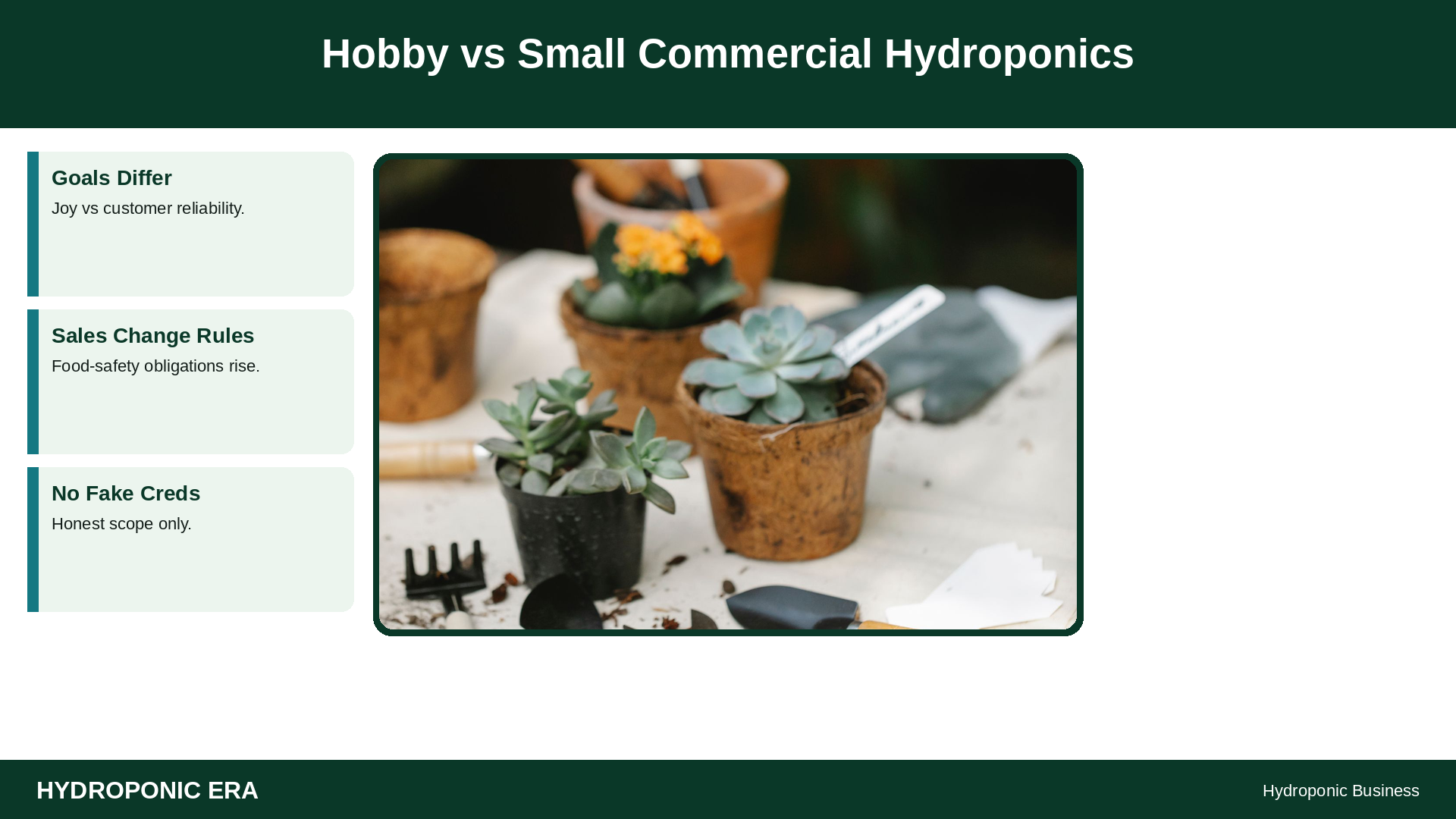
Define hobby vs commercial hydroponics clearly

| Dimension | Hobby | Small commercial |
|---|---|---|
| Primary goal | Learning, food for household, enjoyment | Reliable product for paying customers |
| Failure cost | Lost time/plants | Lost accounts, reputation, possible compliance issues |
| Sanitation | Best practice for plant health | Documented SOPs; food-contact awareness |
| Records | Optional notes | Production, cleaning, sales, inputs |
| Crop mix | Experiments welcome | Standardized SKUs |
| Labor | Flexible | Scheduled harvest/pack regardless of mood |
Hobby vs commercial hydroponics decision tree
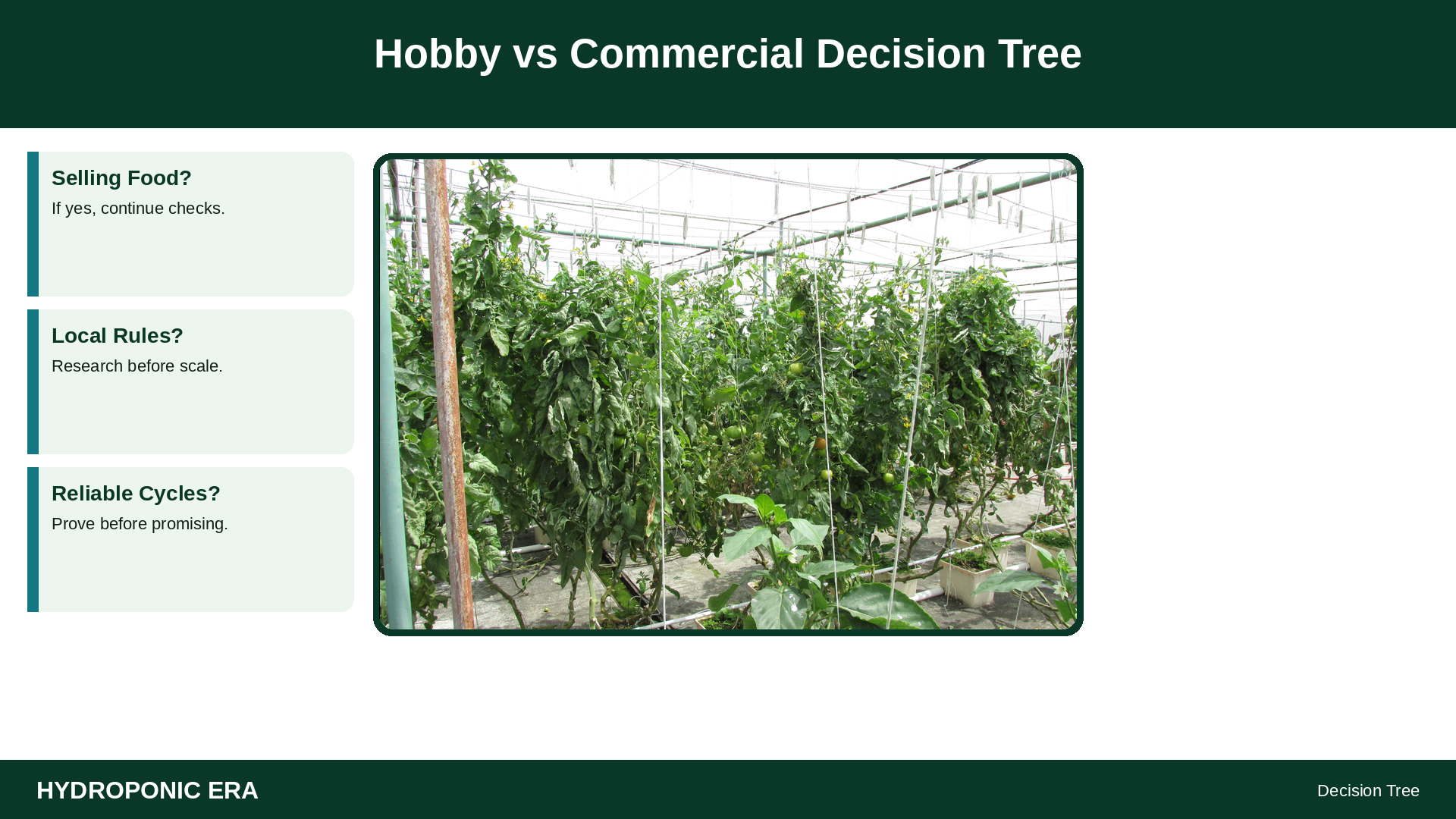
- Will you sell food? If no → hobby path; optimize learning. If yes → continue.
- Do you know legal requirements where you live (business registration, cottage/food rules, market vendor rules, taxes)? If no → research locally before buying more channels.
- Can you produce the same crop quality for several consecutive cycles? If no → remain pre-commercial.
- Do you have at least one realistic sales channel (market stall rules permitting, restaurant chef interest, CSA members)? If no → do not plant “for sale” volumes.
- Can you clean and sanitize between rotations and keep water/food-contact hygiene credible? If no → read VT/UVM sanitation framing and practice on hobby scale first.
- Can labor cover harvest days without heroic all-nighters? If no → shrink scope.
- Only then plan a small commercial pilot with limited SKUs.
What changes in hobby vs commercial hydroponics when you sell
- Consistency: Buyers remember the week you failed more than the week you shone.
- Traceability mindset: What was sanitized, when, with what?
- Packaging and cold chain: Leaves wilt; fruit bruises.
- Customer communication: Shortages need honest notices, not silence.
- Cost honesty: Track your own expenses locally—do not copy internet ROI graphics.
VT SPES-467’s checklists around cleaning channels, rafts, and water systems illustrate the operational texture of edible hydroponics beyond “plants in water.”
Honest Scope: What This Site Is Not Claiming
- HydroponicEra is an educational hydroponics publisher. This article does not certify you as a food-safety auditor, pesticide applicator, or licensed farm advisor.
- No fabricated case studies, earnings, or “our farm cleared $X.”
- No promise that AI search engines will cite this page.
- Local regulations differ—verify with local extension, departments of agriculture, and qualified advisors.
Capability Checklist Before a Pilot
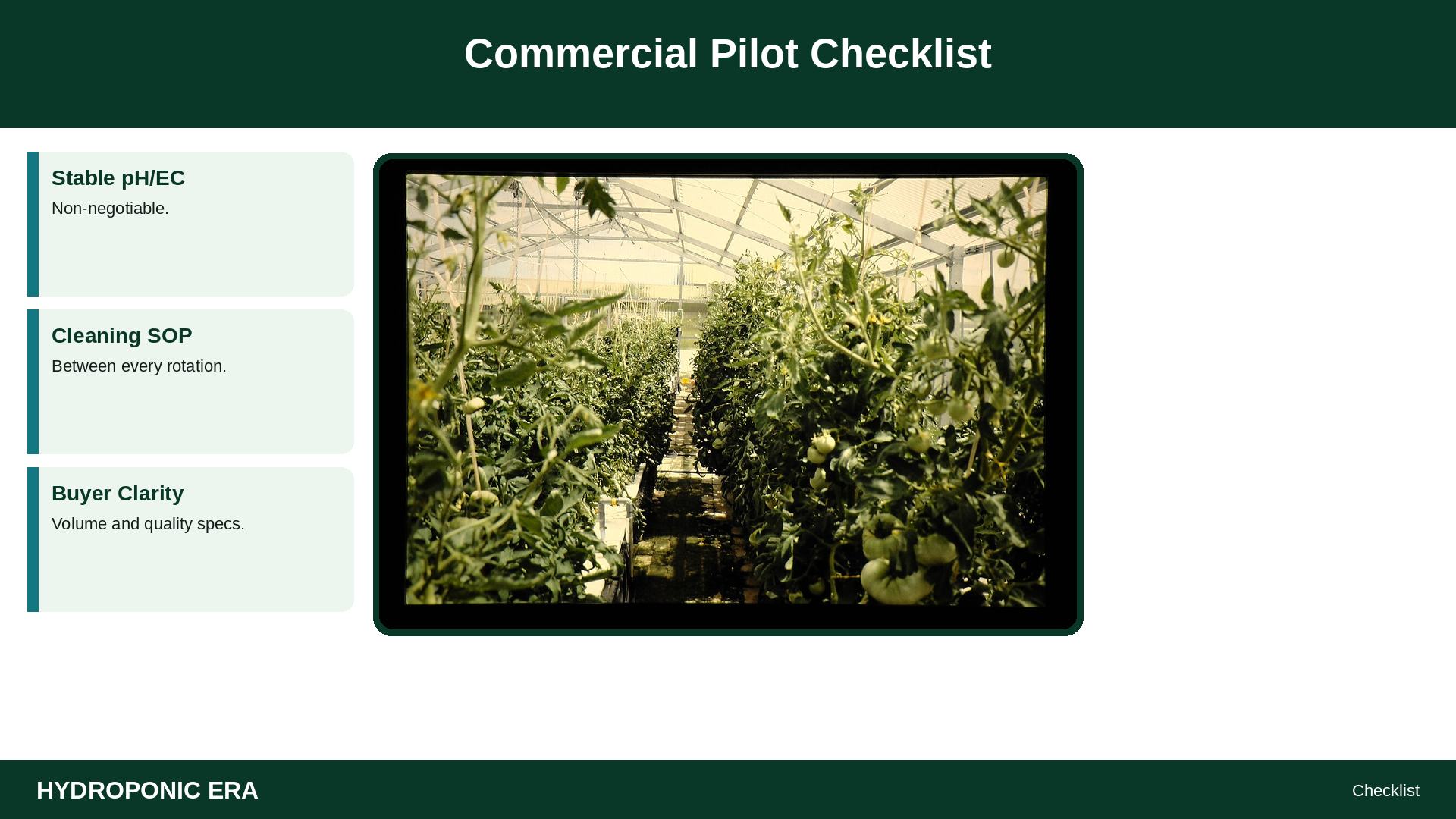
| Capability | Hobby OK if missing? | Commercial pilot needs? |
|---|---|---|
| Stable pH/EC habits | Learning OK | Yes |
| Between-crop cleaning SOP | Recommended | Yes |
| Pest scouting routine | Recommended | Yes |
| Backup pump/air stone | Nice | Yes for risk control |
| Buyer agreement clarity | N/A | Yes |
| Packout space | N/A | Yes |
| Time buffer for failures | Flexible | Required |
Hybrid Path: Serious Hobby → Tiny Pilot
Many growers do best with a staged path:
- Hobby mastery on one system and one crop group (often greens/herbs).
- Give-away or informal sharing only where legal—still not a business.
- Market research conversations without promising volume.
- Pilot sales at very small volume with full cleaning/pack discipline.
- Expand sites only after several clean cycles and retained buyers.
Crop selection framework: small hydroponic farm crop selection.
Environment and Infrastructure Reality
UMass notes that greenhouse environment control is largely the same challenge whether plants are in soil or hydroponics. Commercial quality lettuce in July heat is an HVAC and airflow problem as much as a nutrient problem. Hobby tents can ignore some seasonal extremes by shrinking ambitions; commercial calendars cannot always wait for perfect weather.
Common Mistakes

- Buying commercial-scale channels before completing hobby cycles
- Pricing before measuring your own labor time
- Assuming hydroponics is automatically “organic” or automatically “food-safe”
- Posting supply promises publicly before pilot success
- Skipping sanitation because plants “look clean”
- Treating family labor as free and infinite
Troubleshooting the Decision Itself
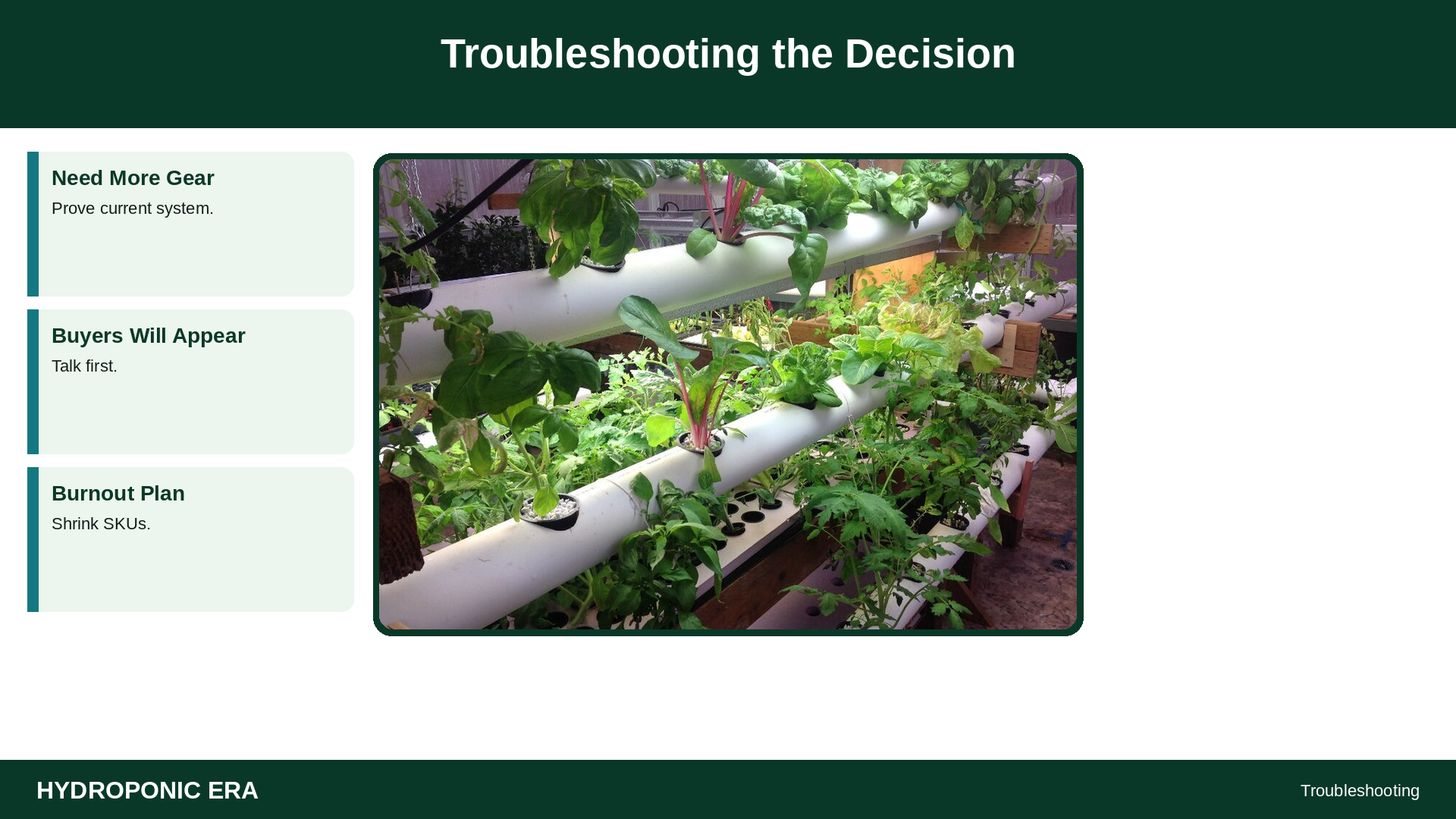
| Feeling / symptom | Interpretation | Move |
|---|---|---|
| “I need more equipment to be legit” | Gear cosplay | Prove cycles on current gear |
| “Buyers will appear when I harvest” | Market risk | Talk to buyers first |
| “I’ll sleep when the farm works” | Labor underestimation | Shrink SKUs; schedule rest |
| “ROI calculators online disagree” | Noise | Track your own costs; ignore fake precision |
| “Hobby feels too small” | Maybe boredom, maybe readiness | Use decision tree honestly |
What to Check in Your Own Situation
- Written goal: hobby, pilot, or commercial?
- Local rules researched (not guessed)?
- Consecutive successful cycles logged?
- Cleaning SOP exists and is used?
- Buyer channel named?
- Labor calendar realistic?
- Emergency plan for pump failure before a delivery day?
Money Talk Without Fake ROI
Track your own categories: electricity, nutrients, seed, media, packaging, transport, market fees, and labor hours. Use those real numbers to decide. Ignore screenshots of anonymous “$10k/month container farms.” If a spreadsheet requires invented wholesale prices, label those cells as assumptions—not facts.
Profit is possible in some markets and impossible in others with the same crop. Location, competition, and skill dominate hardware brand.
Insurance, Liability, and Quiet Risks
Selling food can introduce liability questions. This article cannot tell you what policy to buy. Talk to qualified local advisors. Hobby growers giving food to family still practice safe washing and sanitation, but commercial sales raise the stakes.
Community and Mentorship
Local extension offices, grower associations, and established market vendors often teach faster than solo YouTube binges. Bring specific questions: “What do buyers reject?” beats “How do I get rich with towers?”
HydroponicEra articles aim to make technical topics clearer. They are not a substitute for on-the-ground mentorship or legal advice.
Exit Ramps Are Allowed
If a pilot burns you out, scaling down to a proud hobby is a valid outcome. Many excellent growers never sell. Food on your table and skills in your hands still count.
Worked Decision Examples (Illustrative, Not Advice)
Example A: You harvest salad weekly for your household, enjoy tinkering, and dislike packing. Decision tree stops at hobby—and that is success.
Example B: You completed six clean lettuce cycles, keep sanitation logs, and a café asked for 20 bags weekly starting next month. You still verify local rules, confirm labor for wash/pack, and pilot at partial volume before quitting other income.
Example C: You bought a large greenhouse before growing a single successful crop. Pause sales plans. Run learning cycles. Equipment is not a business model.
Metrics That Matter Before Revenue Bragging
- Percent of transplant sites reaching harvestable quality
- Number of consecutive cycles without catastrophic loss
- Hours of labor per harvest week (measured)
- Customer rejection rate (if selling)
- Cleaning turnaround hours between crops
These operational metrics teach faster than vanity follower counts.
Connecting Technical Skills to the Decision
If pH still swings wildly, read the pH guide and lockout draft before printing business cards. If roots fail, fix oxygen and sanitation. Commercial pressure makes technical gaps louder—it does not magically close them.
Obligation checklist: hobby vs commercial hydroponics
Before you rename your tent a farm, walk this obligation checklist for hobby vs commercial hydroponics.
| Obligation | Hobby OK | Commercial expects |
|---|---|---|
| Harvest consistency | Variable OK | Repeatable quality/volume |
| Food safety routines | Household care | Documented hygiene & handling discipline |
| Buyer communication | None | Orders, standards, replacements |
| Records | Optional notes | Inputs, cleaning, lots, basics your locality requires |
| Legal/tax reality | Personal use | Know rules where you sell food |
- Hobby vs commercial hydroponics is about obligations, not how expensive the LED is.
- A hybrid path—serious hobby plus a tiny compliant pilot—beats a dramatic overnight “business launch.”
- This site does not certify farms or invent ROI for your zip code.
One-page decision writeup
Write four lines: goal, customer (or none), weekly hours you can sustain, and the first crop you can cleanly repeat. If you cannot fill those lines, stay hobby until you can. That is responsible hobby vs commercial hydroponics decision-making.
hobby vs commercial hydroponics: practical review sheet
Use this review sheet to keep hobby vs commercial hydroponics actionable after you finish the main guide.
- What did you measure today related to hobby vs commercial hydroponics?
- What did you change with your hands (not just what you bought)?
- What will you re-check in 24–48 hours about hobby vs commercial hydroponics?
- Which linked HydroponicEra guide should you reread next?
- What cleaning or logging step did you skip last cycle?
| Item | Today | Next check |
|---|---|---|
| Environment | ||
| Solution (pH/EC) | ||
| Roots / pests / biofilm | ||
| Plant response |
Print or duplicate this table in your notes app. The goal is not paperwork—it is fewer repeated mistakes around hobby vs commercial hydroponics.
When results are unclear, slow down and restate the problem in one sentence that includes hobby vs commercial hydroponics, then list the last three changes you made. Most home-system failures come from stacked changes without logs. Keep hobby vs commercial hydroponics paired with basic hygiene: clean reservoirs, honest meter calibration, and root inspection. If you cannot explain your last adjustment, do not add another product. Re-read the troubleshooting section and apply one change at a time while you watch how hobby vs commercial hydroponics interacts with pH, temperature, and oxygen.
When results are unclear, slow down and restate the problem in one sentence that includes hobby vs commercial path, then list the last three changes you made. Most home-system failures come from stacked changes without logs. Keep hobby vs commercial hydroponics paired with basic hygiene: clean reservoirs, honest meter calibration, and root inspection. If you cannot explain your last adjustment, do not add another product. Re-read the troubleshooting section and apply one change at a time while you watch how hobby vs commercial hydroponics interacts with pH, temperature, and oxygen.
When results are unclear, slow down and restate the problem in one sentence that includes hobby vs commercial path, then list the last three changes you made. Most home-system failures come from stacked changes without logs. Keep hobby vs commercial hydroponics paired with basic hygiene: clean reservoirs, honest meter calibration, and root inspection. If you cannot explain your last adjustment, do not add another product. Re-read the troubleshooting section and apply one change at a time while you watch how hobby vs commercial hydroponics interacts with pH, temperature, and oxygen.
When results are unclear, slow down and restate the problem in one sentence that includes hobby vs commercial path, then list the last three changes you made. Most home-system failures come from stacked changes without logs. Keep hobby vs commercial hydroponics paired with basic hygiene: clean reservoirs, honest meter calibration, and root inspection. If you cannot explain your last adjustment, do not add another product. Re-read the troubleshooting section and apply one change at a time while you watch how hobby vs commercial hydroponics interacts with pH, temperature, and oxygen.
hobby vs commercial hydroponics FAQs
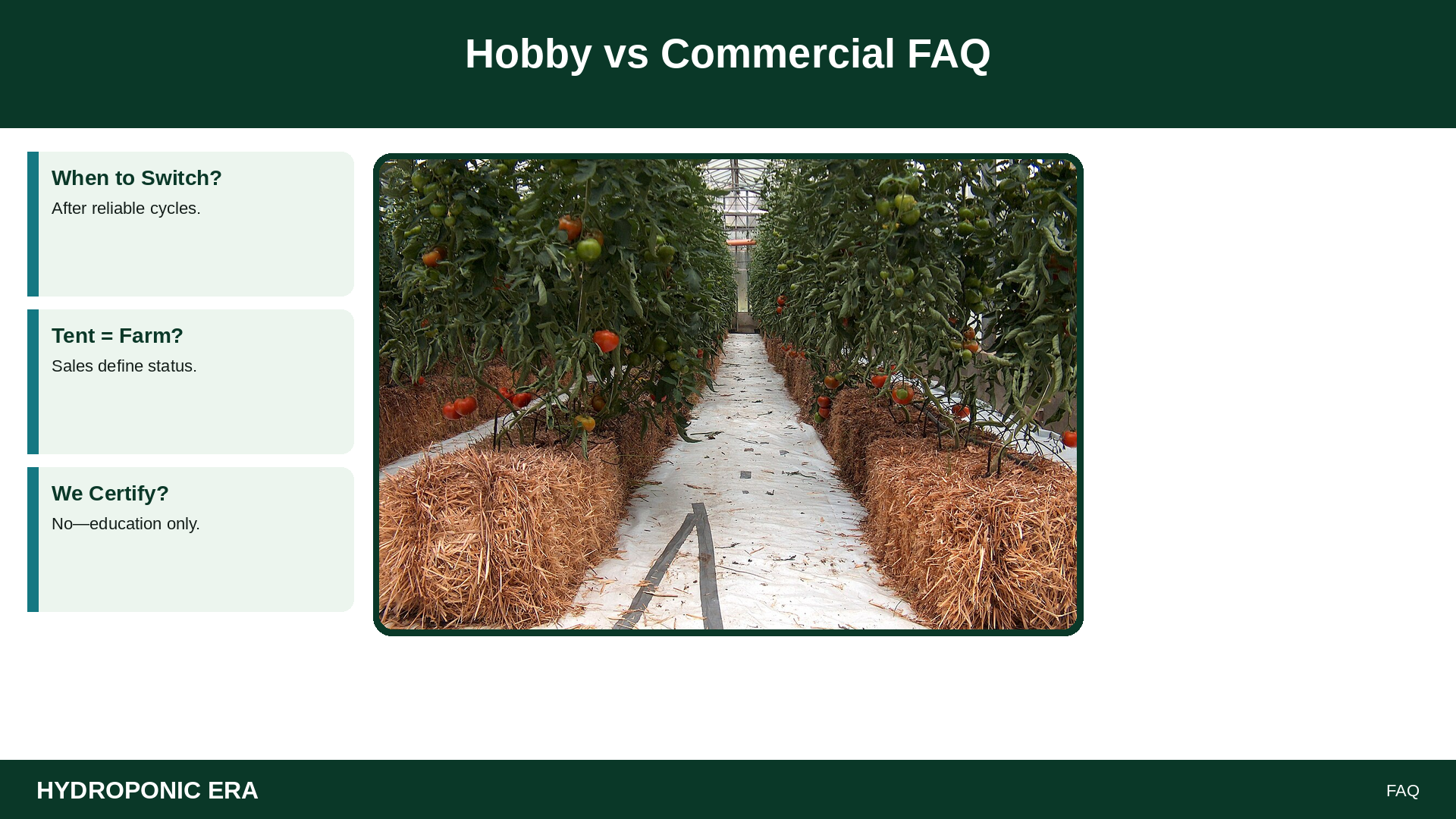
When should I switch from hobby to commercial hydroponics?
After you can reliably complete cycles, clean between crops, and fulfill a real buyer’s quality expectations—and after you understand local rules for selling food.
Is a large grow tent a commercial farm?
Not by itself. Commercial status is about sales, compliance, and consistency, not square footage alone.
Do I need a greenhouse to sell?
Not always, but environment control limits what you can promise year-round. Match crop promises to infrastructure.
Can I start selling immediately after one successful harvest?
You can legally in some places with proper permissions—but operationally, one harvest is weak evidence. Pilot carefully.
Does HydroponicEra offer farm certification?
No. This is educational content. Seek qualified local advisors for compliance questions.
Should I quit my job to grow hydroponic lettuce?
Not based on this article. Use the decision tree; treat income replacement as a high-risk leap requiring real local numbers you gather yourself.
Sources
- UF/IFAS EDIS — Hydroponic Vegetable Production in Florida (HS405)
- Virginia Cooperative Extension — Hydroponic Edible Crops Food Safety Considerations (SPES-467)
- University of Vermont — Cleaning and Sanitizing Hydroponic/Aquaponic Operations (PDF)
- UMass Extension — Hydroponic Systems
- Oklahoma State University Extension — Hydroponics
- UF/IFAS EDIS — Growing Lettuce in Small Hydroponic Systems (HS1422)
2 thoughts on “Hobby vs Commercial Hydroponics: 7 Powerful, Honest Decisions for a Successful Start”