
Organic Farming for Beginners: How It Works and How to Start
Organic farming is a production system that grows food with cultural, biological, and mechanical practices instead of relying on most synthetic fertilizers and pesticides. At home scale it means feeding living soil with compost, rotating crops, and preventing pests before you reach for a spray. Beginners in the United States, United Kingdom, Australia, and Canada can start with one sunny bed and honest records; a legal “organic” label is a separate step.
This guide explains what organic farming is, how it differs from conventional growing, how soil and compost work, what backyard pest and weed habits look like, and why certification is not the same as a garden style. It also compares organic farming with hydroponics in plain language.
Published by Hydroponic Era, beginner hydroponics and farming guides for home growers. This is not legal advice. If you plan to sell food as organic, talk to an accredited certifier in your country.
Key takeaways
- Organic farming is a defined production system, not a synonym for “homegrown.”
- USDA organic rules describe approved methods that foster soil, water, and biodiversity.
- Home growers can follow the spirit: compost, rotation, mulch, and prevention.
- Certification is a legal label. Backyard practice does not automatically earn a seal.
- Most home hydroponic gardens are not certified organic.
- Start with one sunny, well-drained bed and a soil test.
- Do not invent claims about nutrition or search volume; keep notes on what actually grew.
Table of contents
- What Organic Farming Is
- Organic Farming vs Conventional Farming
- How Do Soil, Compost, and Fertility Work?
- What Pest and Weed Rules Apply at Home?
- Organic Certification Caveats
- What Can Beginners Do in a Backyard?
- Organic Farming vs Hydroponics
- Frequently Asked Questions
- Final Thoughts
What Organic Farming Is

Organic farming is a labeling term and a production system. The USDA National Organic Program says organic indicates that food was produced through approved methods that integrate cultural, biological, and mechanical practices. Those methods are meant to cycle resources, promote ecological balance, and conserve biodiversity. Synthetic fertilizers, sewage sludge, irradiation, and genetic engineering may not be used under the US standard.
The Soil Association in the United Kingdom describes organic farming as a whole-system approach that works with nature. It protects soil health, supports wildlife, and produces food without the routine use of artificial pesticides, fertilisers, or antibiotics. The wording differs by country. The shared idea is a farm or garden managed as an ecosystem, not as a bare surface that only receives a bag of product.
University of Georgia Extension’s bulletin on growing vegetables organically puts the same idea in backyard language: feed the soil with organic matter so the soil can feed the plant. That is the practical core of home-scale organic farming. You are not copying a warehouse. You are building crumbly soil, keeping records, and choosing prevention over panic.
A raised bed in a US suburb, an allotment plot in the UK, a backyard in suburban Melbourne, or a community garden plot in Ontario can all use these habits. Climate changes the calendar. The soil job does not.
Organic Farming vs Conventional Farming

Conventional growing is not a slur. It usually means a wider set of allowed synthetic fertilizers and pesticides, plus familiar tillage and rotation choices. Organic farming narrows the input list and asks you to maintain or improve soil and water quality. Both systems can be tidy or sloppy. The difference is the rulebook and the soil habit.
| Question | Organic farming | Conventional (typical) |
|---|---|---|
| Main fertility path | Compost, manure (composted), rotations, allowed natural inputs | Often includes synthetic N-P-K plus soil tests |
| Most synthetic pesticides | Prohibited unless specifically allowed | Allowed when labeled for the crop |
| Sewage sludge / irradiation / GE | Not allowed under USDA organic rules | May appear in some conventional supply chains |
| Soil goal | Maintain or improve living soil and biodiversity | Yield and efficiency; soil care varies by grower |
| Home beginner step | Compost, mulch, rotation, soil test | Soil test, labeled fertilizer, same cultural care |
USDA’s introduction to organic practices repeats that organic agriculture applies cultural, biological, and mechanical practices that support on-farm resource cycling. It also names what to avoid: most synthetic fertilizers, sewage sludge, irradiation, and genetic engineering. That list is the clearest contrast for a beginner reading about organic farming.
UGA Extension notes that organic fertilizers are less soluble and must mineralize before plants can use them. You apply earlier and sometimes in greater bulk than a conventional soluble feed. Plan ahead. A Saturday dump of fresh manure on lettuce is not a careful organic move; it can harm plants and people.
How Do Soil, Compost, and Fertility Work?

Soil is the workplace of organic farming. UGA’s organic vegetable bulletin describes an ideal mineral soil as a mix of sand, silt, and clay with about 5% organic matter. Many garden soils start far below that. You cannot change a soil type overnight, but you can add finished compost, keep traffic off wet beds, and avoid leaving soil bare.
Test first. UGA recommends a soil test to set pH. Most vegetables prefer about 6.0 to 6.5. Lime recommendations come from the lab, not from a guess. In the US, county Extension offices run these tests. In the UK, Australia, and Canada, use a local lab or a reputable kit and treat the numbers as a starting map, not as a brand advertisement.
Compost is the everyday amendment. University of New Hampshire Extension’s home composting fact sheet explains why: kitchen scraps in a landfill can produce methane, while a backyard pile returns organic matter to the garden. UNH notes that a pile works best when brown (carbon-rich) and green (nitrogen-rich) materials are balanced, kept moist like a wrung-out sponge, and given enough size—often about 3 feet on a side—to heat.
UGA describes a convenient pile about 4 ft by 5 ft by 5 ft, or a purchased tumbler if space is tight. Layer kitchen and yard waste (no meat or bones, which attract animals). Turn the pile. Finished compost is dark and crumbly, not steaming and sharp. Apply modest amounts each year. UGA cautions that fresh manures should be composted to kill pathogens and weed seed, and that some hay or straw can carry persistent herbicides that survive composting. Ask where the material came from.
Green manures—cover crops turned into the soil—add organic matter and, when legumes are used, can add nitrogen. UGA lists rye, vetch, clover, and summer options such as buckwheat. Match the cover to your season. A Canadian or northern US winter cover is not the same as a Queensland summer cover. The principle of organic farming stays: return living material to the bed before you plant the next crop.
What Pest and Weed Rules Apply at Home?

Weeds are the hardest job on a small organic plot. UGA says so plainly. Herbicides that fit organic rules are few, expensive, and often non-selective. The practical tools are stale seedbeds (prepare early, kill the first flush, then plant), mulch, cover crops, and a hoe used while weeds are small. Mulch also conserves moisture and reduces splash that spreads disease. Keep mulch a few inches back from stems.
Insects and disease start with healthy plants and clean stock. Buy insect-free transplants. Remove sick plants. Prefer trickle irrigation so leaves dry. Rotate families so squash does not follow cucumber on the same ground. UGA groups related vegetables (nightshades, cucurbits, brassicas, legumes) so you can plan that rotation. Resistant varieties—such as VFN tomatoes—reduce pressure before any product comes off a shelf.
When a product is needed, home growers look for materials accepted in organic production, such as those reviewed by the Organic Materials Review Institute (OMRI). Examples UGA discusses include insecticidal soap, Bt for caterpillars, horticultural oils, and certain copper or bicarbonate fungicides. That is not a shopping list to empty. It is a reminder that organic farming still uses tools; it just uses a shorter, more cultural list. Always read the current label. This page is not a pesticide recommendation.
Animals are a separate chapter. Deer, rabbits, and dogs ignore your philosophy. UGA mentions fencing, including heights that may be limited by local codes. In the UK, allotment rules may restrict structures. Check before you build.
Organic Certification Caveats

Here the tone stays careful. Organic farming as a backyard practice is not the same as selling food under a protected label. In the United States, the National Organic Program develops and enforces national standards and accredits certifiers. Operations that want to sell, label, or represent products as organic generally must follow USDA organic regulations and work with a certifier, with limited exemptions that you must verify yourself.
This is not legal advice. Rules change. Exemptions have income and labeling conditions. If you sell at a market in the US and want the USDA seal, contact an accredited certifier. If you grow only for your household, you can still use compost, rotation, and prevention without filing paperwork. Do not print a seal you have not earned.
In the United Kingdom, organic products must meet legal standards and be certified along the supply chain. The Soil Association describes certification as proof that every step meets organic standards. Their standards emphasize soil, biodiversity, and animal welfare. Australia maintains a national standard for organic and biodynamic produce; soilless systems are often treated differently than soil-based organic. Canada has its own organic regime. The names differ. The caution is the same: a label is a compliance system.
USDA has, in recent years, allowed some hydroponic and container operations to be certified organic if they meet NOP rules and a certifier agrees. That decision is debated. Courts have reviewed challenges. Home readers should not treat a tote of nutrient solution as “organic” by default. Organic farming on this site means the soil-and-ecosystem path unless a certifier has actually said otherwise.
What Can Beginners Do in a Backyard?

Start smaller than you think. UGA’s location advice is practical in any of the four countries: full sun if you can get it, at least 6 to 8 hours for most fruiting vegetables, good drainage after rain, water nearby, and fewer competing tree roots. Leafy greens tolerate a bit less light. Raised beds help where native soil is compacted or poorly drained.
A calm first-year plan for home organic farming looks like this:
- Pick one bed you can reach with a hose or watering can. Level it. Note shade from fences and houses.
- Test the soil and write pH and any lime or compost notes.
- Add finished compost and turn or fork only as deep as you can do well. UGA mentions turning 10 to 12 inches when you are building a new bed; do not make it a weekend injury.
- Plant crops that match the season. Cool greens in a UK or Canadian spring; heat lovers after frost in the southern US or much of Australia.
- Mulch and hoe early. Keep a simple log of rainfall, pests, and harvest dates.
- Rotate families next year. Do not follow tomato with potato on the same ground.
- Compost kitchen scraps (no meat) so next season’s fertility is already in motion.
- Skip the seal until you actually need one. Grow food you will eat.
Climate notes: US last-frost dates vary from February in parts of the Gulf Coast to May or June in the north. UK growers lean on cool-season brassicas and cloches. Australian readers reverse the calendar and watch heat more than frost in many regions. Canadian short seasons favor raised beds that warm faster and covers that extend fall. Units stay mixed: feet and metres, pounds and kilograms, °F and °C. Label your own notebook and stay consistent.
If you also keep an indoor soilless loop, keep soil and compost out of that reservoir. The two methods can live on the same property. They should not share dirty tools.
Organic Farming vs Hydroponics
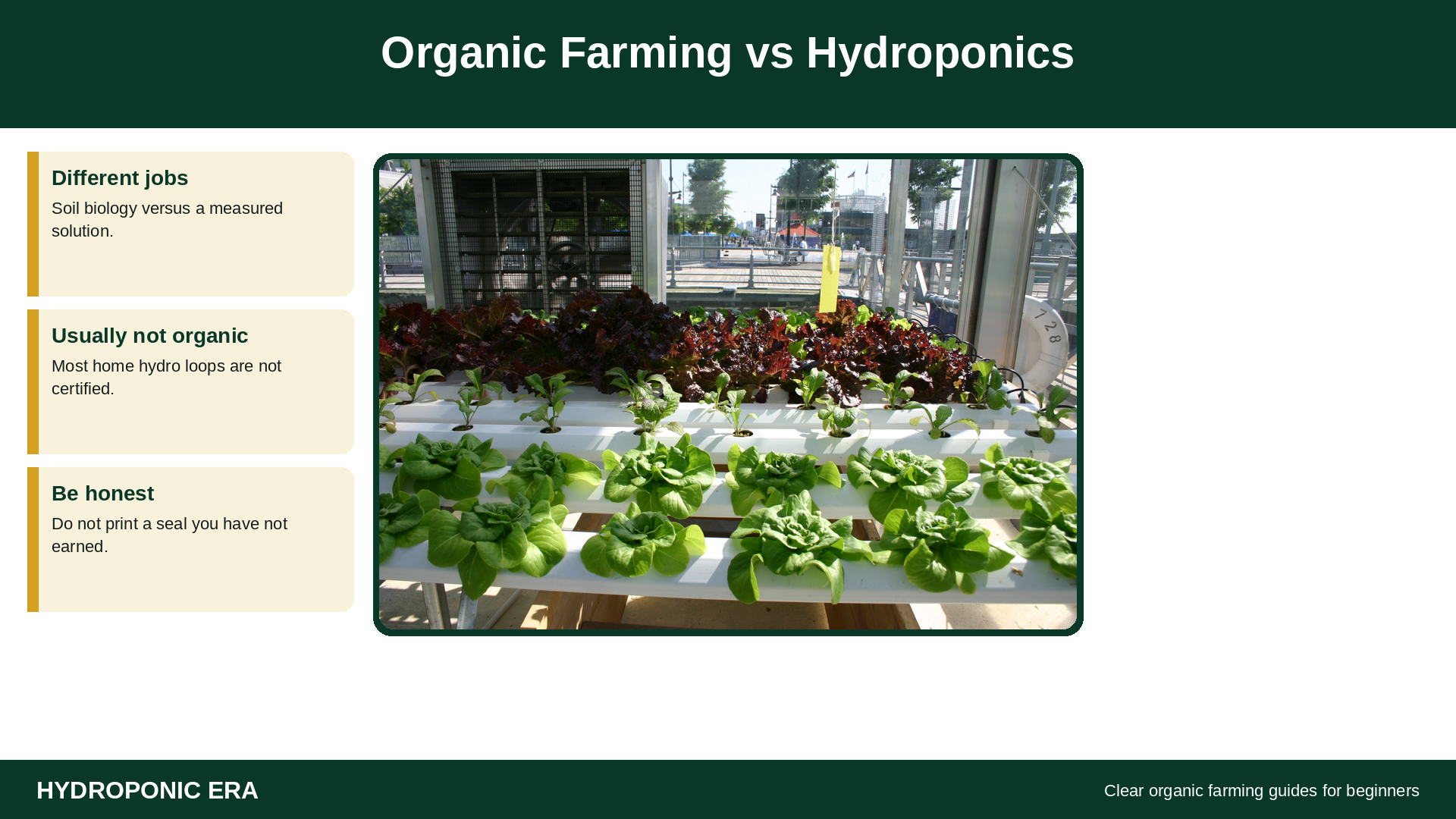
People often ask whether hydroponics can be organic. The honest beginner answer is: they are different jobs. Organic farming is built around living soil, compost, and an ecosystem standard. Hydroponics is built around a measured nutrient solution and inert media. You can respect both. You should not blur the words.
| Topic | Organic farming | Home hydroponics |
|---|---|---|
| Where roots live | Soil with organic matter and biology | Solution or inert media (coco, clay, rockwool) |
| Fertility | Compost, covers, allowed soil inputs | Complete soilless formula plus pH and EC |
| Typical home label | Practices you follow; seal only if certified | Almost never a certified organic seal |
| Water habit | Irrigation plus soil storage | Reservoir you meter and refresh |
| First crops | Seasonal vegetables in a sunny bed | Lettuce, herbs, microgreens under a lamp |
Most home hydroponic gardens are not certified organic. USDA may certify some commercial hydroponic operations that meet NOP rules; that is a certifier decision, not a kitchen-counter default. UK and Australian organic frameworks generally treat soil as central. If you grow lettuce in a tower, call it hydroponic. If you grow beans in compost-fed soil using organic practices, call it that. Linking the two methods for learning is fine. Pretending they are the same label is not.
If you want soilless technique after this page, use the live hydroponic garden beginner guide and the indoor hydroponic garden guide. For towers and mist, see the hydroponic tower garden and aeroponics for beginners. Those pages do not make a hydro loop organic. They make the plumbing clear. For pH in a reservoir, use how to control pH in hydroponics. For leaf and root trouble in a tank, see yellow leaves and brown roots.
Keep compost piles and hydro reservoirs apart. Soil in a pump is a clog, not a philosophy. That boundary is part of honest organic farming and honest hydroponics on the same property.
Frequently Asked Questions

What is organic farming in simple terms?
Organic farming grows food with living soil, compost, rotations, and a short list of allowed inputs. It avoids most synthetic fertilizers and pesticides. A legal organic label requires following your country’s rules, not just good intentions.
Is organic farming the same as gardening without chemicals?
No. Home gardens can use fewer products and still not meet a certified standard. Organic farming as a label is a compliance system. As a backyard habit, it is compost, prevention, and records.
Can I start organic farming in a backyard?
Yes. One sunny bed, a soil test, finished compost, and a hoe are enough to practice the method. Certification can wait until you sell and need a seal.
Is hydroponic produce organic?
Usually not at home. Some commercial hydroponic operations in the US may be certified if they meet USDA rules. Many organic programs treat soil biology as essential. Do not assume a tote is organic.
Do I need certification to eat my own vegetables?
No. Certification matters when you want to sell or label food as organic. Household growing can follow organic practices without a certifier.
What should I compost?
Kitchen scraps and yard waste, not meat or bones. Balance browns and greens, keep the pile moist, and use only finished compost on food crops. UNH and UGA both stress process over a pretty bin.
Where can I read official rules?
Start with the USDA National Organic Program if you are in the US, and with your national organic body or a certifier such as the Soil Association if you are in the UK. Local Extension remains the best backyard coach.
Final Thoughts

Organic farming at beginner scale is a soil habit, not a shopping cart. Build one bed, add finished compost, rotate families, mulch, and write down what worked. Treat the word “organic” with care when you sell or label food.
If you also grow without soil, keep the methods honest and separate. Hydroponics is a measured loop. Organic farming is a living-soil system. Both can feed a household. Neither needs hype.
External reading: the USDA National Organic Program, University of Georgia Extension’s Growing Vegetables Organically (B 1011), UNH Extension’s composting fact sheet, and the Soil Association page on what organic farming is.