
Quick Answer
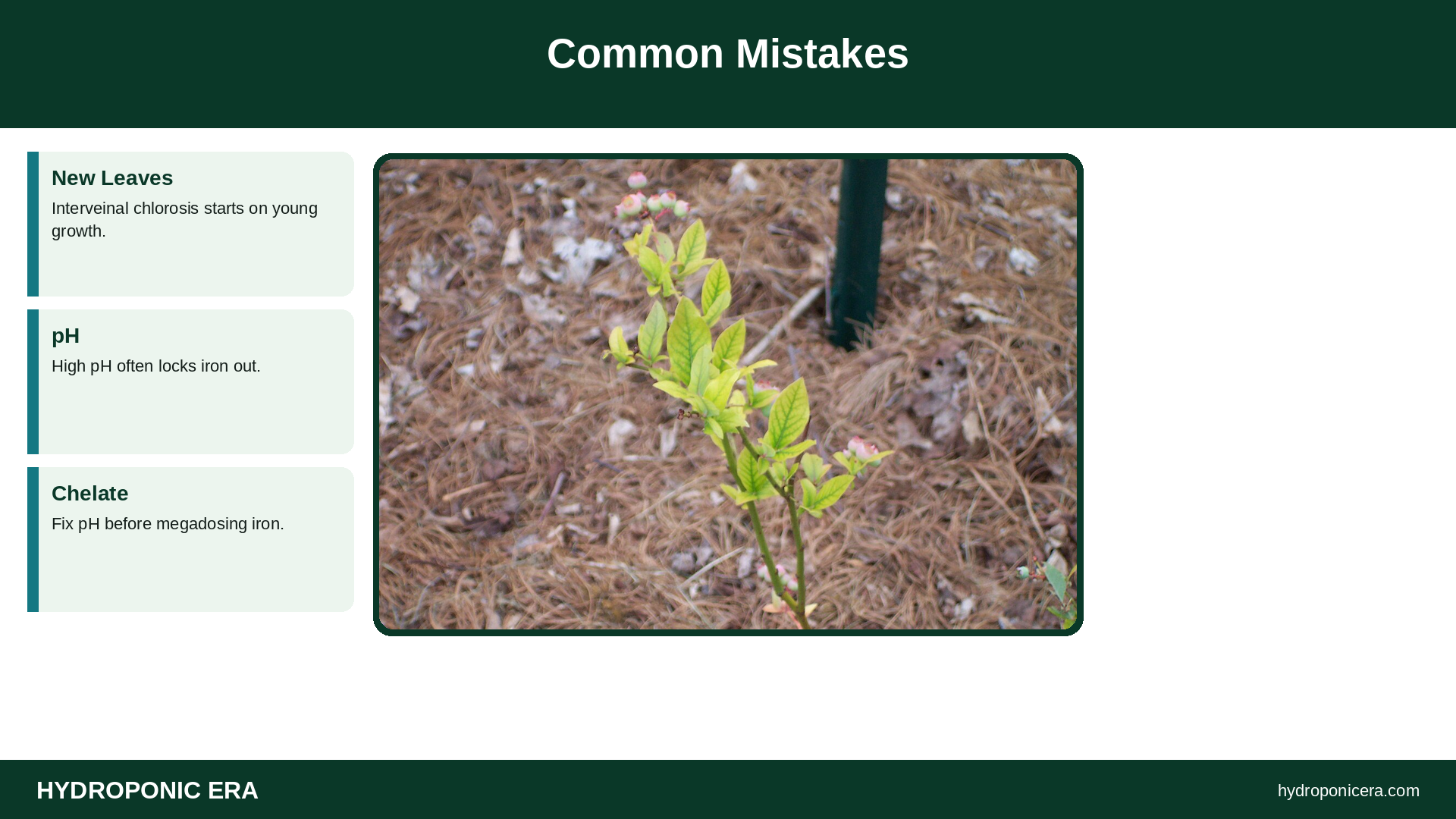
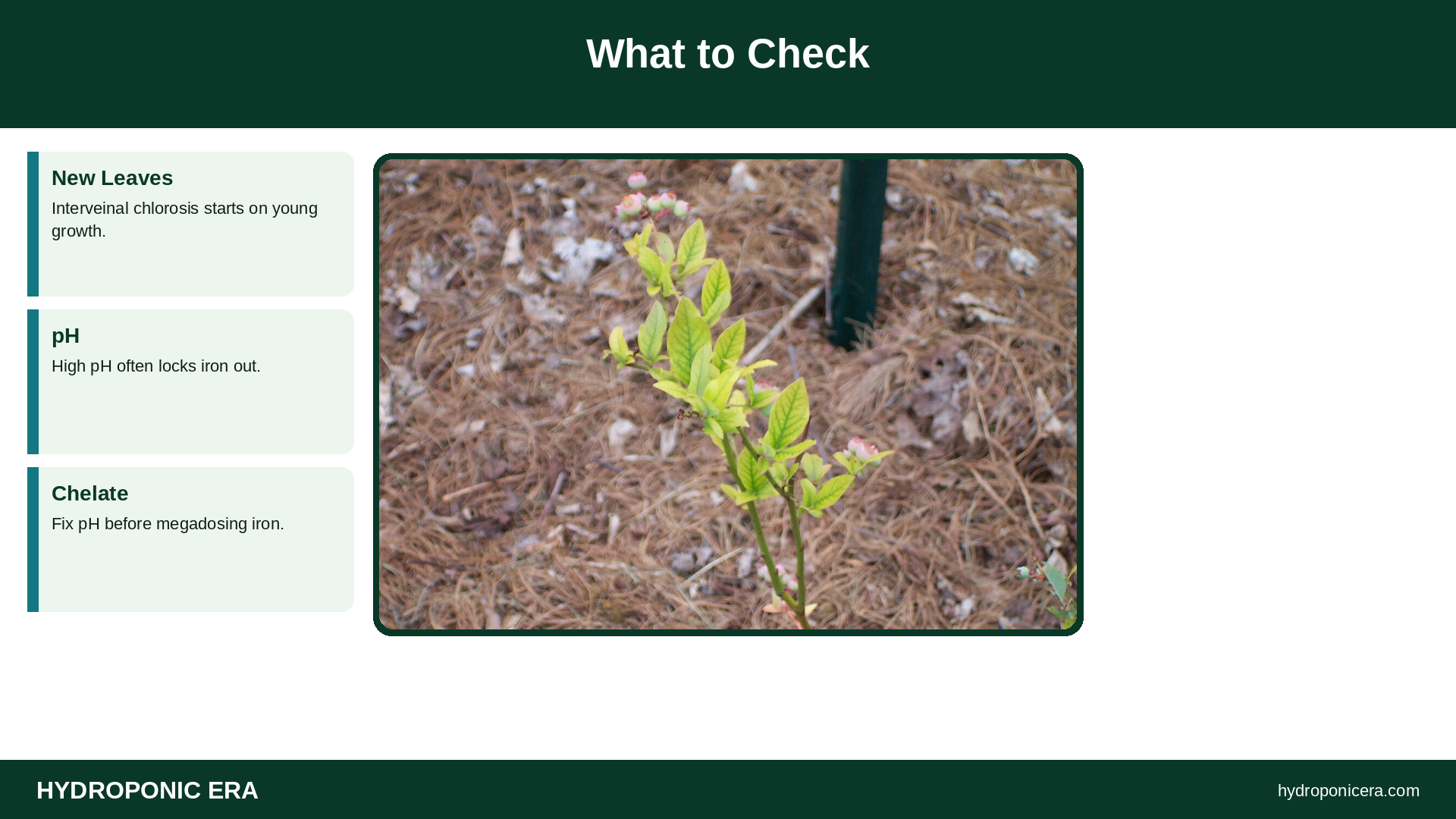
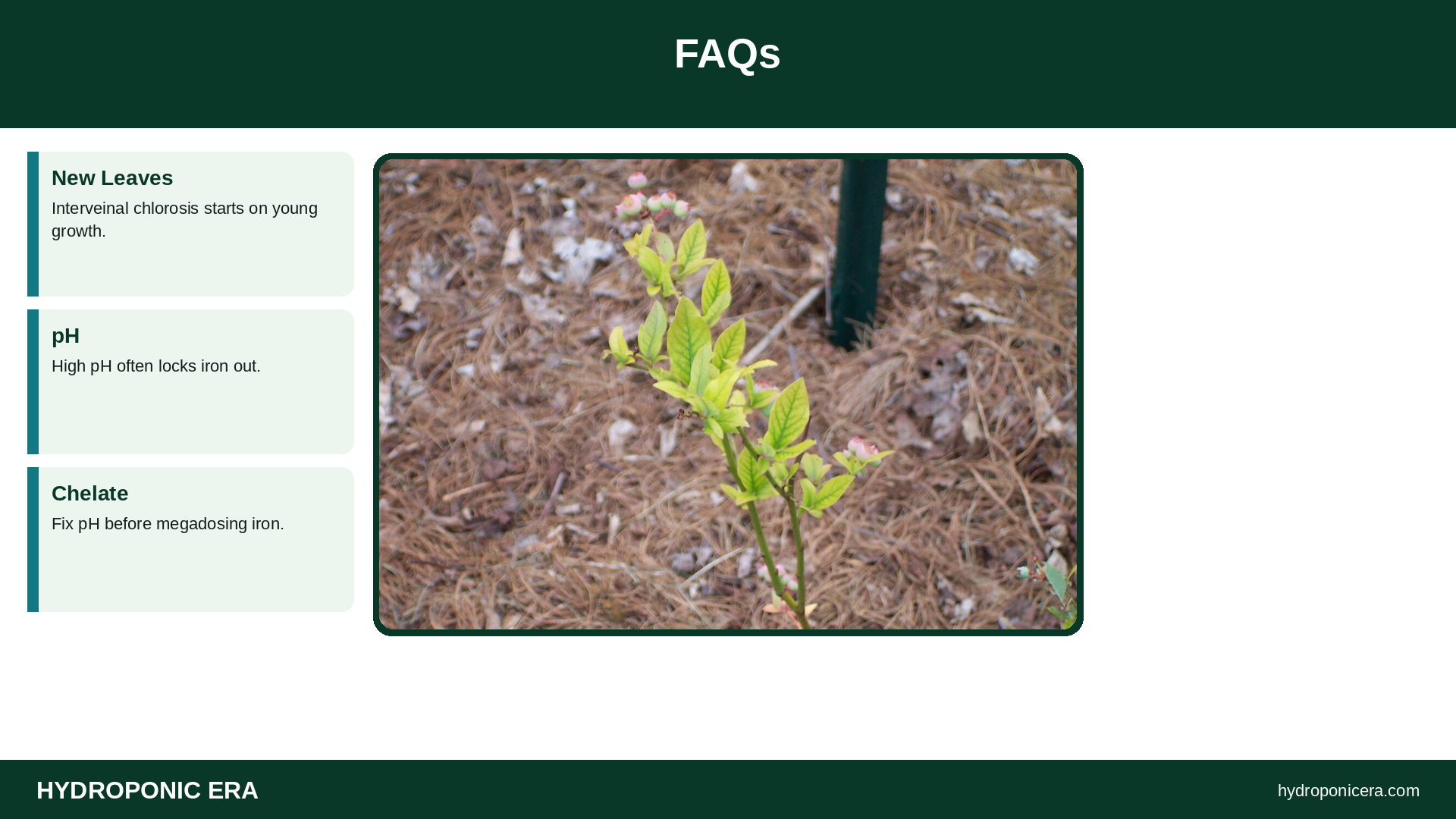
Iron deficiency in hydroponics typically shows as interveinal chlorosis on the newest leaves—yellow leaf tissue with veins that stay greener—because iron is not mobile inside the plant the way nitrogen is. High pH commonly reduces iron availability (lockout), so measure and correct pH before endlessly adding iron. Use chelated iron products carefully and verify you are not masking a broader imbalance.
Key Takeaways
- Penn State’s hydroponic nutrition overview covers essential nutrients including micronutrients and deficiency patterns.
- NC State’s soils and plant nutrients handbook explains nutrient functions and deficiency concepts usable in soilless thinking.
- Oklahoma State EC/pH guidance is critical because pH strongly influences micronutrient availability.
- New-leaf yellowing with green veins points toward immobile micronutrients (often Fe) more than mobile N deficiency on old leaves.
- Calibrate meters—wrong pH readings cause false iron chasing.
- Distinguish true Fe shortage from general lockout and from magnesium patterns on older leaves.
- Root health and oxygen still matter for uptake.
Related HydroponicEra guides
- Yellow leaves guide
- Nutrient lockout
- pH for beginners
- Ca/Mg deficiency
- Nutrients for beginners
- EC and TDS

Symptoms Versus Look-Alikes
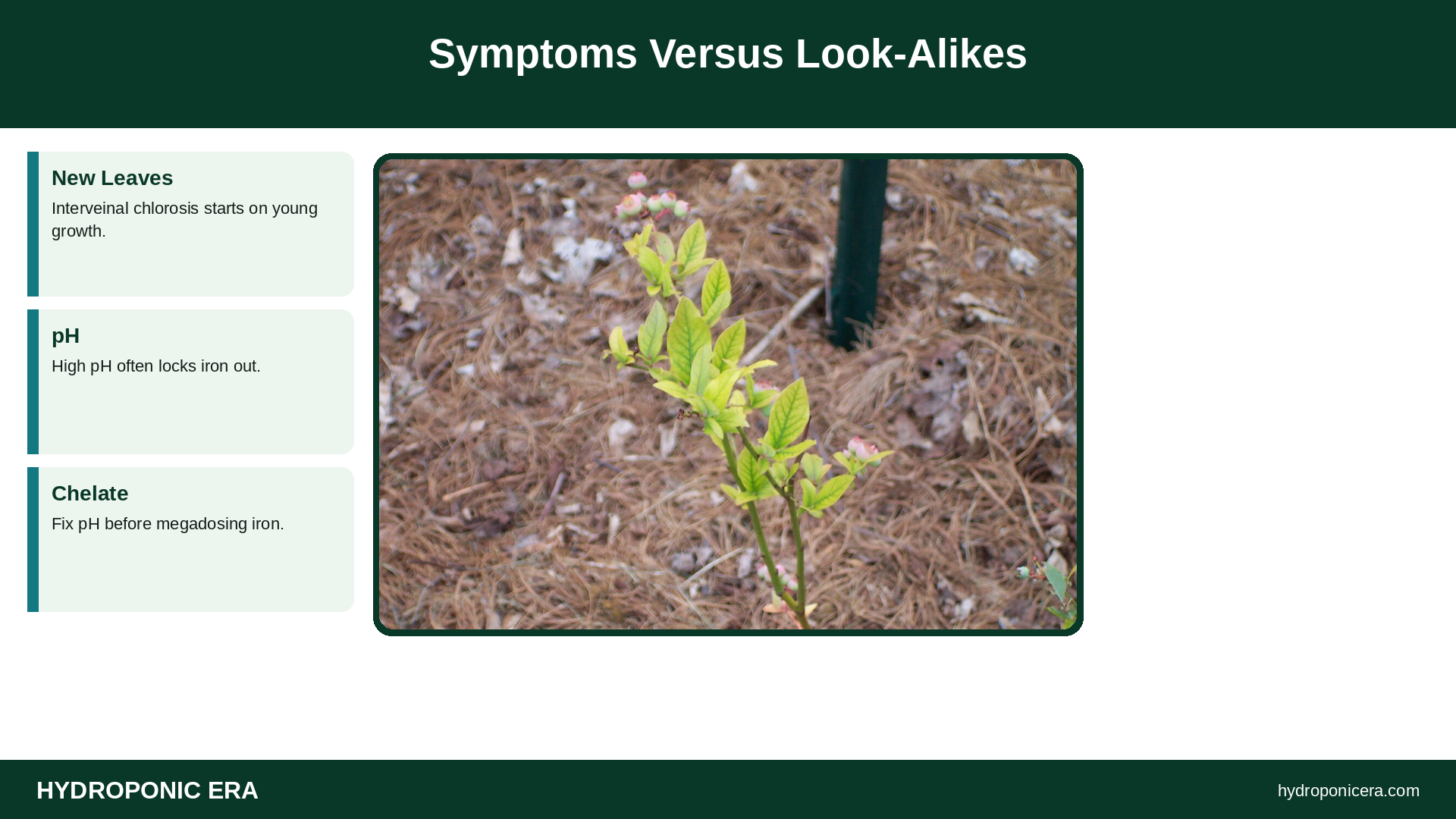
Iron deficiency chlorosis appears first on young leaves: tissue between veins pales while veins may remain darker green. Severe cases can bleach new growth almost white. Older leaves often stay greener longer because iron does not move readily from old to new tissue.
Nitrogen deficiency more often yellows older leaves first. Magnesium deficiency often shows interveinal yellowing on older leaves. Maps matter. Photograph the youngest fully expanded leaves and the oldest leaves before changing anything.
Also rule out light bleach (crispy upper canopy under excessive PPFD) and pest stippling. See the HydroponicEra pest guide if you see webbing or insects.
Why pH Dominates Iron Availability
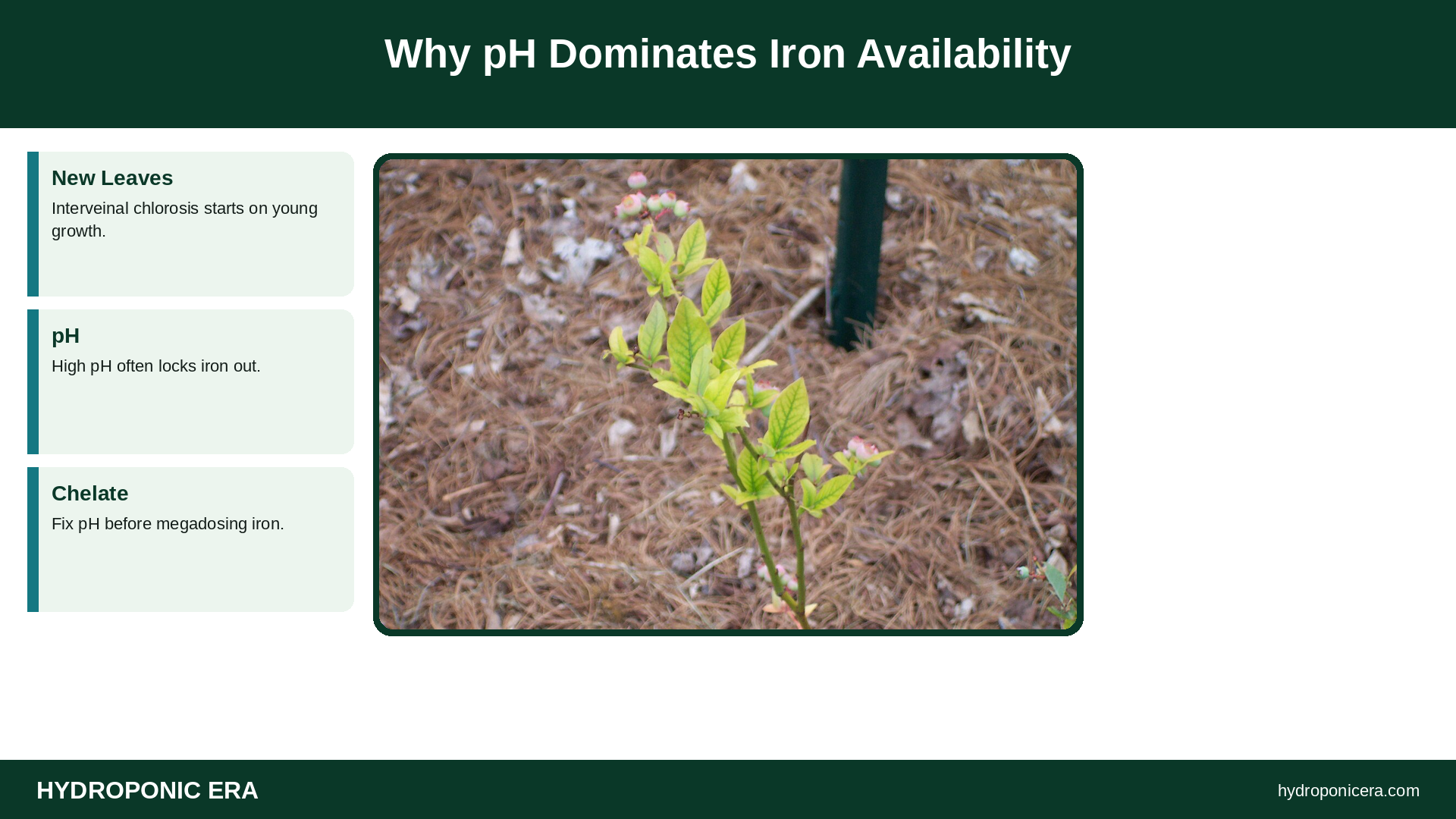
In soilless hydroponics, solution pH strongly influences which micronutrients stay available to roots. When pH drifts high, iron deficiency symptoms can appear even though the fertilizer label lists iron. That is a classic lockout pattern. Oklahoma State’s hydroponic EC and pH fact sheet is a practical companion for target bands and measurement habits.
Corrective order: calibrate meter → measure pH/EC → adjust pH gradually into a soilless band (commonly framed around roughly 5.5–6.5 for many hydroponic crops) → then consider whether additional iron is still needed. Adding iron into a high-pH soup without fixing pH often disappoints.
Penn State’s hydroponics nutrition publication helps you understand essential element roles so you do not treat every yellow leaf as the same deficiency.
Step-by-Step Correction
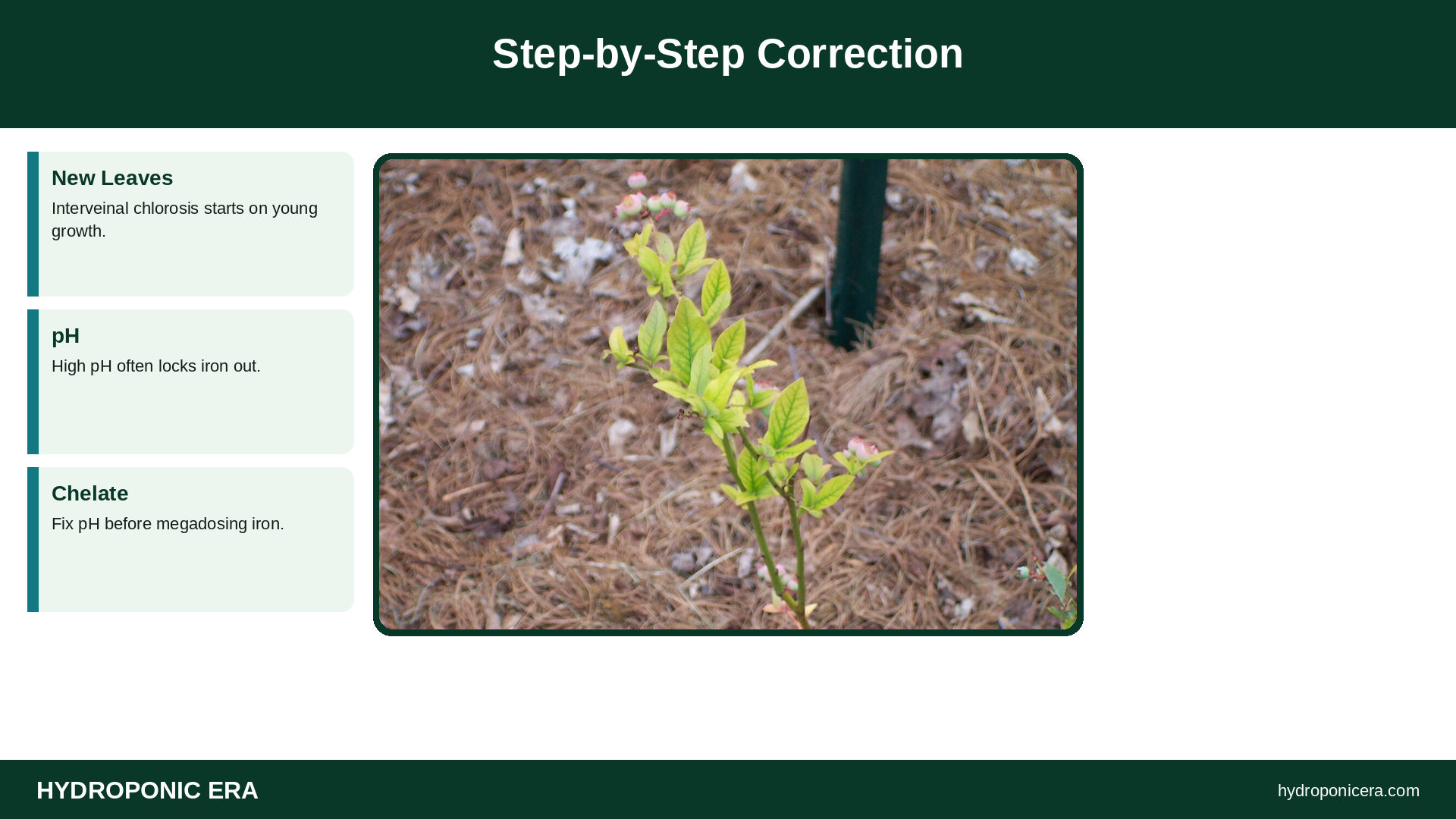
- Confirm the pattern is newest leaves, interveinal.
- Calibrate pH and EC meters; measure the reservoir.
- If pH is high, lower gradually with a labeled pH-down product—avoid overshooting into extreme acidity.
- Verify you are using a complete hydroponic fertilizer that includes micronutrients.
- If pH is already in band and symptoms persist, consider a carefully measured iron chelate addition per product directions—do not “shake in mystery amounts.”
- Inspect roots; uptake fails if roots are dead (brown roots).
- Track recovery on new growth—already chlorotic leaves may not fully re-green.
Variables Table
| Variable | Iron-related note | Action |
|---|---|---|
| pH high | Fe availability drops | Lower gradually; see pH + lockout guides |
| Incomplete fertilizer | Missing micronutrients | Switch to complete hydro formula |
| Root disease | Uptake failure | Oxygen, hygiene, remove worst plants |
| Very high EC | General stress | Dilute; see nutrient burn guide |
| Carbonate-rich hard water | pH bounce-up | See hard water/RO article |
Common Mistakes
- Adding iron weekly without ever measuring pH
- Confusing old-leaf magnesium patterns with new-leaf iron patterns
- Using uncalibrated meters
- Expecting chlorotic leaves to become perfect overnight
- Ignoring hard-water alkalinity that keeps pushing pH up after every adjustment
Hard water and alkalinity deserve their own plan—see the HydroponicEra hard water and RO guide once published in this batch, and Penn State irrigation water interpretation resources for lab-test thinking.
What to Check
- Newest leaf color pattern
- Today’s calibrated pH and EC
- Whether pH rises again within 24 hours
- Root color and smell
- Fertilizer completeness (micronutrients listed)
- Water source alkalinity clues (heavy pH up-drift)
Deeper Practical Notes
Iron chemistry in nutrient solutions is tied to chelation and pH. Growers using hard, alkaline water often watch pH climb after mixing, which repeatedly pushes iron out of comfortable availability. If your pH rebound is chronic, water testing and possible RO blending become more important than buying a larger iron bottle. Penn State irrigation water interpretation resources explain how to read water reports; the HydroponicEra hard-water/RO article in this batch expands practical options.
Chelated iron products differ. Labels matter. Adding random amounts of multiple micronutrient bottles can antagonize other ions or raise EC unexpectedly. Prefer a complete fertilizer program designed for hydroponics, then make small, measured corrections.
Watch the newest leaves for recovery signals. Leaves that formed while iron was unavailable may never look perfect. Judge success by the color of growth that appears after you stabilized pH. That patience prevents overcorrection loops.
Iron issues can coexist with root disease. Dead roots cannot take up micronutrients. If chlorosis pairs with wilt and brown roots, prioritize oxygen, temperature, and sanitation using the brown-roots and Pythium guides rather than only feeding iron.
Document meter calibration dates. A pH probe that reads 0.5 units low can trick you into believing you are acidic enough while iron stays locked. Store probes per manufacturer guidance and use fresh calibration solutions.
For cluster linking: yellow leaves overview, lockout, Ca/Mg, EC/TDS, and pH beginners articles should be open in your reading path whenever new-leaf chlorosis appears. Pattern recognition beats product collecting.
Logging Template for Iron Events
When new-leaf interveinal chlorosis appears, write down: date, crop, pH (pre/post adjustment), EC, reservoir age, source water notes, and whether Fe was recently added. This log prevents circular bottle-stacking. If symptoms return every top-off, suspect alkalinity-driven pH rise and read the hard water/RO article.
For mixed systems, note which species shows Fe symptoms first—some crops telegraph micronutrient stress earlier. Correct the shared solution carefully so you do not burn less-sensitive neighbors.
FAQs
Is yellow new growth always iron deficiency?
No. High pH lockout, other micronutrients, light bleach, and disease can overlap. Diagnose with pattern + meters.
What pH should I use?
Many soilless hydroponic guides frame a practical band near 5.5–6.5. Crop nuances exist—measure and stay consistent rather than chasing perfection to two decimals every hour.
Do I need Fe-EDDHA specifically?
Chelate choice depends on pH and product labeling. Follow reputable hydroponic fertilizer guidance; do not invent chemistry.
Can I foliar spray iron?
Some growers use foliar feeds as a temporary bridge. Root-zone pH correction remains the durable fix when lockout is the cause.
How is this different from nitrogen deficiency?
Nitrogen deficiency usually shows on older leaves first; iron patterns favor youngest leaves.
Practice log and next steps
Keep a simple logbook for this topic: date, meter readings when relevant, what you changed, and what the plants did over the next three to seven days. Hydroponics rewards slow feedback loops more than frantic daily recipe rewrites.
When in doubt, return to calibrated pH and EC, root inspection, and light adequacy before buying another bottle. Extension hydroponic and plant nutrition resources emphasize fundamentals for a reason.
Link outward to the matching HydroponicEra cluster pages so readers can continue into systems, water, crops, or troubleshooting without dead ends. Internal links are part of topical authority, not decoration.
Sanitation and opaque reservoirs prevent many secondary problems that look like nutrient mysteries. Clean systems make diagnosis clearer.
If you sell produce or teach workshops, document procedures. Consistency protects customers and your future self.
Sources
- Penn State Extension — Hydroponics Systems and Principles of Plant Nutrition
- NC State Extension — Soils and Plant Nutrients
- Oklahoma State University Extension — Electrical Conductivity and pH Guide for Hydroponics
- Oklahoma State University Extension — Hydroponics
- Penn State Extension — Interpreting Irrigation Water Tests
- University of Florida IFAS — CV265: Fertilizer Management for Greenhouse Vegetables
1 thought on “Iron Deficiency in Hydroponics: Interveinal Yellow New Leaves”