
Quick Answer
Foliar Feeding Hydroponics (foliar feeding hydroponics) is the practical focus of this guide for home growers.
Foliar feeding in hydroponics can help as a short-term micronutrient rescue when roots cannot take up nutrients (pH lockout, root damage), but it should not replace a correct root-zone solution. Sprays raise humidity on leaf surfaces and can worsen foliar disease if rooms are already damp.
Use with iron deficiency, deficiency chart, powdery mildew, and humidity/VPD.
Key Takeaways
- Roots remain the primary nutrient pathway in hydroponics; foliar is a bridge, not the highway.
- Penn State nutrition literacy helps you pick which deficiency patterns might respond to foliar micronutrients.
- Iron chlorosis on new leaves is a classic case where foliar Fe is sometimes used while you fix pH/roots.
- Spray in lower light / cooler parts of the day to reduce burn risk; cover both leaf sides lightly.
- High humidity + wet leaves invites powdery mildew and other foliar diseases.
- Do not foliar-feed as a way to ignore reservoir EC/pH problems.
- Avoid oily or unknown mixes that clog stomata or leave heavy residues on food crops.
- Food-safety: wash harvestables and respect label PHI/restrictions for any product used.
Related HydroponicEra guides
- Iron deficiency
- Powdery mildew
- Humidity and VPD
- Deficiency chart
- Nutrient lockout
- Yellow leaves
- pH control
- Ca/Mg
- Food safety
Foliar Feeding Hydroponics: When Foliar Feeding Helps
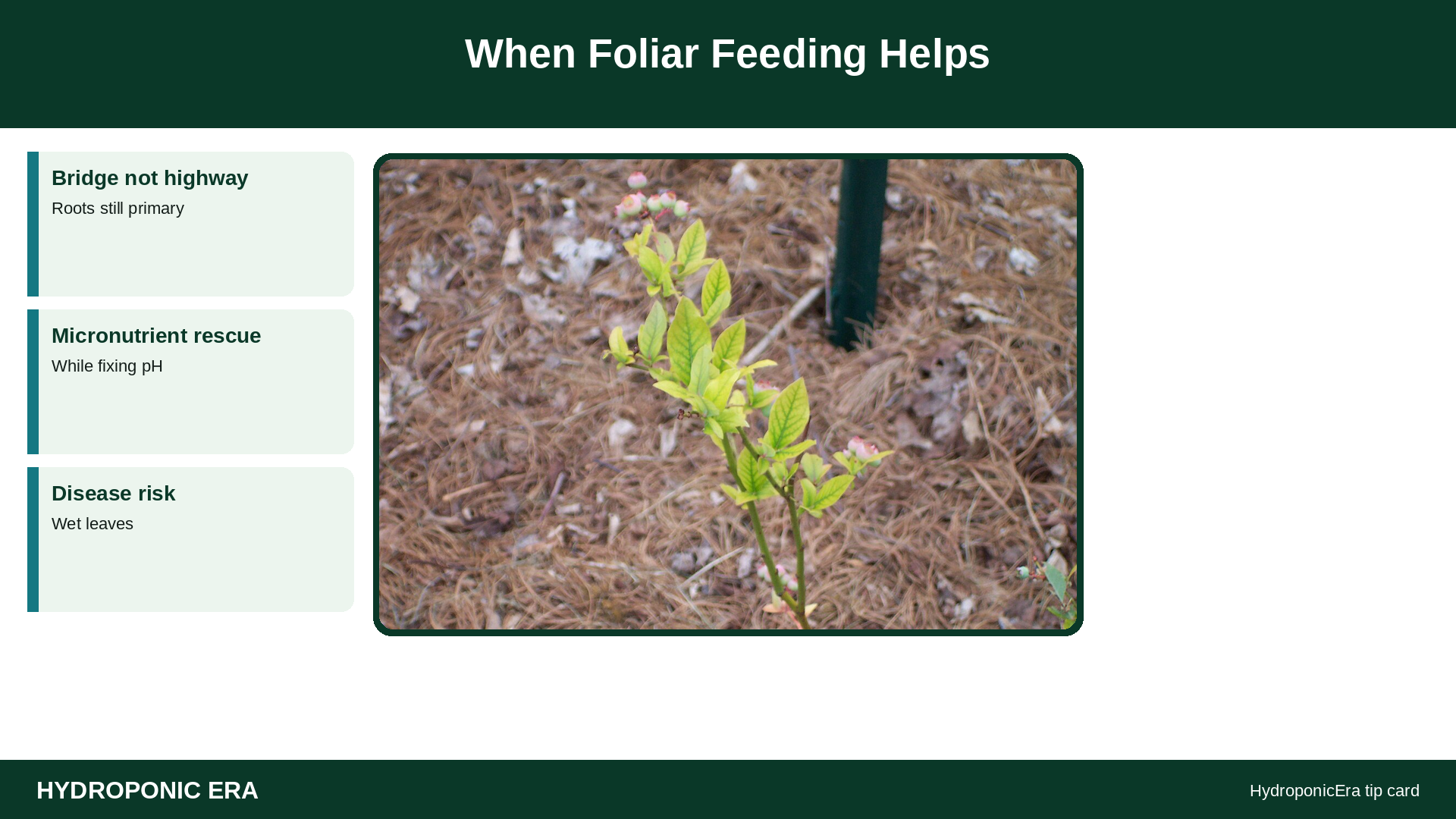
Foliar applications deliver small amounts of nutrients to leaf tissue. They can buy time when new leaves show micronutrient symptoms while you correct root-zone pH, EC, or oxygen. They rarely fix chronic underfeeding of macros for a whole canopy.
Iron deficiency patterns (young-leaf interveinal chlorosis) are a frequent hydroponic example—see iron deficiency. Calcium issues are trickier because Ca movement and transpiration matter; foliar Ca is sometimes discussed for fruit disorders, but environment and steady root uptake still dominate (blossom end rot, Ca/Mg).
Always differential-diagnose against lockout and root disease (lockout, brown roots) before spraying.
Foliar Feeding Hydroponics: Step-by-Step Cautious Foliar Workflow
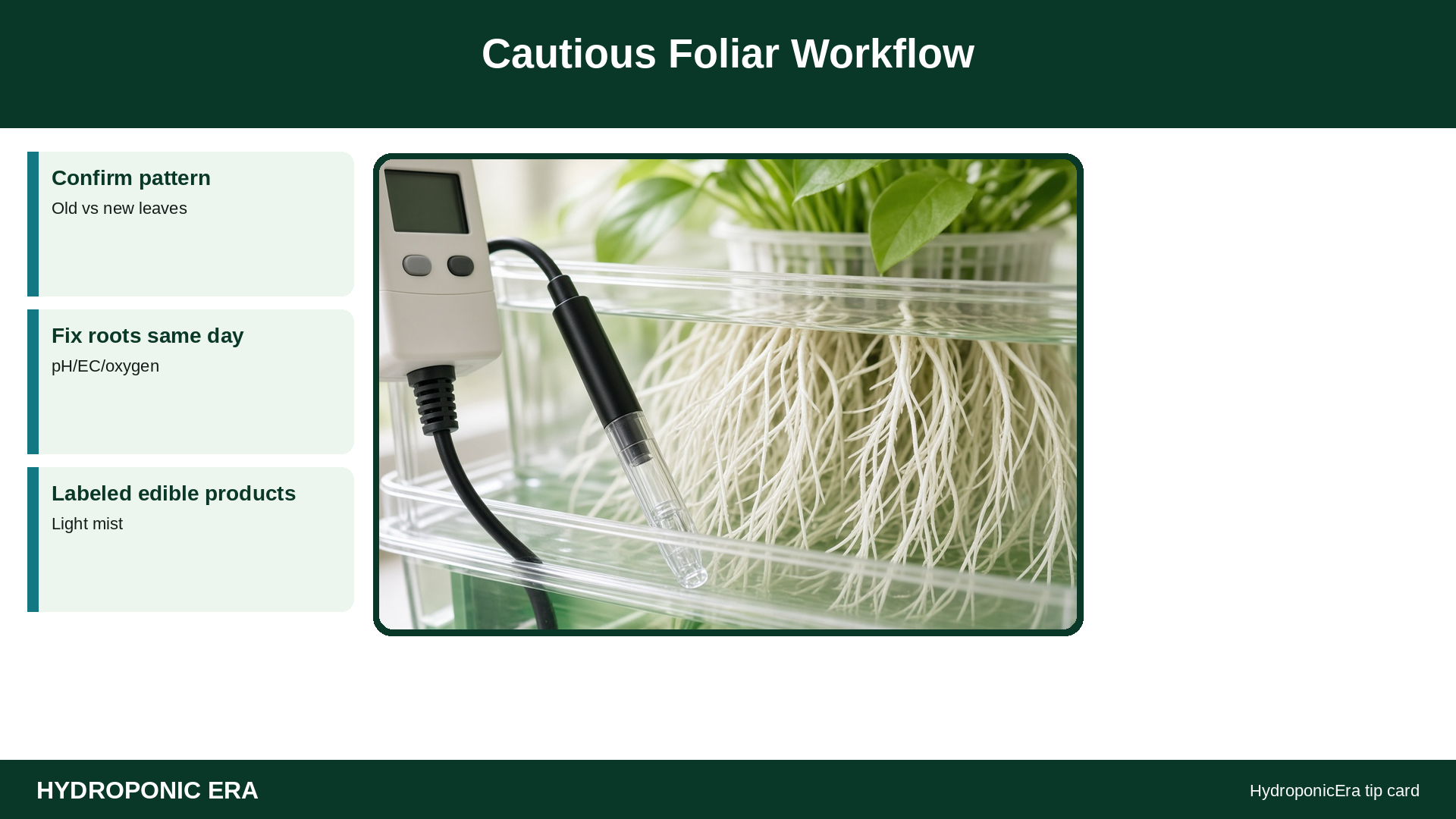
- Confirm the pattern with leaf position and the deficiency chart.
- Measure reservoir pH/EC and inspect roots the same day.
- Fix root-zone causes in parallel (pH band, oxygen, complete nutrient).
- Choose a product labeled for foliar use on edibles when spraying food crops.
- Dilute per label; when unsure, err milder and watch for burn.
- Spray as a fine mist to lightly cover, not drench to runoff puddles.
- Apply when lights are gentler and airflow can dry leaves within a reasonable time.
- Avoid spraying into a powdery-mildew-prone humid tent without climate fixes (PM, VPD).
- Reassess in several days; repeat only if justified.
- Wash harvestables and follow any label harvest intervals.
Foliar Feeding Hydroponics: Foliar vs Root Feeding Decision Table
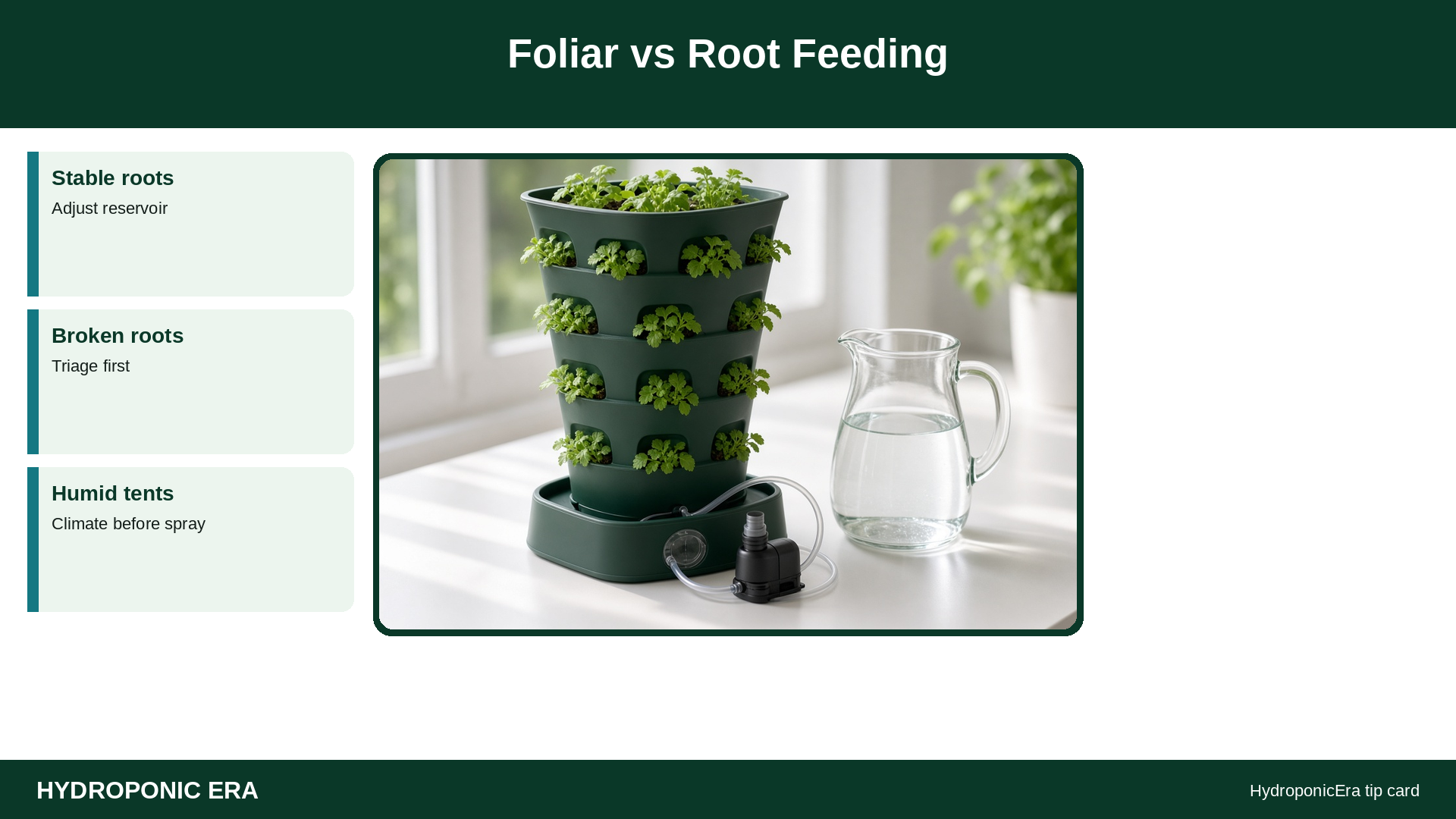
| Situation | Prefer | Why |
|---|---|---|
| Stable roots, correct pH, hungry plants | Root-zone strength adjust | Scales to whole plant |
| New-leaf micronutrient pattern + pH off | Fix pH + optional foliar bridge | Buys time |
| Root rot / anaerobic tank | Root triage, not foliar macros | Uptake still broken |
| High humidity disease pressure | Climate first | Wet leaves add risk |
| Fruit Ca disorders | Environment + steady Ca uptake | Foliar alone often insufficient |
Foliar Feeding Hydroponics: Common Mistakes
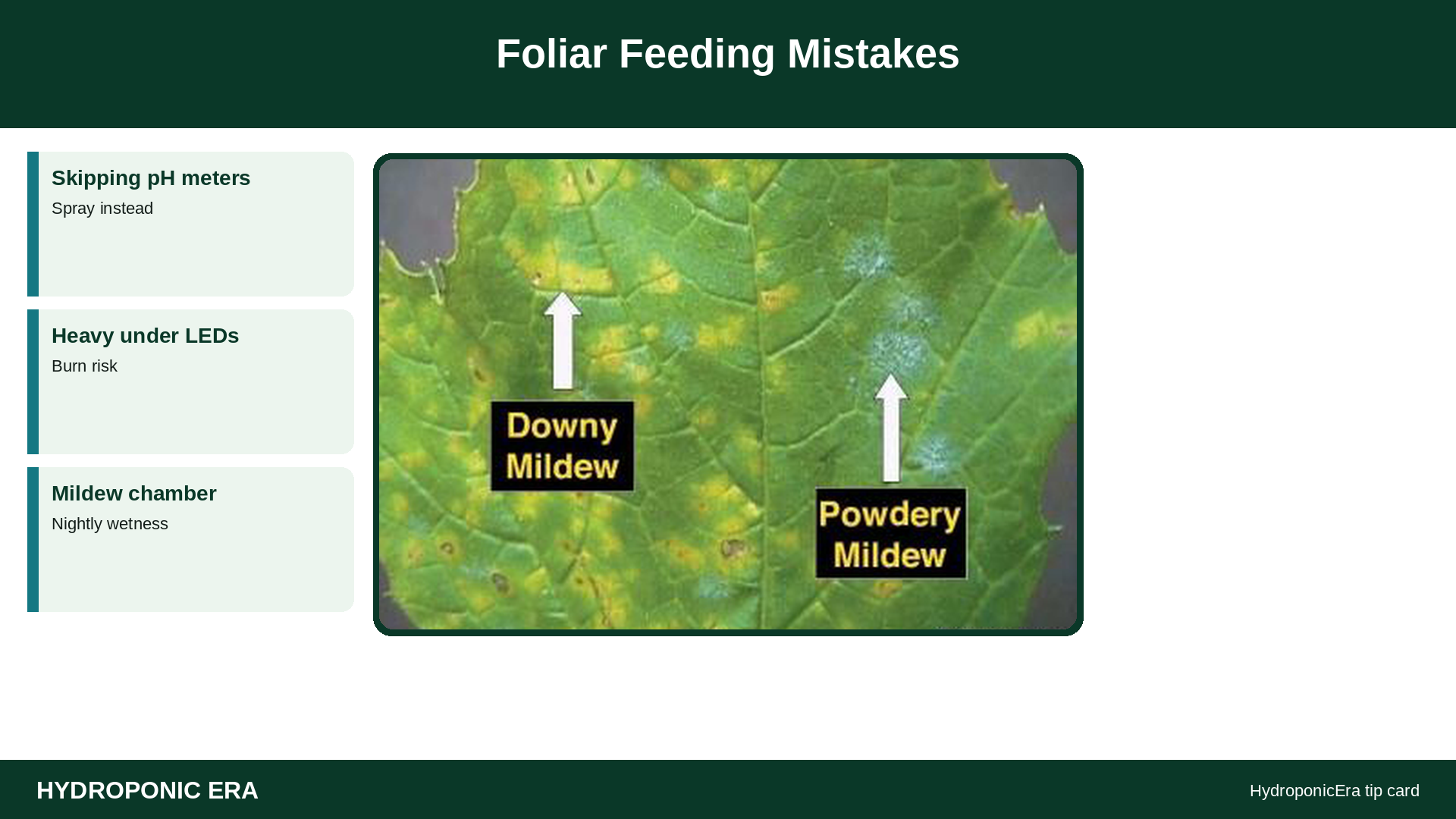
- Foliar feeding instead of calibrating pH meters
- Spraying heavy droplets under intense LED heat
- Using soil “miracle” mixes not meant for leaves/edibles
- Creating a mildew chamber with nightly wet canopies
- Expecting foliar N to replace a correct reservoir recipe
- Ignoring root smell while polishing leaves
- Skipping food-crop label and wash discipline
Foliar Feeding Hydroponics: Troubleshooting After Foliar Sprays

| After spraying | If you see | Next |
|---|---|---|
| Leaf edge burn | Too strong / light heat | Dilute more; spray off-peak |
| White patches expand | Possible mildew | Powdery mildew + humidity control |
| No greening in a week | Wrong diagnosis / roots still bad | Recheck pH, roots, chart |
| Sticky residue | Poor product choice | Rinse cautiously; switch products |
Also see yellow leaves and tip burn.
What to Check Before You Foliar Spray
- Old vs new leaves documented?
- Reservoir pH/EC calibrated readings today?
- Roots healthy enough that foliar is only a bridge?
- Room humidity/VPD acceptable for wet leaves?
- Product labeled for foliar/edible use?
- Lights dimmed or timing off-peak?
- Harvest wash plan ready?
Practical Framework: Bridge, Diagnose, Then Stop
Use a three-step mental model. Bridge: a mild, labeled foliar may support expanding leaves while roots recover. Diagnose: the same day, fix pH, EC, oxygen, or light causes. Stop: once new growth emerges clean from a corrected root zone, return to root feeding only.
Micronutrient rescues are the usual justification. Macro nutrient shortfalls across an entire plant are rarely solved by leaf misting alone—raise complete solution strength carefully or reset the reservoir instead (mixing, EC/TDS).
Indoor tents concentrate risk. Every spray adds leaf wetness hours. If VPD is already low and fans are weak, you may trade a yellow leaf for a mildew outbreak. Improve airflow and humidity control before making foliar a habit.
For fruiting crops, remember blossom-end disorders and tip burn often track calcium movement and transpiration, not a missing nightly spray. Steady irrigation, sensible EC, and canopy climate beat panic foliar calcium. Cross-check blossom end rot and tip burn.
Keep a spray log: date, product, dilution, plant stage, and photo. Without notes, growers oscillate between burn and deficiency. The same discipline you use for reservoir logs applies to foliar experiments (pH, meters).
If you sell or gift produce, disclose nothing magical—just wash thoroughly and follow label rules. Foliar residues are part of home food safety thinking, not an afterthought.
Variables and Edge Cases
Seedlings: tender leaves burn easily—prefer root corrections. Hairy or delicate herbs: residues show; use extra caution. Flowering fruit crops: avoid heavy sprays on open blossoms you need for fruit set; see indoor pollination.
Hard water spots on leaves after spraying are cosmetic but can confuse deficiency diagnosis—use decent water quality for foliar mixes when possible (hard water/RO).
If powdery mildew is already present, fix climate and sanitation first; nutrient foliar is not a fungicide substitute (powdery mildew, cleaning).
FAQs
Can foliar feeding replace hydroponic nutrients?
No—use it as a supplement while roots work correctly.
Best time to spray?
When leaves can dry and light/heat stress is lower—often lights-off or lower intensity periods.
Iron foliar useful?
Sometimes for new-leaf chlorosis while fixing pH—see iron guide.
Will it cause mildew?
Wet leaves + high humidity increase risk—manage climate.
Safe on lettuce?
Only with edible-appropriate products, light coverage, and wash habits.
Ca sprays fix BER alone?
Seldom—steady root uptake and environment matter more.
Foliar Feeding Hydroponics: Practical Checklist
Foliar Feeding Hydroponics matters every week in a home system. Recheck foliar feeding hydroponics after transplants, heat spikes, and canopy fill-in. Strong foliar feeding hydroponics habits beat one-time guesses. When foliar feeding hydroponics drifts, leaves crowd, roots stress, or harvest quality drops. Write foliar feeding hydroponics targets into your log so you do not rely on memory. Teach helpers your foliar feeding hydroponics checklist before you leave town.
Sources
- Penn State Extension — Hydroponics Systems and Principles of Plant Nutrition
- Oklahoma State University Extension — Electrical Conductivity and pH Guide for Hydroponics
- Oklahoma State University Extension — Hydroponics
- NC State Extension — Soils and Plant Nutrients (Extension Gardener Handbook)
- University of Florida IFAS — CV265: Fertilizer Management for Greenhouse Vegetables
- Virginia Cooperative Extension — SPES-720: Calculating and Using Daily Light Integral (DLI)
- University of Florida IFAS — HS1279: Leafy Greens in Hydroponics and Protected Culture for Florida
- Ohio State University Extension — HYG-1132 Food safety / produce handling