
Quick Answer
Organic Bioponic Nutrients Hydroponics (organic bioponic nutrients hydroponics) is the practical focus of this guide for home growers.
Organic and bioponic nutrients for home hydroponics can work, but they behave differently from clear mineral salt fertilizers: more biofilm, smell risk, emitter clogs, and EC readings that are harder to interpret. Beginners usually succeed faster on complete mineral nutrients, then experiment with organics once hygiene and filtration habits are solid.
See nutrients for beginners, mixing, NFT, and organic farming for beginners.
Key Takeaways
- Mineral hydroponic fertilizers deliver ions plants absorb directly; many organic products rely on microbial mineralization.
- Penn State hydroponic nutrition principles still apply: essential elements have functions—delivery method changes.
- NFT and fine drip systems clog more easily with organic particulates and biofilms.
- EC/TDS can under-represent some organic mixes—observe plants, not meters alone.
- Foul anaerobic smells mean oxygen and cleanliness problems—not “healthy compost tea vibes.”
- Food-safety and reservoir hygiene matter when organics feed microbes ({a(‘foodsafe’,’food safety’)}).
- If you want organics, prefer systems with media, filters, and easy cleaning access.
- Do not mix random soil organics into recirculating tanks without a plan.
Related HydroponicEra guides
- Nutrients for beginners
- Mixing nutrient solution
- NFT for beginners
- Organic farming beginners
- Cleaning
- Algae
- Dissolved oxygen
- EC and TDS
- Reservoir setup

Organic Bioponic Nutrients Hydroponics: Why Organics Behave Differently in Water Culture

In soil, microbes help convert organic amendments into plant-available forms. In recirculating hydroponics, that biology happens inside pipes and reservoirs—exactly where biofilm and clogs hurt you.
UF/IFAS and land-grant hydroponic materials commonly assume soluble fertilizer management for protected culture. That does not ban organics; it explains why mineral salts dominate reliable home teaching content.
Bioponic approaches intentionally use organic nutrition with managed biology. Success depends on aeration, filtration, temperature control, and disciplined cleaning—more moving parts than a clear two-part mineral bottle.
Organic Bioponic Nutrients Hydroponics: Beginner Decision Path

- Choose your goal: learning hydroponics reliably vs insisting on organic inputs from day one.
- If learning systems, start mineral for clear EC/pH feedback.
- If going organic, pick products labeled for hydroponics/bioponics when possible.
- Pre-filter and avoid dumping solids into pumps and emitters.
- Prefer media beds / Dutch-style over skinny NFT until you have filtration (NFT, Dutch).
- Aerate aggressively and keep reservoirs cool enough for oxygen.
- Schedule scrubbing more often than a sterile mineral system.
- Watch for slime, odor, and pressure loss in lines.
- Keep a mineral backup plan if a crop is failing mid-cycle (flush).
- Harvest with food-safety habits regardless of nutrient type.
Organic Bioponic Nutrients Hydroponics: Mineral vs Organic Home Comparison

| Factor | Mineral salts | Organic/bioponic |
|---|---|---|
| EC readability | Usually clearer | Can be misleading |
| Clog risk | Lower | Higher |
| Odor/biofilm | Lower if clean | Higher management need |
| Beginner feedback | Faster learning | More variables |
| Philosophy fit | Conventional hydro | Organic preference |
Related reading: mixing, EC/TDS, cleaning.
Organic Bioponic Nutrients Hydroponics: Common Mistakes

- Pouring soil compost tea into NFT channels
- Ignoring pump strainers until flow collapses
- Reading low EC and overfeeding organics into a clogged mess
- Assuming “organic” means sterile or pathogen-free
- Skipping aeration because the tank “looks rich”
- Never planning a full clean between crops
- Blaming plants when emitters are half-blocked
Organic Bioponic Nutrients Hydroponics: Troubleshooting Organic Reservoirs

| Symptom | Likely cause | Fix direction |
|---|---|---|
| Rotten smell | Anaerobic organics | Aerate; clean; reduce load |
| Emitter clogs | Biofilm/particles | Filter; flush; simplify |
| Yellow plants + weird EC | Mineralization lag / pH | Measure pH; consider reset |
| Slimy roots | Pathogen + low O2 | Pythium, DO |
| Algae mats | Light + nutrients | algae control |
What to Check Before Switching to Organics
- Is your system type tolerant of organics (media vs fine NFT)?
- Filtration/strainers in place?
- Aeration strong and reliable?
- Last reservoir scrub date?
- Product actually labeled for hydro use?
- Food-safety harvest plan ready?
- Mineral fallback nutrients on hand?
Practical Framework: Choose Complexity on Purpose
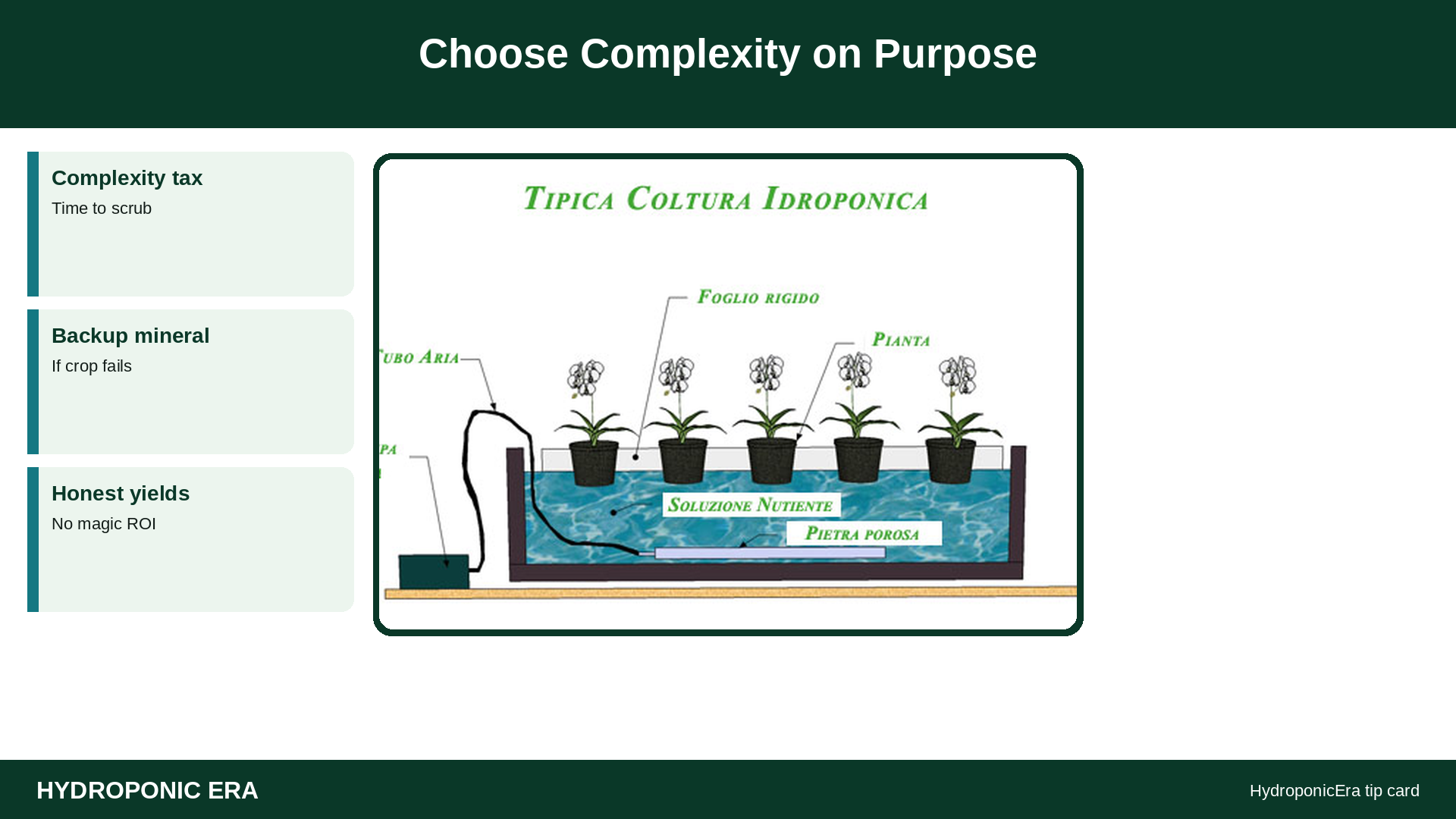
Organic hydroponics is a complexity choice. You are volunteering for more biology management in exchange for input philosophy. That can be rewarding when you enjoy the craft. It is a poor default when your only goal is reliable salad greens in a bedroom tent next month.
A workable home path: master mineral recirculating or Kratky basics first (Kratky, start at home), learn what healthy roots look like, then convert one small media system to a hydro-labeled organic feed. Keep NFT and misting systems mineral until filtration is excellent.
Budget time for strainer cleaning, reservoir scrubbing, and smell checks. If your schedule already struggles with pH calibration, organics will feel chaotic. Use timers/automation for pumps, but do not automate away visual inspection.
When comparing products, ask: Is it formulated for water culture? Does it list expected mixing order? Are solids meant to be filtered? What is the storage life after opening? Vague “plant food” bottles designed for soil watering cans often fail in recirculating loops.
Yield expectations should stay honest. Organics do not automatically outyield minerals at home; results depend on environment and grower skill. Track grams and weeks yourself rather than quoting marketing ROIs. See yield expectations and cost to start for planning context.
If a living reservoir goes wrong, have a reset ritual: drain, clean, flush lines, restart mineral, then decide whether to retry organics next cycle. Pride is cheaper than losing a whole canopy to slime.
Variables That Make or Break Organic Hydro at Home
Temperature: warm reservoirs accelerate unwanted microbes. Filtration: sock filters and strainers are not optional accessories. Plant density: overcrowding raises cleanup difficulty. System design: open media trays forgive more than capillary NFT channels.
Light leaks still grow algae even when your fertilizer is organic. Opacity remains non-negotiable (algae, reservoir setup).
For learning resources beyond this page, stay with university hydroponic nutrition and system primers (nutrients, system comparison) rather than anonymous recipe screenshots.
If you are comparing philosophies for content clusters, link mineral nutrient literacy (beginner nutrients, mixing) beside this page so readers can choose deliberately. Topical authority means covering both paths honestly—not pretending organics are always superior or always impossible.
Commercial greenhouse literature often assumes soluble fertilizers because consistency and food-safety programs are easier to document. Home growers can still experiment, but should borrow the same seriousness about cleanliness, labeling, and record-keeping.
FAQs
Can beginners use organic hydro nutrients?
Possible, but mineral salts usually teach faster with fewer clogs.
Is bioponic the same as aquaponics?
Related living ideas, but aquaponics centers on fish; bioponic usually means organic fertigation without fish.
Will EC tell me everything?
Often no—observe plants and system hygiene closely.
NFT OK?
Higher clog risk; many growers avoid heavy organics in NFT.
Smell normal?
Mild earthy odor can occur; foul anaerobic stench is a warning.
More on organics philosophy?
See the organic farming beginners guide for soil-side context.
Organic Bioponic Nutrients Hydroponics: Practical Checklist
Organic Bioponic Nutrients Hydroponics matters every week in a home system. Recheck organic bioponic nutrients hydroponics after transplants, heat spikes, and canopy fill-in. Strong organic bioponic nutrients hydroponics habits beat one-time guesses. When organic bioponic nutrients hydroponics drifts, leaves crowd, roots stress, or harvest quality drops. Write organic bioponic nutrients hydroponics targets into your log so you do not rely on memory. Teach helpers your organic bioponic nutrients hydroponics checklist before you leave town. Improve organic bioponic nutrients hydroponics in small steps—measure, adjust, then wait a day.
Sources
- Penn State Extension — Hydroponics Systems and Principles of Plant Nutrition
- Oklahoma State University Extension — Hydroponics
- Oklahoma State University Extension — Electrical Conductivity and pH Guide for Hydroponics
- University of Florida IFAS — CV265: Fertilizer Management for Greenhouse Vegetables
- University of Florida IFAS — HS1279: Leafy Greens in Hydroponics and Protected Culture for Florida
- University of Georgia Extension — B1314: Soilless Growing Media
- Michigan State University Extension — Hydroponics as an agricultural production system
- Penn State Extension — A Water Quality Toolkit for Greenhouse and Nursery Production
1 thought on “Organic and Bioponic Nutrients for Home Hydroponics”