
Quick Answer
Hydrogen Peroxide Hydroponics (hydrogen peroxide hydroponics) is the practical focus of this guide for home growers.
Hydrogen peroxide (H2O2) in hydroponics is sometimes used as an emergency oxygen/pathogen aid or cleaning helper. Chronic daily dosing is often oversold. Prefer fixing dissolved oxygen, temperature, and hygiene; use peroxide cautiously with labeled household/garden concentrations and never invent “miracle ppm” from social media.
Pair this page with Pythium, algae, and cleaning.
Key Takeaways
- H2O2 breaks down to water and oxygen—but transient chemistry is not a replacement for continuous aeration.
- UKY hydroponic root-disease guidance prioritizes cultural controls; oxidizers are not a free pass to run hot anaerobic tanks.
- Concentration matters: drugstore 3% is not the same as concentrated industrial grades—handle and dilute carefully.
- Overdosing can damage fine roots and kill beneficial organisms you intended to keep.
- Use peroxide more as a targeted sanitation/emergency tool than as a permanent nutrient additive.
- Store away from children/pets; never mix casually with incompatible cleaners.
- Algae and biofilm still need light control and scrubbing ({a(‘algae’,’algae’)}, {a(‘clean’,’clean’)}).
- If roots are already rotting, combine triage with reservoir reset—not peroxide alone.
Related HydroponicEra guides
- Dissolved oxygen
- Pythium root rot
- Algae in reservoirs
- Cleaning and sterilizing
- Brown roots
- Air pumps
- Reservoir temperature
- Water changes
- Food safety
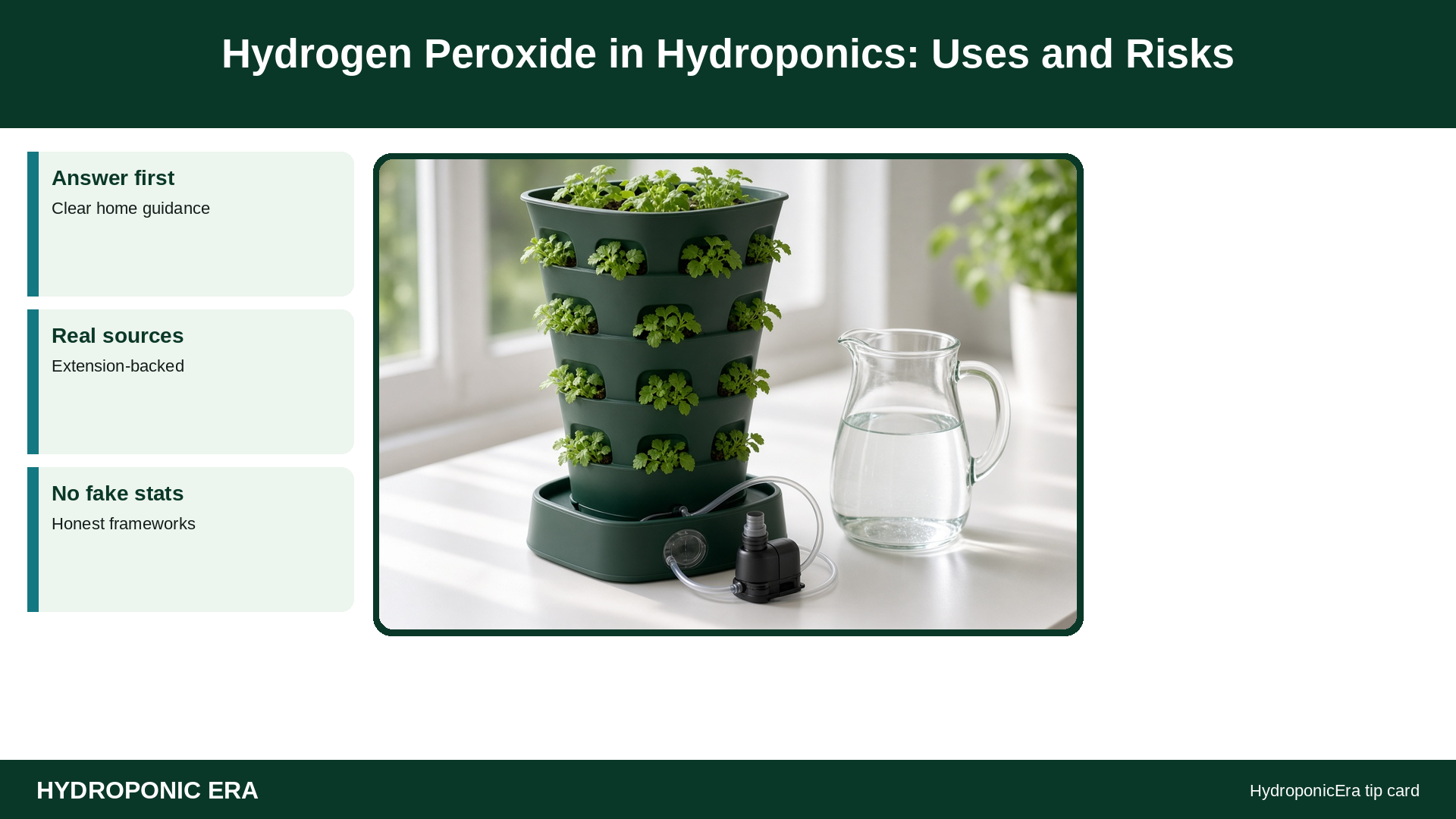
Hydrogen Peroxide Hydroponics: What Peroxide Can and Cannot Do
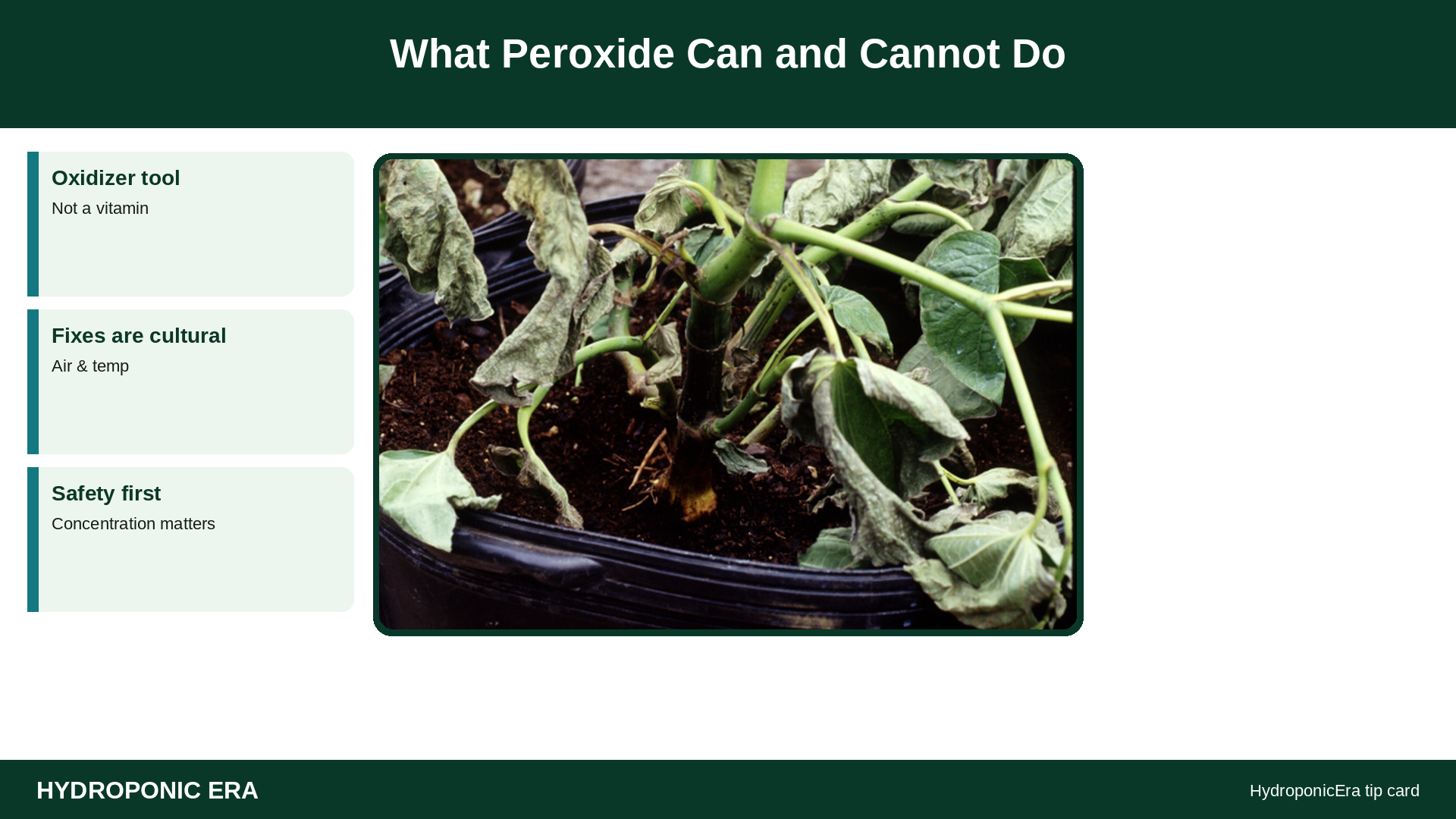
Hydrogen peroxide is an oxidizer. In water it can release oxygen as it decomposes and can reduce some microbial loads on contact. That does not mean a weekly splash fixes poor air stones, warm reservoirs, or constant light leaks.
Extension disease-management framing for hydroponic roots (including UKY materials) centers on environment: oxygen, temperature, sanitation, and avoiding pathogen introduction. Peroxide sits downstream of those fundamentals.
Home growers should also respect chemical safety. Concentrated peroxide causes burns; food-crop systems deserve careful, labeled use—not random internet recipes. When in doubt, favor mechanical aeration and a clean reset.
Hydrogen Peroxide Hydroponics: Safer Home Workflow If You Choose to Use It
- Identify the goal: equipment sanitation between crops vs emergency response during root stress.
- Fix aeration and temperature first so you are not masking a chronic oxygen problem.
- Use the concentration on the bottle; calculate dilutions carefully; wear eye protection when handling stronger solutions.
- Prefer treating empty/cleaned hardware between cycles when possible, then rinse thoroughly.
- If treating a live reservoir, start conservatively and watch plants for stress—stop if roots bleach/damage.
- Do not combine with random acids, bleach, or unknown additives in one bucket.
- Remove severely diseased plants and clean (Pythium, cleaning).
- Opaque the reservoir to cut algae that invites repeated oxidizer use.
- Resume normal complete nutrition after chemistry settles; recheck pH/EC.
- Log dose and outcome—if you need peroxide constantly, the system design is wrong.
Hydrogen Peroxide Hydroponics: Use Cases vs Better Alternatives
| Goal | Peroxide role | Usually better first move |
|---|---|---|
| Low oxygen | Temporary at best | Air pump sizing, cooler water (DO, air) |
| Root disease | Adjunct only | Sanitation + environment (Pythium) |
| Algae | Limited | Block light; scrub (algae) |
| Between-crop clean | Possible helper | Full clean protocol (cleaning) |
| Chronic additive habit | Poor strategy | Redesign aeration/hygiene |
Hydrogen Peroxide Hydroponics: Common Mistakes
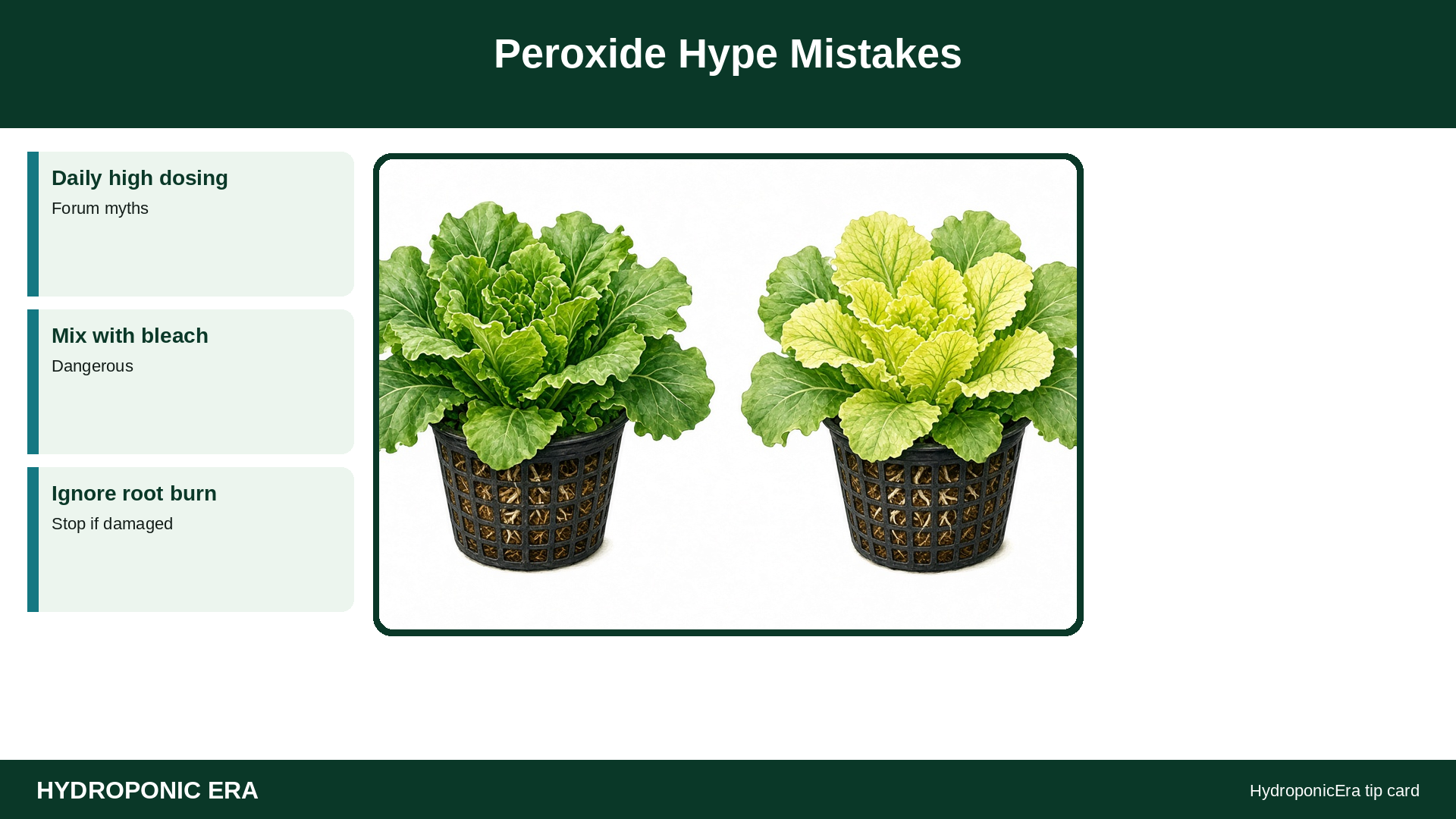
- Daily high dosing because a forum promised bigger yields
- Using unknown concentrated peroxide without PPE or math
- Mixing with bleach or ammonia-based cleaners
- Ignoring burns risk around kids and pets
- Bleaching roots then blaming “deficiency”
- Skipping reservoir light-proofing
- Treating peroxide as food-safe magic without rinse/protocol discipline
Hydrogen Peroxide Hydroponics: Troubleshooting and Safety Notes
| Signal | Interpretation | Action |
|---|---|---|
| Roots look damaged after dose | Too strong / sensitive crop | Stop; fresh solution; gentle care |
| Problem returns in 48h | Environment unchanged | Fix DO/temp/light leaks |
| Skin/eye exposure | Chemical injury risk | Rinse; seek medical advice if serious |
| Persistent foul roots | Disease + anaerobiosis | Full triage guides |
Food handling after any chemical sanitation should follow cautious rinse/harvest hygiene (food safety).
What to Check Before You Dose Peroxide
- Is aeration actually adequate without peroxide?
- Reservoir temperature measured recently?
- Exact bottle concentration known?
- Dilution math double-checked?
- PPE available (eyes/skin)?
- Kids/pets secured from storage?
- Compatible with other additives today?
- Is this a between-crop clean or a live-tank experiment?
Practical Framework: Emergency Tool, Not Daily Vitamin
Think of hydrogen peroxide like a fire extinguisher for specific sanitation or short oxygen gaps—not like a daily multivitamin. Continuous root oxygenation comes from properly sized air pumps, clean stones, sensible water volume, and cooler solution temperatures. If you need oxidizer every day to “keep roots white,” redesign the system.
Between crops, a structured clean beats random pouring: drain, scrub biofilm, rinse, optionally use a labeled sanitizer protocol, rinse again, then refill with fresh nutrients. See cleaning and sterilizing for the hygiene spine of the site.
During a crop, prioritize triage order: remove collapsed plants, increase aeration, lower temperature if safe for the species, check for light leaks, measure EC/pH, then consider whether a conservative oxidizer step adds anything. Document concentrations so you never rely on memory.
Apartment growers should also plan storage. Keep bottles in original containers, away from heat and children, and never decant into drink bottles. If you share a bathroom or balcony grow, label clearly.
Compare peroxide chasing with durable upgrades: spare air pump, GFCI-safe power habits, opaque reservoir paint/covers, and a simple backup plan when electricity blips (backup power for pumps). Those upgrades compound; daily chemical band-aids do not.
If algae is the recurring excuse for peroxide, fix photons in the water first (algae guide). Green water under LEDs is a lighting and opacity problem wearing a chemistry costume.
Beginner Mistakes Specific to Oxidizer Hype
Social media often shows dramatic “before/after” root photos without disclosing temperature cuts, reservoir changes, or plant removals that happened at the same time. Treat those clips as entertainment until you can reproduce results with notes.
Another trap is using peroxide to hide the smell of a neglected tank. Odor is information. Scrub, drain, and rebuild. Pair hygiene with water-change judgment and flush decisions when EC or biology goes off the rails.
If you grow in a shared apartment, communicate storage and spill plans. A knocked-over bottle is a safety incident, not a grow flex. Keep paper towels and water for dilution rinses nearby when handling concentrates.
FAQs
Does H2O2 replace an air pump?
No. Continuous aeration is still the primary oxygen strategy.
Is 3% drugstore peroxide OK?
Sometimes used diluted by home growers, but follow careful measurement and watch for plant stress—there is no universal safe chronic dose published here.
Can it kill beneficial bacteria?
Oxidizers can reduce living microbes—plan strategy deliberately.
Good for algae?
Light exclusion beats repeated chemical chasing.
Food safety?
Treat as a chemical tool; rinse and follow cautious harvest hygiene.
Better long-term fix?
Oxygen, temperature, opacity, and cleaning schedules.
Hydrogen Peroxide Hydroponics: Practical Checklist
Hydrogen Peroxide Hydroponics matters every week in a home system. Recheck hydrogen peroxide hydroponics after transplants, heat spikes, and canopy fill-in. Strong hydrogen peroxide hydroponics habits beat one-time guesses. When hydrogen peroxide hydroponics drifts, leaves crowd, roots stress, or harvest quality drops. Write hydrogen peroxide hydroponics targets into your log so you do not rely on memory. Teach helpers your hydrogen peroxide hydroponics checklist before you leave town. Improve hydrogen peroxide hydroponics in small steps—measure, adjust, then wait a day.
Sources
- University of Kentucky Greenhouse Horticulture — Root disease management in hydroponic systems (PDF)
- Oklahoma State University Extension — Hydroponics
- Penn State Extension — Hydroponics Systems and Principles of Plant Nutrition
- University of Florida IFAS — HS184: Building a Floating Hydroponic Garden
- Michigan State University Extension — Hydroponics as an agricultural production system
- Ohio State University Extension — HYG-1132 Food safety / produce handling
- University of Florida IFAS — FS233: Food safety publication
- Penn State Extension — A Water Quality Toolkit for Greenhouse and Nursery Production