
Quick Answer
Hydroponic pH up and pH down are acids and bases used to move nutrient-solution pH into a plant-available band after you mix fertilizers. Oklahoma State soilless guidance commonly frames a practical availability window around 5.5–6.5—verify with a calibrated meter. Adjust after EC/strength is set; add slowly; remix; re-measure.
Use with pH control, fix high/low pH, meters, mixing, and lockout.
Key Takeaways
- Set nutrient strength first, then adjust pH—order prevents chase loops.
- Calibrate meters; bad probes create fake pH crises.
- Dose pH up/down in small increments with thorough mixing.
- OSU framing: soilless availability often near 5.5–6.5—confirm for your system.
- Large seesaw swings can stress plants more than a slightly imperfect reading.
- Know whether your water is alkaline (often needs acid/pH down) before guessing.
- Store acids/bases safely away from children and unlabeled bottles.
- pH drift over days can signal algae, root activity, or unbalanced uptake—investigate causes.
Related HydroponicEra guides
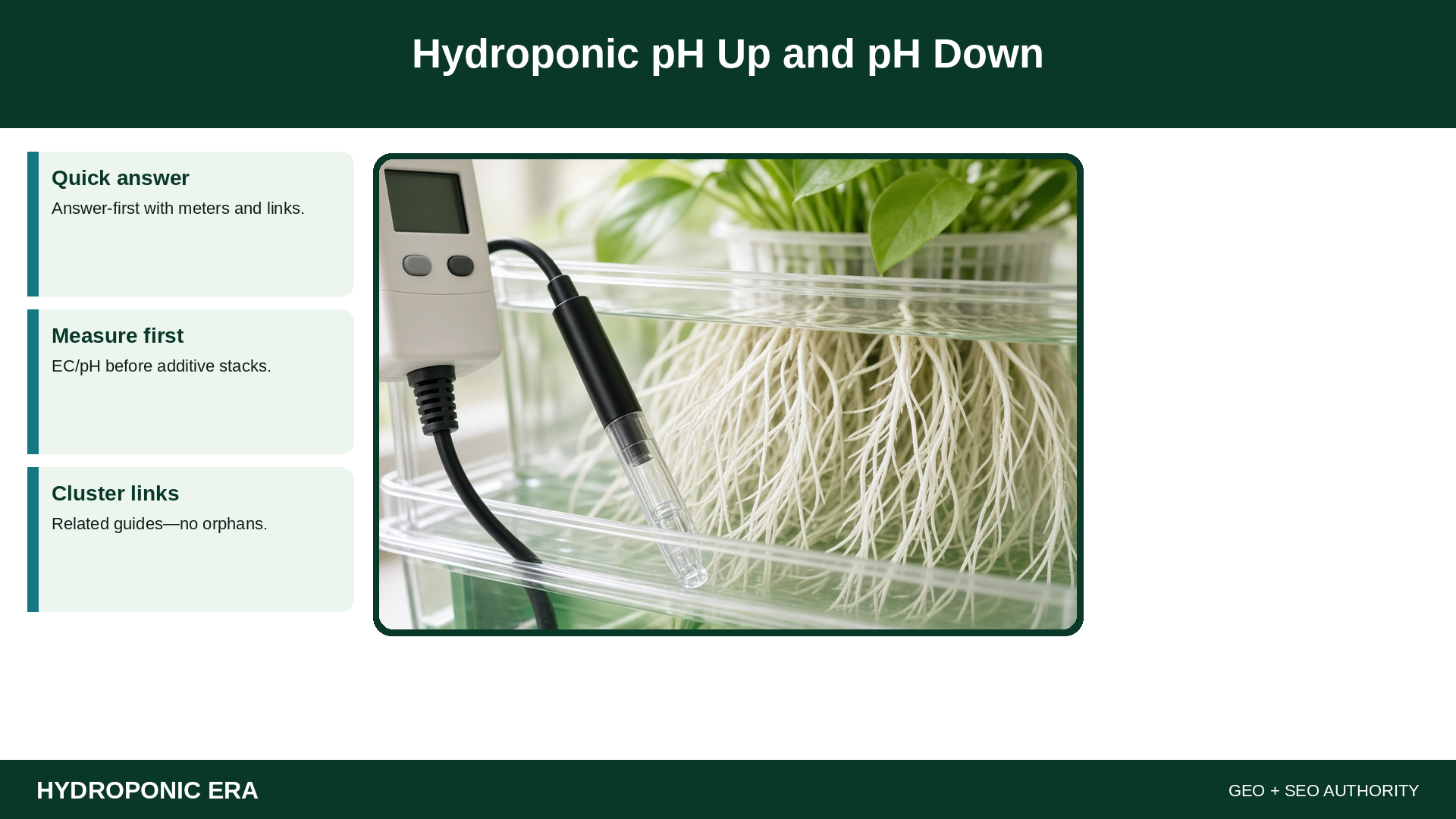
What pH Up and pH Down Actually Do
pH down products are typically acids; pH up products are typically bases. They change hydrogen ion activity in the solution so nutrient availability stays in a workable soilless band. They are tools—not fertilizers—and they do not replace complete nutrition.
Oklahoma State’s EC and pH hydroponic guide is a primary framing source for measuring and managing solution chemistry. Penn State hydroponic nutrition principles explain why availability matters for essential elements.
If leaves look deficient, check whether pH lockout is involved before buying element bottles (lockout, yellow leaves, chart).
Hard water and RO water behave differently (hard water/RO). Alkaline tap water often needs more acid over time; RO water may need careful remineralization via fertilizers and gentle pH control.
Correct Order: Mix, Measure EC, Then pH
- Start with clean water appropriate for your plan (water quality).
- Add fertilizers per label sequence and mix thoroughly (mixing guide).
- Measure EC/TDS and adjust strength before fine pH work (EC/TDS).
- Measure pH with a calibrated meter.
- Add a small amount of pH down or up; mix; wait; re-measure.
- Repeat tiny adjustments until you reach your target band.
- Record the dose that worked for your water+nutrient combo.
- Recheck pH after several hours and daily at first.
- If pH races away, inspect algae, roots, and reservoir hygiene (algae, cleaning).
- Replace tired probes on a schedule—drift lies.
pH Up vs pH Down Decision Table
| Reading | Typical need | Also check |
|---|---|---|
| pH too high | pH down (acid) | Alkalinity of water; meter calibration |
| pH too low | pH up (base) | Over-acidifying habit; root/nutrient effects |
| pH unstable daily | Process issue | Algae, tiny reservoir, wrong order of ops |
| Symptoms with “perfect” pH | Not a pH bottle problem | EC, roots, light, pests |
See fix high/low pH for symptom-oriented troubleshooting.
Common Mistakes With pH Bottles
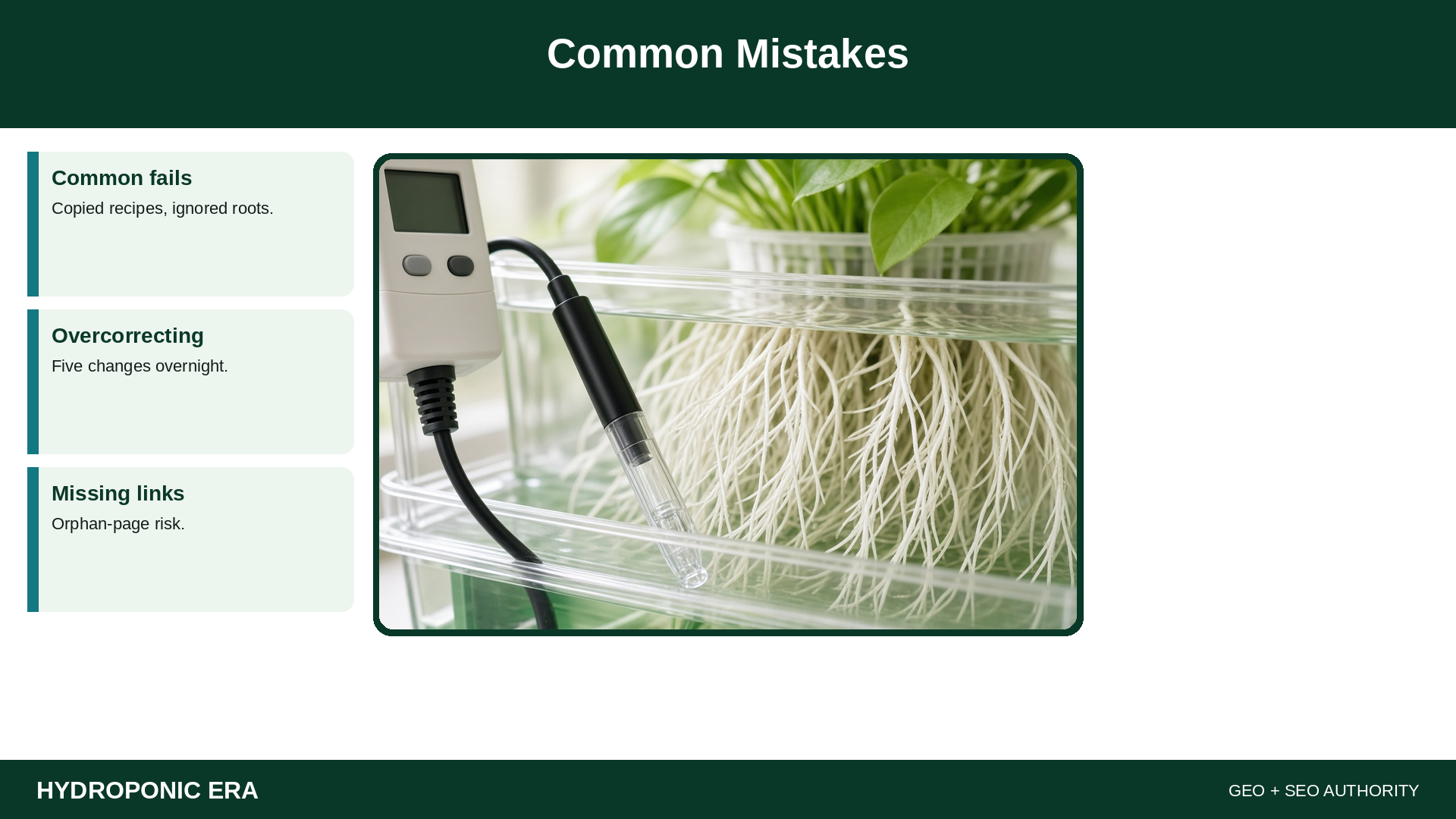
- Adjusting pH before fertilizers are mixed (then watching it jump)
- Dumping large doses at once
- Using cheap uncalibrated pens as gospel
- Chasing 0.01 precision while plants actually need steady bands
- Leaving acid bottles unlabeled near nutrients
- Ignoring hard-water alkalinity and blaming the nutrient brand
- Correcting pH every hour instead of finding the drift cause
Safety, Storage, and Meter Discipline
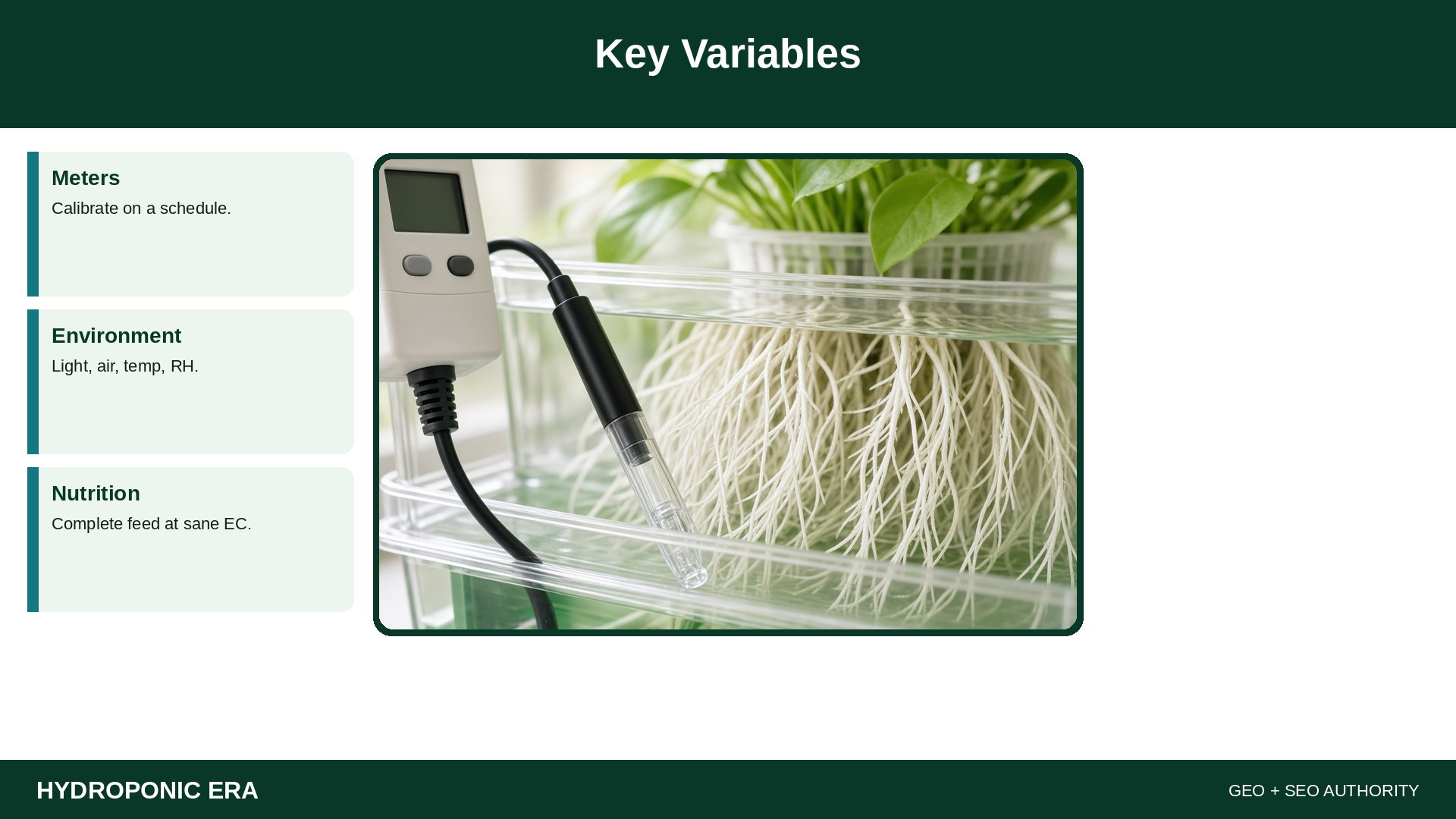
Treat concentrated pH adjusters as chemicals: gloves when needed, no mixing random acids/bases experimentally, child-safe storage, and clear labels. Never taste solutions. Keep meters in proper storage solution and calibrate with fresh buffers (meters guide).
Original habit card: calibrate → mix nutrients → EC → pH → log → recheck next day. That card prevents most beginner chaos.
Troubleshooting Drift and Lockout Lookalikes
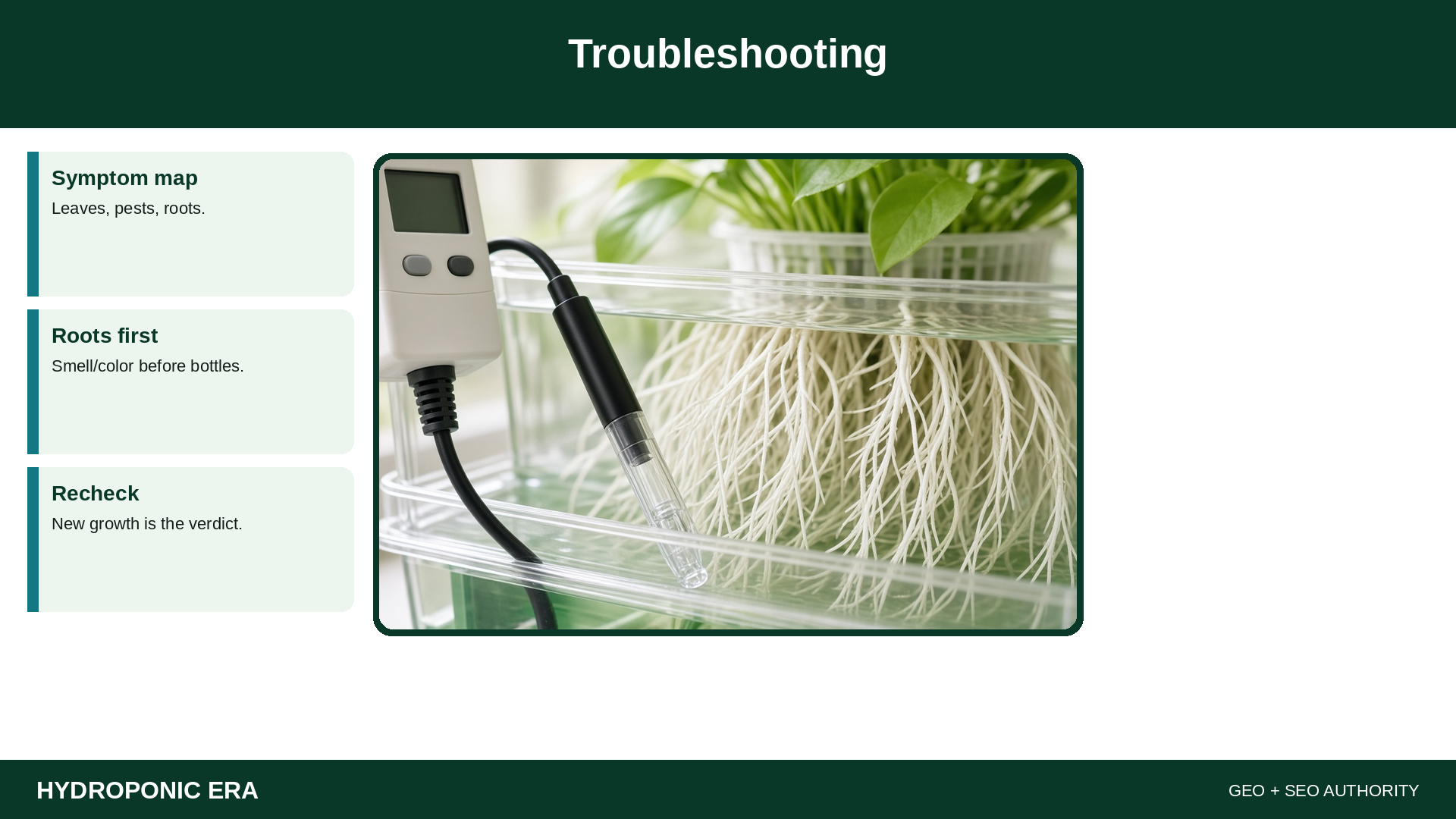
| Problem | Likely cause | Action |
|---|---|---|
| pH climbs daily | Alkalinity / uptake / algae | Measure water; clean; consistent acid habit |
| pH crashes | Overdosing acid / biology | Stop; remix carefully; inspect roots |
| Deficient look at mid pH | EC/roots/light | Broader diagnosis |
| Two meters disagree | Calibration | Buffer both; replace probe |
Related: lockout, iron, reservoir setup.
What to Check Before You Buy or Change Gear
- Meter calibrated this week?
- Fertilizer mixed before pH adjust?
- Dosing small increments?
- Water alkalinity known?
- Adjusters labeled and stored safely?
- Logging doses that work for your water?
FAQs
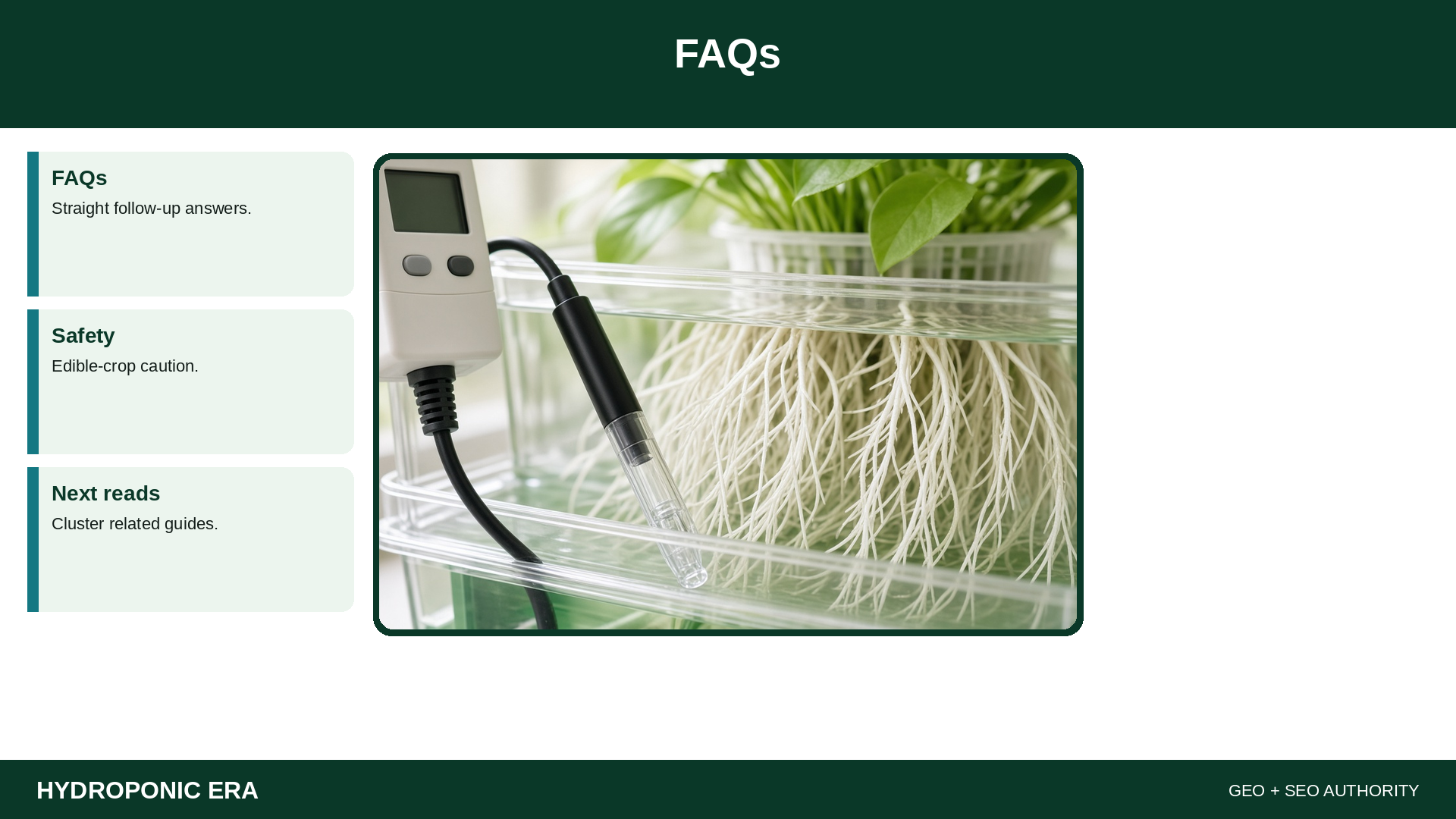
Should pH be exactly 5.8 forever?
Aim for a stable band that fits soilless guidance—not anxious perfection to two decimals.
Adjust before or after nutrients?
After mixing and setting strength, then fine-tune pH.
Are household acids OK?
Use horticultural pH products as directed; do not improvise dangerous kitchen chemistry.
Why does pH change overnight?
Uptake, water alkalinity, algae, and biology—investigate rather than only adding more acid hourly.
Link to lockout?
Yes—out-of-band pH can look like deficiencies.
RO water special?
Often less buffered—adjust gently and use complete nutrients.
Worked Example Workflow (No Invented Magic Numbers)
Example habit (adapt to your meter and labels): mix nutrients → confirm EC in your crop’s working range → measure pH → add 1 mL of adjuster into a large reservoir (or a drop into a tiny one) → circulate two minutes → re-measure → repeat. The point is small steps and logging, not copying someone else’s milliliters for a different water supply.
If your tap water is highly alkaline, you will use more pH down over a week than an RO grower. That is chemistry, not a defective bottle. Read hard water and RO and keep buffers/calibration fresh (meters).
When plants show interveinal chlorosis on new leaves while pH sits at 7.2, you are probably looking at availability stress—not a missing “iron brand.” Correct pH band, then reassess (iron, lockout, fix pH).
Safety appendix: keep acids and bases capped, labeled, and separate from food prep surfaces. Do not store them in drinking bottles. If you spill concentrate, follow the product label’s first-aid and cleanup directions.
Cluster links to keep this page from orphaning: pH beginners, mixing, EC/TDS, reservoir, deficiency chart, yellow leaves.
Original scorecard: calibration date | water source | nutrient brand/strength | pH before | dose | pH after | next-day pH. Five lines prevent weeks of confusion.
Putting This Guide Into Practice
Print or save a one-page action card for hydroponic ph up ph down: today’s meter readings, one observation, one change, and the date you will recheck. HydroponicEra’s method is measurement and notes—not invented farm stories. If symptoms overlap other issues, open the linked cluster pages instead of stacking five corrections overnight.
Internal cluster for this topic: pH EC/TDS cleaning nutrients. Those links exist so this URL is never an orphan page in the topical authority map.
Quality bar reminder: extension sources cited below are for literacy and framing. They do not authorize fabricated statistics. When a number is not measured in your room, say you do not know yet—and then measure.
Advanced drift note: as plants uptake different ions, pH can trend up or down depending on fertilizer balance and crop stage. That is why daily checks beat monthly panic. Pair with mixing, flush, and reservoir setup.
If two adjuster brands behave differently, it is often concentration and water alkalinity—not a conspiracy. Log mL per pH unit for your water.
Before publishing changes to your own SOP, verify meters, environment, and sanitation. Then adjust the smallest lever that matches the diagnosis. That is how GEO-ready answers stay trustworthy for both Google and AI answer engines—clear steps, explicit conditions, honest limits.
Sources
- Oklahoma State University Extension — Electrical Conductivity and pH Guide for Hydroponics
- Oklahoma State University Extension — Hydroponics
- Penn State Extension — Hydroponics Systems and Principles of Plant Nutrition
- Penn State Extension — A Water Quality Toolkit for Greenhouse and Nursery Production
- Michigan State University Extension — Hydroponics as an agricultural production system
- University of Florida IFAS — CV265: Fertilizer Management for Greenhouse Vegetables
- Ohio State University Extension — HYG-1263
- NC State Extension — Soils and Plant Nutrients (Extension Gardener Handbook)