
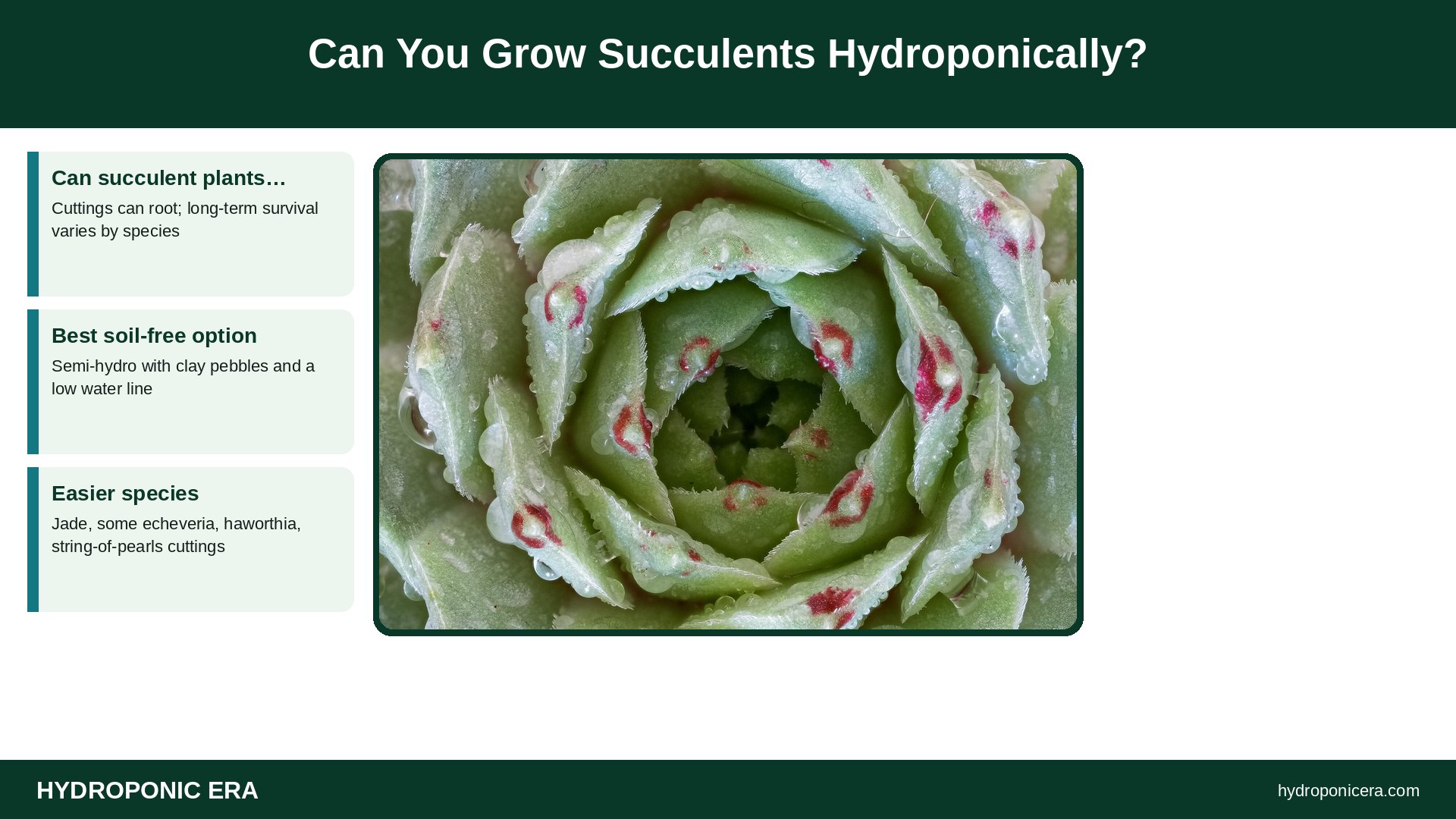
Some succulents can grow hydroponically, but most do better in fast-draining soil. Cuttings and rosettes of succulents like echeveria, jade, and haworthia can root in water, and some growers keep them in semi-hydro setups with clay pebbles. The challenge is rot: succulents are built to store water and dry out between drinks, so constant moisture works against them. If you try growing succulents without soil, use shallow water, airy media, strong light, and plenty of patience.
Key takeaway: Water propagation of succulents is a fun experiment. Long-term hydroponic succulents need semi-hydro media and careful drying cycles.
| Question | Short answer |
|---|---|
| Can succulent plants grow in water? | Cuttings can root; long-term survival varies by species |
| Best soil-free option | Semi-hydro with clay pebbles and a low water line |
| Easier species | Jade, some echeveria, haworthia, string-of-pearls cuttings |
| Light | Bright; direct sun or strong grow light |
| Main risk | Rot at the base and roots |
Why Succulents Resist Hydroponics
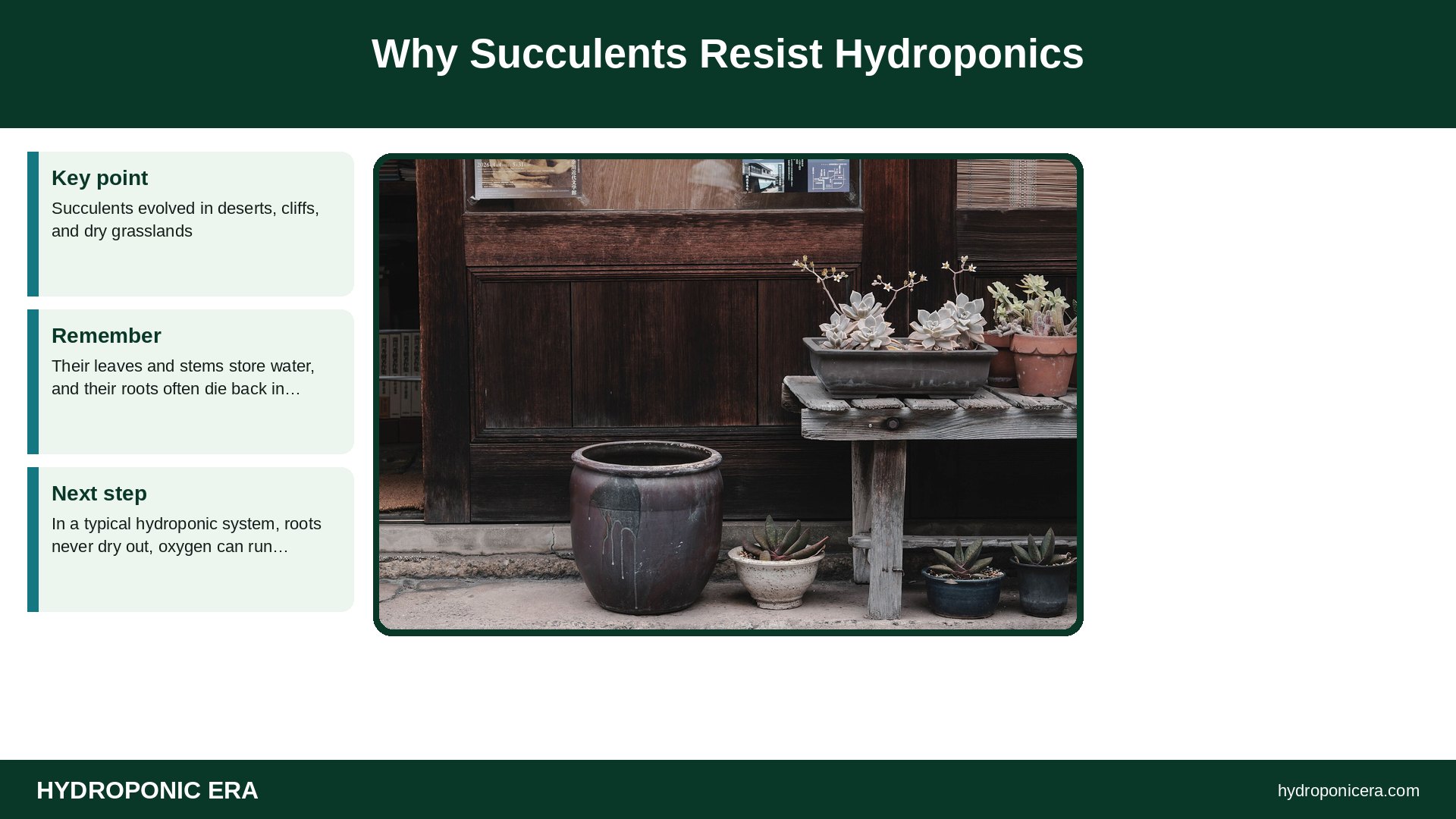
Succulents evolved in deserts, cliffs, and dry grasslands. Their leaves and stems store water, and their roots often die back in drought and regrow after rain. In a typical hydroponic system, roots never dry out, oxygen can run low, and rot organisms thrive. That is why University of Minnesota Extension and other horticulture sources emphasize well-drained mixes and letting succulents dry between waterings.
We list succulents among plants that struggle in home hydroponics. That doesn’t mean impossible. It means you have to design around the plant’s biology.
How to Root Succulents in Water
- Take a cutting or rosette with a short stem, or a healthy leaf from easy species like jade.
- Let it callus for a few days until the cut end is dry and sealed.
- Suspend the cutting just above the water. Roots will grow toward the moisture. A plastic-wrap cover with a hole, or a narrow-necked bottle, works well.
- Place in bright indirect light while rooting.
- Refresh water weekly to keep it clean.
- Move rooted succulents to cactus mix or semi-hydro once roots appear.
Semi-Hydro Succulents: A Workable Setup

- Container: an inner pot with holes inside an outer reservoir, or a clear pot so you can see the water line.
- Medium: clay pebbles or pumice that leave lots of air around roots. See our growing media guide.
- Water line: only the bottom inch; the crown sits well above it.
- Drying cycles: let the reservoir go dry for several days before refilling.
- Nutrients: a very dilute complete fertilizer a few times in the growing season.
Light Matters More Than You Think
Most succulents need high light. In a dim room, rosettes stretch upward and lose their compact shape, a habit called etiolation. Put them near the brightest window you have or under a strong LED. Our PPFD and DLI guide shows how to estimate light levels.
Succulents Problems and Fixes

| Symptom | Likely cause | Fix |
|---|---|---|
| Black, mushy stem | Rot from constant moisture | Cut above rot, callus, restart |
| Stretched, pale rosette | Low light | Brighter light |
| Shriveled leaves | No roots yet, or root loss | Be patient with cuttings; check roots |
| Translucent leaves | Overwatering | Lower water line, add drying cycles |
| White cottony spots | Mealybugs | Isolate and treat; see our mealybug guide |
Mealybugs love these plants. Our mealybugs and scale guide explains identification and control.
Common Mistakes When Growing Succulents Without Soil
- Submerging the stem or rosette.
- Skipping the callus step.
- Keeping roots wet all the time.
- Low light.
- Fertilizing like a vegetable crop.
Choosing a Container and Medium
For soil-free growing, the container matters as much as the plant. A clear inner pot lets you see roots and the water line. An outer cachepot provides a small reservoir. Larger clay pebbles or pumice create air pockets, while fine media stay soggy. Keep the pot snug; oversized containers hold more water than a small rosette can use.
Variables That Change Results
| Variable | Effect | Adjustment |
|---|---|---|
| Species | Some tolerate moisture better than others | Start with jade or echeveria |
| Season | Growth slows in winter | Longer dry periods |
| Humidity | Humid rooms slow drying | More airflow, smaller reservoir |
| Light | Low light causes stretch | Brighter window or LED |
Keep notes on which plants thrive and which struggle. Over a few months, you’ll learn which species suit your home.
Weekly Routine
- Check the water line and let it drop to dry before refilling.
- Inspect stems at the base for softness or darkening.
- Look under leaves for mealybugs.
- Rotate pots toward the light to keep rosettes compact.
- Remove dead lower leaves that can harbor rot.
Propagation Is Where Water Shines
Even if you don’t keep these plants in water long-term, water rooting is a handy propagation trick. Rosettes knocked off during repotting, leggy stems you’ve cut back, and offsets can all be callused and rooted above water, then moved to gritty soil. It’s a low-risk way to turn trimmings into new plants and to watch roots form, which kids especially enjoy.
Which Succulents Tolerate Soil-Free Growing Best
Not all succulents respond the same way. Fleshy rosette types such as Echeveria and Graptopetalum often root readily from leaves or offsets, and jade plant (Crassula ovata) cuttings commonly root in water or moist mineral grit. Haworthia and Gasteria tolerate the lower light of many US homes better than most. Cacti, on the other hand, are generally less suited to water culture and usually do better in a fast-draining gritty mix. If you’re new to growing these plants without soil, start with jade or a common Echeveria rather than a rare or expensive specimen.
Moving a Water-Rooted Cutting Into Grit
Water roots are thin and adapted to constant moisture. When you move a cutting into pumice, lava rock, or a gritty cactus mix, keep it lightly moist for the first week or two, then stretch the time between waterings gradually. Expect a short pause in growth while new roots form. Bright light during this period helps the plant recover faster. See transplant shock recovery for signs to watch.
FAQs: Succulents in Hydroponics
Can succulents live in water forever?
A few cuttings survive a long time, but most succulents do better in semi-hydro or soil long-term.
Which succulents root best in water?
Jade, many echeverias, and string-of-pearls cuttings are commonly rooted in water.
Do succulents need fertilizer in hydroponics?
Yes, but very little. A diluted complete fertilizer a few times in the growing season is enough.
Why did my succulent cutting rot in water?
The cut end wasn’t callused, or the stem was submerged. Keep the cutting just above the water.
Related HydroponicEra Guides
- Plants that struggle in home hydroponics
- Clay pebbles for hydroponics
- Growing media for hydroponics
- Plants that grow in water
Sources
- University of Minnesota Extension — Cacti and succulents
- NC State Extension Plant Toolbox — Echeveria
- Photo credits (Wikimedia Commons, edited with titles): Echeveria A7CR 02866-90 zsp by This Photo was taken by Timothy A. Gonsalves. Feel free to use my photos, but pl (CC BY-SA 4.0); Charming outdoor display of succulent plants in vintage pots by Lowoxay68 (CC0)