
Mushrooms cannot be grown hydroponically in the usual sense, because they are fungi, not plants. Mushrooms have no roots, no leaves, and no chlorophyll, so they don’t take up dissolved mineral nutrients from water or make food from light. Instead, the mushroom’s body (mycelium) digests an organic substrate such as pasteurized straw, hardwood sawdust, or compost. You can absolutely grow mushrooms indoors next to your hydroponic garden, but the method is substrate cultivation, not a nutrient solution.
Key takeaway: If a product promises “hydroponic mushrooms,” it is really selling a humid, substrate-based grow kit. That can work well. It just isn’t hydroponics.
| Question | Short answer |
|---|---|
| Can mushrooms grow in a nutrient solution? | No; they need an organic substrate to digest |
| Easiest home mushroom | Oyster mushrooms on straw or a ready-made kit |
| Incubation (oysters) | Dark, roughly 75°F, for about 2–3 weeks (UF/IFAS) |
| Fruiting (oysters) | Around 68°F, high humidity, some light, fresh air |
| Do mushrooms need grow lights? | Only low light to trigger and orient fruiting |
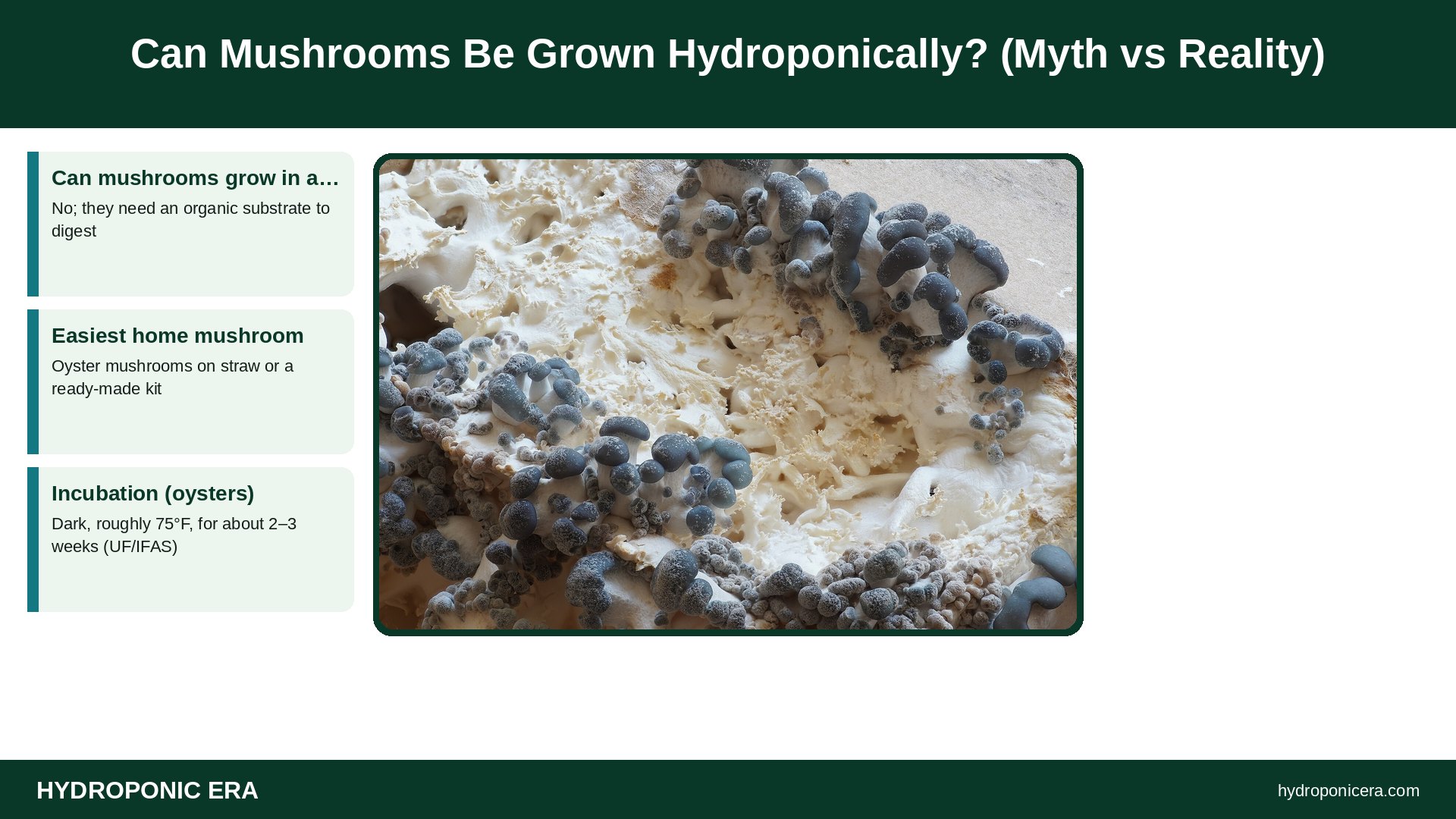
Why Mushrooms Aren’t Hydroponic
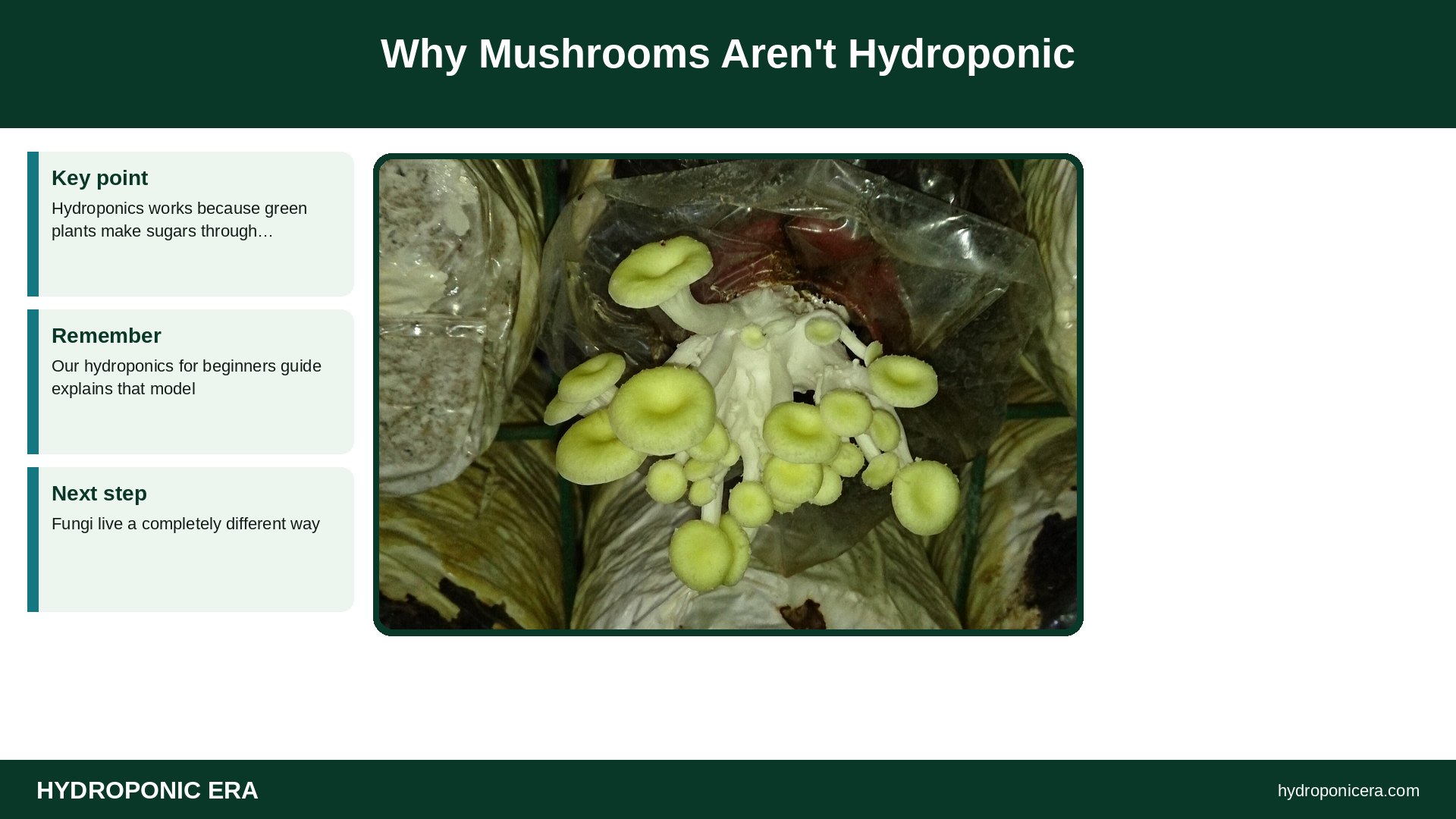
Hydroponics works because green plants make sugars through photosynthesis and only need water, oxygen, and mineral ions at their roots. Our hydroponics for beginners guide explains that model.
Fungi live a completely different way. Mushrooms are the fruiting bodies of a fungus whose thread-like mycelium grows through wood, straw, or compost and releases enzymes that break it down. The fungus absorbs the resulting sugars and nutrients. Without that organic food source, there is nothing for the mycelium to eat, no matter how well-balanced a hydroponic solution is.
University of Florida IFAS Extension describes oyster mushrooms as easy to cultivate on “lignocellulose substrates,” such as wheat straw and even paper. That’s the core of mushroom growing: the right substrate, kept clean, moist, and at the right temperature.
What “Hydroponic Mushrooms” Usually Means
- Grow kits sold for kitchens: pre-colonized blocks of sawdust or straw that you mist with water.
- Misting or fogging chambers: high-humidity tents that keep fruiting bodies from drying out. Water is used for humidity, not nutrition.
- Marketing language: “soilless” gets mislabeled as “hydroponic.”
So yes, these fungi can be grown without soil, but they still need food in the substrate.
How to Grow Oyster Mushrooms Indoors

This simplified outline follows the UF/IFAS home guide for growing oysters on straw:
- Prepare straw. Cut into 4–5 inch pieces and soak overnight.
- Pasteurize. Hold the straw at about 165°F in a water bath for 1–2 hours to knock back competing microbes, then drain and cool.
- Inoculate. Mix in oyster spawn at roughly 5–10% of the substrate and pack into bags.
- Incubate. Keep bags dark and warm (about 75–77°F) for 2–3 weeks until fully white with mycelium.
- Fruit. Move to cooler conditions (around 68°F), cut holes in the bag, provide high humidity, indirect light, and fresh air.
- Harvest clusters before the caps flatten and drop spores.
Beginners often start with a ready-to-fruit kit, which skips pasteurization and inoculation.
Growing Mushrooms Next to a Hydroponic Garden
Fungal crops and hydroponic plants can share a basement or spare room, but keep some separation:
- Humidity. Fruiting blocks want very high humidity, which can encourage mold and mildew on plants. See our humidity and VPD guide.
- Spores. Mature oyster mushrooms release lots of spores; harvest on time and keep them away from intake fans.
- Pests. Fungus gnats love moist substrate. Our fungus gnats guide covers control.
- Spent substrate. Used mushroom blocks make a good compost ingredient. See composting for beginners.
Mushroom Growing Problems
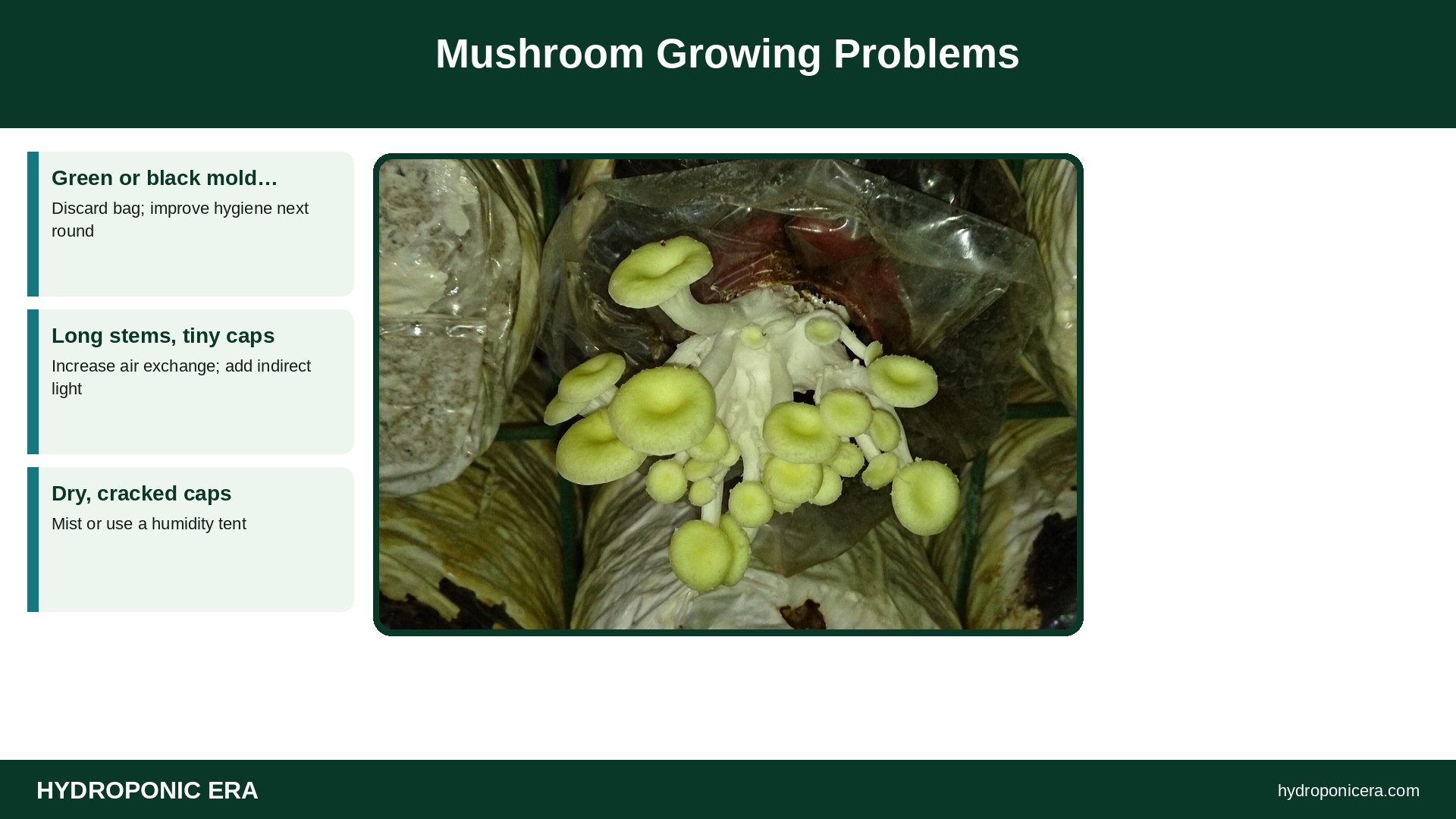
| Symptom | Likely cause | Fix |
|---|---|---|
| Green or black mold patches | Contamination; poor pasteurization | Discard bag; improve hygiene next round |
| Long stems, tiny caps | Too little fresh air or light | Increase air exchange; add indirect light |
| Dry, cracked caps | Low humidity | Mist or use a humidity tent |
| No pins after colonizing | Conditions not triggering fruiting | Cooler temps, more light, fresh air |
| Sour smell | Bacterial contamination, waterlogging | Discard; drain substrate better |
Common Mistakes
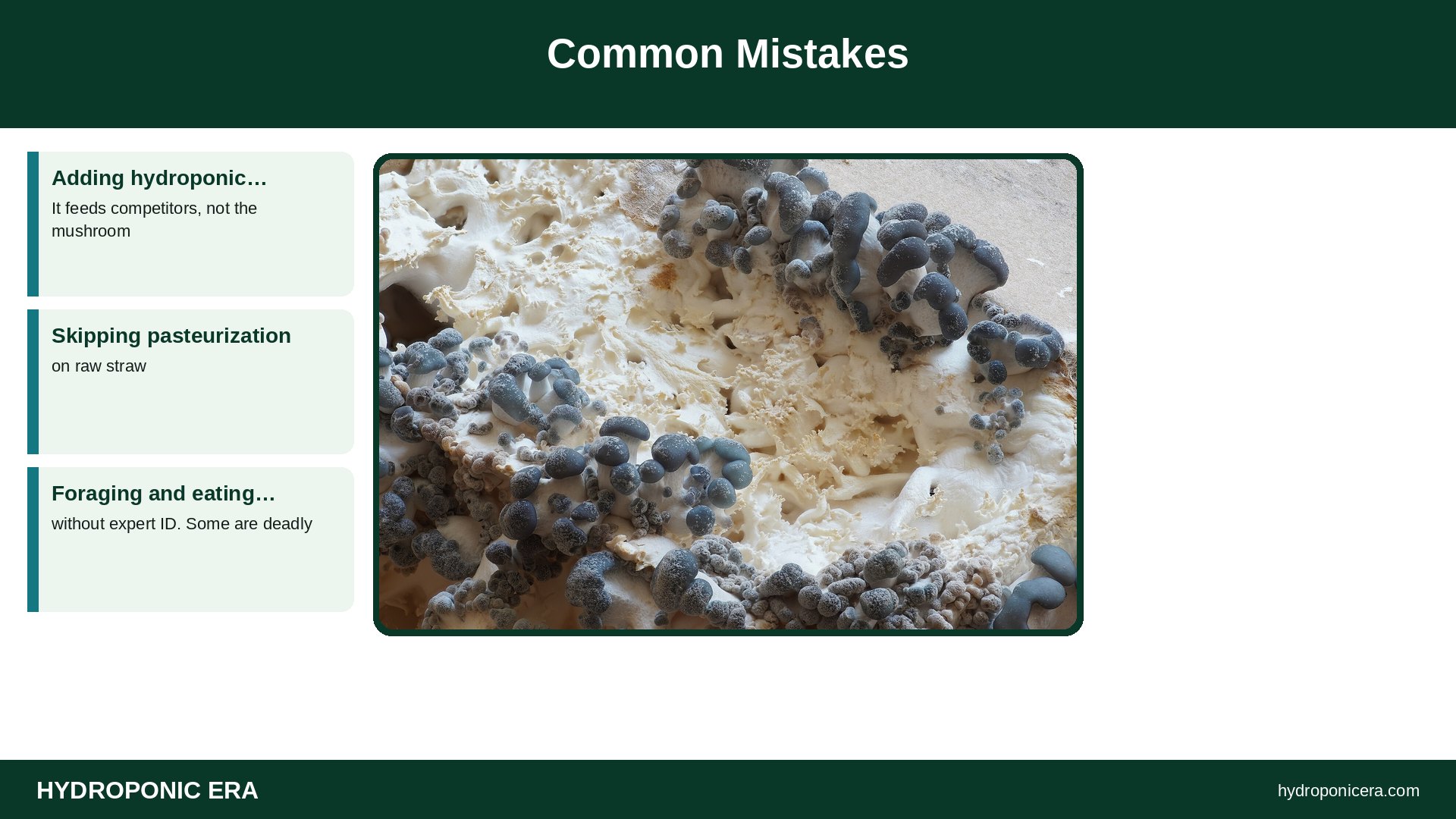
- Adding hydroponic nutrients to mushroom substrate. It feeds competitors, not the mushroom.
- Skipping pasteurization on raw straw.
- Foraging and eating wild mushrooms without expert ID. Some are deadly.
- Running fruiting tents inside a plant tent. The humidity mismatch hurts both.
Hydroponic Plants vs Fungi: Side-by-Side
| Need | Hydroponic lettuce | Oyster fungi |
|---|---|---|
| Energy source | Light (photosynthesis) | Organic substrate (digestion) |
| Nutrient delivery | Dissolved mineral salts in water | Straw, sawdust, or compost |
| Light role | Essential, high intensity | Low light to trigger and shape fruiting |
| Humidity | Moderate | Very high during fruiting |
| Sterility | Clean, but not sterile | Pasteurized or sterilized substrate |
That table explains why a nutrient reservoir can’t replace a substrate. It also shows why the two crops are better grown in separate spaces.
Food Safety and Wild Species
Only grow and eat species you have bought as labeled spawn or kits from a reputable supplier. Never eat wild fungi without expert identification. If your kit grows unexpected colors or smells off, discard it rather than eat it. Our home food safety guide covers general hygiene for homegrown food.
Where Indoor Fungi Fit in a Home Garden
Fungi kits can be a nice companion project to a hydroponic garden. They use space that plants can’t, such as a dim closet shelf, and they turn agricultural byproducts like straw into food. Spent blocks can feed a compost pile, and the compost can feed outdoor soil beds. Just keep the two growing spaces separate so high fruiting humidity and spores don’t affect your plants.
Quick Decision Guide
- Want fresh greens fast? Choose hydroponic lettuce or microgreens.
- Want an indoor fungal crop? Choose an oyster kit or a straw bucket.
- Want both? Use two separate spaces and schedules.
FAQs: Can Mushrooms Be Grown Hydroponically?
Can mushrooms grow in water only?
No. Mushrooms need an organic substrate such as straw or sawdust to digest. Water provides moisture and humidity only.
What is the easiest mushroom to grow at home?
Oyster mushrooms are widely considered the easiest, especially from a ready-to-fruit kit.
Do mushrooms need light?
Low, indirect light helps oysters fruit and grow normally shaped caps, but they don’t need grow lights for photosynthesis.
Can I grow mushrooms in my grow tent?
Only if it is dedicated to fungi. Plant tents and fruiting chambers need very different humidity and airflow.
Related HydroponicEra Guides
- Plants that struggle in home hydroponics
- How to grow sprouts in a jar
- How to grow microgreens
- Grow tent setup
Sources
- UF/IFAS Extension — D.I.Y. FunGuide: Grow Your Own Oyster Mushrooms at Home (SS662)
- The Ohio State University Mycology — Oyster Mushrooms Made Easy
- UGA Extension Newton County — Oyster Mushroom Growing Instructions
- Photo credits (Wikimedia Commons, edited with titles): 20210718 Pleurotus ostreatus 116-138 by Zinnmann (CC BY-SA 3.0); Mushroom farm by ProjectManhattan (CC BY-SA 3.0)