
You can grow leeks hydroponically, but plan for a long crop. Leeks are slow, upright alliums that often need about 120–150 days from seed to full size, according to University of Minnesota Extension, though some newer cultivars mature in about 90 days. In a home system they do best in deep water culture, Dutch buckets, or deep media beds with a mild nutrient solution, cool temperatures around 60–75°F, plenty of light, and a way to blanch the lower stem white.
Key takeaway: Leeks are easy but slow. Pick a fast “summer” cultivar, give them depth for the shank, and blanch with a collar.
| Factor | Target to grow leeks hydroponically |
|---|---|
| Days to maturity | About 90–150 days depending on cultivar (UMN) |
| Best systems | DWC with deep net pots, Dutch buckets, deep media beds |
| Air temperature | Cool to moderate, about 60–75°F |
| pH | About 6.0–6.5 in solution |
| Light | At least 8 hours of bright light; longer under LEDs |
| Harvest size | Shaft about 1 inch wide; smaller types at 1/2–3/4 inch |

Is It Worth It to Grow Leeks Hydroponically?

Leeks take a long time per plant compared with lettuce or basil, so they tie up system space. They are worth it if you love leeks, want a cool-season crop for a basement setup, or have deep containers that suit long-stemmed plants. For faster allium harvests, see our guides to green onions and chives.
Starting Leeks From Seed
- Sow in rockwool, coco plugs, or oasis cubes. See our germination methods guide.
- Keep plugs warm and moist until grass-like sprouts appear.
- Give strong light early to avoid floppy seedlings.
- Trim tops to a few inches if seedlings flop; many growers do this to keep them sturdy.
- Transplant when seedlings are pencil-lead thick. UMN advises transplants be no more than 10–15 weeks old.
Best Systems to Grow Leeks Hydroponically

| System | Fit for leeks | Notes |
|---|---|---|
| Deep water culture | Good | Use tall net pots or collars for blanching. See our DWC guide |
| Dutch buckets | Good | Perlite depth helps blanch the shank |
| NFT | Fair | Works for small leeks; large roots can clog channels |
| Kratky | Fair | Long crop means many refills |
| Tower gardens | Poor to fair | Tall plants and long crop time |
Nutrients, pH, and Temperature
Leeks are moderate feeders. A balanced vegetative nutrient that you’d use for leafy greens works well. Keep pH around 6.0–6.5 and check EC regularly with a meter. Our EC and TDS guide and pH guide cover the basics.
- Reservoir temperature: cooler water holds more oxygen. See our reservoir temperature guide.
- Air temperature: leeks are cool-season plants; very hot rooms slow growth.
- Change the reservoir regularly over a long crop to avoid imbalances.
Blanching Leeks in a Hydroponic System
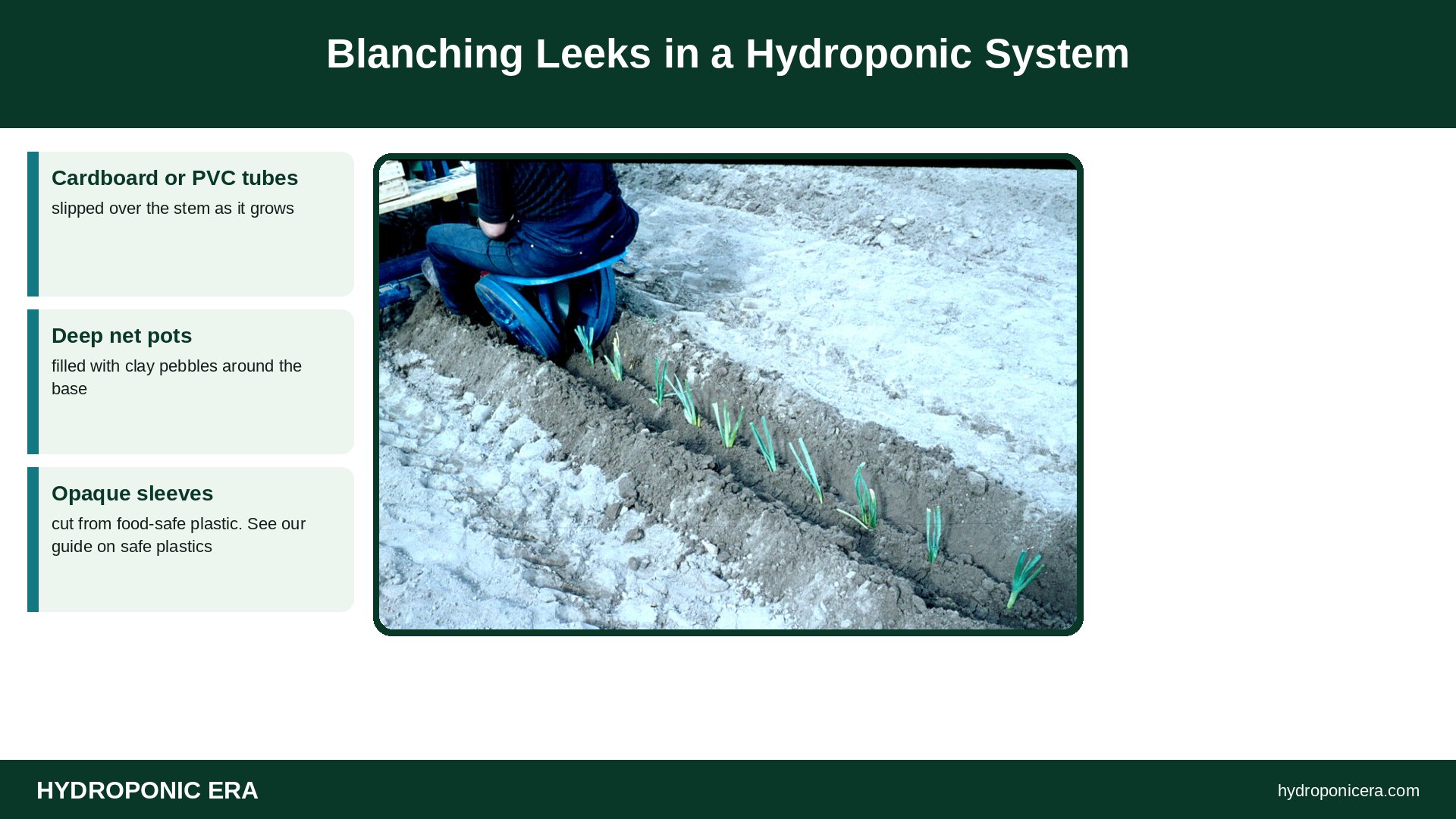
The prized white part of a leek forms where light is blocked. In soil, gardeners hill up dirt. In hydroponics, use a collar:
- Cardboard or PVC tubes slipped over the stem as it grows.
- Deep net pots filled with clay pebbles around the base.
- Opaque sleeves cut from food-safe plastic. See our guide on safe plastics.
Keep collars loose enough to allow growth and airflow.
Harvesting and Problems

UMN Extension says most leeks are fully developed when the stem is wider than an inch, with a firm, white shaft more than 3 inches long. Swelling at the base (“bulbing”) is undesirable.
| Symptom | Likely cause | Fix |
|---|---|---|
| Thin, floppy leeks | Low light or crowding | More light, wider spacing |
| Short white shank | No blanching | Add collars early |
| Yellow leaf tips | Nutrient imbalance or heat | Check EC/pH, cool the room |
| Brown, slimy roots | Warm, low-oxygen water | Cool reservoir, add aeration |
| Thrips damage (silvery streaks) | Thrips | See our thrips guide |
Alliums are common thrips hosts. Our thrips guide covers control.
Spacing and Timeline When You Grow Leeks Hydroponically
Leeks are upright, so they can be spaced closer than leafy greens. In home systems, about 4–6 inches between plants works for most cultivars. Closer spacing gives thinner leeks; wider spacing gives thicker shanks.
| Stage | Approximate timing | What to do |
|---|---|---|
| Germination | About 1–2 weeks | Keep plugs moist and warm |
| Seedling | About 6–10 weeks | Strong light, trim floppy tops |
| Transplant | Pencil-lead thickness | Move to deep net pots or buckets |
| Bulking | Several weeks to months | Add collars, steady nutrients |
| Harvest | About 90–150 days from seed | Pull when shank reaches target width |
Choosing Cultivars to Grow Leeks Hydroponically
Look for “summer” or “early” leeks, which mature faster than hardy winter types. Fast cultivars make more sense indoors, where system space is valuable. UMN Extension notes some newer cultivars need as few as 90 days. Long-season winter leeks are better left to outdoor gardens in the US, where they can stand in the ground into fall.
If you grow leeks hydroponically alongside lettuce, keep in mind that leeks occupy their spot for months while lettuce turns over every few weeks. A dedicated bucket or two often works better than sharing an NFT channel. Our continuous harvest planning guide helps you balance long and short crops.
Many people who grow leeks hydroponically also enjoy the leaves; the green tops are tougher than the white shank but make excellent stock.
Common Mistakes
- Using shallow net pots that leave no room for blanching.
- Starting winter cultivars indoors and waiting months.
- Letting the reservoir warm in summer.
- Crowding seedlings so they stay pencil-thin.
Bottom line: if you have the patience and a deep container, you can grow leeks hydroponically year-round, even in the middle of a northern winter.
FAQs: Grow Leeks Hydroponically
How long does it take to grow leeks hydroponically?
Often 90–150 days from seed, depending on cultivar. Fast summer types are best for indoor systems.
Can I regrow leeks in water from the root end?
Yes, you can regrow green tops from a root end in water, but you won’t get a new full-size shank quickly.
What pH do leeks like in hydroponics?
Around 6.0–6.5 works well for most alliums.
How do I get white leek stems?
Block light from the lower stem with collars or deep media as the plant grows.
Related HydroponicEra Guides
- How to grow green onions hydroponically
- How to grow garlic hydroponically
- How to grow chives hydroponically
- Dutch bucket hydroponics
Sources
- University of Minnesota Extension — Growing leeks in home gardens
- NC State Extension Plant Toolbox — Allium ampeloprasum
- Photo credits (Wikimedia Commons, edited with titles): Allium ampeloprasum MHNT.BOT.2006.46.12 by Roger Culos (CC BY-SA 3.0); Porree Scharpflanzung–Josef Schlaghecken by Schlaghecken Josef (CC BY-SA 4.0)