
Aquaponics fish to plant ratio is best set by feed, not by counting fish. FAO’s aquaponics manual calls the feed rate ratio the most important calculation in aquaponics: feed about 40–50 grams of fish feed per square meter of leafy greens per day (roughly 3.7–4.6 grams per square foot), or 50–80 grams per square meter for fruiting crops like tomatoes (about 4.6–7.4 grams per square foot). Then size the fish to eat that feed: grow-out fish eat about 1–2% of their body weight per day. FAO’s worked example: 25 heads of lettuce a week needs about 4 m² (43 sq ft) of growing space, 200 g (7 oz) of feed daily, and 10–20 kg (22–44 lb) of fish.
Key takeaway: Decide your plant area first, multiply by the feed rate, then stock enough fish to eat that feed. Use nitrate tests to fine-tune.
| Crop type | Daily feed (FAO) | Per square foot | Planting density (FAO) |
|---|---|---|---|
| Leafy greens | 40–50 g per m² | About 3.7–4.6 g | 20–25 plants per m² (about 2 per sq ft) |
| Fruiting vegetables | 50–80 g per m² | About 4.6–7.4 g | 4–8 plants per m² (about 1 per 1.3–2.7 sq ft) |
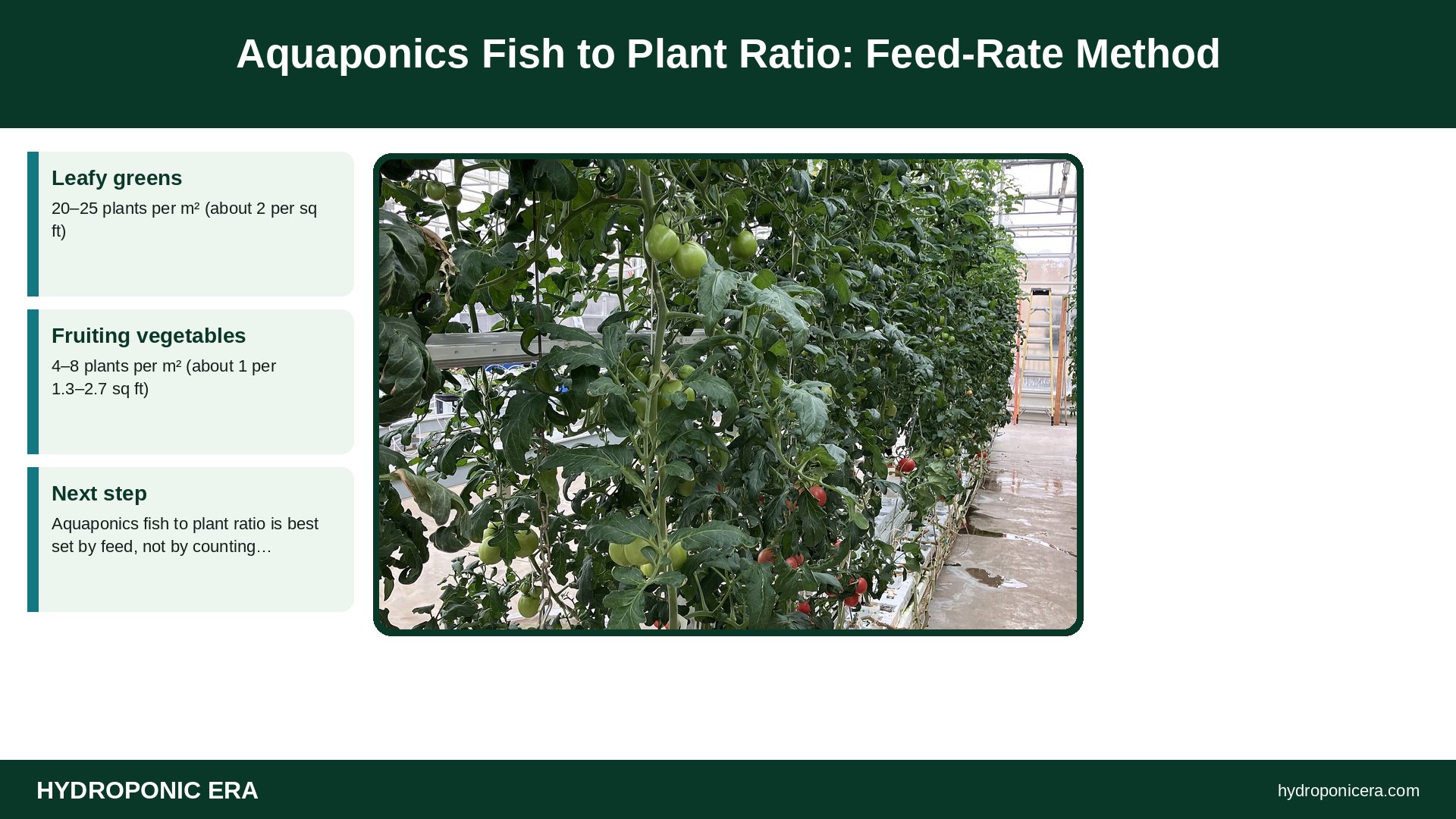
Why Feed Sets the Aquaponics Fish to Plant Ratio

FAO explains that it’s more useful to balance a system by the amount of feed going in than by the number of fish. Many small fish can eat as much as a few large fish, and the plants respond to the nutrients that feed releases, not to fish counts. FAO’s feed rate ratio combines the three key variables: daily grams of fish feed, plant type (leafy or fruiting), and plant growing area. Those ratios assume a standard fish feed with about 32% protein.
Step-by-Step: Calculate Your Aquaponics Fish to Plant Ratio
- Choose your crops and how much you want to harvest.
- Work out growing area. FAO’s averages: leafy greens at 20–25 plants per m², fruiting crops at 4–8 per m².
- Multiply area by feed rate. 40–50 g/m²/day for greens, 50–80 g/m²/day for fruiting crops.
- Find fish biomass. Divide daily feed by 1–2% (grow-out fish over 50 g eat about 1–2% of body weight per day).
- Check tank size. FAO recommends no more than 20 kg of fish per 1,000 liters (about 0.17 lb per gallon).
- Size your biofilter. FAO lists about 1 liter of volcanic gravel, or 0.5 liters of Bioballs, per gram of daily feed.
FAO’s Lettuce Example in US Units

- Lettuce takes about 4 weeks after transplant. Harvesting 25 heads a week means 100 heads in the system.
- At 25 heads per m², that’s 4 m², about 43 square feet.
- At 50 g of feed per m², that’s 200 g (about 7 ounces) of feed a day.
- At 1–2% of body weight per day, the fish biomass is 10–20 kg, about 22–44 pounds.
That fits FAO’s typical 1,000-liter (about 264-gallon) small-scale unit, which holds 10–20 kg of fish.
Example: A Small Tomato and Pepper Bed
To see the aquaponics fish to plant ratio for fruiting crops, say you have a 4 ft × 8 ft (32 sq ft, about 3 m²) bed of tomatoes and peppers:
- At 50–80 g/m²/day, that’s about 150–240 g (5–8.5 oz) of feed per day.
- At 1–2% body weight, that’s roughly 7.5–24 kg (16–53 lb) of fish.
- Plants: at 4–8 per m², about 12–24 plants, fewer for big indeterminate tomatoes.
That shows why fruiting crops need more fish or more feed per square foot than greens. FAO notes fruiting crops need about one-third more nutrients to support flowers and fruit.
Checking the Aquaponics Fish to Plant Ratio With Nitrate Tests

FAO says the feed rate ratio is only a guide to the aquaponics fish to plant ratio; fish size, water temperature, feed protein, and seasonal plant demand all change it. Nitrogen testing shows how well you’re balanced:
- Nitrate below 5 mg/L: slowly increase feed (without leaving uneaten pellets), add fish, or remove some plants.
- Nitrate stable but plants show deficiencies: FAO notes calcium, potassium, and iron may need supplements.
- Nitrate rising above 150 mg/L: exchange some water or add more plants.
See ammonia, nitrite and nitrate levels.
What About Fish-to-Water or Grow-Bed-to-Tank Ratios?
You’ll see rules of thumb like a 1:1 grow bed to fish tank volume ratio in hobby guides. They can help with plumbing, especially for media beds, but they don’t measure nutrients. FAO’s feed-based method ties the plant area directly to what the fish produce. Use volume ratios for hardware design, and the feed rate ratio to set your aquaponics fish to plant ratio. For media bed specifics, FAO’s small media bed design uses grow beds that are about 30 cm (12 inches) deep.
Seasonal Aquaponics Fish to Plant Ratio Adjustments
Fish eat less in cool water, so nutrient output falls in winter. You may need fewer plants, slower-growing crops, or warmer water. In summer, fish eat more and plants grow faster. Watch fish appetite and nitrate levels each season. See tilapia aquaponics for a warm-water example and trout aquaponics for cold water.
Common Aquaponics Fish to Plant Ratio Mistakes

- Counting fish instead of weighing feed.
- Overfeeding to “feed the plants,” which leaves uneaten feed and spikes ammonia.
- Planting fruiting crops at leafy-green feed rates.
- Undersizing the biofilter for the feed amount.
- Ignoring seasonal drops in fish appetite.
Quick Reference: Feed and Fish for Common Bed Sizes
| Bed area | Leafy greens: daily feed | Fish biomass (1–2% feed rate) |
|---|---|---|
| 2 × 4 ft (8 sq ft, 0.74 m²) | About 30–37 g | About 1.5–3.7 kg (3–8 lb) |
| 4 × 4 ft (16 sq ft, 1.5 m²) | About 60–74 g | About 3–7.4 kg (7–16 lb) |
| 4 × 8 ft (32 sq ft, 3 m²) | About 120–150 g | About 6–15 kg (13–33 lb) |
These aquaponics fish to plant ratio numbers apply FAO’s 40–50 g/m²/day leafy-green ratio and its 1–2% body weight feeding rate. They’re starting points; adjust with nitrate tests and your fish’s actual appetite.
FAQs: Aquaponics Fish to Plant Ratio
What is the best aquaponics fish to plant ratio?
FAO recommends 40–50 g of feed per m² per day for leafy greens and 50–80 g for fruiting crops.
How many fish do I need per plant?
It depends on fish size and feed. Use the feed method: plant area × feed rate ÷ 1–2% body weight.
How many plants per square foot?
FAO averages about 2 leafy greens per square foot, or one fruiting plant per 1.3–2.7 square feet.
Why are my plants yellow even with fish?
Possibly too little feed for the plant area, or a shortage of iron, potassium, or calcium.
Can the aquaponics fish to plant ratio have too many fish?
Yes. Nitrate will keep rising; add plants or exchange water above 150 mg/L.
Sources
- FAO — Small-scale aquaponic food production
- Photo credits (Wikimedia Commons, edited with titles): Solanum lycopersicum in aquaponics at the NC Greenhouse Nursery by Gogerr (CC BY-SA 4.0); Fish Feed Pellets by Narek75 (CC BY-SA 4.0); Deep water culture by ArcadiYay (CC BY-SA 4.0); Oreochromis-niloticus-Nairobi by Bjørn Christian Tørrissen (CC BY-SA 3.0); AQUAPONIE by Hopeballa (CC BY-SA 4.0)