
Aquaponics raft system designs, also called deep water culture (DWC), float plants on foam rafts over long, water-filled canals, with roots hanging straight into nutrient-rich fish water. FAO’s aquaponics manual calls the DWC aquaponics raft system the most common method for large commercial aquaponics, especially for lettuce, salad greens, and basil. FAO recommends canals about 12 inches (30 cm) deep, a retention time of 1–4 hours (the time it takes to replace all the water in a canal), and air stones releasing about 4 liters of air per minute for every 2–4 m² (roughly 21–43 sq ft) of canal. Unlike media beds, raft systems need a separate solids filter and biofilter at normal stocking.
Key takeaway: Raft systems are excellent for leafy greens and herbs, but they depend on good solids removal, strong canal aeration, and keeping root-eating fish out of the canals.
| Design factor (FAO) | Recommendation |
|---|---|
| Canal depth | About 12 in (30 cm) |
| Canal width | Width of a standard foam sheet, or multiples |
| Retention time | 1–4 hours per canal |
| Canal aeration | About 4 L/min of air per stone, one stone per 2–4 m² |
| Filtration | Mechanical filter + biofilter (except very low-density designs) |
| Best crops | Lettuce, salad leaves, basil, other leafy greens and herbs |

How an Aquaponics Raft System Works

FAO describes the DWC water path as a “figure 8.” Water flows by gravity from the fish tank through a mechanical filter and into a combined biofilter and sump. From the sump, a pump sends water two ways through a Y-connector and valves: some goes back to the fish tank, and the rest feeds the canals through a manifold. Water flows slowly through the canals and back to the sump. The fish tank overflows into the mechanical filter, and the cycle repeats.
The large water volume in the canals is a big advantage. FAO notes it holds plenty of nutrients for plants and buffers temperature and water-quality swings better than thin-film systems like NFT.
Building Aquaponics Raft System Canals
FAO’s canal guidelines:
- Depth: about 30 cm (12 inches) for root space.
- Width: match a standard sheet of foam board, or multiples. Narrow, long canals move water faster past roots.
- Length: from one meter to tens of meters; length matters less than in NFT because of the large water volume.
- Materials: IBC totes or fiberglass for small units; wood or concrete blocks lined with food-grade waterproof liner for larger ones. FAO says to seal concrete with a non-toxic sealer.
Use food-safe, UV-stable liners and foam. See deep water culture basics.
Retention Time and Flow
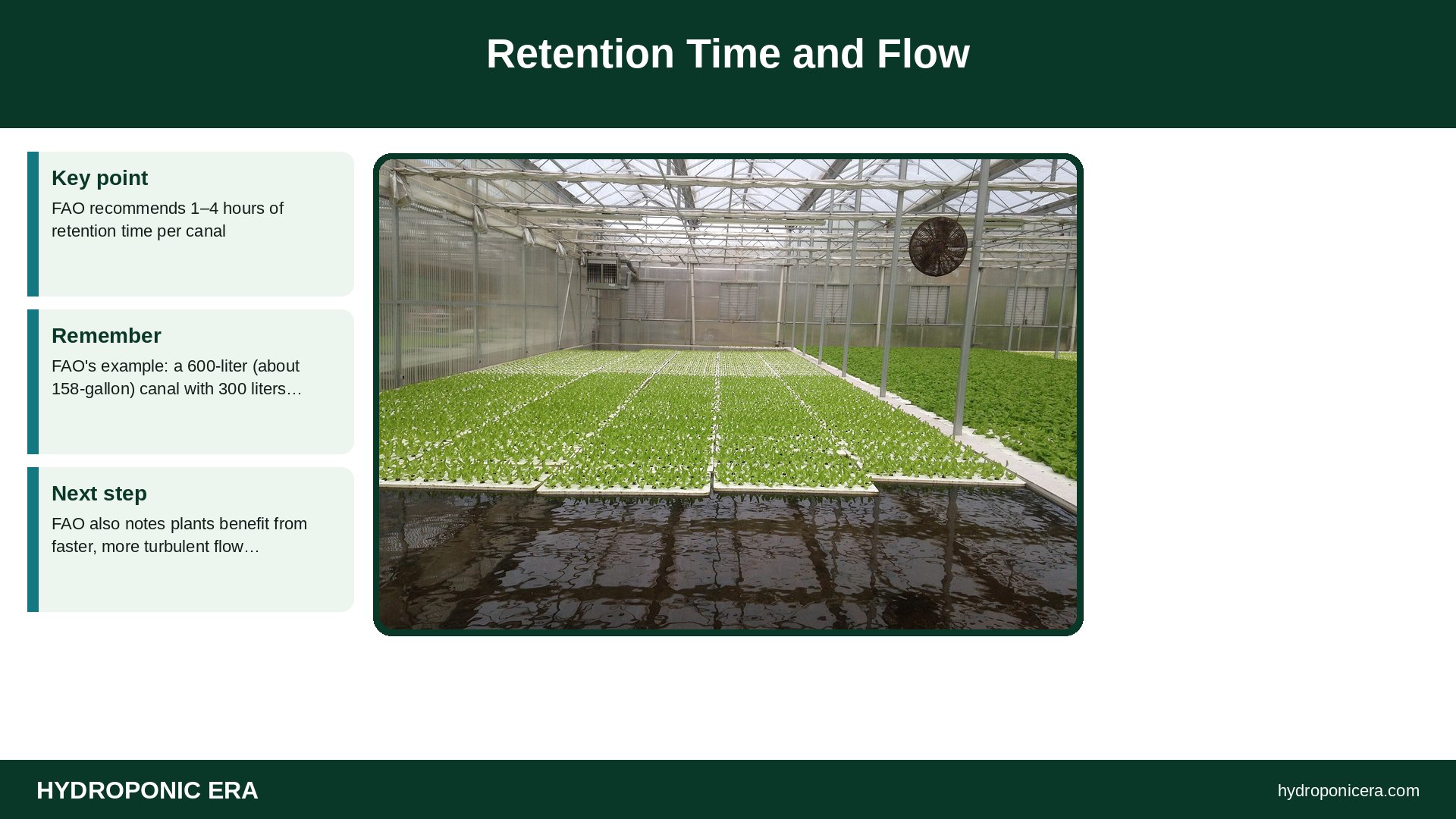
FAO recommends 1–4 hours of retention time per canal. FAO’s example: a 600-liter (about 158-gallon) canal with 300 liters per hour (about 79 GPH) of inflow has a 2-hour retention time. FAO also notes plants benefit from faster, more turbulent flow because roots contact more nutrient ions, while nearly stagnant water hurts growth. You can feed canals in parallel from a manifold or in a “cascade,” where each canal’s outlet feeds the next.
Aeration in an Aquaponics Raft System
FAO calls aeration vital in an aquaponics raft system. In a densely planted canal, plant roots can pull dissolved oxygen below safe levels, and any decomposing solids make it worse. FAO suggests small air stones releasing about 4 liters of air per minute, one every 2–4 m² of canal, plus Venturi fittings on inflow pipes. See air pumps and air stones.
FAO also describes a Kratky-style DWC option that leaves a 3–4 cm (about 1.2–1.6 inch) air gap between raft and water. Roots in the gap get oxygen from the air, which can replace air stones, keeps plant stems dry, and helps release heat in hot climates.
Aquaponics Raft System Planting

Drill holes in foam rafts to fit net cups or sponge cubes. Spacing depends on the crop; smaller plants can be closer. FAO suggests starting seedlings in a nursery, then moving them into net cups filled with volcanic gravel, rockwool, or LECA. You can also sow seeds directly into net cups to avoid transplant shock. After harvest, FAO says remove the whole plant, including roots, then rinse rafts and return them quickly. Don’t let rafts dry out, because nitrifying bacteria live on their underside.
Keep Fish Out of the Canals
FAO warns not to put fish that eat roots, such as tilapia or carp, in the canals. Small fish such as guppies, mollies, or mosquitofish can live in canals to control mosquito larvae. Check your state’s rules before stocking mosquitofish, since some states regulate them.
Aquaponics Raft System Filtration
Because there’s no gravel to trap waste, an aquaponics raft system needs a mechanical filter to remove solids before water reaches the canals. Solids that settle in canals rot, use up oxygen, and coat roots. They also need a biofilter, since rafts and roots alone usually can’t host enough bacteria at normal stocking. FAO says the mechanical separator should be about 10–30% of the fish tank volume, and lists about 0.5 liter of Bioballs per gram of daily feed for NFT and DWC biofilters.
Low-Density Aquaponics Raft System Without Filters
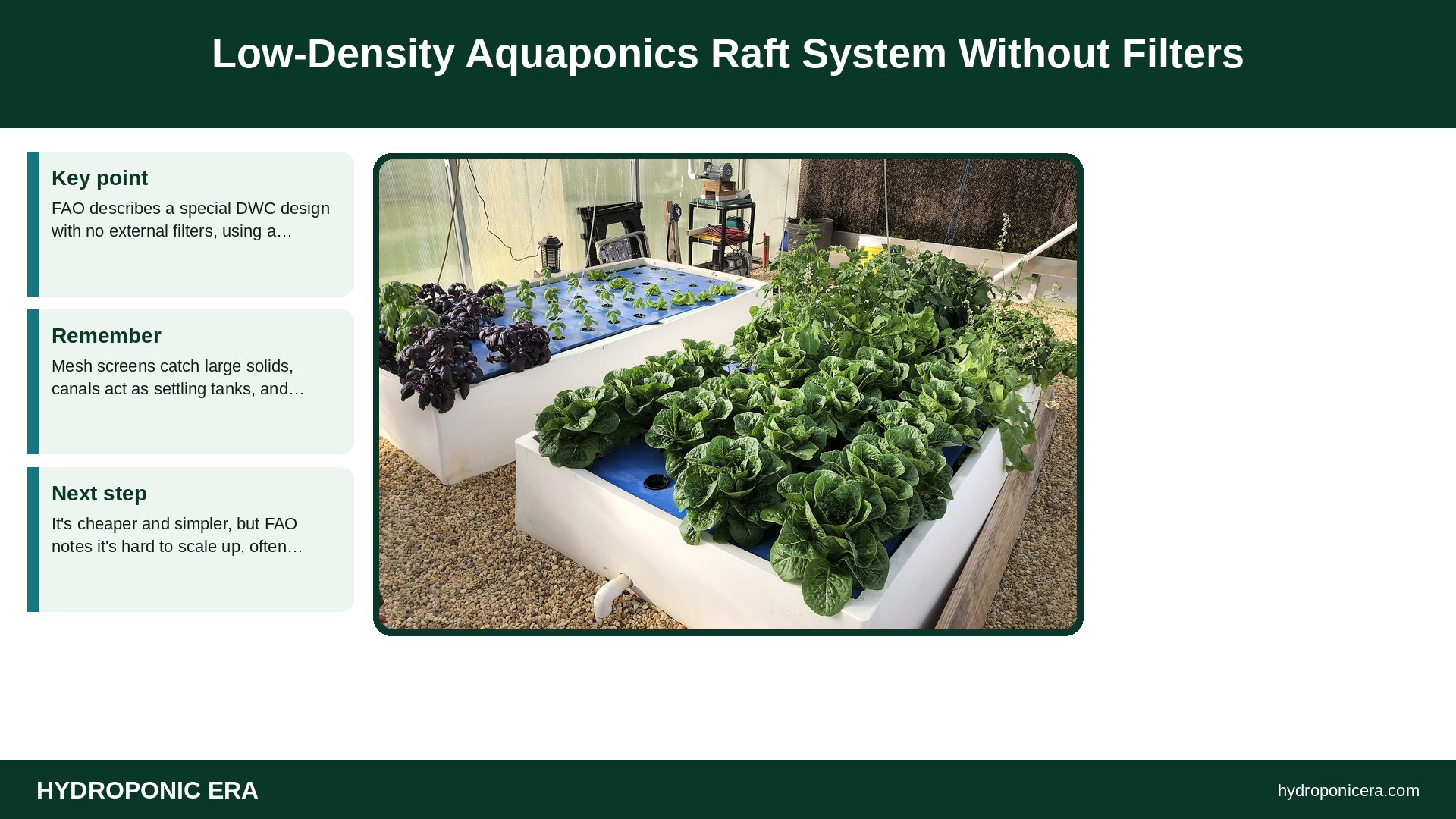
FAO describes a special DWC design with no external filters, using a very low stocking density of 1–5 kg of fish per cubic meter (compared with 10–20 kg normally). Mesh screens catch large solids, canals act as settling tanks, and roots and canal walls host bacteria. It’s cheaper and simpler, but FAO notes it’s hard to scale up, often needs nutrient supplements, and depends on plants staying in the canals at all times. Pump at least half the fish tank volume per hour.
Best Plants for an Aquaponics Raft System
Leafy greens and herbs do best: lettuce, kale, chard, basil, mint, watercress, and pak choi. Large fruiting plants like tomatoes need support and more nutrients, so many growers put them in media beds instead. See aquaponics media beds and fish to plant ratio.
Aquaponics Raft System Materials
Most growers use closed-cell foam board for rafts. Choose a type that won’t shed beads into the water, and cover any exposed cut edges where possible. Rafts should cover the whole canal surface to block light and prevent algae. Fill unused holes with blank plugs or extra cups. Check rafts periodically for root-chewing pests and for cracks that let light into the canal.
FAQs: Aquaponics Raft Systems
What is an aquaponics raft system?
Plants float on foam rafts over canals, with roots in fish water. It’s also called deep water culture.
How deep should raft canals be?
FAO recommends about 12 inches (30 cm).
Does an aquaponics raft system need aeration?
Yes. FAO calls it vital; use air stones about every 2–4 m² of canal.
Can fish live in the raft canals?
Not root-eating fish like tilapia. Small mosquito-eating fish can, where legal.
What grows best in aquaponic rafts?
Lettuce, salad greens, basil, and other leafy crops.
Sources
- FAO — Small-scale aquaponic food production
- Photo credits (Wikimedia Commons, edited with titles): Deepwater Aquaponics Floating Rafts Growing Lettuce, Basil and Arugula by Alabama Extension (CC0); CDC South Aquaponics Raft Tank 1 2010-07-17 by Bryghtknyght (CC BY 3.0); Deep water culture by ArcadiYay (CC BY-SA 4.0); Air Stone Disk aquarium Germany 2024 by Nimmerwelk (CC BY-SA 4.0); Deepwater Aquaponics Floating Rafts Growing Lettuce, Basil and Arugula by Alabama Extension (CC0)