
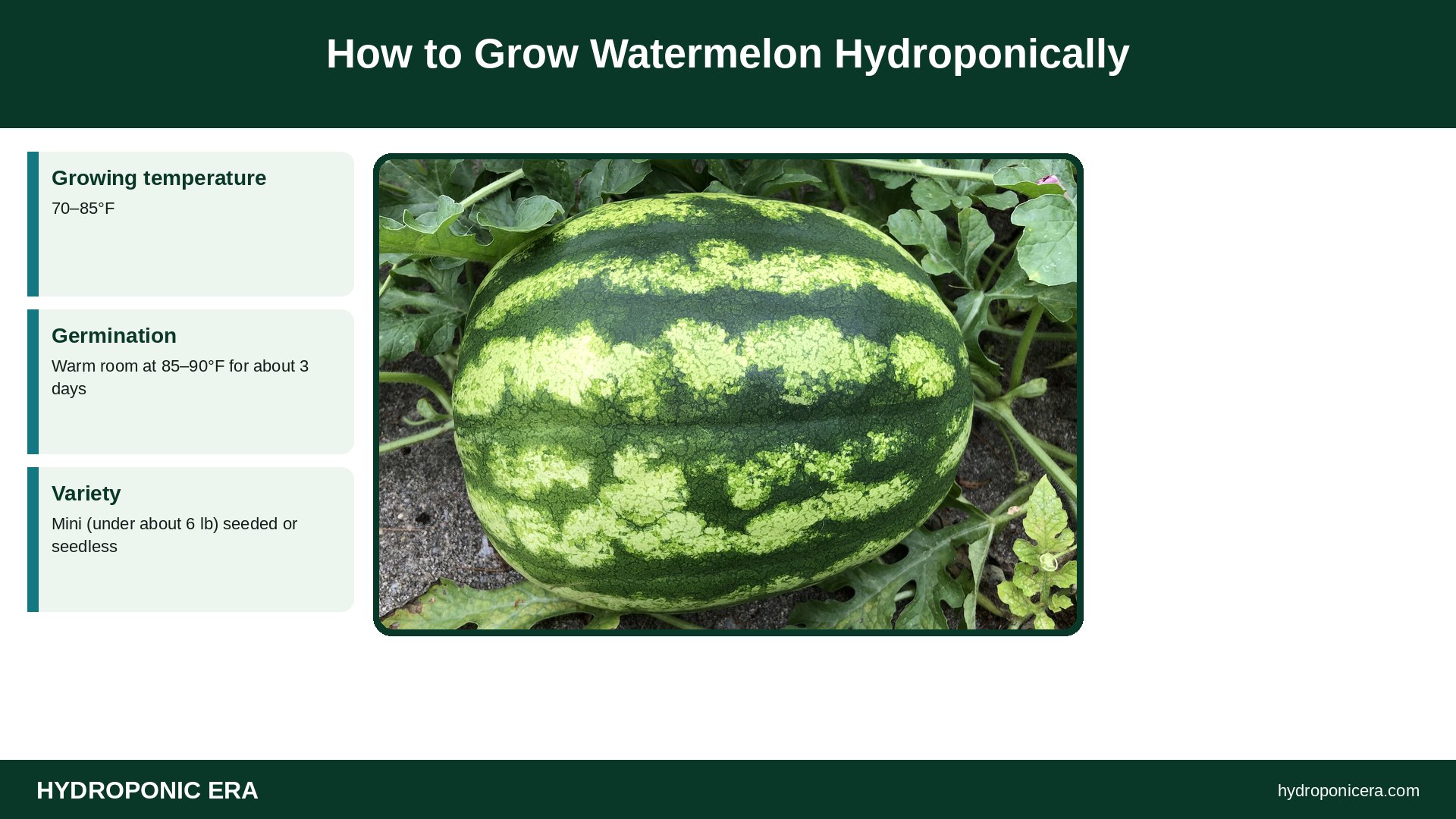
Hydroponic watermelon is possible in a greenhouse, high tunnel, or large indoor space if you grow compact personal-size varieties vertically on a trellis, support each fruit in a sling, and hand-pollinate. Use a large media-based system such as Dutch buckets with perlite or coco, rather than small channels, because vines grow big and roots need room. University of Missouri Extension gives 70–85°F as the optimal growing temperature for melons and watermelons and notes trellising allows higher plant populations in protected structures. Mini watermelons under about 6 pounds, such as seeded ‘Sweet Beauty’ or seedless minis, suit vertical growing best.
Key takeaway: Grow mini watermelons in Dutch buckets, trellis the vine, sling each fruit, hand-pollinate in the early morning, and keep temperatures in the 70s and low 80s.
| Factor | Guideline (MU Extension unless noted) |
|---|---|
| Growing temperature | 70–85°F |
| Germination | Warm room at 85–90°F for about 3 days |
| Variety | Mini (under about 6 lb) seeded or seedless |
| Pollination | Bees, or hand-pollinate 6–9 a.m. |
| Seedless types | Need a seeded pollinizer variety |
| Days to maturity | About 75–85 days for minis listed by MU |
Can You Grow Hydroponic Watermelon?
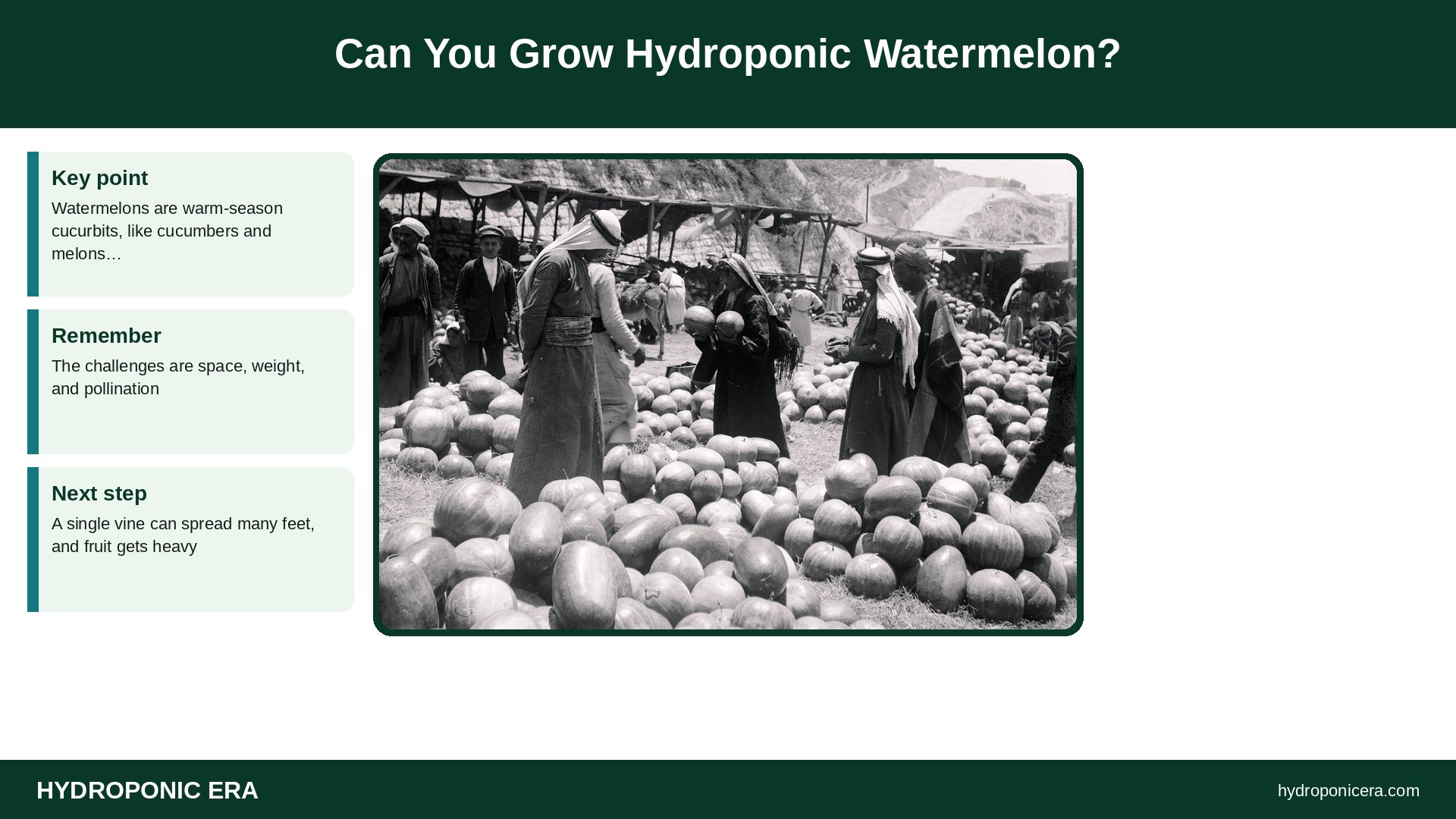
Yes. Watermelons are warm-season cucurbits, like cucumbers and melons, which are already grown hydroponically in greenhouses. The challenges are space, weight, and pollination. A single vine can spread many feet, and fruit gets heavy. Growing vertically and choosing mini varieties make hydroponic watermelon practical. See how to grow melons hydroponically.
Best Systems for Hydroponic Watermelon
- Dutch buckets: best choice; perlite or coco gives roots support and drainage. See DWC vs NFT vs Dutch bucket.
- Large DWC tubs: possible with strong aeration and cool water.
- Drip-fed grow bags: similar to Dutch buckets.
Avoid NFT channels; vine crops have large root systems that can clog them.
Choosing Hydroponic Watermelon Varieties
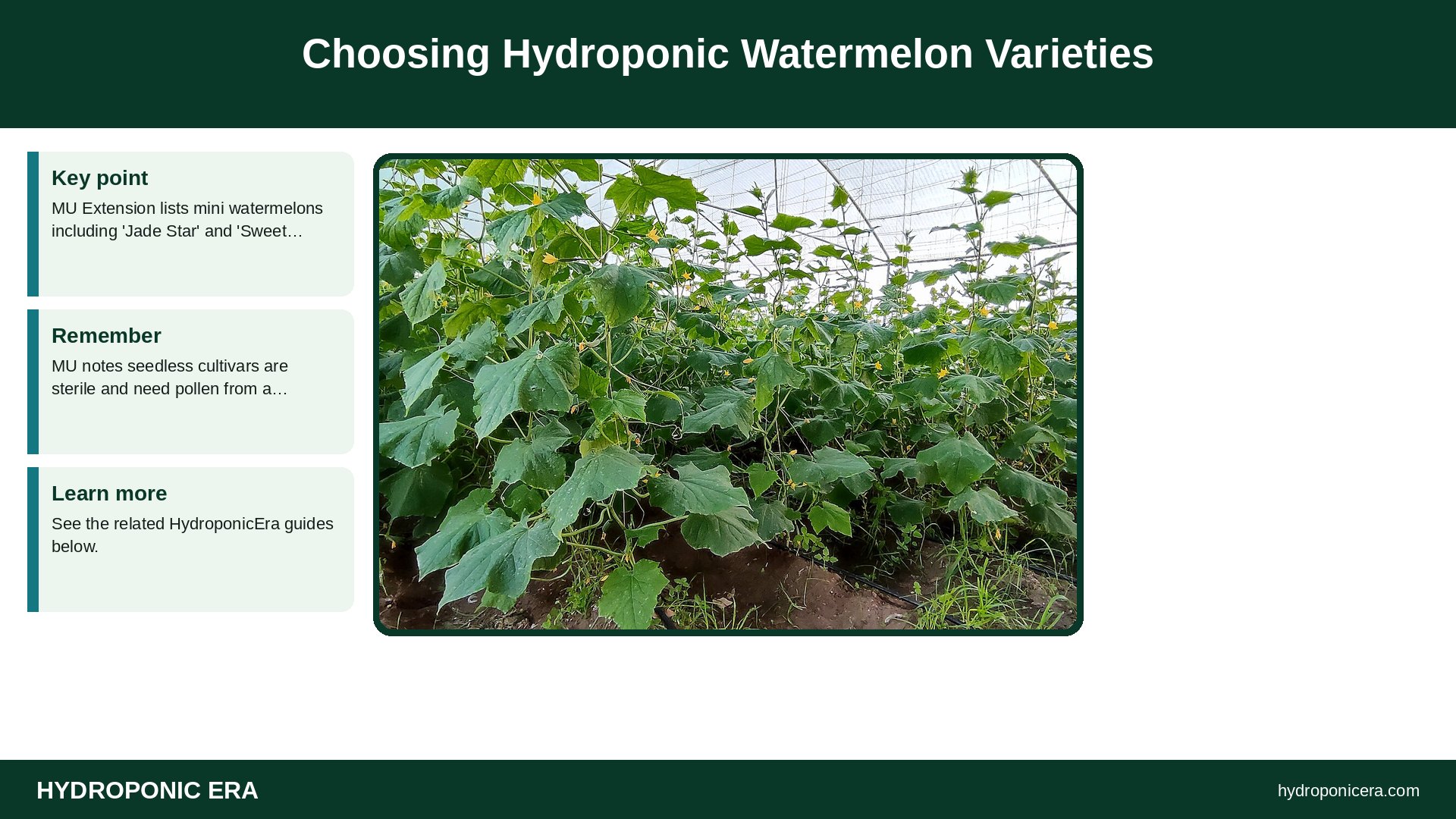
MU Extension lists mini watermelons including ‘Jade Star’ and ‘Sweet Beauty’ (seeded, about 75–77 days) and mini seedless types such as ‘Extazy’ (about 85 days). MU notes seedless cultivars are sterile and need pollen from a seeded, diploid variety to set fruit, so grow at least one seeded plant if you choose seedless.
Starting Hydroponic Watermelon Seeds
MU recommends placing seeded trays in a warm room at 85–90°F for about three days to speed germination. Use starter plugs, keep them moist, and transplant when seedlings have a few true leaves. See starter sponges.
Trellising and Pruning Hydroponic Watermelon
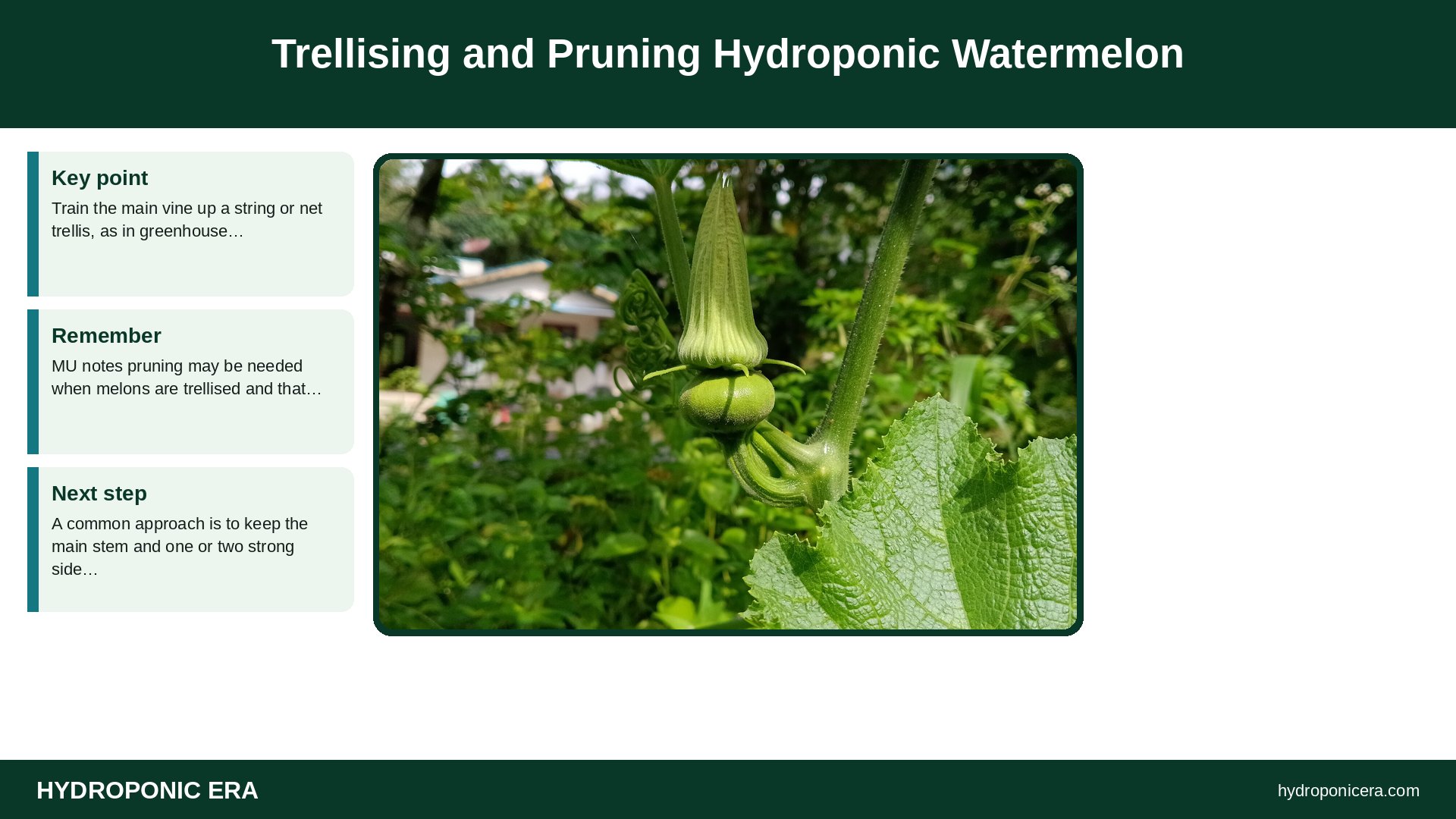
Train the main vine up a string or net trellis, as in greenhouse tomato production. MU notes pruning may be needed when melons are trellised and that pruning balances vine growth and fruit set, raising average fruit weight. A common approach is to keep the main stem and one or two strong side shoots and remove the rest. Support each fruit with a mesh sling or cloth hammock tied to the trellis once it reaches tennis-ball size.
Pollinating Hydroponic Watermelon
Watermelon plants produce separate male and female flowers; MU notes plants make about 12–15 male flowers for each female flower. Bees normally pollinate them. Indoors or in a closed greenhouse, hand-pollinate: pick a fresh male flower, remove the petals, and brush its pollen onto the center of an open female flower (the one with a tiny melon behind it). MU says hand pollination is most effective from 6 to 9 a.m. and may succeed only about half the time, so pollinate several flowers.
Nutrients and Water
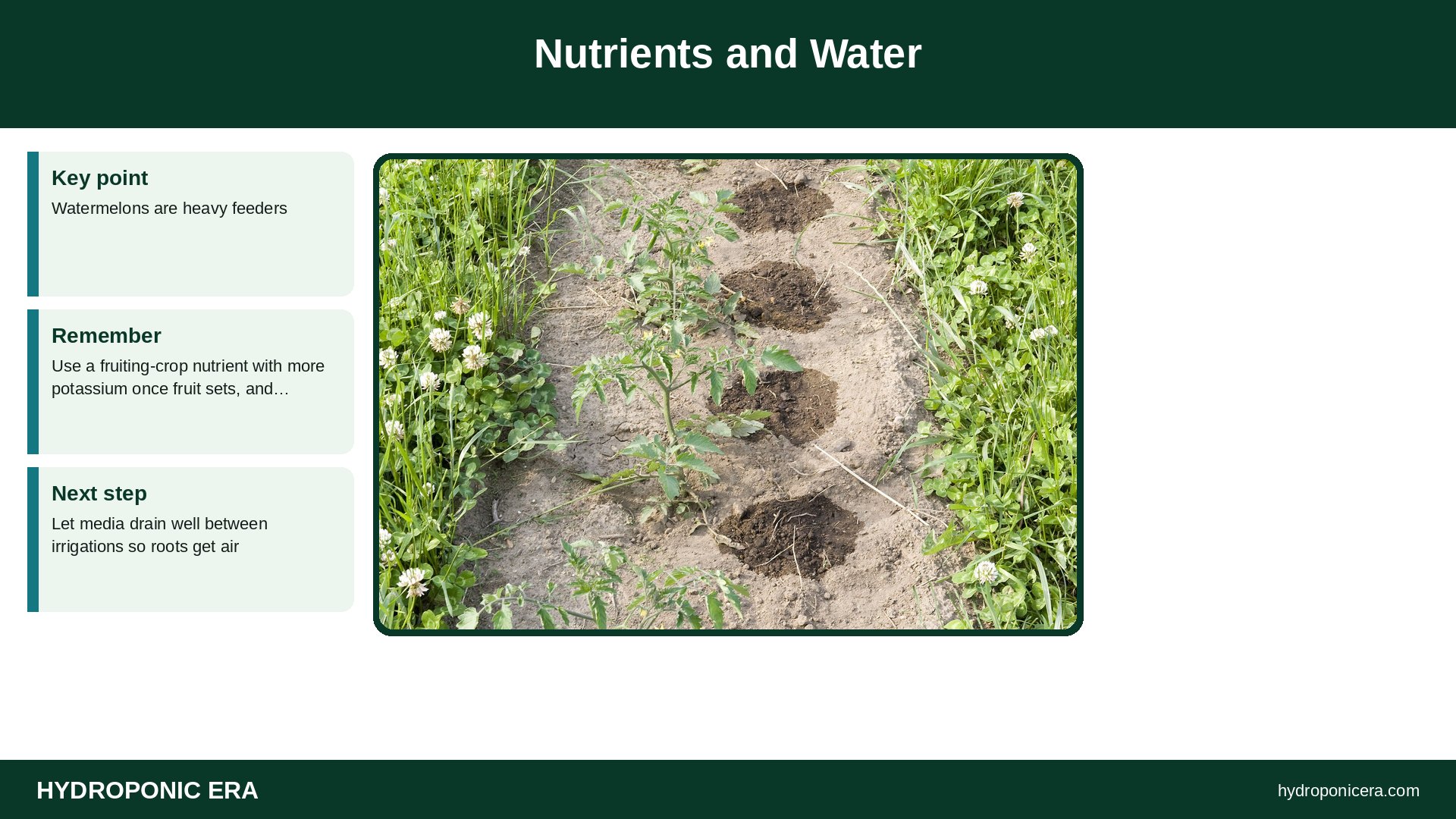
Watermelons are heavy feeders. Use a fruiting-crop nutrient with more potassium once fruit sets, and keep pH in the usual hydroponic range. Let media drain well between irrigations so roots get air. Large vines drink a lot on hot days; check reservoirs daily. See leafy vs fruiting recipes.
Light and Temperature
Hydroponic watermelon needs strong light: full sun in a greenhouse or powerful grow lights indoors. Keep temperatures around MU’s 70–85°F range. Cool nights slow growth and pollination; very hot conditions can reduce fruit set.
When to Harvest Hydroponic Watermelon
- The tendril nearest the fruit turns brown and dry.
- The spot where the fruit rests turns from white to creamy yellow.
- The rind loses its shine and becomes dull.
- Days from seeding match the variety’s maturity rating.
Planning Tips: Hydroponic Watermelon
Support is essential for hydroponic watermelon grown vertically. Train vines up a trellis and hold each fruit in a sling made from netting or old fabric tied to the trellis, so its weight doesn’t tear the vine. Mini or icebox types are much easier to support indoors than full-size melons.
Plants use a lot of water once fruit sets, so check reservoir levels daily and keep feeding steady to reduce cracking.
Weekly Routine for Hydroponic Watermelon
- Check pH and EC, and record them.
- Top off the reservoir with plain, pH-adjusted water.
- Look at roots for color and smell.
- Check leaves, especially undersides, for pests.
- Clean filters, emitters, and pump intakes.
- Change the nutrient fully every two to three weeks, or sooner if EC drifts.
Beginner Mistakes With Hydroponic Watermelon
The most common mistakes are skipping pH testing, using nutrient that’s too strong, letting light reach the water, and ignoring water temperature. Each one is easy to fix once you know to check for it. Start with fewer plants than you think you need, learn the routine, and expand once the system runs smoothly.
Best Systems for Hydroponic Watermelon
Dutch buckets and large media beds suit hydroponic watermelon best, because the vines need a big root zone and steady water. Drip feeding on a timer into perlite or coco works well. Deep water culture can work but large plants make buckets top-heavy and warm water raises the risk of root rot.
Choosing Hydroponic Watermelon Varieties
MU Extension describes small icebox and mini watermelons, which are easier to grow in tight spaces and on trellises. Seedless types need a pollinizer variety nearby to set fruit, which adds complexity indoors, so seeded minis are simplest for beginners.
FAQs: Hydroponic Watermelon
Can watermelon grow hydroponically?
Yes, especially mini varieties on a trellis in Dutch buckets.
Do I need to pollinate by hand?
Indoors, yes. Hand-pollinate early in the morning.
Do seedless watermelons need a pollinizer?
Yes. MU says they need pollen from a seeded variety.
What temperature is best?
About 70–85°F, per MU Extension.
How do I support the fruit?
Use a mesh sling tied to the trellis.
How many melons per plant?
Indoors, keeping one to two fruit per vine helps each reach full size.
Sources
- University of Missouri Extension — High Tunnel Melon and Watermelon Production
- Photo credits (Wikimedia Commons, edited with titles): 2023-09-17 16 15 05 A watermelon growing on a vine growing out of the crack in a concrete patio along Mercer County Route 526 (Robbinsville-Edinburg Road) in Robbinsville Township, Mercer County, New Jersey by Famartin (CC BY-SA 4.0); Watermelon market. Jerusalem. approximately 1900 to 1920. matpc.05613.II by American Colony (Jerusalem). Photo Dept., photographer (Public domain); Cucumber greenhouse plants of Dr. Mahmoud Salem’s farm by Amnsalem (CC BY-SA 4.0); Female flower bud in pumpkin by Pragathi. BH (CC BY-SA 4.0); Drip irrigation (2552390830) by Dwight Sipler from Stow, MA, USA (CC BY 2.0)