
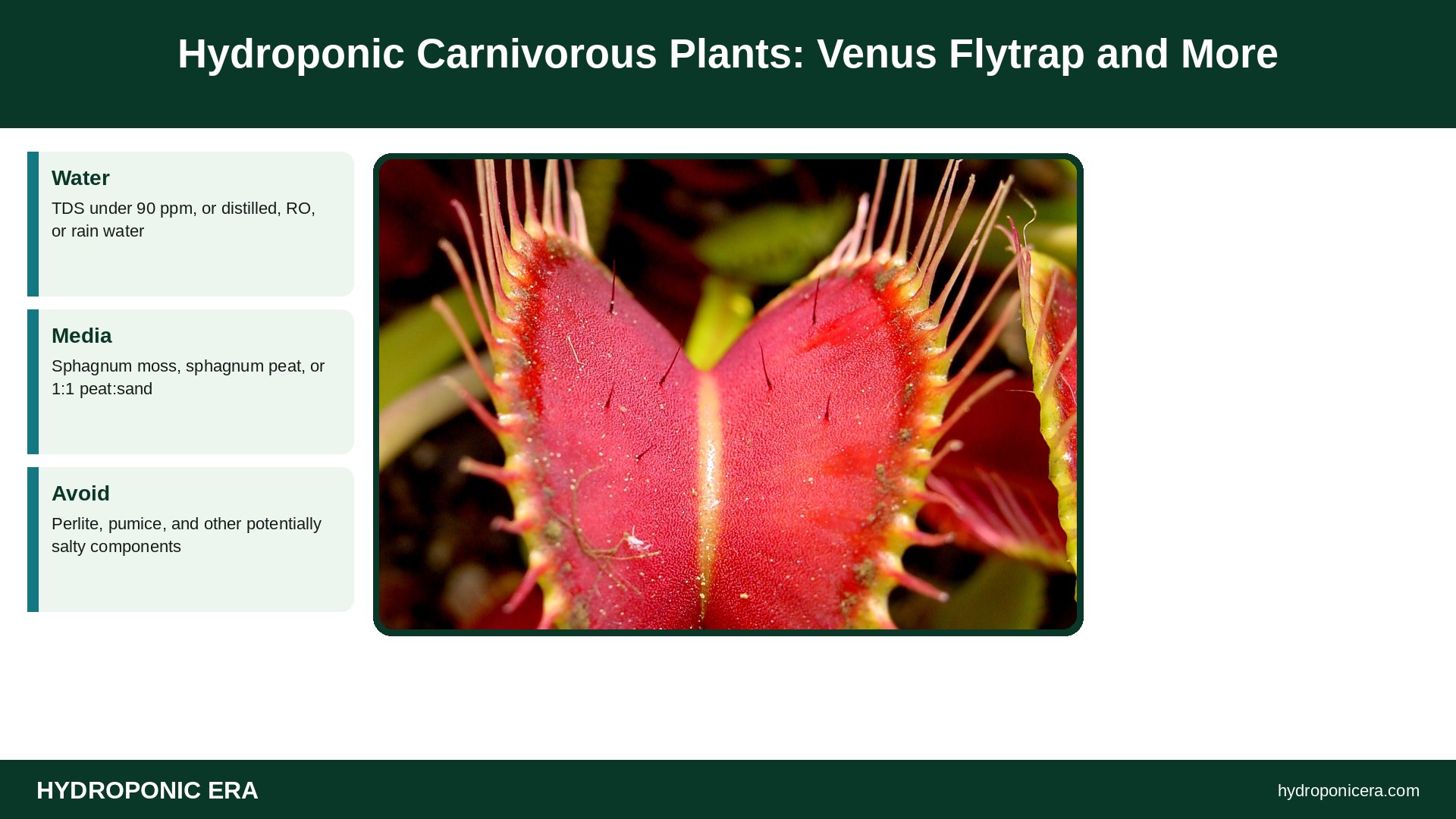
Hydroponic carnivorous plants need a different approach from almost every other hydroponic crop: they should not get nutrient solution. Venus flytraps, pitcher plants, and sundews evolved in poor, wet soils and get extra nutrients from insects. The International Carnivorous Plant Society says to use water with total dissolved solids below about 90 ppm, or distilled, reverse osmosis, or clean rain water, and warns not to fertilize flytraps unless you’re prepared to lose them. The workable “hydroponic” method is the tray method: plants in low-nutrient media, sitting in a shallow tray of pure water.
Key takeaway: Grow carnivorous plants in peat or sphagnum standing in pure, low-TDS water, give them strong light, and skip hydroponic nutrients.
| Need | Guidance (ICPS) |
|---|---|
| Water | TDS under 90 ppm, or distilled, RO, or rain water |
| Media | Sphagnum moss, sphagnum peat, or 1:1 peat:sand |
| Avoid | Perlite, pumice, and other potentially salty components |
| Fertilizer | Don’t fertilize; feed traps instead |
| Light | More than a typical windowsill provides |
| Dormancy | Not required indoors; needed if exposed to freezing outdoors |
Why Hydroponic Carnivorous Plants Don’t Use Nutrients
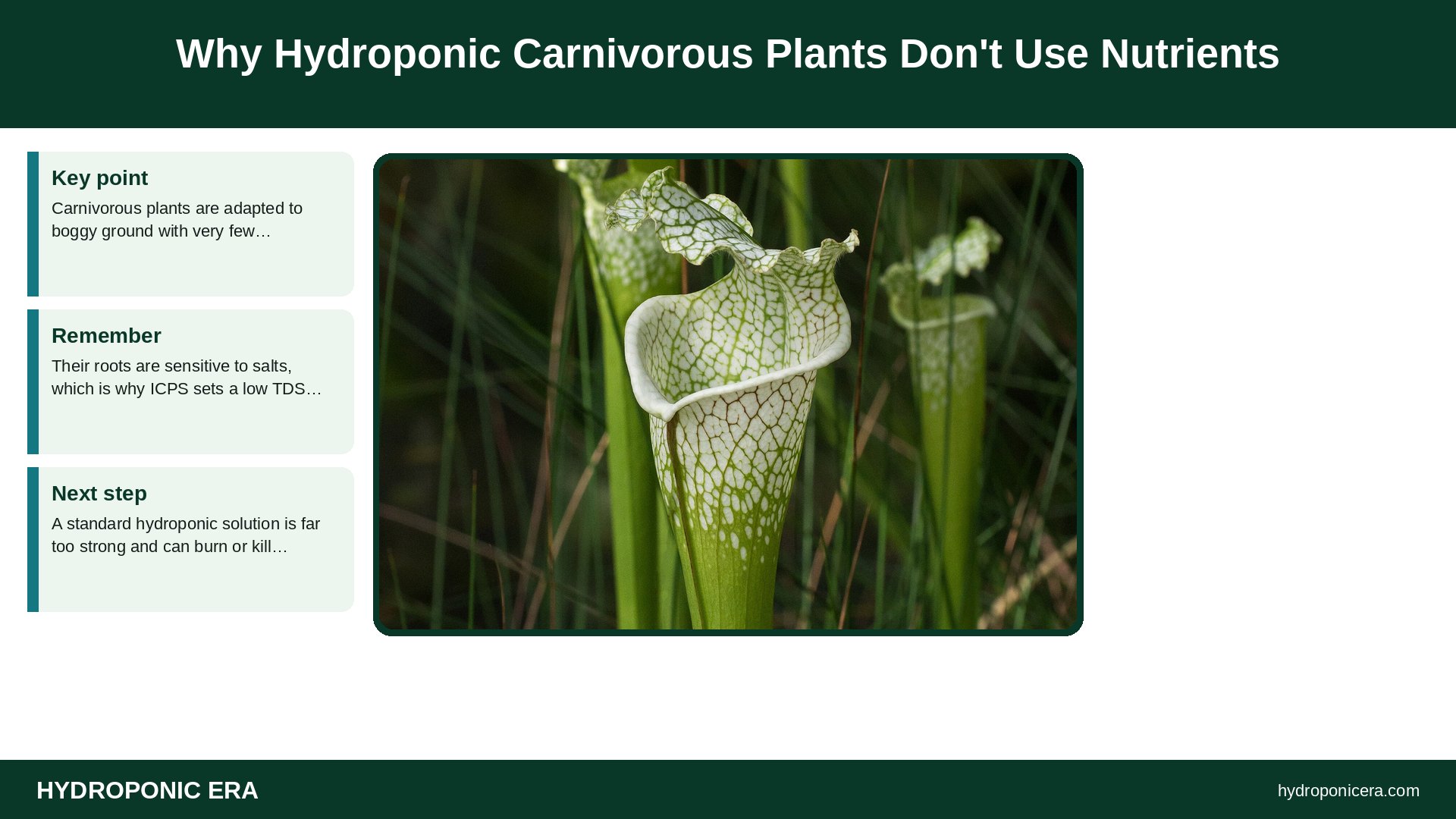
Carnivorous plants are adapted to boggy ground with very few dissolved minerals. Their roots are sensitive to salts, which is why ICPS sets a low TDS limit for water and warns against fertilizing the soil. A standard hydroponic solution is far too strong and can burn or kill roots. See pH and EC meters to check your water.
The Tray Method
ICPS says a flytrap pot should always sit in pure water, but the plants don’t like being soggy. It advises keeping the water level more than 2 inches below the soil surface, using taller pots for wetter mixes. A shallow tray of distilled or rain water under each pot keeps media wet from below. Top off with pure water only, and replace it if it gets dirty.
Best Media for Hydroponic Carnivorous Plants

ICPS says flytraps grow well in live or dried sphagnum moss, sphagnum peat, or a 1:1 peat and sand mix, and advises avoiding perlite, pumice, and other potentially salty components. This is the opposite of most hydroponic advice, where perlite is standard. Rinse peat with distilled water before use if you can.
Light
ICPS notes a flytrap needs more light than a typical house windowsill gives. Indoors, a bright LED grow light a short distance above the plants works well. Strong light gives red trap color and compact growth. See grow lights for hydroponics.
Feeding Hydroponic Carnivorous Plants

Instead of fertilizing roots, feed traps. ICPS suggests dried blood worms for flytraps. Use small amounts, and only feed healthy, active traps. Plants outdoors catch enough insects on their own.
Dormancy
ICPS says flytraps don’t need dormancy to survive long term indoors under strong light, and that dormancy matters only for plants exposed to freezing outdoors. NC State Extension discusses flytrap dormancy for outdoor plants in their native region. Pitcher plants (Sarracenia) from temperate areas also go dormant outdoors in winter.
Popular Hydroponic Carnivorous Plants

- Venus flytrap (Dionaea): classic, needs strong light.
- North American pitcher plants (Sarracenia): tall, colorful, need full sun.
- Sundews (Drosera): easy, many species.
- Butterworts (Pinguicula): good windowsill plants.
Common Problems
- Black traps: normal aging, or overfeeding.
- Plant declining: tap water with high TDS, or fertilizer.
- Weak, green, floppy growth: too little light.
- Rot: water level too high in a short pot.
Hydroponic Carnivorous Plants and Water Testing
A cheap TDS meter tells you whether your tap water is safe. ICPS uses 90 ppm as the limit. Measure water each time you refill if you use tap water, since it can change seasonally. Rain water collected from clean surfaces and distilled water from the store are both reliable.
Repotting Carnivorous Plants
Repot into fresh peat or sphagnum when media breaks down, usually every year or two. Handle roots gently and rinse new media with pure water before use. Keep the tray topped up after repotting while plants settle.
Outdoor Bog Gardens vs Indoor Trays
In warm, sunny regions, an outdoor bog container lined with peat and kept wet with rain water gives carnivorous plants full sun and natural insects. Indoors, the tray method with strong LED light works well. Either way, pure water and low-nutrient media are the rules that matter most.
Hydroponic Carnivorous Plants for Beginners
Sundews and butterworts are the most forgiving hydroponic carnivorous plants for a first try. They tolerate indoor conditions, grow quickly under LED light, and show clear signs when water or light is wrong. Once you can keep them healthy on the tray method with pure water, Venus flytraps and pitcher plants are the natural next step.
Equipment Checklist for Hydroponic Carnivorous Plants
- Distilled, RO, or rain water.
- A TDS meter.
- Sphagnum moss or peat.
- Shallow water trays.
- A bright LED light.
Most of this gear is reusable from crop to crop, so the first setup costs the most. Buy reliable meters first; they prevent the majority of problems.
Beginner Mistakes With Hydroponic Carnivorous Plants
The most common mistakes are using tap water with high TDS, adding fertilizer, using perlite, and giving too little light.
Getting Started With Hydroponic Carnivorous Plants
Start small, change one thing at a time, and keep a simple log of pH, EC, temperature, and what you changed. Most hydroponic problems show up as patterns in those numbers before they show on the plant. Compare your notes with the sources below, and adjust slowly rather than chasing every small swing. A steady routine matters more than any single product or setting.
FAQs: Hydroponic Carnivorous Plants
Can carnivorous plants grow in hydroponics?
Not with nutrient solution; use the tray method with pure water.
What water do carnivorous plants need?
TDS under 90 ppm, or distilled, RO, or rain water.
Should I fertilize a Venus flytrap?
ICPS advises against it.
Can I use perlite?
ICPS says to avoid perlite and pumice.
Do flytraps need dormancy indoors?
ICPS says no, under strong light.
Can I use bottled spring water?
Only if its TDS is low enough.
Sources
- International Carnivorous Plant Society — Growing Dionaea muscipula
- NC State Extension, New Hanover County — Venus Flytrap Dormancy
- Photo credits (Wikimedia Commons, edited with titles): Venus Flytrap showing trigger hairs by Noah Elhardt (CC BY-SA 2.5); Sarracenia leucophylla at the Brooklyn Botanic Garden (81396)b by Rhododendrites (CC BY-SA 4.0); US Navy 050107-N-0057P-246 Aviation Electronics Technician 2nd Class Jason D. Schapp of Oakridge, Ore., and members of the Indonesian Army unload jugs of water that were purified in distilling plant aboard USS Abraham Lincoln ( by U.S. Navy photo by Photographer’s Mate 2nd Class Seth C. Peterson (Public domain); Terramera scientists working in a climate-controlled growth chamber located in Vancouver, BC. The space uses LED lighting, which supports plant growth. (50188965171) by Simon Fraser University – Communications & Marketing (CC BY 2.0); Water droplets on a late cotoneaster (Cotoneaster coriaceus) leaf, Jardim da Fundação Calouste Gulbenkian, Lisbon, Portugal julesvernex2 by Jules Verne Times Two (CC BY-SA 4.0)