
Does UV light for plants help? A small amount can. Research shows UV-A can boost seedling growth and UV-B can deepen red and purple leaf color and raise protective compounds. But UV light for plants is a supplement, not a main grow light, and too much UV-B stunts and burns leaves. UV is also hazardous to your eyes and skin, so use shielded fixtures and timers.
Key takeaway: Before buying UV light for plants, get the main light right first (PPFD and DLI). Add UV only if you want color or compact growth, at low doses, with eye protection.
| UV band | Wavelength | What it can do for plants | Main risk |
|---|---|---|---|
| UV-A | 315–400 nm | In studies, raised biomass in tomato seedlings and lettuce | Stress at high doses |
| UV-B | 280–315 nm | Increases anthocyanins and other protective compounds | Leaf damage, reduced growth |
| UV-C | 100–280 nm | Used to sanitize, not to grow | Harmful to plants, eyes and skin |
What Is UV Light for Plants?
UV is the short-wavelength light just beyond violet, below the 400–700 nm range plants use for photosynthesis. Sunlight contains UV-A and some UV-B; the atmosphere blocks UV-C. Indoors, glass and most LED grow lights deliver little or none. Michigan State University’s Roberto Lopez notes in an e-GRO alert that UV radiation is not present in the vast majority of supplemental LED fixtures.
Because UV photons don’t drive much photosynthesis, they work mostly as a signal. Plants sense UV with photoreceptors and respond by building pigments, thickening leaves and staying compact.
Does UV-A Light Help Plants Grow?
In some studies, yes. A 2018 HortScience study (Kang and colleagues) found that adding UV-A to the light for indoor tomato seedlings increased biomass by 29% with 8 hours and 33% with 16 hours of daily exposure, mainly because leaves grew larger and caught more light. A 2019 study in Frontiers in Plant Science reported that supplemental UV-A raised lettuce shoot dry weight by 27% and 29% at the two lower doses, but only 15% at the highest dose. More was not better. Effects vary by crop and dose, so treat these as research results, not guarantees.
What Does UV-B Light Do to Plants?

UV-B is the form of UV light for plants that mainly changes quality rather than yield. A 2021 review in Horticulturae describes UV as a tool to improve produce quality and food safety, and a 2024 lettuce study found short UV-B treatments before harvest raised antioxidant compounds. Michigan State’s floriculture team also links purple leaf coloring to anthocyanins, which UV-B and high light can promote.
The trade-off is real. Higher UV-B doses reduce growth, curl leaves and damage photosynthesis. A 2021 Horticulture Research review on UV-B discusses its potential to reduce some diseases and pests, but dosing has to be precise.
Should Home Growers Add UV Light for Plants?
Most don’t need UV light for plants. Lettuce, herbs and microgreens grow well under full-spectrum white LEDs with no UV. Consider UV if:
- You want deeper color: Red lettuce, purple basil and red microgreens often color better with UV-B or strong blue light.
- Plants will move outside: Seedlings grown with some UV may handle outdoor sun with less shock. Hardening off is still essential.
- You’re experimenting: Run a side-by-side test with an untreated control.
If your plants are pale or stretched, UV won’t fix it. Check intensity first with our guide to PPFD and DLI and see the best grow lights for hydroponics.
How Do You Use UV Light for Plants Safely?
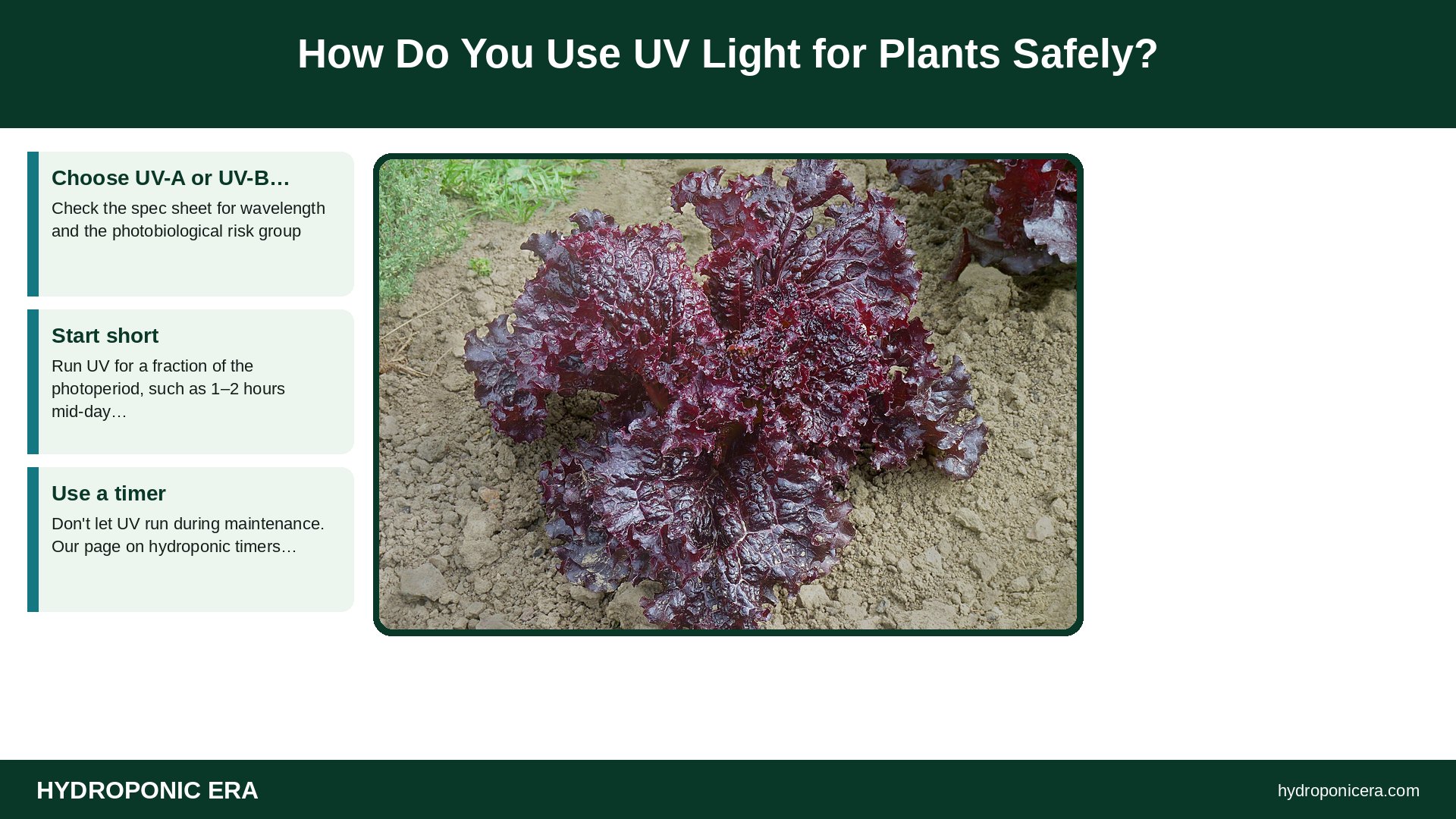
Use low doses on a timer, never look at the lamp, and keep UV-C out of grow spaces.
- Choose UV-A or UV-B diodes made for horticulture. Check the spec sheet for wavelength and the photobiological risk group.
- Start short. Run UV for a fraction of the photoperiod, such as 1–2 hours mid-day, and watch for leaf curl or bronzing.
- Use a timer. Don’t let UV run during maintenance. Our page on hydroponic timers covers setups.
- Turn it off before working. e-GRO recommends turning off nearby fixtures and using general lighting when working close to plants.
- Wear protective eyewear rated for UV. Ordinary sunglasses may not block enough.
- Cover skin. UV-B can burn skin with repeated exposure.
What Do Risk Group Labels Mean on Grow Lights?
They tell you how long you can look at the light before it becomes an eye hazard. Under ANSI/CAN/UL 8800 and IEC 62471, lamps fall into Exempt (no hazard), Risk Group 1 (low), Risk Group 2 (moderate) and Risk Group 3 (high). e-GRO explains that Risk Group 2 lamps should not be stared at, and that a custom LED fixture emitting UV carries its own warning label. For broader safety, see electrical safety for indoor hydroponics.
Can UV Light for Plants Kill Pests or Mold?
Research is promising but not a home cure. UV-B and UV-C are being studied against powdery mildew and some pests, usually with carefully timed night treatments in commercial settings. Too much UV-C damages leaves. For now, stick to proven controls: airflow, humidity management and sanitation. Our guide to powdery mildew in hydroponics covers these. UV sterilizers inside water lines are a different tool; see UV sterilizers for reservoirs.
Which Crops Respond Most to UV Light for Plants?
Colored leafy crops show the clearest response. Red-leaf lettuce, purple basil, red kale and red-stemmed microgreens build more anthocyanin pigment when they get UV-B or strong light, so the color difference is easy to see. Green lettuce and herbs may get slightly thicker, more compact leaves but little visible change. Fruiting crops such as tomatoes and peppers are mostly studied as seedlings, where UV-A has increased leaf area.
Houseplants grown for foliage rarely need UV. A bright window or a good white LED covers their needs.
How Is UV Different From Blue Light?
Blue light (400–500 nm) drives photosynthesis and also keeps plants compact and colorful. UV does similar signaling with much less photosynthetic value and more risk. For most indoor growers, a fixture with a healthy blue share gives many of the same benefits more safely. Our guide to the hydroponic light schedule explains how hours of light matter as much as color.
Do Regular Grow Lights Emit UV?
Mostly not, so UV light for plants usually means a separate lamp or channel. Standard white and red/blue LEDs emit little or none. Some full-spectrum fixtures add a UV-A or UV-B channel and say so on the spec sheet. Metal halide lamps emit some UV, which is why many have glass shields.
FAQs
Is UV light for plants necessary?
No. Plants grow fine without it under good visible light.
Can I use a black light as a UV grow light?
It emits UV-A, but at low intensity and with no plant-specific dosing data.
Does UV light for plants improve flavor?
It can raise some compounds linked to flavor and color, but results vary by crop.
Is UV light for plants safe for pets?
Keep pets out of direct UV exposure, as with people.
How far should UV light for plants hang from the canopy?
Follow the maker’s distance; start far and move closer only if leaves show no stress.
Sources
- e-GRO (Lopez, Michigan State University) — Are There Risks of Working Under LED Supplemental Lighting?
- HortScience (2018) — Ultraviolet-A Radiation Stimulates Growth of Indoor Cultivated Tomato Seedlings
- Frontiers in Plant Science (2019) — UVA Radiation Is Beneficial for Yield and Quality of Indoor Cultivated Lettuce
- Horticulturae (2021) — UV Lighting in Horticulture: A Sustainable Tool for Improving Production Quality and Food Safety
- Horticulture Research (2021) — UV-B Light and Its Application Potential to Reduce Disease and Pest Incidence in Crops
- Plants (2024) — Effects of UV-B and UV-C Spectrum Supplementation on Lettuce Cultivars
- Michigan State University Floriculture — Purpling of Leaves
- Photo credits (Wikimedia Commons, edited with titles): Rough diamonds – necklace in UV and normal light B – composite by W.carter (CC BY-SA 4.0); Terramera scientists working in a climate-controlled growth chamber located in Vancouver, BC. The space uses LED lighting, which supports plant growth. (50188965171) by Simon Fraser University – Communications & Marketing (CC BY 2.0); Red leaf lettuce J1 by Jamain (CC BY-SA 3.0); Aspect Black 20W Growlight over Bonsai by Hotmilk400 (CC BY-SA 4.0); Click & Grow Smart Garden 27 by Janar Raidla (CC BY-SA 4.0)