
What is the best fertilizer for plants in water? Use a complete, water-soluble fertilizer that includes micronutrients, mixed at about one-quarter of the label strength. Add it when you change the water, typically every 4–6 weeks for houseplants kept in water. Don’t feed fresh cuttings until they have roots, and never add slow-release spikes or granules to a jar.
Key takeaway: The best fertilizer for plants in water is weak and complete. Plants living in water have no soil to buffer mistakes. Feed weak, feed complete, and refresh the water instead of piling more fertilizer on top.
| Situation | What to use | How often |
|---|---|---|
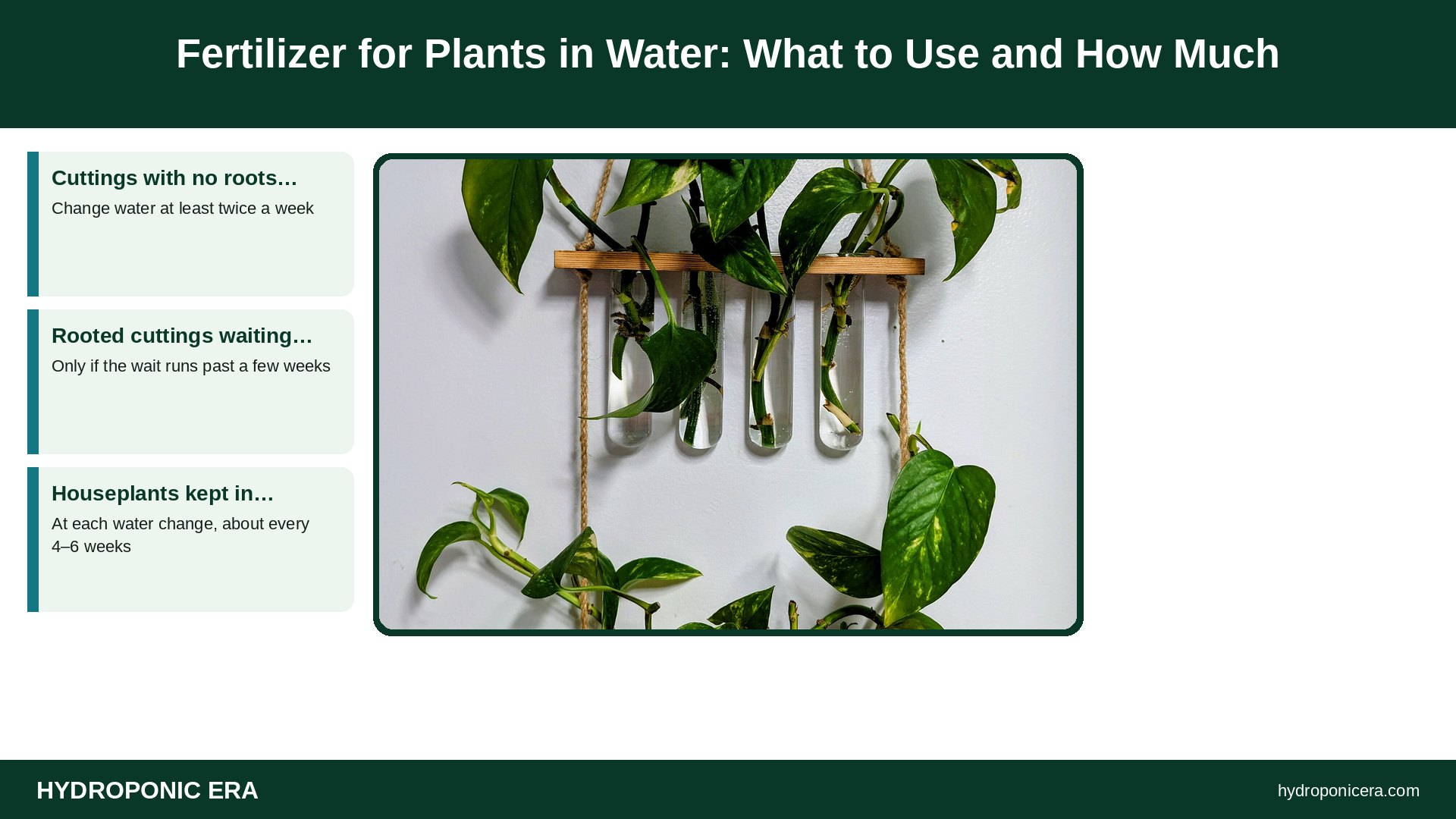
| Cuttings with no roots yet | Plain water | Change water at least twice a week |
| Rooted cuttings waiting to be potted | Plain water or a very weak feed | Only if the wait runs past a few weeks |
| Houseplants kept in water long term | Complete liquid or powder fertilizer at 1/4 strength | At each water change, about every 4–6 weeks |
| Hydroponic edibles (lettuce, herbs) | Hydroponic nutrient, measured by EC | Per the nutrient chart |
Do Plants Growing in Water Need Fertilizer?
Yes, if they stay in water for more than a few weeks. Plants make sugars from light, air and water, but they need at least 16 elements to grow, as UConn’s Home and Garden Education Center explains. In soil, the mix supplies some of these. In a jar of tap water, there is almost nothing beyond whatever minerals your water carries. Unfed plants show slow growth, weak stems and pale leaves.
Fresh cuttings are the exception. A cutting draws on stored energy while it roots, and adding fertilizer then only feeds algae and bacteria. Wait for roots.
What Type of Fertilizer for Plants in Water Works Best?
A balanced, water-soluble product with micronutrients is the best fertilizer for plants in water. UConn notes that an all-purpose fertilizer with roughly equal numbers, such as 20-20-20 or 10-8-7, suits most houseplants, and that micronutrients like iron, zinc and manganese are often missing from soilless setups. Water is the most soilless setup of all, so check the label for trace elements.

| Fertilizer type | Use in water? | Why |
|---|---|---|
| Liquid concentrate (houseplant) | Yes, diluted | Dissolves completely; easy to dose small amounts |
| Water-soluble powder | Yes, diluted | Same as liquid; weigh or measure carefully |
| Hydroponic nutrient | Yes | Built for water; includes calcium, magnesium and chelated micros |
| Slow-release pellets or spikes | No | Made for soil; release is uncontrolled in water |
| Fish emulsion, compost tea | Not recommended | Organic matter clouds water and can smell or rot |
If you want to go further, our guide to using hydroponic nutrients explains how complete formulas differ from houseplant food.
How Much Fertilizer for Plants in Water Should You Use?
Start any fertilizer for plants in water at one-quarter of the label rate. Gardening Know How recommends a quarter-strength solution of a water-soluble fertilizer, added each time you change the water. UConn describes the same “weakly, weekly” logic for houseplants: if a label says 1 teaspoon per quart for monthly feeding, you could instead use 1/4 teaspoon per quart (about 1.2 mL per 0.95 L) weekly for a steadier supply.
- Read the label rate for houseplants.
- Divide by four. For example, a label calling for 1/4 teaspoon per gallon (3.8 L) becomes a small pinch, so mixing a full gallon and pouring from it is easier.
- Mix in a separate jug so it’s fully dissolved.
- Replace the old water with the new mix rather than topping up.
- Watch the plant for 2–3 weeks before changing the dose.
Can You Use Hydroponic Nutrients as Fertilizer for Plants in Water?
Yes, and they are often the better choice for plants that will live in water permanently. Hydroponic formulas are designed as the plant’s only nutrient source, so they include calcium, magnesium, sulfur and chelated micronutrients that stay dissolved. Houseplant fertilizers assume some help from potting mix. Use a one-part hydroponic nutrient for simplicity, and start at a quarter of the leafy-green rate for foliage houseplants. Our comparison of one-part vs two-part vs three-part nutrients explains the options.
How Often Should You Add Fertilizer for Plants in Water?

Every 4–6 weeks for slow houseplants, at the same time you change the water. Gardening Know How suggests that interval, or sooner if half the water has evaporated. Between feedings, top up with plain water. UConn adds that houseplants respond to fertilizer during active growth, usually March to October, and recommends not feeding dormant plants in winter’s low light.
Fast hydroponic crops are different. Lettuce and herbs in a reservoir use nutrients quickly, so follow a nutrient chart and measure with an EC meter. See EC and TDS in hydroponics.
What Are Signs of Too Much Fertilizer for Plants in Water?
Brown leaf tips, brown or slimy roots and wilting despite plenty of water are the classic signs. UConn lists browning roots and leaf tips, wilting and misshapen leaves as symptoms of overfertilization, because high salt levels make it harder for roots to take up water. In a jar, the fix is simple: pour it out, rinse the roots and glass, and start again with plain water for a week. Our page on nutrient burn shows the leaf patterns.
What Are Signs a Water-Grown Plant Needs Fertilizer?

- Pale or yellowing new leaves: Often nitrogen or iron shortage.
- Small new leaves: General lack of nutrients.
- Long gaps between leaves: Could be low light, not fertilizer. Check light first.
- No new growth for months in spring or summer: Time to start a weak feed.
Yellowing has many causes. Our guide to why hydroponic leaves turn yellow helps narrow it down.
Does Your Tap Water Change How You Fertilize?
It can. Gardening Know How points out that water may already carry calcium, magnesium and sodium while lacking iron, potassium and phosphorus. Hard water adds minerals; softened water can add sodium, which plants don’t want. If leaves stay pale despite feeding, a basic water test helps. For more, see chlorine and chloramine in tap water.
Does Fertilizer for Plants in Water Cause Algae?
It speeds it up. Nutrients plus light on clear glass is ideal for algae. Use opaque or tinted containers for long-term plants, keep them out of direct sun, and rinse the glass at each change.
FAQs
Can I use Miracle-Gro for plants in water?
A water-soluble all-purpose product works at quarter strength. See our Miracle-Gro hydroponics notes.
Does pothos need fertilizer for plants in water?
Yes, lightly, once it is rooted and staying in water long term.
Can I use liquid seaweed?
It adds little N-P-K and can cloud water; use a complete fertilizer instead.
Do plants in water need fertilizer in winter?
Usually not; growth slows in low light.
Is aquarium water a good fertilizer for plants in water?
It contains some nutrients but not a balanced set. Use it with caution.
Sources
- UConn Home and Garden Education Center — Houseplant Fertilization
- Gardening Know How — Feeding Houseplants Grown in Water
- Texas A&M AgriLife Extension — Fertilizing Foliage and Flowering Plants
- University of Maryland Extension — 5 Plants That Root Easily in Water
- Photo credits (Wikimedia Commons, edited with titles): Pothos plant on water by Joli Rumi (CC BY-SA 4.0); Basilikum (Ocimum basilicum) Stecklinge — Josef Schlaghecken by Schlaghecken Josef (CC BY-SA 4.0); Electrical conductivity meter by Nuno Nogueira (Nmnogueira) (CC BY-SA 2.5); Philodendron hederaceum, Singapore Botanic Gardens (141542) by Moheen Reeyad (CC BY-SA 4.0); Water droplets on a late cotoneaster (Cotoneaster coriaceus) leaf, Jardim da Fundação Calouste Gulbenkian, Lisbon, Portugal julesvernex2 by Jules Verne Times Two (CC BY-SA 4.0)