
Is USDA organic hydroponics allowed? Yes. USDA says certification of hydroponic, aquaponic and aeroponic operations is allowed under its organic regulations and has been since the National Organic Program began. A USDA-accredited certifier must approve the operation, the land under it must meet the 3-year no-prohibited-substances rule, and every input must comply with the National List.
Key takeaway: USDA organic hydroponics is legal in the United States, a federal appeals court upheld USDA’s position in 2022, but the EU and add-on labels such as Real Organic Project exclude hydroponic crops.
| Question | Short answer | Source |
|---|---|---|
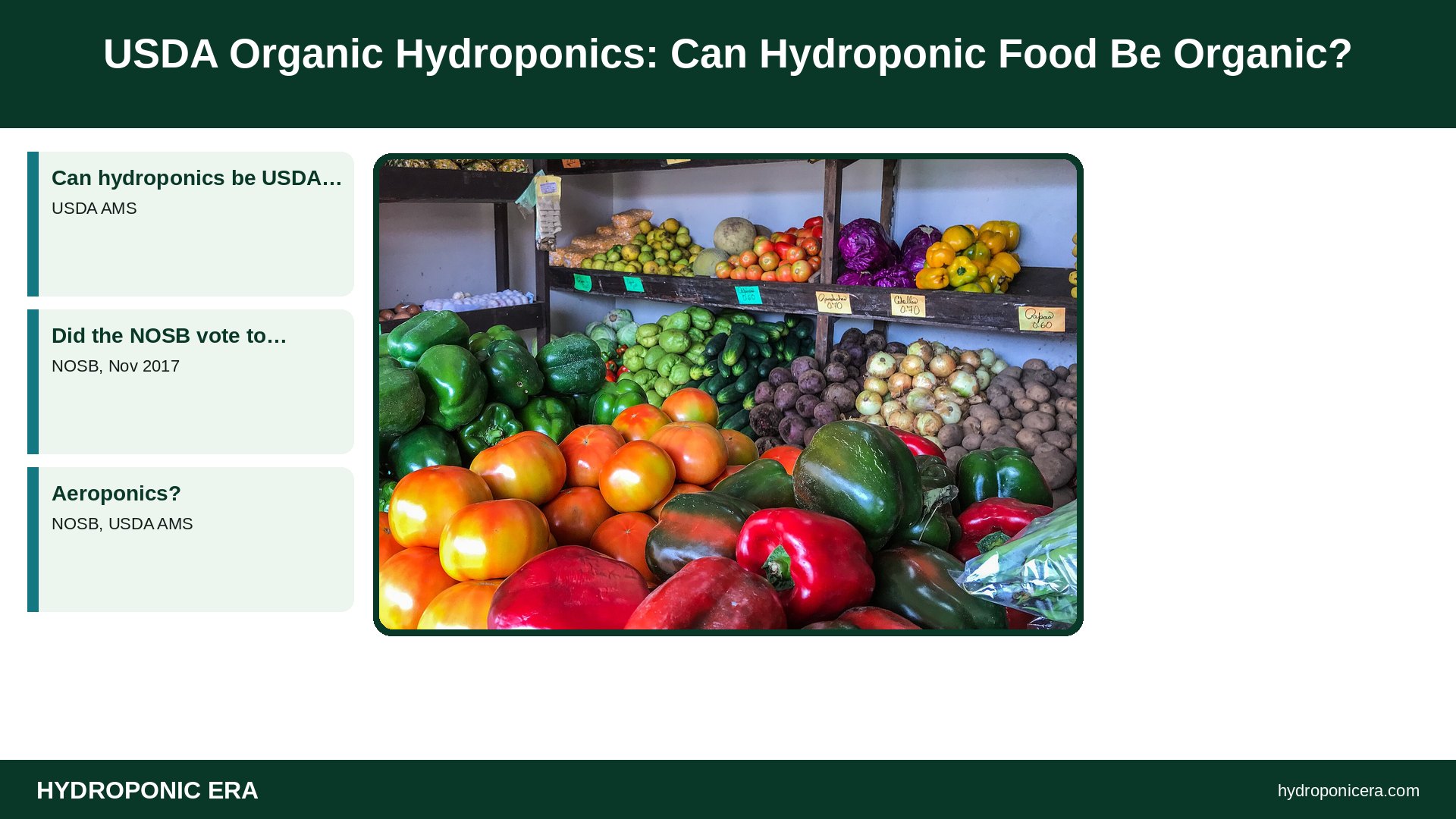
| Can hydroponics be USDA organic? | Yes, if certified and compliant | USDA AMS |
| Did the NOSB vote to ban it? | No; the 2017 motion failed 7–8 | NOSB, Nov 2017 |
| Aeroponics? | NOSB recommended a ban 14–0 (1 abstain); USDA kept it allowed during review | NOSB, USDA AMS |
| Court challenge? | Ninth Circuit upheld USDA, Sept 22, 2022 | 9th Cir. No. 21-15883 |
| EU organic? | Not allowed, except plants that grow naturally in water | European Commission |
What Does USDA Organic Hydroponics Actually Mean?
USDA organic is a process label. Under the Organic Foods Production Act, a crop sold as organic must be produced without synthetic chemicals except those allowed, not be grown on land treated with prohibited substances in the 3 years before harvest, and follow an organic plan agreed with a certifier. Nothing in that list says “soil” outright, which is why USDA has treated hydroponic systems as eligible. In a 2019 memo, USDA defined “container system” to include container, hydroponic and other pot-based systems, with or without soil.
How Did USDA Organic Hydroponics Become Allowed?
USDA’s position is that hydroponics was never prohibited. Federal law says a practice that isn’t prohibited or restricted is permitted unless it is inconsistent with the program, and the 2019 memo cites that rule. The big test came at the National Organic Standards Board (NOSB) meeting in November 2017.
- Hydroponics ban motion: failed 7 yes, 8 no.
- Aquaponics ban motion: failed 7–8.
- Container limit motion (capping nutrients supplied after planting): failed 7–8.
- Aeroponics ban: passed 14–0 with 1 abstention.
After the meeting, USDA posted that certification of hydroponic, aquaponic and aeroponic operations is allowed, and that aeroponics remains allowed while USDA considers the NOSB recommendation.
Did a Court Rule on USDA Organic Hydroponics?
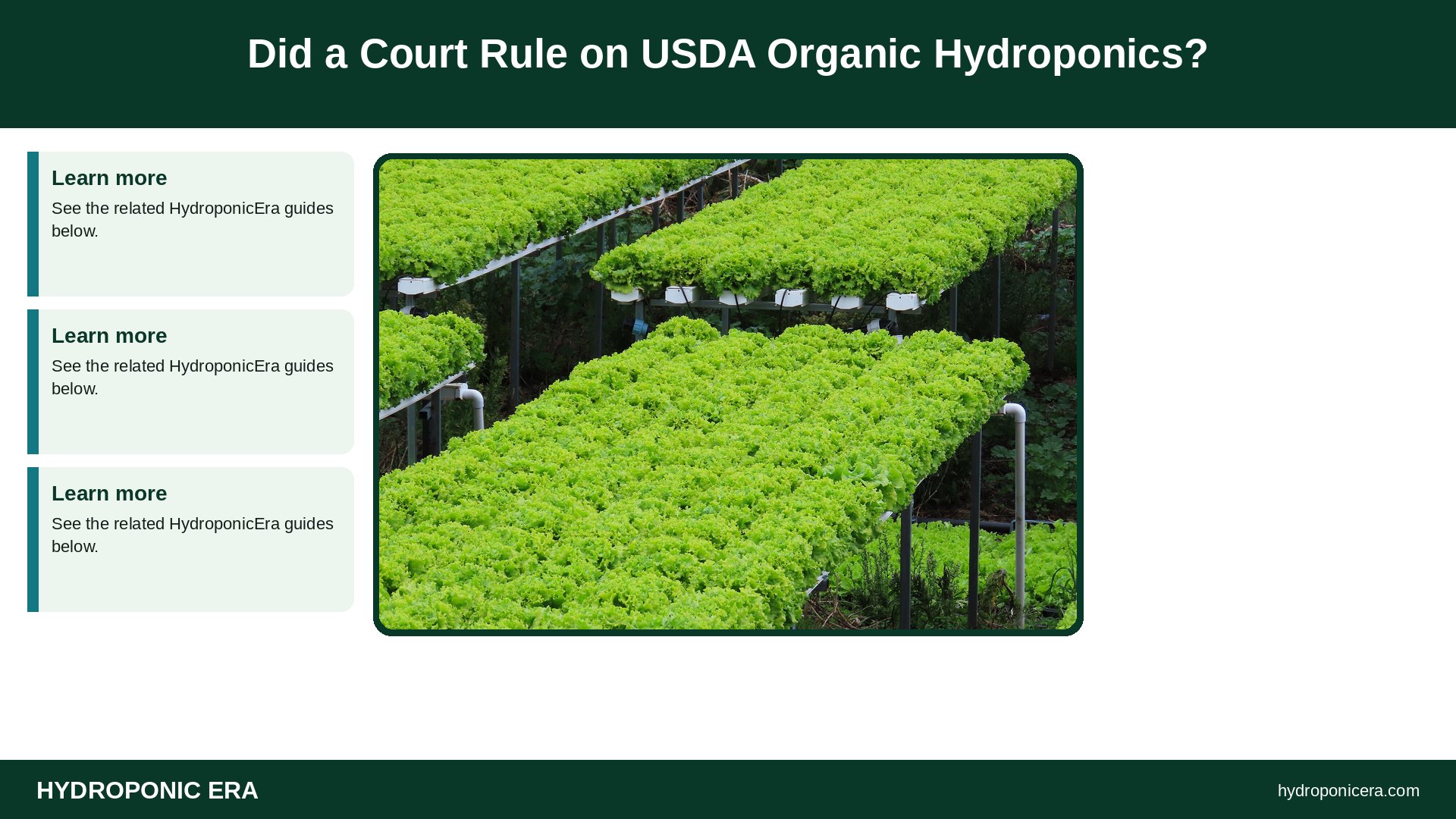
Yes. The Center for Food Safety and others petitioned USDA to bar organic certification of hydroponic crops. USDA refused, and the group sued. A federal district court in California sided with USDA in 2021. On September 22, 2022, the Ninth Circuit affirmed, finding the Organic Foods Production Act does not clearly require USDA to issue a rule banning hydroponics. The memo disposition is unpublished, so it isn’t binding precedent, but USDA’s policy stands.
What Are the Rules for USDA Organic Hydroponics?
The 2019 memo tells certifiers to ask two questions about every container or hydroponic system.
- Is the land eligible? Certifiers check land-use history under the system, just as for a field. If a prohibited substance was applied within 3 years before the first organic harvest, the crop can’t be sold as organic until that period has passed.
- Is the system compliant? No prohibited substances may be applied anywhere in the system, including the land under it.
- Does it support natural resources? Certifiers evaluate whether the system maintains or improves natural resources, supports nutrient cycling, promotes ecological balance and conserves biodiversity.
- Is there an organic system plan? The law requires one, agreed with an accredited certifier.
The memo applies to new systems; already-certified container operations keep certification as long as they stay compliant.
Which Nutrients Work in USDA Organic Hydroponics?
This is the hardest practical part. Many conventional hydroponic fertilizer salts are synthetic, and the law allows synthetic substances only when they’re specifically permitted, so organic growers typically rely on approved natural inputs and microbial systems that break organic matter into plant-available nutrients. Your certifier decides what is acceptable for your plan. Our guide to organic and bioponic nutrients explains how these systems work, and best hydroponic nutrients compares conventional options.
How Do You Get USDA Organic Hydroponics Certification?
- Pick a USDA-accredited certifier that already certifies container or hydroponic systems.
- Document 3 years of land history for the site under the system.
- Write an organic system plan covering inputs, seeds, pest control and record keeping.
- Get every input reviewed, including nutrients, cleaners and pest products.
- Pass the inspection and keep records for ongoing compliance.
How Does USDA Organic Hydroponics Compare With the EU?
| Label | Hydroponic crops allowed? | Basis |
|---|---|---|
| USDA Organic (U.S.) | Yes, with a certifier | USDA AMS policy; 2019 memo |
| EU Organic | No, except plants that grow naturally in water | European Commission: organic requires plants grown naturally in soil |
| Real Organic Project (U.S. add-on) | No; farms can’t have any hydroponic production | ROP standards |
The European Commission states that EU rules don’t let hydroponically grown plants be marketed as organic, and the same applies to plants in aquaponic systems, though fish can qualify under organic aquaculture rules. So a U.S. organic hydroponic tomato can’t simply carry the EU organic logo.
Why Do Critics Oppose USDA Organic Hydroponics?
Opponents argue organic farming means building soil fertility, and that a nutrient-solution system isn’t organic farming no matter its inputs. The Real Organic Project requires crops to grow in living soil connected to subsoil and bedrock. Supporters counter that hydroponic systems can use less land, avoid synthetic pesticides and meet every rule in the law. For the wider debate, see hydroponics vs soil.
How Can You Tell if Produce Is USDA Organic Hydroponic?
USDA doesn’t require a separate “hydroponic” label, so the organic seal alone won’t tell you. Look for packaging that says “hydroponically grown” or “greenhouse grown,” check the grower’s website, or look for a Real Organic Project label if you want soil-grown organic. Whether hydroponic food is nutritious is a separate question covered in are hydroponic vegetables healthy.
Should a Home Grower Care About USDA Organic Hydroponics?
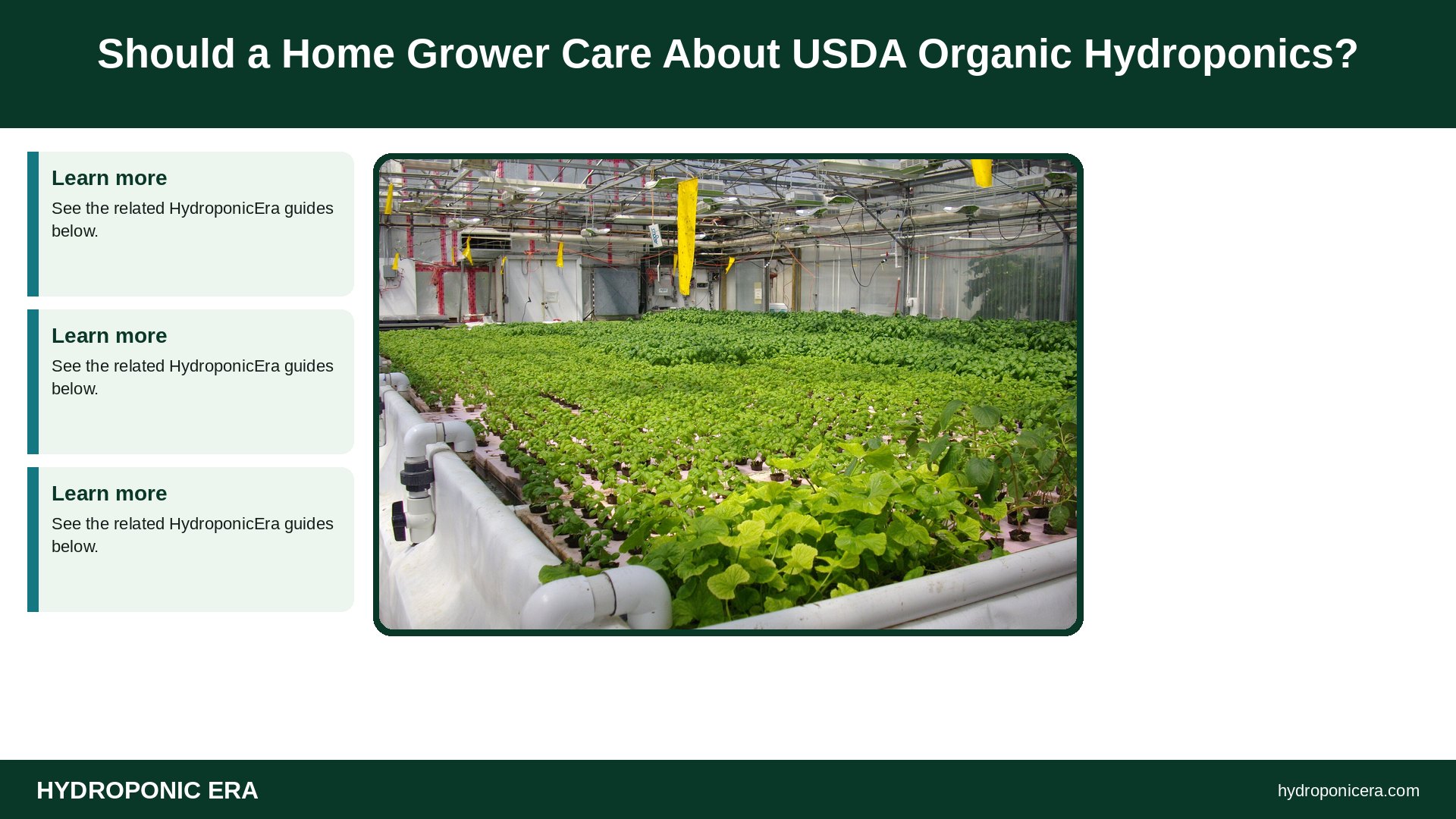
Only if you plan to sell. Certification is for operations marketing products as organic. A home gardener can follow organic practices in any system without certifying. If you want to try organic methods, our aquaponics for beginners guide covers a system where fish waste feeds plants.
FAQ About USDA Organic Hydroponics
Is USDA organic hydroponics legal?
Yes. USDA allows certification of hydroponic operations that comply with its organic regulations.
Is aeroponics allowed under USDA organic?
The NOSB recommended a ban in 2017, but USDA said aeroponics remains allowed during its review.
Can aquaponic vegetables be USDA organic?
Yes, under the same rules; the 2017 ban motion failed.
Can EU organic products be hydroponic?
No, except plants that naturally grow in water.
Does organic hydroponic produce say “hydroponic” on the label?
Not necessarily; USDA doesn’t require it.
Sources
- USDA Agricultural Marketing Service — Status of Organic Hydroponics, Aquaponics, Aeroponics (2017)
- USDA AMS, National Organic Program — Memo to Certifiers on Certification of Organic Crop Container Systems (June 3, 2019)
- National Organic Standards Board — Formal Recommendations and Votes, November 2, 2017
- U.S. Court of Appeals for the Ninth Circuit — Center for Food Safety v. Vilsack, No. 21-15883 (2022)
- European Commission — Organic Production and Products
- Real Organic Project — Standards
- Photo credits (Wikimedia Commons, edited with titles): Public Market in Boquete by FranHogan (CC BY-SA 4.0); Hydroponic lettuce @ Plaine des Cafres 03 by Rémih (CC BY-SA 4.0); Lettuce Closeup Greenhouse Phuktal Zanskar Jun24 A7CR 00442 by This Photo was taken by Timothy A. Gonsalves. Feel free to use my photos, but pl (CC BY-SA 4.0); CDC South Aquaponics Raft Tank 1 2010-07-17 by Bryghtknyght (CC BY 3.0); Deep water culture by ArcadiYay (CC BY-SA 4.0)