
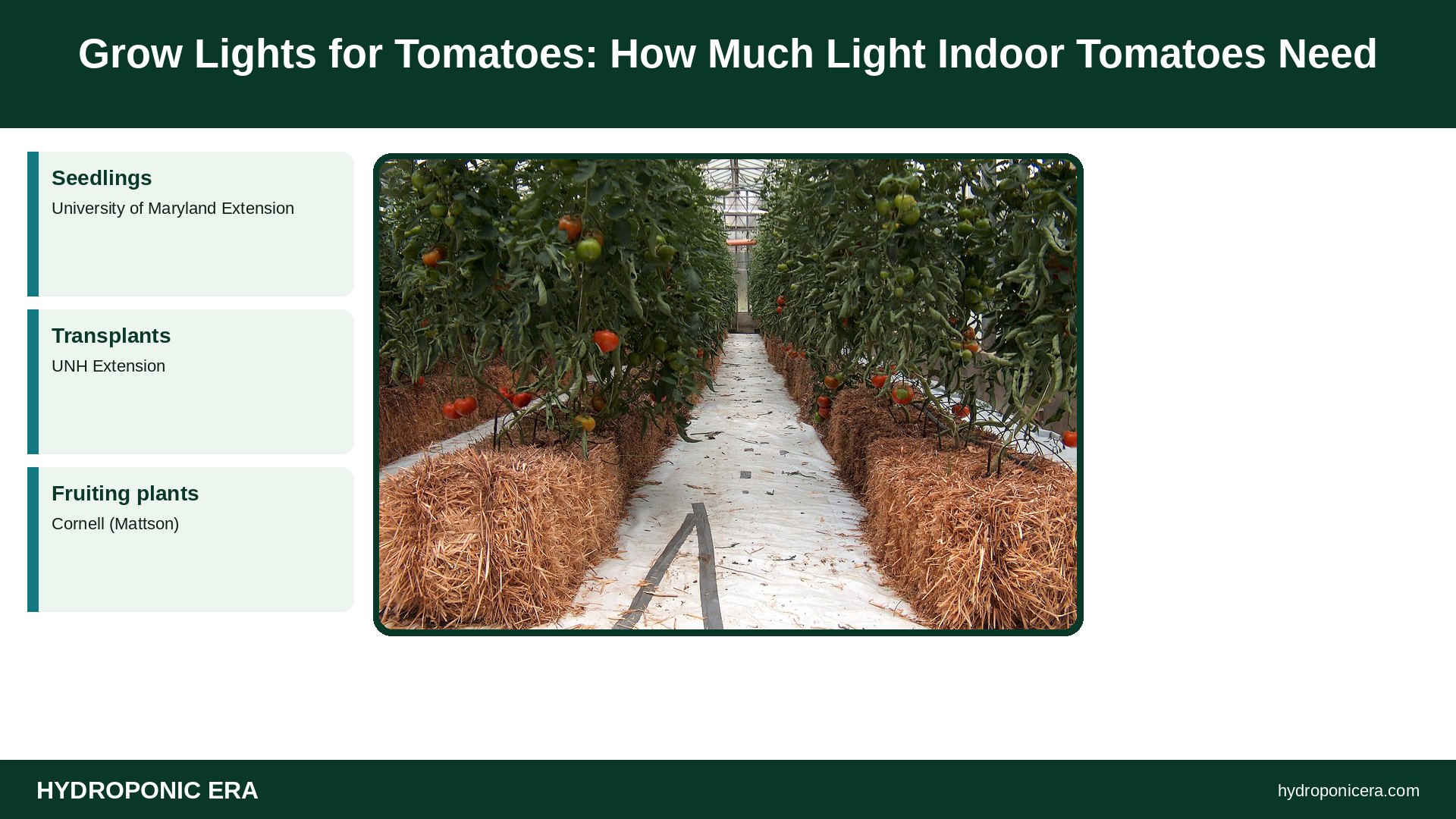
What grow lights for tomatoes work best? Strong full-spectrum LED grow lights for tomatoes work best. Seedlings need light 14–16 hours a day with fixtures close, while fruiting plants need far more light than leafy greens. Cornell’s Neil Mattson lists a daily light integral of at least 20 mol/m²/day for tomatoes, with more than 30 as optimal.
Key takeaway: A small LED bar is fine for tomato seedlings, but fruiting tomatoes indoors need a powerful fixture, usually a quality LED panel that covers the whole canopy. Give tomatoes at least about 6 hours of darkness each day, and raise lights as plants grow.
| Stage | Hours of light | Light target | Source |
|---|---|---|---|
| Seedlings | 14–16 hours | Fixtures 2–6 in (5–15 cm) above plants | University of Maryland Extension |
| Transplants | 14–16 hours | DLI about 12 mol/m²/day | UNH Extension |
| Fruiting plants | 14–18 hours | DLI 20+ mol/m²/day minimum, 30+ optimal | Cornell (Mattson) |
| Darkness | About 6 hours or more | Needed for fruiting | UNH Extension |
Do Tomatoes Need Grow Lights Indoors?
Yes. Tomatoes are high-light plants, and a sunny window rarely gives enough light in winter for strong growth or fruit. Grow lights for tomatoes prevent the tall, weak, pale seedlings that form in low light. For fruiting plants indoors, artificial light is usually the main light source, not just a supplement.
If you only use grow lights for tomatoes to start seedlings and move them outside, a modest fixture works. If you want indoor fruit, plan for a stronger light and more space. Our hydroponic tomatoes guide covers full indoor growing.
How Many Hours Should Grow Lights for Tomatoes Run?
Run grow lights for tomatoes 14–16 hours a day for seedlings and about 14–18 hours for fruiting plants. University of Maryland Extension recommends 14–16 hours on an outlet timer for transplants. UNH Extension notes tomatoes need roughly 6 hours of darkness to fruit, so avoid 24-hour lighting.
- Use a timer: steady schedules beat manual switching.
- Keep nights dark: stray room light can disrupt the dark period.
- Longer hours, same fixture: extending hours raises DLI when a light is weak.
See our light schedule guide for more on photoperiods.
How Close Should Grow Lights Be to Tomato Seedlings?
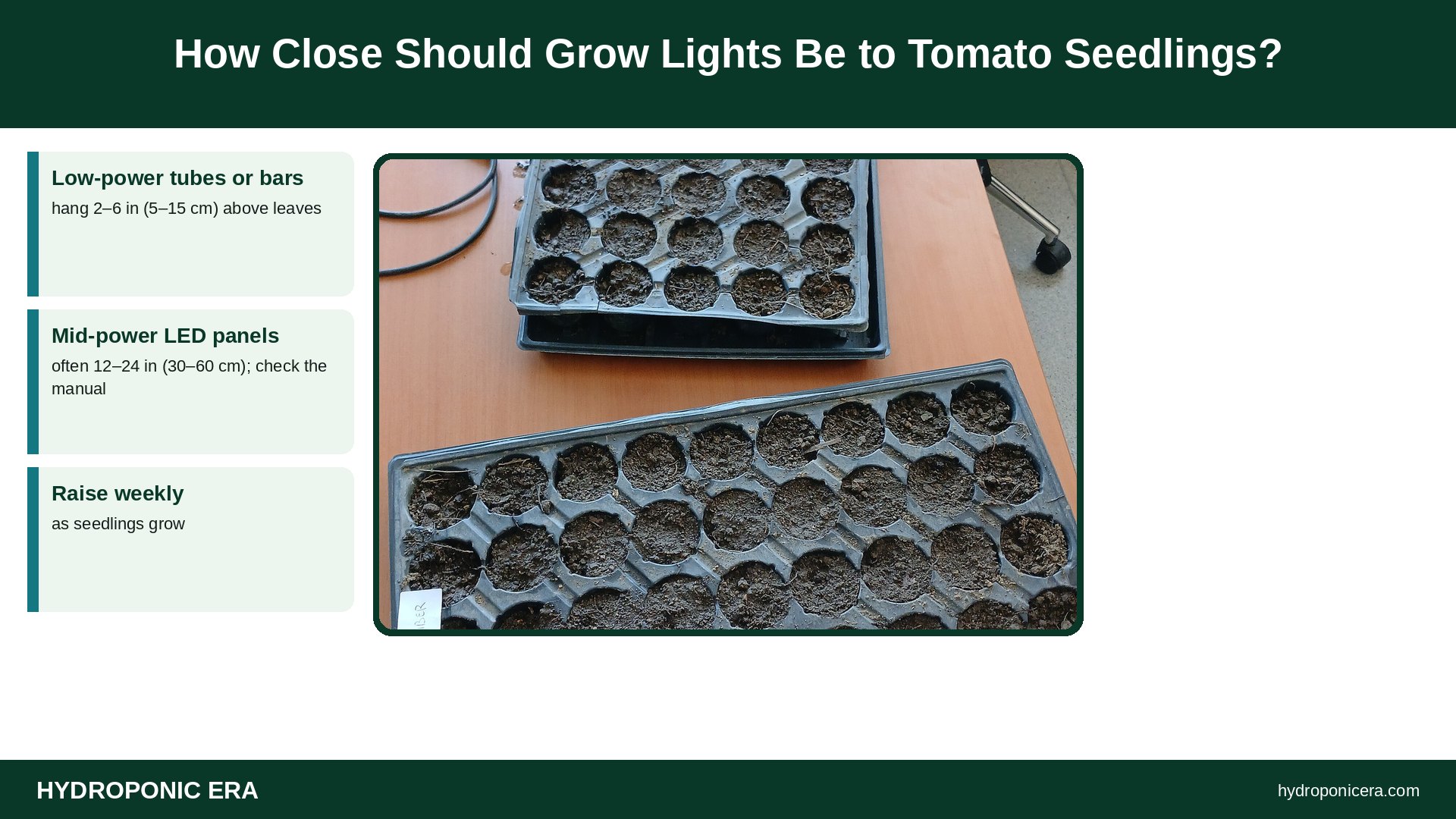
University of Maryland Extension advises keeping fluorescent and LED fixtures 2–6 in (5–15 cm) above seedlings, and the tops of transplants about 1–2 in (2.5–5 cm) from the lights. High-power LED panels need more distance, so follow the maker’s chart and watch for bleaching or curled leaves.
- Low-power tubes or bars: hang 2–6 in (5–15 cm) above leaves.
- Mid-power LED panels: often 12–24 in (30–60 cm); check the manual.
- Raise weekly as seedlings grow.
- Brush tops gently: Maryland Extension notes this helps control height and makes plants stockier.
Our light distance chart gives stage-by-stage heights.
How Much Light Do Fruiting Tomatoes Need?
Fruiting tomatoes need a lot. Cornell greenhouse lighting research by Neil Mattson sets 20 mol/m²/day as the minimum DLI for tomatoes and more than 30 as optimum. At 16 hours a day, a DLI of 20 requires an average PPFD of about 350 µmol/m²/s at the canopy, and 30 requires about 520.
| Target DLI | Hours | PPFD needed (approx.) |
|---|---|---|
| 12 (transplants) | 16 | about 210 µmol/m²/s |
| 20 (fruiting minimum) | 16 | about 350 µmol/m²/s |
| 30 (fruiting optimum) | 16 | about 520 µmol/m²/s |
| 20 | 18 | about 310 µmol/m²/s |
When you shop for grow lights for tomatoes, compare these PPFD numbers with the maker’s map. The math is PPFD × hours × 3,600 ÷ 1,000,000. Our PPFD and DLI guide walks through it.
What Type of Grow Lights for Tomatoes Should You Buy?
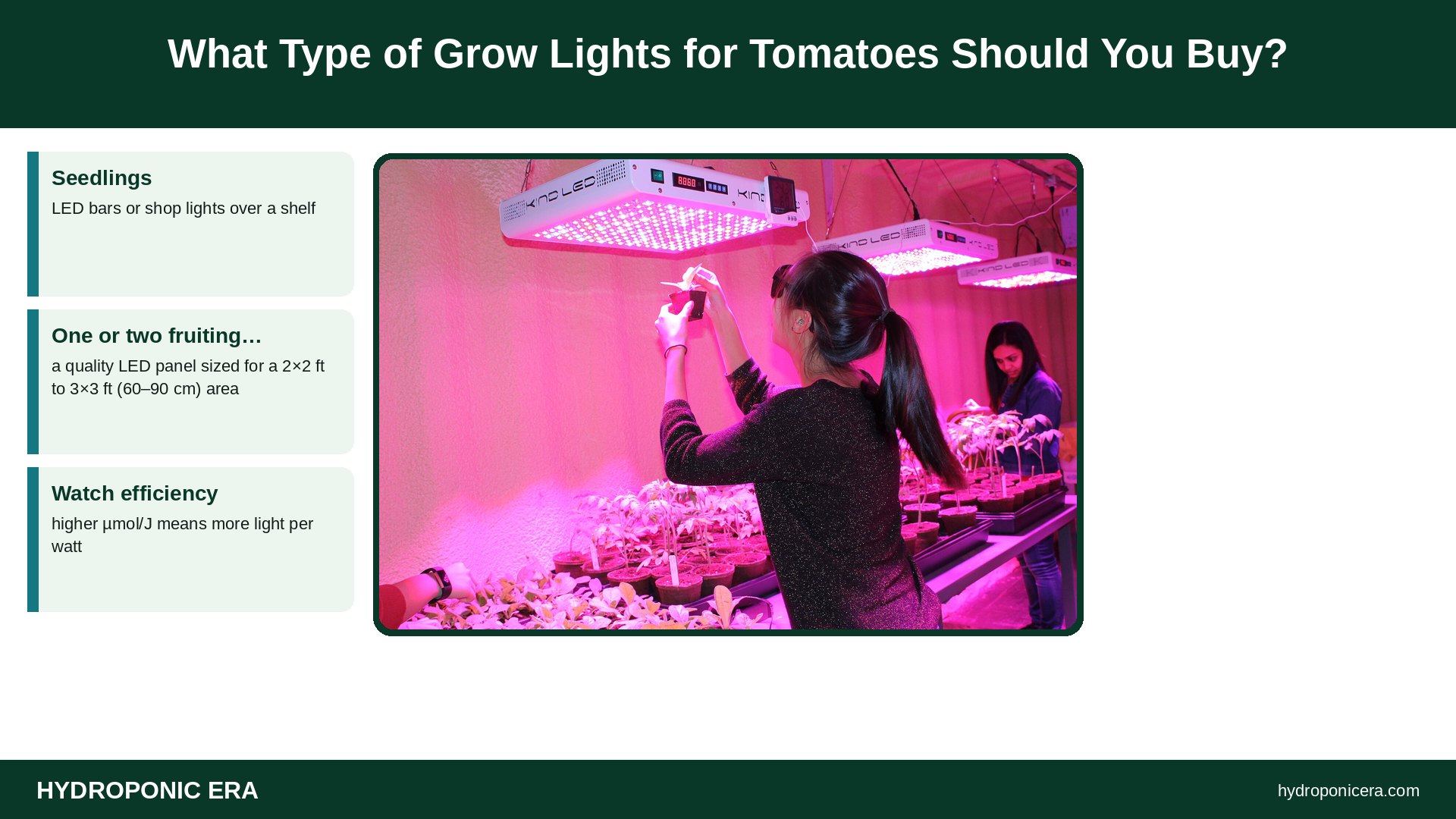
For most homes, choose full-spectrum white LED grow lights for tomatoes with a published PPFD map. They run cooler and use less power than older HID lamps. Look at PPFD across the footprint, not just wattage. Ceramic metal halide and HPS lamps also grow tomatoes well, but they run hot and need ventilation.
- Seedlings: LED bars or shop lights over a shelf.
- One or two fruiting plants: a quality LED panel sized for a 2×2 ft to 3×3 ft (60–90 cm) area.
- Watch efficiency: higher µmol/J means more light per watt.
- Avoid: cheap “equivalent watt” lights without PPFD data.
Compare options in our grow light buying guide.
What Are Signs of Too Little or Too Much Light on Tomatoes?
Too little light causes long gaps between leaves, thin stems, pale color and flower drop. Too much light from grow lights for tomatoes shows as bleached or yellow top leaves, upward cupping and crispy edges. Adjust distance first, then hours. Heat from the fixture can cause similar damage.
| Symptom | Likely cause | Fix |
|---|---|---|
| Leggy seedlings | Light too far or too weak | Lower fixture; add hours |
| Blossoms drop | Low light, heat or poor pollination | Raise DLI; shake flowers |
| Bleached top leaves | Light too close | Raise fixture |
| Leaf yellowing with constant light | No dark period | Give 6+ hours of darkness |
Read more in blossom drop in tomatoes and light burn.
Do Tomatoes Under Grow Lights Need Hand Pollination?
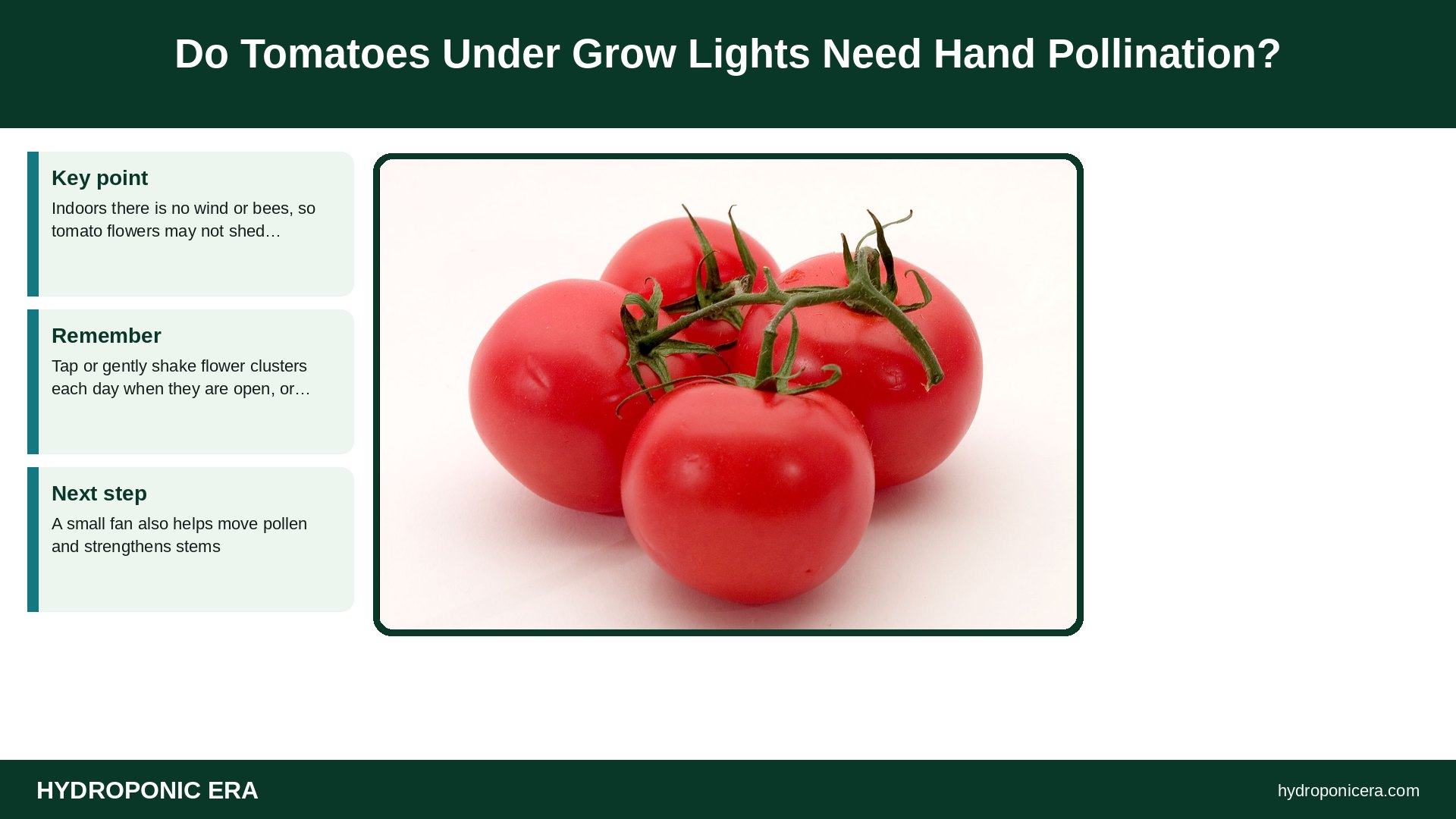
Yes, usually. Indoors there is no wind or bees, so tomato flowers may not shed pollen well. Tap or gently shake flower clusters each day when they are open, or use an electric toothbrush on the stem behind the flowers. A small fan also helps move pollen and strengthens stems.
Dwarf and micro tomatoes are the easiest fruiting choice under grow lights for tomatoes because they stay small, fit under one panel and need less space. Taller indeterminate types can reach 6 ft (1.8 m) or more, which makes even lighting hard in a home setup.
FAQ About Grow Lights for Tomatoes
Can tomatoes grow under regular LED bulbs?
Seedlings can, if bulbs are bright and close. Fruiting plants need a much stronger fixture.
Should grow lights for tomatoes run 24 hours?
No. Give at least about 6 hours of darkness.
What color light is best?
Full-spectrum white LEDs work well and make problems easier to see.
How many watts do I need?
Watts don’t tell the whole story; check PPFD over your growing area.
Do I need to harden off seedlings?
Yes, before moving them outside, increase sun exposure over about a week.
Sources
- University of Maryland Extension — Starting Vegetable Seeds Indoors
- UNH Extension — Optimizing Plant Growth with Indoor Lighting Q&A
- Cornell University (Neil Mattson), New England Greenhouse Conference — Lighting Decisions for Greenhouse Production
- Iowa State University Extension and Outreach — How to Set Up Supplemental Lights for Indoor Plants
- Photo credits (Wikimedia Commons, edited with titles): Hydroponic g12 by Giancarlo Dessì (CC BY-SA 3.0); Pepper and tomato seedling trays at Boğaziçi University 2026 by Furkan Akkurt (CC BY-SA 4.0); Terramera scientists working in a climate-controlled growth chamber located in Vancouver, BC. The space uses LED lighting, which supports plant growth. (50188965171) by Simon Fraser University – Communications & Marketing (CC BY 2.0); Tomato je by Softeis (CC BY-SA 3.0)