
Do plants use green light? Yes. Green light for plants is not wasted. Leaves reflect more green than red or blue, but they still absorb much of it, and green light reaches deeper into leaves and lower in the canopy. Research on lettuce found that adding some green to red and blue LEDs improved growth, so full-spectrum white LEDs are a sound choice.
Key takeaway: Do not buy a pure green light for plants. Choose a full-spectrum or white LED that includes green with red and blue, then focus on light intensity and hours, which matter more than color.
| Light color | Wavelength | Main role |
|---|---|---|
| Blue | About 400–500 nm | Compact growth, leaf thickness |
| Green | About 500–600 nm | Penetrates deeper; drives lower-leaf photosynthesis |
| Red | About 600–700 nm | Efficient photosynthesis, stem growth |
| Far-red | About 700–750 nm | Shade signals, stretching, flowering |
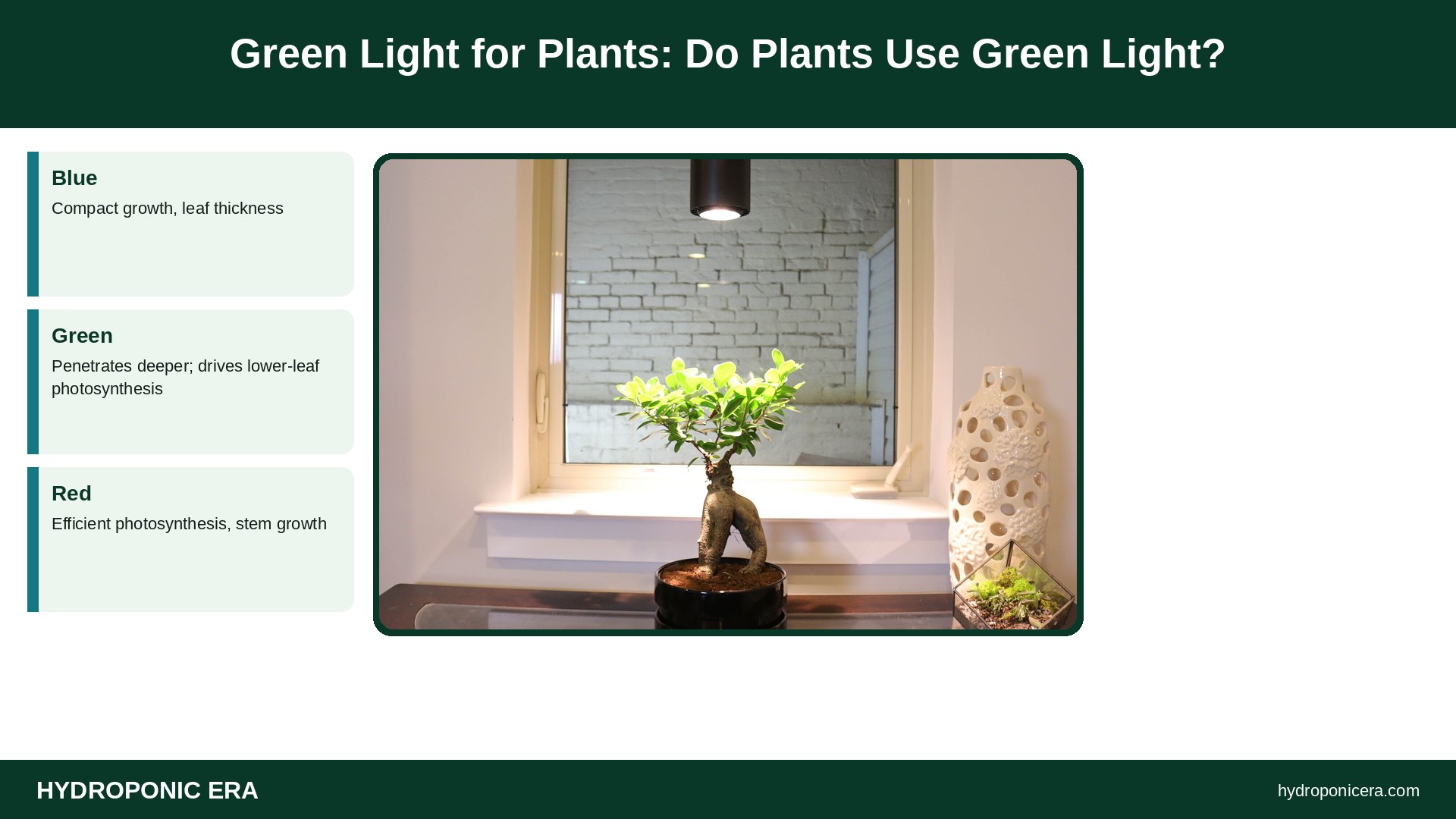
Why Do Plants Look Green if They Use Green Light?
Plants look green because their leaves reflect and transmit more green light than red or blue, not because they reject all of it. Chlorophyll absorbs red and blue very strongly, so the small share of green that bounces back is what our eyes see. A large share of green light is still absorbed inside the leaf.
In their 2017 review in the Journal of Experimental Botany, titled “Don’t ignore the green light,” Smith, McAusland and Murchie explain that the old idea of green as useless is misleading. Green light for plants passes deeper into leaf tissue and through upper leaves, so it reaches cells and lower leaves that red and blue barely touch.
Does Green Light for Plants Help Photosynthesis?
Green light for plants does help photosynthesis, especially in thick canopies and under strong light. Smith and colleagues review evidence that green light drives carbon fixation in deeper leaf layers, while red and blue are mostly absorbed near the upper surface. Under bright white light, top cells may already be saturated, so green light working deeper can add useful gain.
Green light for plants also acts as a signal. The same review describes green light effects on stomata and on shade-avoidance responses, much like a mild shade cue. This is one reason growth under pure red and blue can differ from growth under white light.
What Did a Lettuce Study Find About Green Light for Plants?
A 2004 HortScience study by Kim, Goins, Wheeler and Sager at NASA Kennedy Space Center compared four light sources for lettuce. Adding 24% green light from green fluorescent lamps to red and blue LEDs enhanced plant growth, and those plants produced more biomass than plants under cool-white fluorescent lamps, a common broad-spectrum control.
The authors noted two practical bonuses: green light makes leaves look green instead of purplish gray, so growers can spot problems by eye, and green light can better penetrate the canopy to drive photosynthesis in lower leaves. The best result came from a balanced mix, not from the treatment with the most green.
| Treatment (Kim et al. 2004) | Share of green light | Reported result |
|---|---|---|
| Red + blue LEDs | 0% | Plants look purplish gray |
| Red + blue LEDs + green lamps | 24% | Enhanced growth; most biomass |
| Green fluorescent only | 86% | Not the best treatment |
| Cool-white fluorescent | 51% | Less biomass than the 24% mix |
Is Green Light Bad for Plants at Night?
Green light for plants at night is less disruptive than white light, but it is not invisible to plants. Growers often use dim green work lamps during dark periods because plants respond more weakly to low green light than to red or blue. Keep any night light brief and dim, especially around photoperiod-sensitive crops such as poinsettias.
Our guide to light leaks and night interruption explains why even small leaks can upset flowering.
Should You Buy a Red/Blue or Full-Spectrum Grow Light?
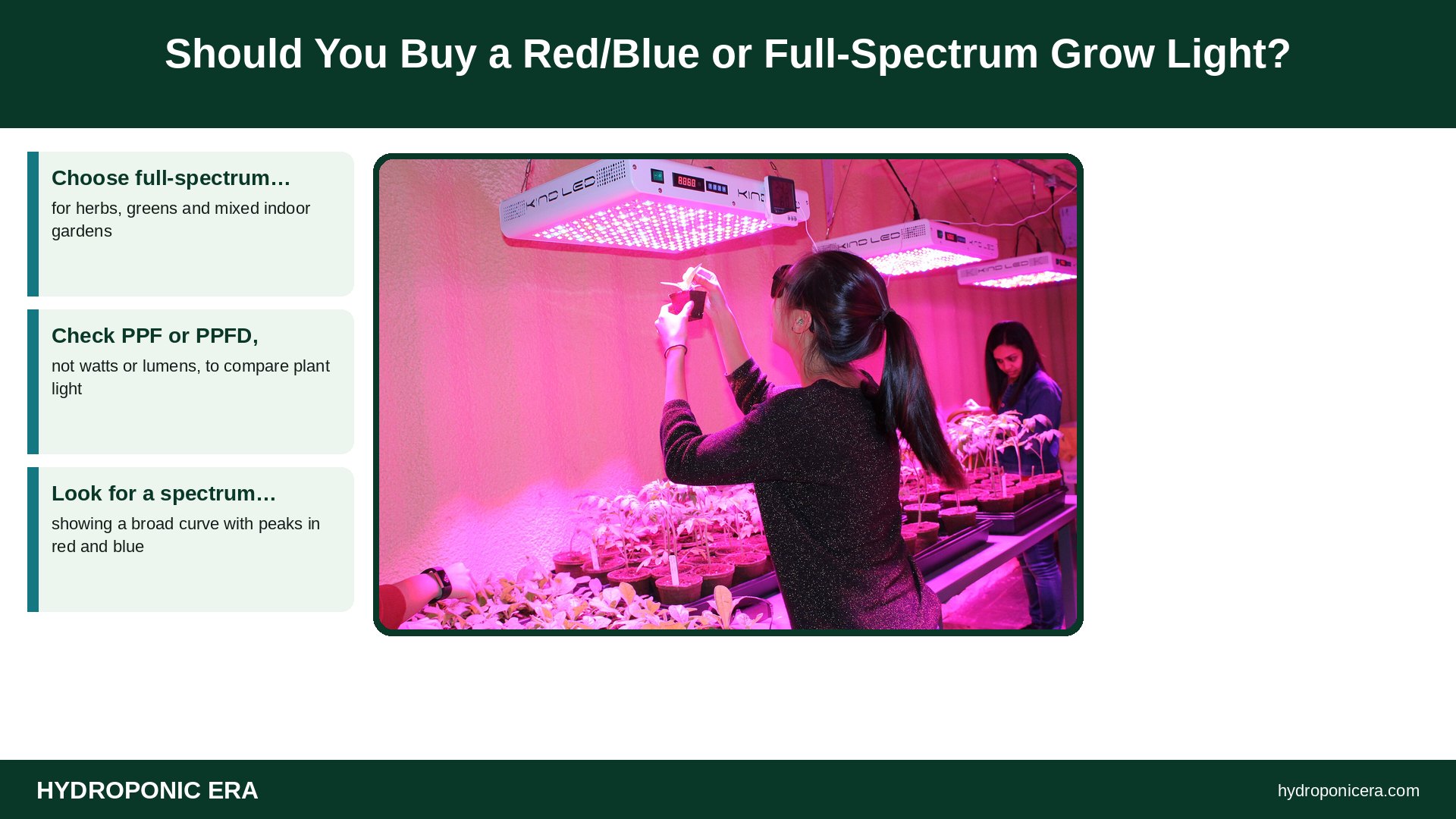
For most home growers, a full-spectrum white LED is the better buy. It includes red, blue and green light for plants in one fixture, lets you see true leaf color, and is easier on the eyes. Red and blue “blurple” lights still grow plants, but they make it hard to spot pests, yellowing or tip burn.
- Choose full-spectrum white for herbs, greens and mixed indoor gardens.
- Check PPF or PPFD, not watts or lumens, to compare plant light.
- Look for a spectrum chart showing a broad curve with peaks in red and blue.
- Skip pure green bulbs; they are for night work, not growth.
See our grow light buyer’s guide.
How Much Light Do Plants Need Besides Color?
Light intensity and duration matter more than color for most indoor crops. South Dakota State University Extension suggests a PAR of about 200–400 µmol/m²/s for leafy greens and 400–600 µmol/m²/s for fruiting crops, with 12–16 hours of light for greens and up to 18 hours for fruiting plants. University of Minnesota Extension adds that LEDs are efficient and run cool.
Set hanging height with our light distance guide and timers with the photoperiod guide.
How Should You Use Green Light for Plants at Home?
Use green light for plants as part of a balanced white or full-spectrum LED, not as a separate lamp. The research supports a mix: red and blue drive efficient photosynthesis near the leaf surface, while green light for plants reaches lower leaves and helps you see true leaf color. That makes a good white LED the simple answer for herbs, lettuce and houseplants.
- Pick a white or full-spectrum LED with a published spectrum chart.
- Compare PPFD at your hanging height, not wattage.
- Set a timer for 12–16 hours for leafy greens.
- Thin crowded canopies so light reaches lower leaves.
- Use a dim green lamp only for night checks, and keep them short.
What Are Signs of the Wrong Spectrum or Too Little Light?
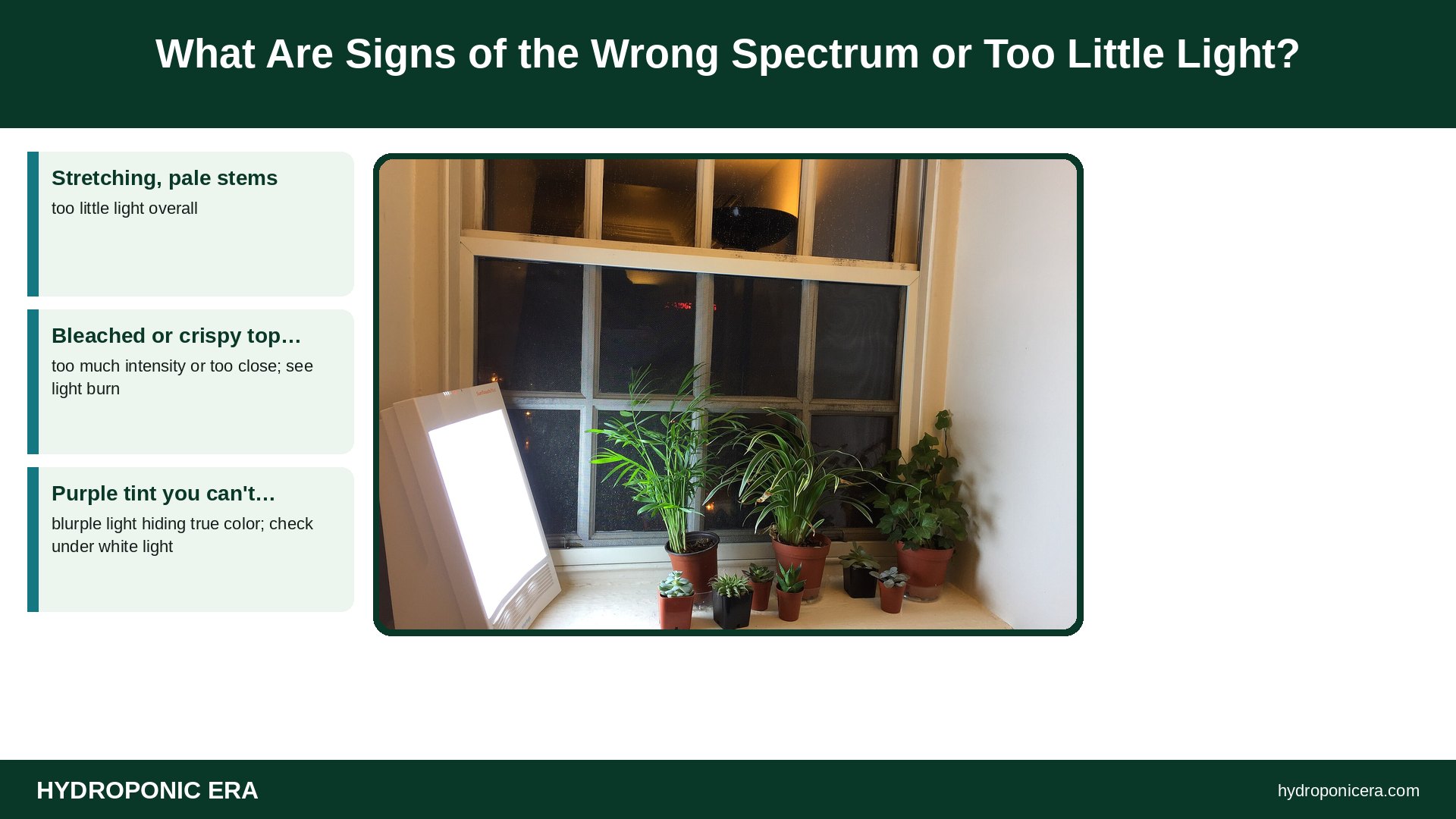
- Stretching, pale stems: too little light overall.
- Bleached or crispy top leaves: too much intensity or too close; see light burn.
- Purple tint you can’t judge: blurple light hiding true color; check under white light.
- Slow growth in lower leaves: dense canopy; thin it or add side lighting.
FAQs
Can plants grow under only green light?
They can grow, but a balanced spectrum works better. In Kim et al., the red, blue and 24% green mix was the treatment that enhanced lettuce growth.
Is green light for plants wasted energy?
No. Much of it is absorbed and used, especially deeper in leaves.
Why do grow rooms use green headlamps?
Dim green light lets people work during dark periods with less effect on plants.
Are white LEDs good for plants?
Yes. Quality white LEDs include red, blue and green for balanced growth.
Does green light affect flavor?
Research is limited; intensity and nutrients affect flavor more clearly.
Sources
- Smith HL, McAusland L, Murchie EH — Don’t ignore the green light: exploring diverse roles in plant processes, Journal of Experimental Botany (2017)
- Kim HH, Goins GD, Wheeler RM, Sager JC — Green-light supplementation for enhanced lettuce growth under red- and blue-light-emitting diodes, HortScience (2004)
- South Dakota State University Extension — Small-scale Hydroponic Production Systems (P-00337)
- University of Minnesota Extension — Small-scale hydroponics
- Photo credits (Wikimedia Commons, edited with titles): Aspect Black 20W Growlight over Bonsai by Hotmilk400 (CC BY-SA 4.0); Infrared HDR St Bartholomew’s church Hanworth Norfolk (7531334490) by David from Colorado Springs, United States (CC BY 2.0); Terramera scientists working in a climate-controlled growth chamber located in Vancouver, BC. The space uses LED lighting, which supports plant growth. (50188965171) by Simon Fraser University – Communications & Marketing (CC BY 2.0); Potted plants succulents under grow light Nov 2016 by Asdfjrjjj (CC BY-SA 4.0); U.S. Department of Agriculture (USDA) Rural Development (RD) Ohio business program staff visited Mucci Farms, a 75-acre greenhouse production farm in Huron, Ohio on September 25, 2024 – 2 by USDAgov (Public domain)