
What is a plant node? A plant node is the point on a stem where leaves attach and buds form. The stretch of stem between two nodes is the internode. Nodes hold cells that grow new shoots, leaves and often roots, so cut just below a node and keep one under water or mix.
Key takeaway: Find the plant node, and you know where to cut. Virginia Cooperative Extension says some plants root only at nodal tissue, so a cutting with no node usually fails, while a cutting with one or two nodes below the surface roots reliably.
| Stem part | What it is | Why it matters |
|---|---|---|
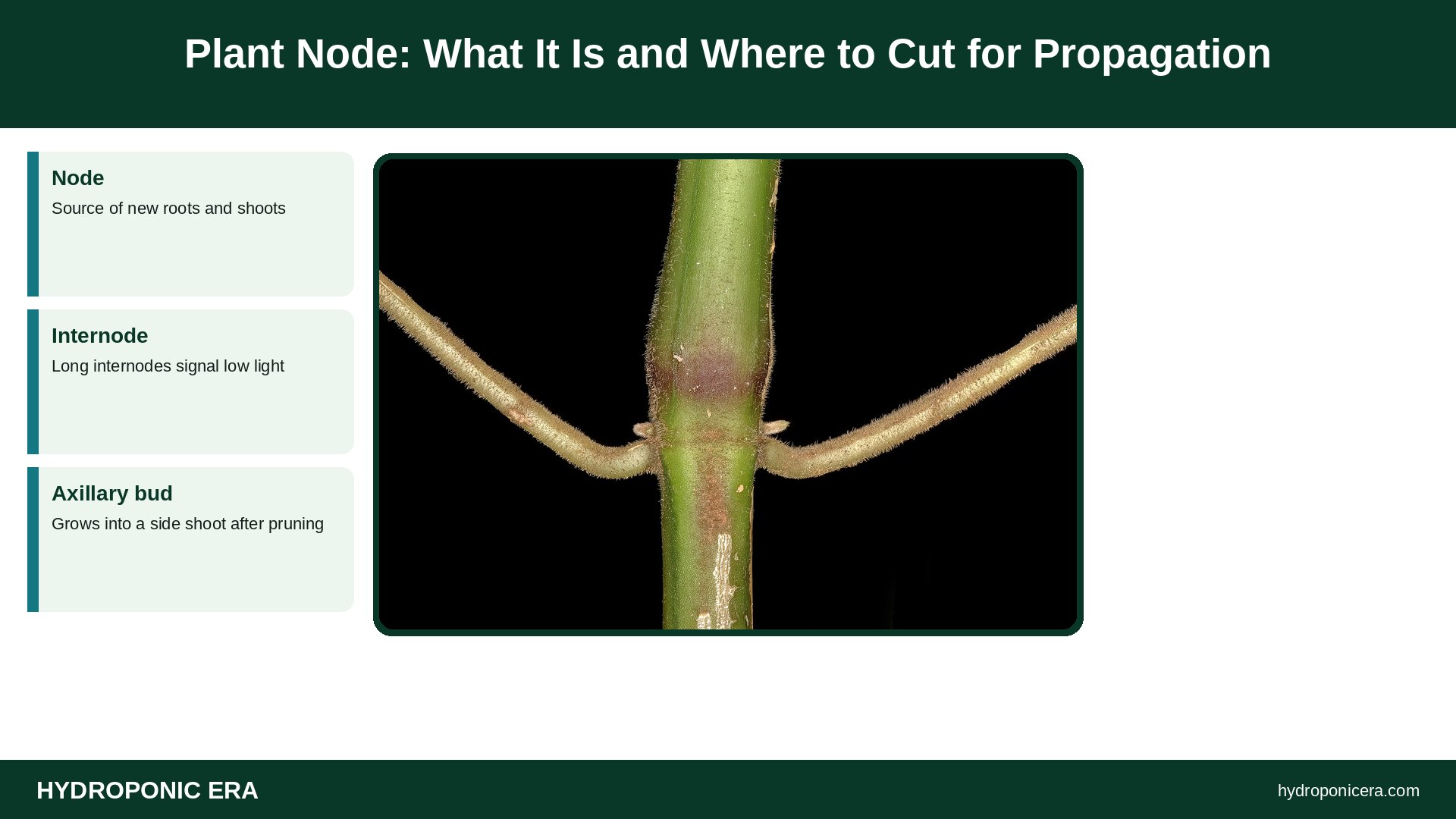
| Node | Where a leaf joins the stem and a bud forms | Source of new roots and shoots |
| Internode | Stem section between nodes | Long internodes signal low light |
| Axillary bud | Bud in the angle above a leaf | Grows into a side shoot after pruning |
| Aerial root | Root growing from a node on some vines | A ready-made start for water rooting |
What Does a Plant Node Look Like?
A plant node looks like a slight bump, ring or joint on the stem where a leaf, leaf scar or bud sits. Mississippi State University Extension describes nodes as “the knobbly bumps on the stem” where stems or flowers grow. On many houseplants you will also see a small brown nub, which is an aerial root starting.
- Pothos and philodendron: a brown nub of aerial root opposite each leaf.
- Basil and mint: pairs of opposite leaves, with tiny buds in each leaf angle.
- Tomato: leaves alternate up the stem, and suckers sprout from the axils.
- Dracaena and cordyline: ring-shaped leaf scars along a cane.
- Bamboo-like stems: clear rings or joints.
What Is the Difference Between a Node and an Internode?
A node is where leaves and buds attach, and an internode is the bare stem between two nodes. Virginia Cooperative Extension notes that some plants can root at internodes, but others root only at nodal tissue. That is why most propagation instructions tell you to cut just below a node and bury or submerge it.
Internode length is also a quick health check. Stretched, long internodes with pale leaves usually mean a plant needs more light; short, compact internodes are a sign of strong light. See our guide to leggy seedlings for fixes.
Where Should You Cut Below a Plant Node for Propagation?
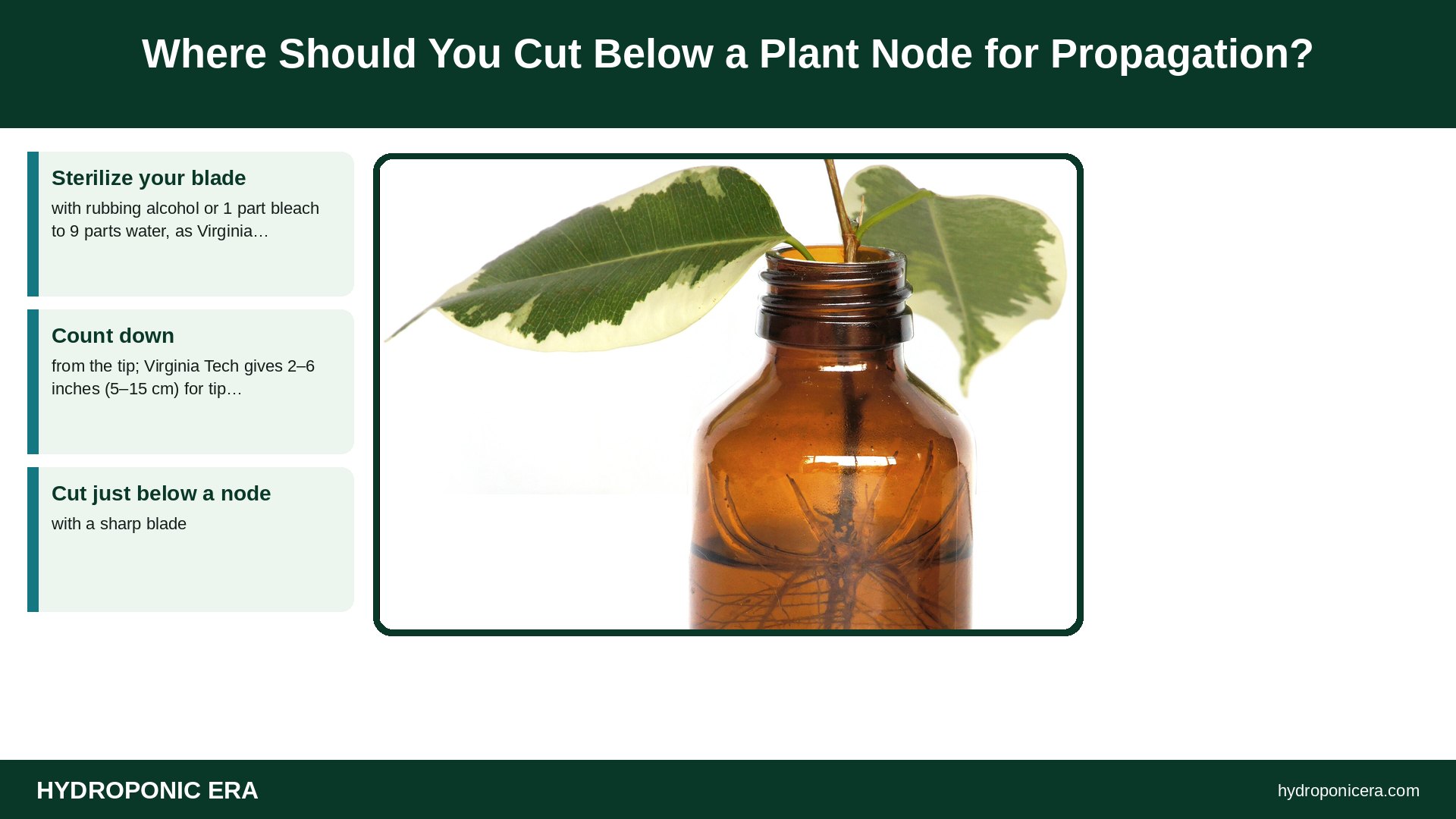
Cut about ¼–½ inch (0.6–1.3 cm) below a plant node for most stem cuttings. Virginia Cooperative Extension says to make the cut just below a node, while Mississippi State Extension suggests a slanted cut about ½ inch (1.3 cm) below the node. Then remove the leaves that would sit in water or rooting mix.
- Sterilize your blade with rubbing alcohol or 1 part bleach to 9 parts water, as Virginia Tech advises.
- Count down from the tip; Virginia Tech gives 2–6 inches (5–15 cm) for tip cuttings.
- Cut just below a node with a sharp blade.
- Strip lower leaves so no leaf sits below the surface.
- Remove flowers so energy goes to roots.
- Bury or submerge at least one node.
- Keep the cutting right side up; Virginia Tech notes that buds are always above leaves.
How Many Nodes Does a Cutting Need?
Most cuttings need at least one or two nodes: one below the surface to make roots and one above to make new leaves. Penn State Extension recommends stem cuttings 2–3 inches (5–8 cm) long with at least two nodes. For plants with large leaves, single-node or “leaf-bud” cuttings also work.
| Cutting type | How to cut (Virginia Tech) | Good for |
|---|---|---|
| Tip cutting | 2–6 inches (5–15 cm) with the terminal bud, cut below a node | Most herbs and houseplants |
| Stem section | Cut above one node and below another 2–6 inches (5–15 cm) down | Long vines |
| Leaf-bud, alternate leaves | ½ inch (1.3 cm) above and below one node | Limited stock |
| Leaf-bud, opposite leaves | ¼ inch (0.6 cm) above and below one node | Limited stock |
| Cane cutting | Sections with 1–2 eyes (nodes), laid on their side | Dracaena, dumb cane |
Can a Plant Node Root in Water?
Yes. A plant node of many soft-stemmed houseplants roots readily in water, especially vines like pothos and philodendron that already carry aerial roots at each node. Keep the node under water and all leaves above it, then change the water when it turns cloudy. Learn the process in our guide to pothos in water.
Woody plants and succulents usually root better in a moist, well-drained medium. For more on clones, see our hydroponic cuttings and cloning guide.
What Happens When You Prune Above a Plant Node?
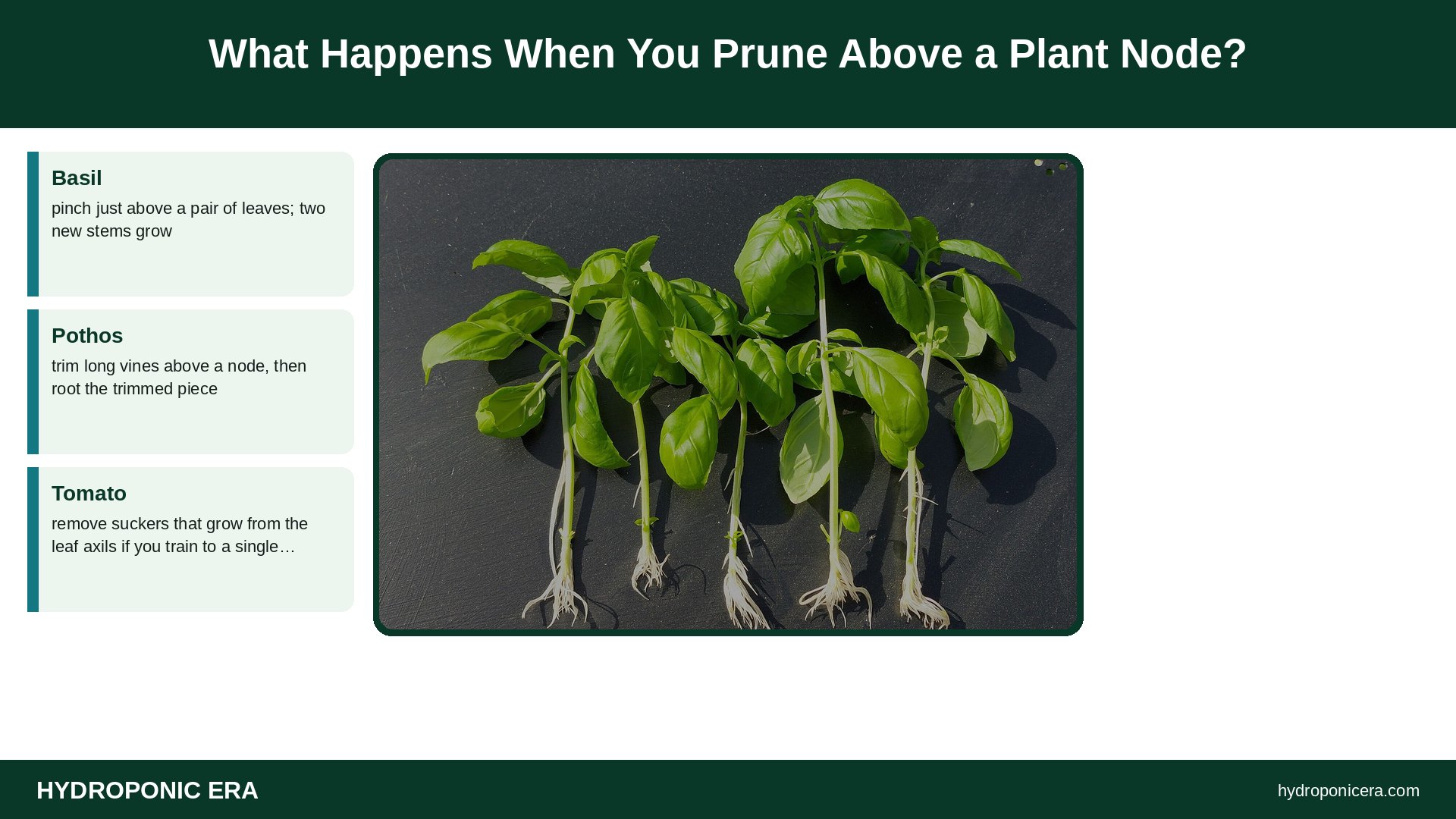
Pruning just above a plant node wakes up the bud at that node, so a new side shoot grows from it. This is how you make basil, mint and pothos bushier. Cut about ¼ inch (0.6 cm) above a node with outward-facing buds, and the plant branches there instead of stretching tall.
- Basil: pinch just above a pair of leaves; two new stems grow.
- Pothos: trim long vines above a node, then root the trimmed piece.
- Tomato: remove suckers that grow from the leaf axils if you train to a single stem.
Why Is My Cutting Not Rooting at the Node?
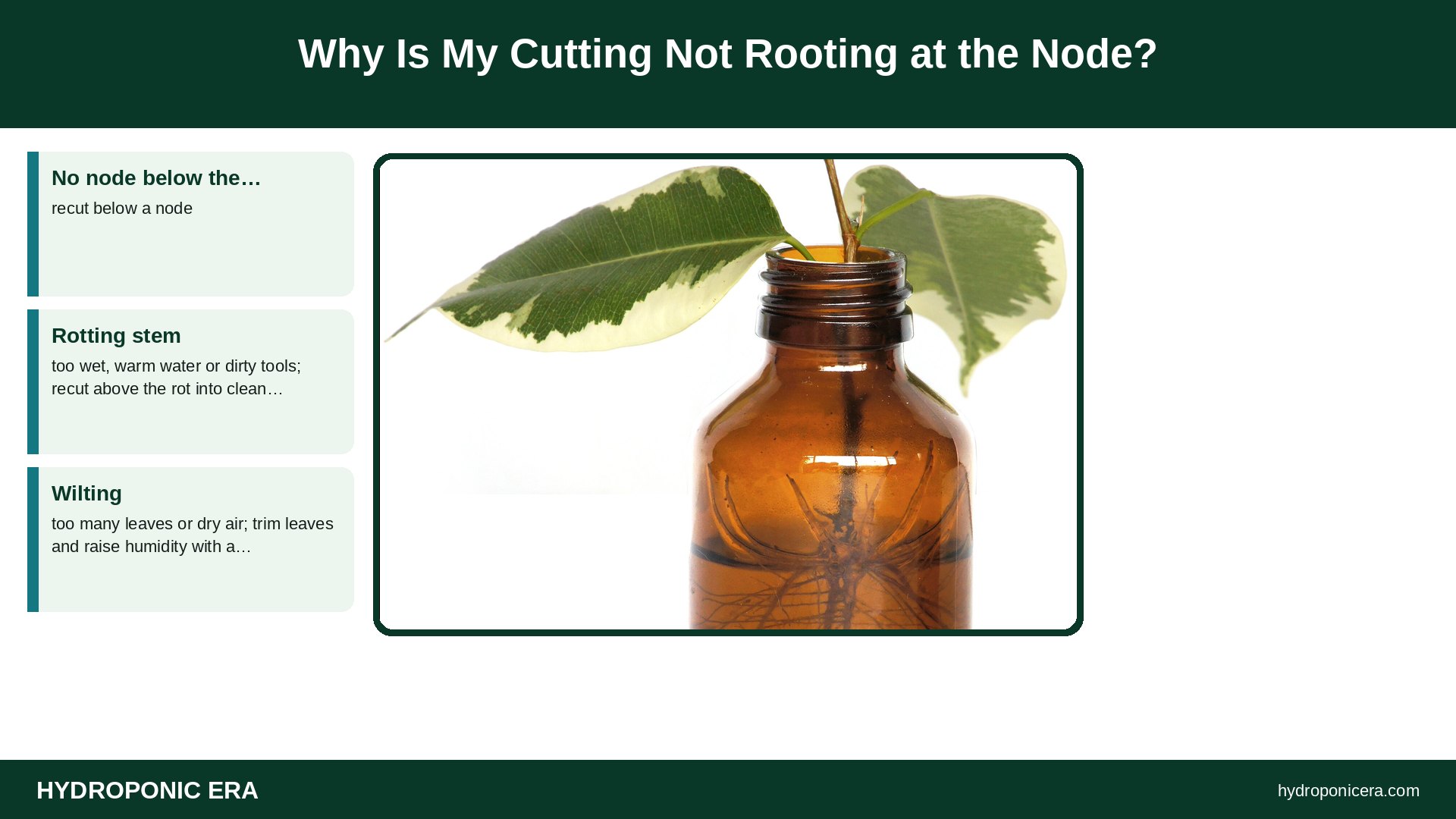
- No node below the surface: recut below a node.
- Rotting stem: too wet, warm water or dirty tools; recut above the rot into clean tissue.
- Wilting: too many leaves or dry air; trim leaves and raise humidity with a humidity dome.
- Slow plants: Mississippi State notes many woody cuttings take two to four months to root.
- Upside-down cutting: check that buds point up.
Why Does a Plant Node Matter in Hydroponics?
A plant node matters in hydroponics because clones, net-cup transplants and pruning all depend on it. When you root a stem cutting in rockwool, a clone collar or plain water, the plant node below the surface is where roots appear first. When you top basil or tomatoes in a hydroponic system, the plant node just below the cut is where new branches start.
- Cloning: keep at least one plant node inside the plug or collar.
- Transplanting: set seedlings so the lowest node sits above the waterline unless the crop roots from the stem, like tomatoes.
- Pruning: cut above a node to shape compact plants under grow lights.
FAQs
Is a node the same as a leaf joint?
Yes. In everyday terms, the leaf joint is the plant node.
Do all plants have nodes?
All stems have nodes, but some are hard to see on short or fleshy stems.
Can I root a cutting with no leaves?
Yes, if it has nodes. Cane cuttings of dracaena root from bare nodes.
Should I use rooting hormone at the node?
It is optional. Virginia Tech says it can hasten rooting and give more uniform results.
How far apart are nodes?
It varies with species and light; low light stretches internodes.
Sources
- Virginia Cooperative Extension — Propagation by Cuttings, Layering and Division (426-002)
- Mississippi State University Extension — How to Propagate Plants from Cuttings
- Penn State Extension — Propagating Houseplants
- Photo credits (Wikimedia Commons, edited with titles): Justicia adhatodoides 2892 by SAplants (CC BY-SA 4.0); Ficus cuttings with roots in a bottle, White background by Biusch (CC BY-SA 3.0); Basilikum (Ocimum basilicum) Stecklinge — Josef Schlaghecken by Schlaghecken Josef (CC BY-SA 4.0); Ficus cuttings with roots in a bottle, White background by Biusch (CC BY-SA 3.0); Pothos plant on water by Joli Rumi (CC BY-SA 4.0)