
Can you do axolotl aquaponics? Yes, on a small scale. Axolotl aquaponics uses a tank’s nitrogen-rich water to feed plants growing above it, such as pothos or lettuce roots in a hang-on bed. The plants pull out nitrate, but the tank still needs cool water, gentle flow, a cycled filter and weekly water changes.
Key takeaway: Plants are a helper, not a replacement for good axolotl care. Keep water below 75°F (24°C), keep flow low, never add plant fertilizer to the tank, and keep testing ammonia, nitrite and nitrate.
| Axolotl need | Target from LafeberVet |
|---|---|
| Water temperature | 60–64°F (15.6–17.8°C) preferred; keep below 75°F (24°C) |
| pH | 7.4–7.6 preferred (6.5–8.0 acceptable) |
| Ammonia, nitrite, chlorine | 0 |
| Nitrate | Under 10 ppm |
| Tank size | 10 gal (38 L) juvenile; 20+ gal (76+ L) adult |
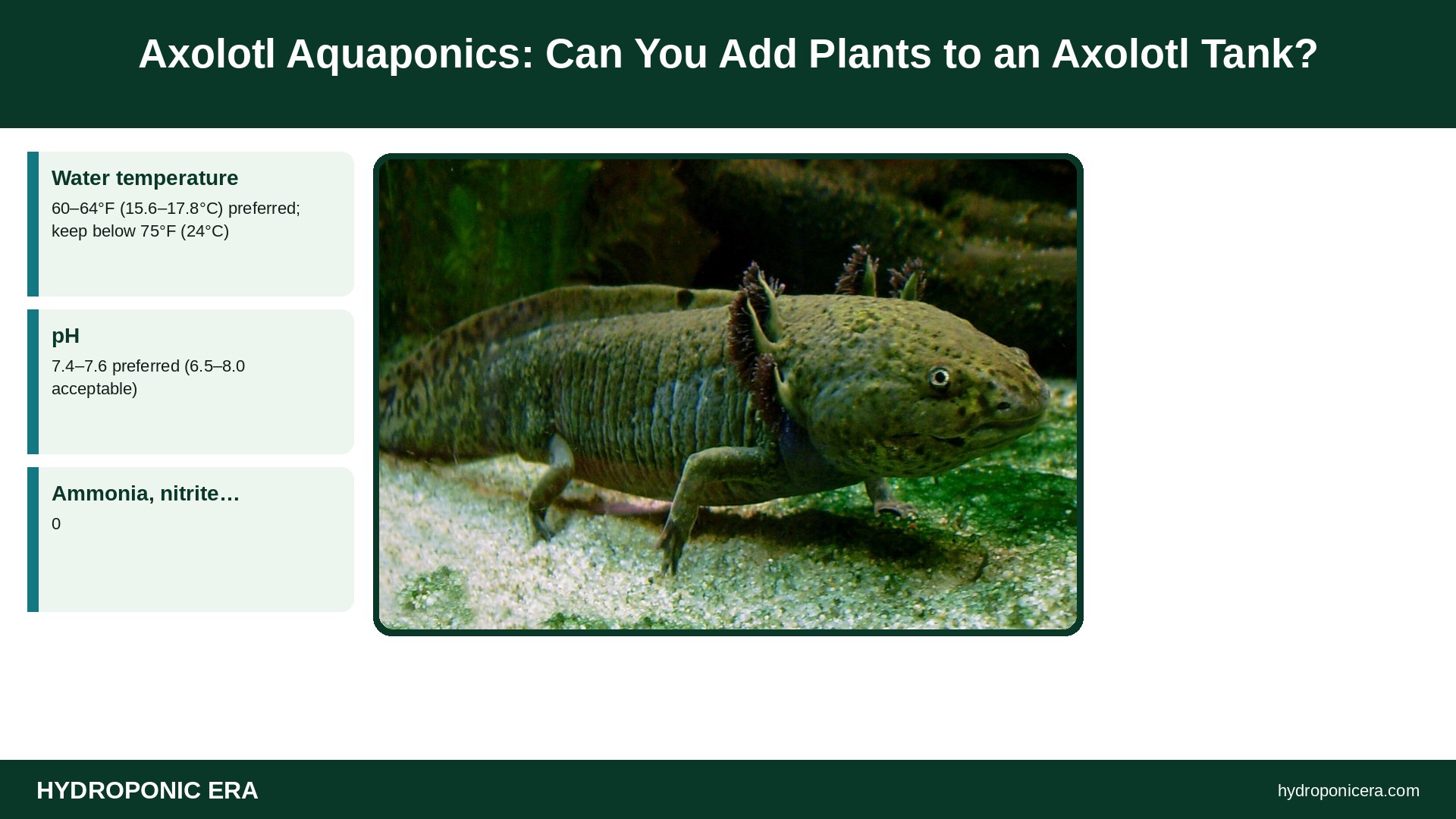
What Is Axolotl Aquaponics?
Axolotl aquaponics is a simple loop where water from an axolotl tank flows through a plant bed and returns cleaner. Beneficial bacteria in the filter turn waste ammonia into nitrite and then nitrate, and the plant roots take up some of that nitrate. It is the same idea as fish-based systems, scaled down for one cool-water amphibian.
The axolotl (Ambystoma mexicanum) is a salamander that stays aquatic its whole life. LafeberVet notes it is critically endangered in the wild, lives about 10–15 years in captivity, and is best kept alone or with other axolotls only. If you are new to fish-and-plant loops, start with our aquaponics for beginners guide.
Is Axolotl Aquaponics Safe for the Animal?
Axolotl aquaponics is safe when the plants sit above or outside the tank and nothing harmful returns to the water. The main risks are warm water from grow lights, strong pump flow, plant fertilizers, pesticide residue on store plants, and copper. LafeberVet lists copper and malachite green among chemicals that are unsafe for axolotls.
- No fertilizer: never dose hydroponic nutrients into an axolotl tank.
- No copper: skip copper-based treatments and copper fittings.
- Rinse plants: wash roots well and avoid plants recently sprayed with pesticides.
- Gentle flow: use a spray bar or baffle so the return water barely moves.
Our aquarium water caution framework explains why tank water and plant nutrients should stay separate.
Which Plants Work Best for Axolotl Aquaponics?
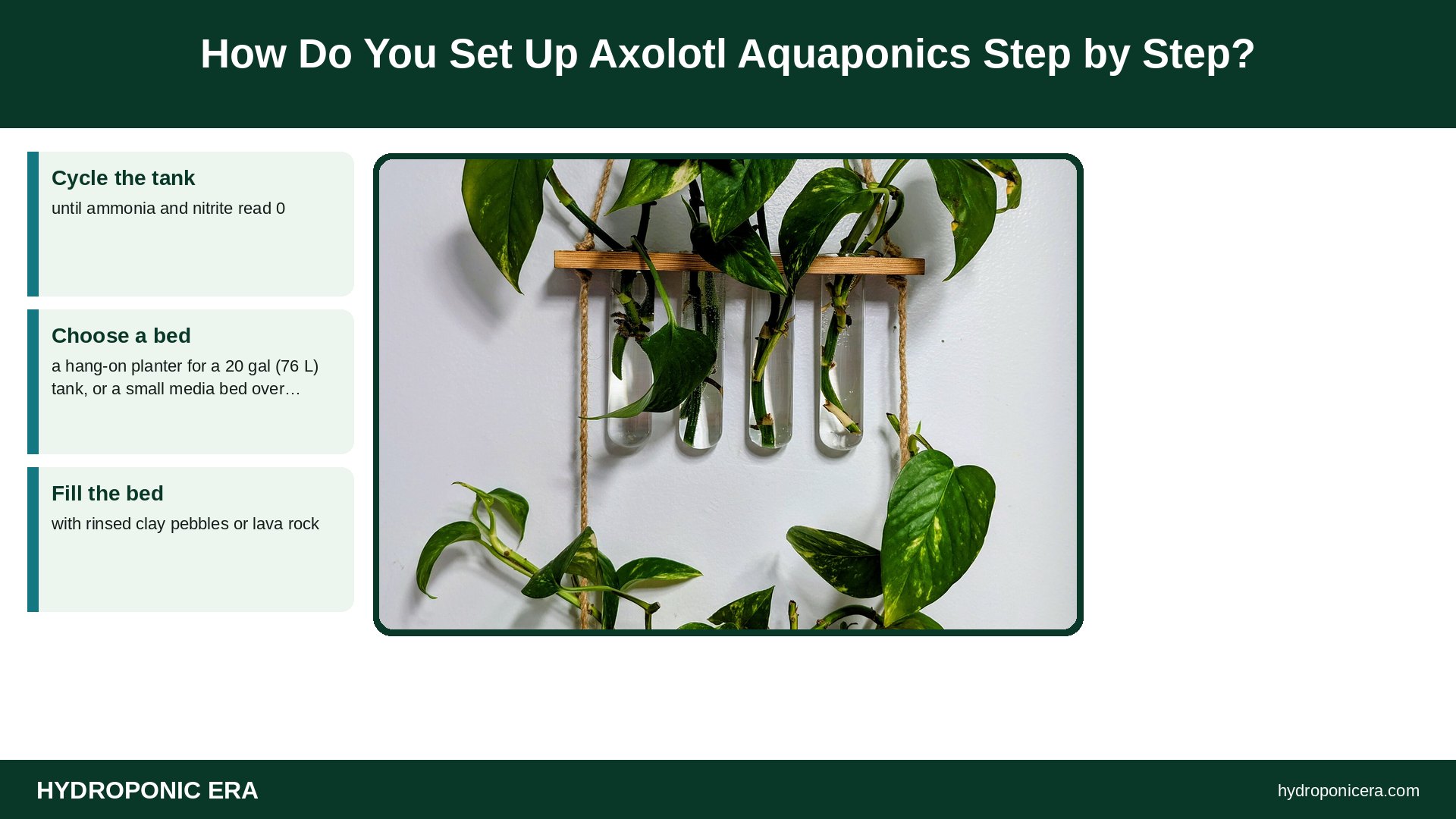
The best plants for axolotl aquaponics tolerate cool water, low nutrient levels and roots kept wet all the time. Pothos, philodendron and peace lily cuttings are easy to tuck into a filter or planter with roots in the water. Lettuce, mint and watercress can grow in a small bed fed by tank water, though growth will be slower than with full nutrients.
| Plant | Where it goes | Notes |
|---|---|---|
| Pothos | Roots in a hang-on filter or planter | Keep leaves out of the water |
| Peace lily | Roots-only in a planter cup | Leaves above the lid |
| Lettuce | Small media bed or raft | Likes cool water; slow growth |
| Mint and watercress | Media bed | Vigorous; trim often |
See our guide to pothos in water for rooting cuttings before you add them.
How Do You Set Up Axolotl Aquaponics Step by Step?
To set up axolotl aquaponics, start with a fully cycled tank, add a small plant bed or hang-on planter, run a low-flow pump on a gentle return, and add plants a few at a time while testing water. Keep the bed lighting off the tank surface so the water stays cool.
- Cycle the tank until ammonia and nitrite read 0.
- Choose a bed: a hang-on planter for a 20 gal (76 L) tank, or a small media bed over a sump for larger tanks.
- Fill the bed with rinsed clay pebbles or lava rock.
- Add a low-flow pump and a spray bar or baffle on the return.
- Plant rinsed cuttings with roots in the water and leaves dry.
- Light the plants from the side or above the bed, not the open tank.
- Test weekly and keep doing about a 30% water change each week.
How Do You Keep the Water Cool and Calm?
Keeping the water cool and calm matters more than plant growth. LafeberVet warns that axolotls face heat stress above 75°F (24°C) and prefer minimal water flow and low light. Place the tank away from windows and heaters, use a fan or chiller if your room runs warm, and keep grow lights aimed at leaves only.
Air pumps add oxygen without much current if you use a small stone and a gang valve. Our guide to air pumps and air stones covers sizing. Always treat tap water to remove chlorine before water changes; see our chlorine and chloramine guide.
Does Ambystoma Care Change With Plants?
Basic Ambystoma mexicanum care stays the same when you add plants. LafeberVet recommends fine sand or large stones instead of gravel, which axolotls can swallow and become impacted, plus hides, a secure lid and regular water testing. Plants may lower nitrate between changes, but they do not remove the need to clean waste and change water.
- Feed earthworms or sinking pellets suited to axolotls and remove leftovers.
- Siphon waste from the bottom during water changes.
- Watch for floating, curled gills or skin changes, and call an exotic vet if they appear.
Is It Legal to Keep an Axolotl in the US?
Rules vary by state. California lists the whole Ambystoma genus as restricted, and the California Department of Fish and Wildlife says it does not issue permits for pet ownership of restricted species. Other states and some cities have their own rules, so check your state wildlife agency before buying an axolotl or building any system around one.
What Problems Show Up in Axolotl Aquaponics?
Most problems in axolotl aquaponics come from heat, too much flow, or treating the plants instead of the animal. Rotting roots, decaying leaves in the water, and stirred-up waste can all raise ammonia. Fix the cause, test the water, and do a partial water change if any reading is off.
| Problem | Likely cause | Fix |
|---|---|---|
| Gills curled forward | Strong flow or poor water | Baffle the return; test and change water |
| Water above 75°F (24°C) | Lights, sun or warm room | Move lights; add a fan or chiller |
| Ammonia rising | Dead roots or leftover food | Trim roots; remove food; water change |
| Plants yellowing | Low nutrients | Accept slow growth; never add fertilizer |
FAQ About Axolotl Aquaponics
Can I put live aquarium plants in with an axolotl?
Yes. Hardy, cool-tolerant plants such as anubias and java fern are common choices.
Will plants replace water changes?
No. LafeberVet still recommends about 30% weekly water changes.
Can I grow vegetables with axolotl water?
Leafy greens can grow slowly; wash and handle them with clean hands.
Do axolotls need a grow light?
No. They prefer low light; light only the plants.
What size tank do I need?
At least 20 gal (76 L) for an adult, per LafeberVet.
For more water-rooted plant ideas, see our list of plants that grow in water.
Sources
- LafeberVet — Basic Information Sheet: Axolotl
- California Department of Fish and Wildlife — Restricted Species Permits
- FAO Fisheries and Aquaculture Technical Paper 589 — Small-scale aquaponic food production
- Oklahoma State University Extension — Nitrification and Maintenance in Media Bed Aquaponics
- Photo credits (Wikimedia Commons, edited with titles): Axolotl ganz by LoKiLeCh (CC BY-SA 3.0); Fish farming on Øksfjorden in Loppa, Troms og Finnmark, Norway, 2022 August by Ximonic (Simo Räsänen) (CC BY-SA 4.0); Pothos plant on water by Joli Rumi (CC BY-SA 4.0); Covid test kit 2022 by Downtowngal (CC BY-SA 4.0)