
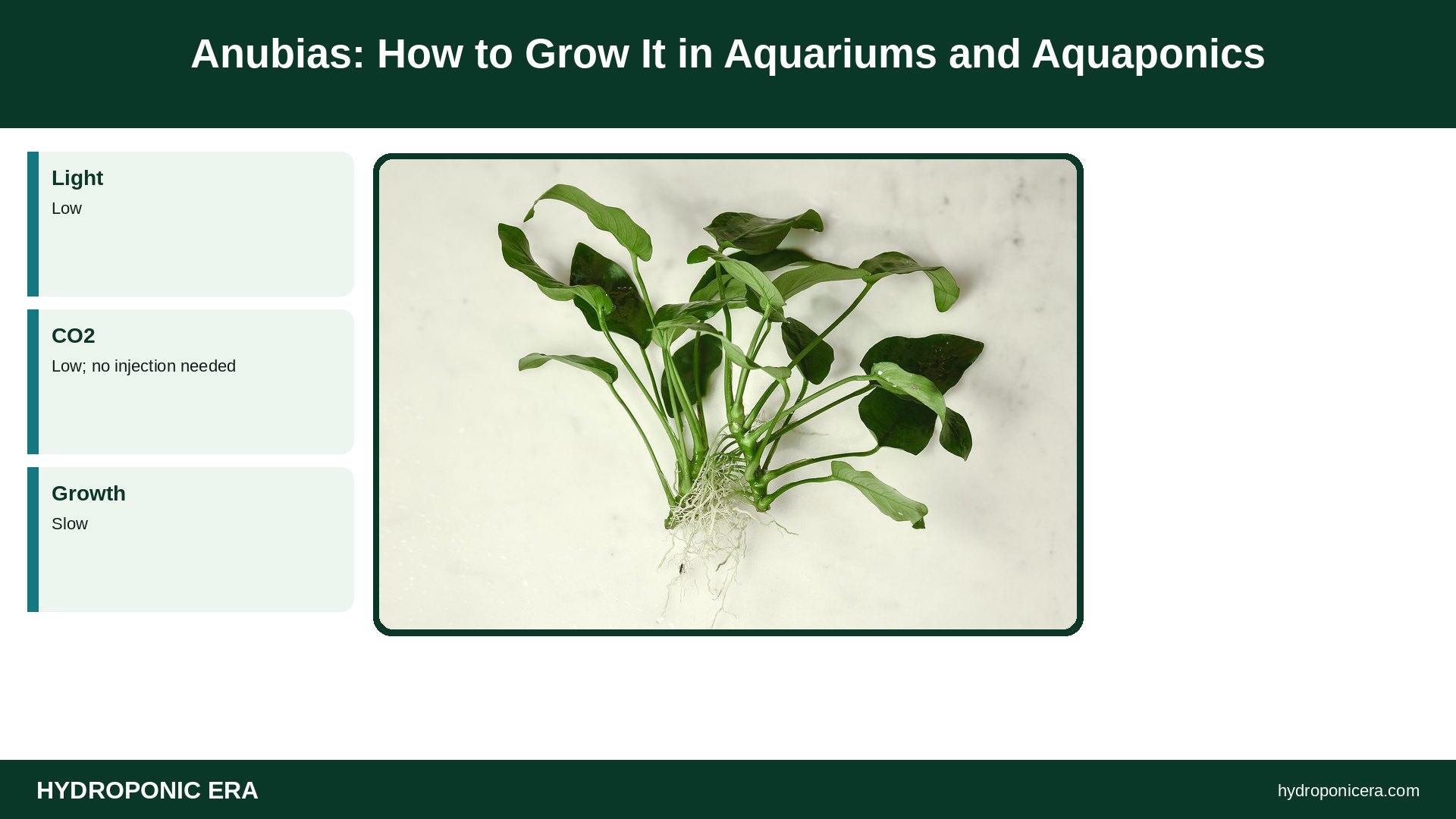
How do you grow anubias? Anubias is a slow-growing, low-light aquarium plant that grows best tied or glued to rock or driftwood, with its thick rhizome kept above the substrate. Give it modest light, stable warm water and patience. It needs no CO2 injection, and most plant-eating fish leave its tough leaves alone.
Key takeaway: Never bury the rhizome. Tropica, a major aquarium plant grower, warns a buried rhizome can rot. Attach it to hardscape and let only the roots touch the gravel.
| Need | Typical for the nana variety (Tropica) |
|---|---|
| Light | Low |
| CO2 | Low; no injection needed |
| Growth | Slow |
| Height | About 2–6 in (5–15 cm) |
| Placement | On rock or wood; foreground or midground |
| Origin | Cameroon, West Africa |
What Is Anubias?
Anubias is a genus of tough, dark green plants from West and Central Africa that grow along streams and riverbanks, often partly out of the water. In aquariums they grow fully submerged. The most popular kind, Anubias barteri var. nana, stays small, which makes it a good fit for nano tanks, betta tanks and aquascapes.
Other common forms include ‘Petite’, a mini variety, and larger plants such as A. gigantea that suit big tanks. All share the same basic care: a creeping rhizome, sturdy leaves and slow growth.
How Do You Plant Anubias Without Killing It?
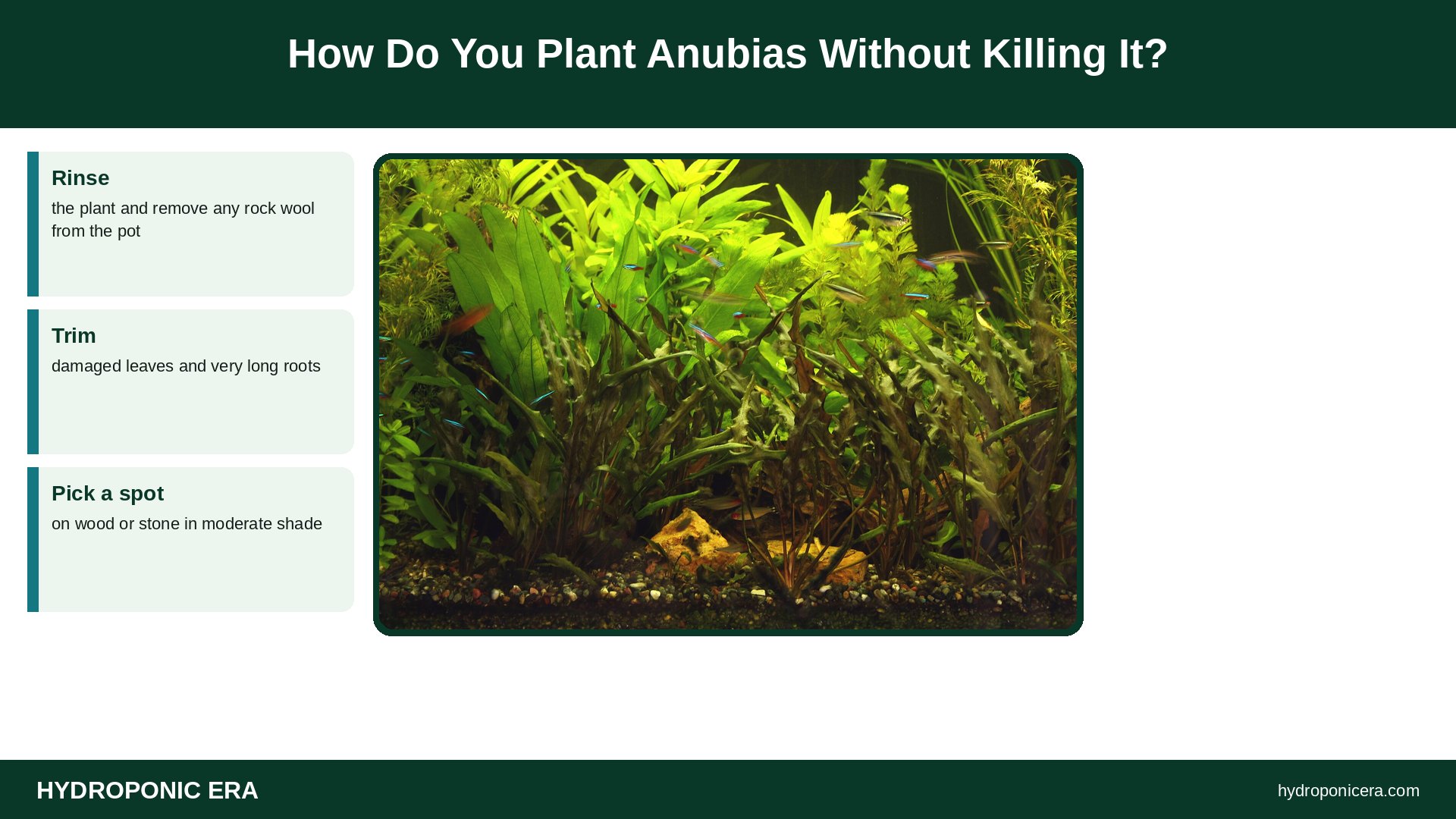
Plant it by attaching its rhizome to rock or driftwood with cotton thread, fishing line or aquarium-safe superglue, or wedging it into a crevice. Tropica’s planting guide says plants with rhizomes should not be buried in the substrate. Roots will grip the surface within a few weeks, and the thread can then be removed.
- Rinse the plant and remove any rock wool from the pot.
- Trim damaged leaves and very long roots.
- Pick a spot on wood or stone in moderate shade.
- Tie or glue the rhizome, leaving the top exposed.
- Place the hardscape in the tank.
- Remove the thread once the roots hold on.
How Much Light Does Anubias Need?
Anubias needs only low to moderate light, so a basic aquarium LED is usually enough. Tropica rates the nana variety as a low-light, low-CO2 plant. Because the leaves grow so slowly, strong light often causes green spot algae on them, so shade the plant under taller plants or wood in bright tanks.
- Low-tech tank: a standard aquarium hood light is fine.
- High-light tank: place it in shaded spots.
- Photoperiod: about 6–8 hours a day limits algae in many tanks.
See our guides to light schedules and algae control for related tips.
Can Anubias Grow in Aquaponics?
Yes. It can grow in aquaponics either inside the fish tank on wood or with its roots in a hang-on filter or planter. It uses fish waste nutrients slowly, so it won’t clean the water as fast as pothos or lettuce, but it adds cover for fish and survives conditions that kill delicate plants.
It also grows emersed with roots in water and leaves in humid air, which some growers use in paludariums and planter boxes. New to fish-and-plant systems? Read our aquaponics for beginners guide.
Is Anubias an Epiphyte?
Yes. In aquarium terms, it is an epiphyte: a plant that grows attached to another surface rather than rooted in soil. In the wild it clings to rocks and roots along streams. That habit is why it does so well on driftwood, stones, cork and even mesh, and why burying it causes problems.
- Good surfaces: driftwood, lava rock, slate and porous stone.
- Good tools: cotton thread, fishing line or gel superglue labeled aquarium safe.
- Avoid: metal wire that can corrode and harm fish or shrimp.
Other attached plants with similar care include java fern and many mosses, so they pair well on one piece of wood.
What Water Conditions Does It Prefer?
This plant is forgiving about water. It tolerates the soft-to-moderately hard water and tropical temperatures found in most community tanks. Stability matters more than any exact number, so avoid big swings during water changes.
Treat tap water to remove chlorine before refills. Our chlorine and chloramine guide explains how. A cycled filter matters more for the fish than for the plant.
Which Fish Are Good With Anubias?
Most community fish do well with this plant, and its tough leaves make it one of the few choices for herbivorous fish. Tropica describes it as resistant to plant-eating fish. Cichlids, goldfish and plecos that shred softer plants usually leave it alone, though digging fish can uproot it if it isn’t attached.
| Fish | Fit |
|---|---|
| Betta | Good; bettas rest on the wide leaves |
| Goldfish | Good if tied to rock or wood |
| African cichlids | Good; attach firmly |
| Shrimp and snails | Good; they graze on the leaves’ film |
How Do You Propagate Anubias?
Propagate it by cutting the rhizome into pieces with a clean blade, leaving at least three or four leaves on each section. Attach each piece to rock or wood the same way you planted the parent. New leaves appear slowly, often only one every few weeks, so expect a plant that is worth waiting for.
Why Is My Anubias Melting or Turning Yellow?
Melting or yellow leaves usually point to a rotting rhizome, low nutrients, or a plant that was grown out of water and is adjusting. Check the rhizome first: a soft, mushy or foul-smelling section should be cut away. Older leaves also yellow naturally and can be trimmed at the base.
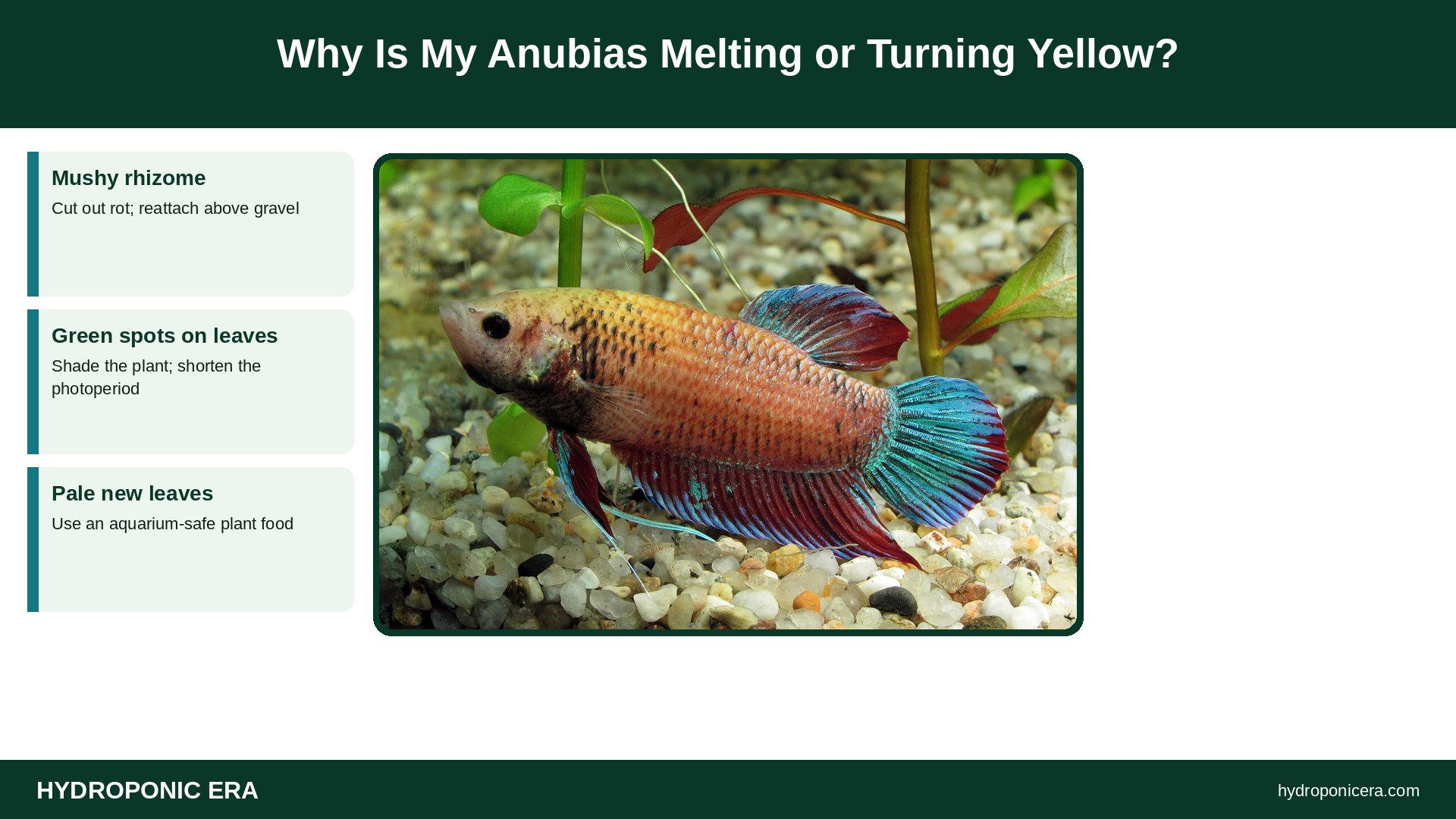
| Symptom | Likely cause | Fix |
|---|---|---|
| Mushy rhizome | Buried or damaged | Cut out rot; reattach above gravel |
| Green spots on leaves | Too much light | Shade the plant; shorten the photoperiod |
| Pale new leaves | Low nutrients | Use an aquarium-safe plant food |
| Holes in leaves | Snails or old damage | Trim leaves; check grazers |
FAQ About Anubias
Does it need substrate?
No. It grows on rock or wood; roots may reach gravel.
Does it need CO2?
No. Tropica rates it as a low-CO2 plant.
Can it grow out of water?
Yes, with roots wet and high humidity.
How fast does it grow?
Slowly; often a new leaf every few weeks.
Is it safe for bettas?
Yes. Its smooth leaves are a favorite resting spot.
For more water-rooted plants, browse our list of plants that grow in water, and read our aquarium water caution framework before reusing tank water on food crops.
Sources
- Tropica Aquarium Plants — Anubias barteri var. nana
- Tropica Aquarium Plants — Planting Guide
- FAO Fisheries and Aquaculture Technical Paper 589 — Small-scale aquaponic food production
- Oklahoma State University Extension — Nitrification and Maintenance in Media Bed Aquaponics
- Photo credits (Wikimedia Commons, edited with titles): Anubias barteri var. nana by Abhik.Mazumdar.73 (CC BY 4.0); Planted Tank 03 – Flickr – The Wandering Angel by The Wandering Angel from Makati City, Philippines (CC BY 2.0); Fish farming on Øksfjorden in Loppa, Troms og Finnmark, Norway, 2022 August by Ximonic (Simo Räsänen) (CC BY-SA 4.0); Siamese fighting fish (Betta splendens) female orange by Bernard Ladenthin (CC BY 4.0)