
How do you grow onion sprouts at home? Soak onion seeds in cool water for 8–12 hours, drain, and keep them in a jar or tray at about 70°F (21°C) out of direct sun. Rinse and drain 2–3 times a day. Sprouts appear in 4–7 days, green up in indirect light, and are ready in about 10–15 days.
Key takeaway: Onion sprouts are slow compared with most sprouts, but they taste like mild scallions. Use seed sold for sprouting, rinse often, drain well, and refrigerate the harvest. Like all raw sprouts, they carry a food safety risk, so higher-risk people should skip them raw.
| Onion sprouts factor | Target | Source |
|---|---|---|
| Soak | 8–12 hours in cool 60–70°F (16–21°C) water | Sproutpeople |
| Rinse and drain | 2–3 times a day | Sproutpeople, UVM |
| Room temperature | About 70°F (21°C) | Sproutpeople |
| First sprouting | 4–7 days | Sproutpeople |
| Harvest | About 10–15 days | Sproutpeople |
| Storage | Refrigerator, 38–50°F (3–10°C) | NC State |
What Are Onion Sprouts?
Onion sprouts are onion seeds grown for a couple of weeks in a jar or tray until each seed sends up a thin green shoot. Sproutpeople, a sprouting-seed supplier, describes them as tasting just like a scallion. Unlike bean sprouts, the onion sprout itself is the first leaf, so it turns green quickly once it sees light. The black seed coat often stays attached to the tip.
Onion sprouts differ from regrowing scallions in water, which starts from bulbs. For that method, see our guide to growing green onions hydroponically.
How Do You Grow Onion Sprouts in a Jar Step by Step?

- Buy seed sold for sprouting, ideally certified pathogen-free, as UC ANR advises.
- Rinse the seed and skim off any floating plant bits and debris.
- Soak 8–12 hours in 2–3 times as much cool 60–70°F (16–21°C) water, per Sproutpeople.
- Drain completely and put the seed in a clean quart (1 L) jar with a mesh lid.
- Tilt the jar mouth-down in a bowl so water keeps draining.
- Rinse and drain 2–3 times a day at about 70°F (21°C), out of direct sun.
- Move to indirect light once shoots appear so they green up.
- Harvest at 10–15 days, rinse, drain well and refrigerate.
NC State Extension notes that chlorinated water can cause poor sprouting, so use non-chlorinated water if your tap water is heavily treated. For a full jar method, see how to grow sprouts in a jar.
How Long Do Onion Sprouts Take to Grow?
Onion sprouts take about 10–15 days from dry seed to harvest, according to Sproutpeople’s growing guide, with the first sprouting usually visible in 4–7 days. That is slower than mung bean or radish sprouts, which Oregon State University lists at about 3–5 days. Warm, steady room temperature and regular rinsing keep growth even.
| Day | What you see | What to do |
|---|---|---|
| 0–1 | Seeds soaking | Skim floating debris; drain |
| 2–7 | Tiny white tips emerge | Rinse 2–3 times a day |
| 7–10 | Thin shoots lengthen | Give indirect light to green |
| 10–15 | Green micro-scallions, 1 inch (2.5 cm)+ | Harvest and refrigerate |
How Much Seed Should You Start With?
Start small. Sproutpeople’s jar instructions suggest no more than about 4 tablespoons of seed per quart (1 L) of sprouter space, since sprouts swell well beyond the dry seed volume. UVM Extension’s general home method starts with about 1 tablespoon of seed. A small batch also lets you taste-test before committing to a larger one.
Do These Sprouts Need Light?
Onion sprouts need little light at first but should get indirect light once shoots appear. Sproutpeople explains that light has little effect until a sprout has leaves; these sprouts are leaves from the start, so they green up with only modest light. Avoid direct sun, which can overheat the jar and cook the sprouts.
Are Onion Sprouts Safe to Eat Raw?
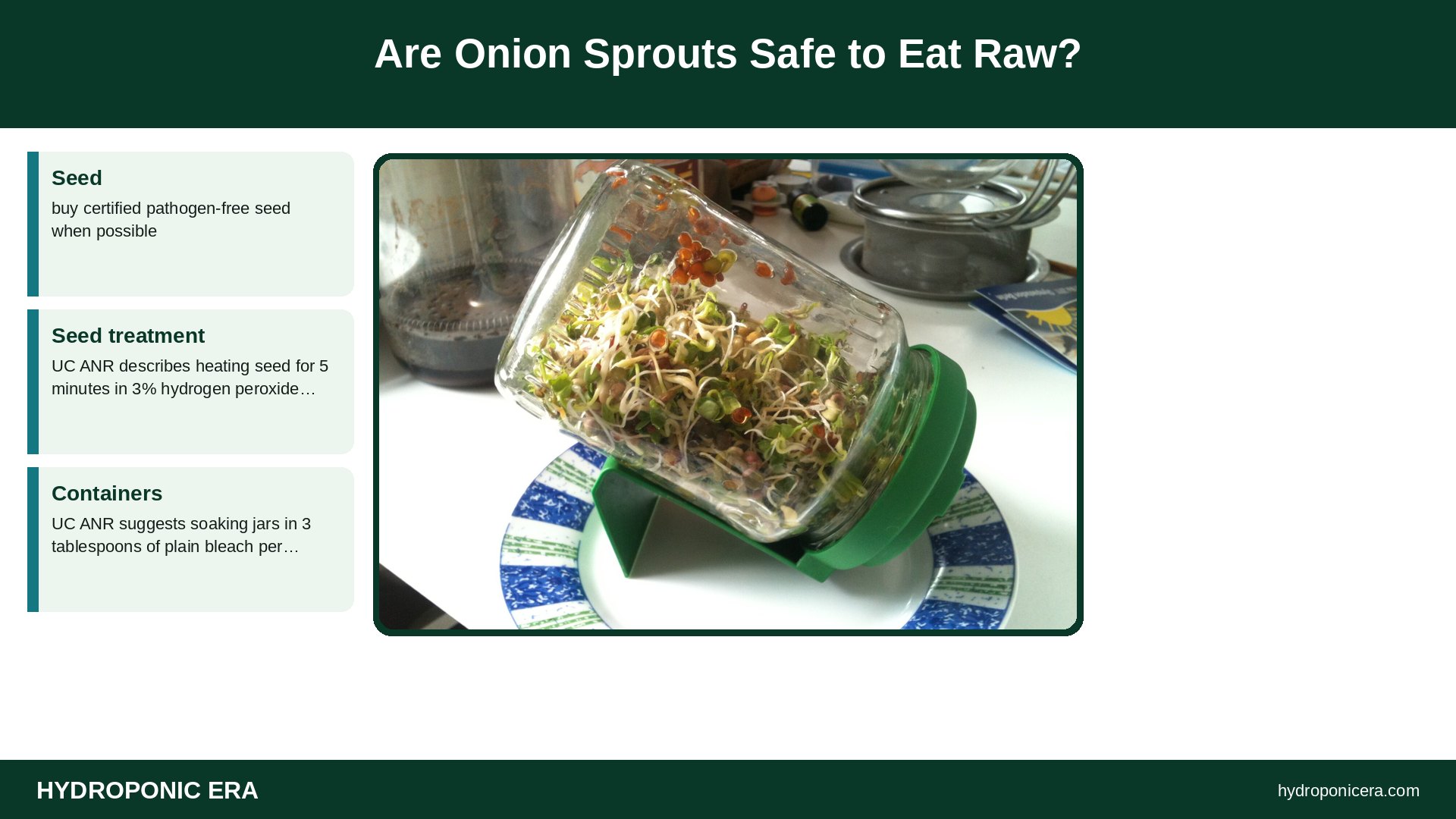
Onion sprouts carry the same risk as other raw sprouts. The FDA says the warm, humid conditions used for sprouting are also ideal for bacteria, and that people at higher risk of foodborne illness should avoid raw or lightly cooked sprouts of any kind, naming onion sprouts specifically. UC ANR says children, older adults and people with weakened immune systems should not eat raw homegrown sprouts.
- Seed: buy certified pathogen-free seed when possible.
- Seed treatment: UC ANR describes heating seed for 5 minutes in 3% hydrogen peroxide held at 140°F (60°C), then rinsing.
- Containers: UC ANR suggests soaking jars in 3 tablespoons of plain bleach per quart (1 L) of water for at least 5 minutes, then rinsing.
- Location: sprout away from raw meat, pets and busy food-prep areas.
Read more in our guide to hydroponic food safety at home.
How Do You Store Onion Sprouts?
Store onion sprouts dry and cold. NC State Extension says sprouts keep several days in the refrigerator at 38–50°F (3–10°C). Drain them well, or spin them dry, before chilling, since excess water speeds spoilage. Discard any sprouts that smell sour, feel slimy or look moldy.
How Do You Use Them in Food?

Use onion sprouts anywhere you would add chopped scallions. They are strong, so a small pinch goes a long way. Try them on eggs, baked potatoes, soups, rice bowls and sandwiches. If you are in a higher-risk group, add them to hot dishes and cook them thoroughly instead of eating them raw.
Why Is My Onion Seed Not Sprouting?
- Slow start: onion seed is slower than most; Sproutpeople says to keep going through day 7.
- Cold room: aim for about 70°F (21°C).
- Chlorinated water: NC State links chlorine to poor sprouting.
- Musty smell or mold: rinse more often and drain fully.
- Old seed: buy fresh sprouting seed from a supplier that tests it.
Growing onion sprouts in a tray of soil or mat instead yields onion microgreens; see our microgreens guide.
What Is the Difference Between Onion Sprouts and Onion Microgreens?
Onion sprouts are grown in water only and eaten whole, seed and root included, while onion microgreens grow in a tray of soil or a grow mat under light and are cut above the surface. Sprouts are faster and need no medium; microgreens take longer but leave roots and hulls behind.
| Feature | Onion sprouts | Onion microgreens |
|---|---|---|
| Growing medium | None; jar or tray with rinsing | Soil, coco or grow mat |
| Part eaten | Whole sprout, seed and root | Shoots cut above the medium |
| Light | Indirect light near the end | Steady light throughout |
FAQs
Can I sprout onion seed from a garden packet?
Use seed sold for sprouting; garden seed may be treated.
Do I need to remove the black hulls?
No. They are edible, and some fall away with rinsing.
How do they taste?
Sproutpeople says they taste just like scallions.
Can I grow onion sprouts in a tray?
Yes, with rinsing and good drainage.
How long do they keep?
Several days in the refrigerator, per NC State.
Sources
- Sproutpeople (sprouting-seed supplier) — Onion Sprouts growing guide
- NC State Extension — Bean Sprouts and Other Vegetable Seed Sprouts
- University of California ANR — Growing Seed Sprouts at Home (Publication 8151)
- U.S. Food and Drug Administration — Selecting and Serving Produce Safely
- University of Vermont Extension — Sprouts: The Superfood to Grow at Home
- Oregon State University Extension — Grow Your Own Vegetable Sprouts
- Photo credits (Wikimedia Commons, edited with titles): Manns’ superior seeds (16204128977) by Henry G. Gilbert Nursery and Seed Trade Catalog Collection.; J. Manns & Co. (CC BY 2.0); Growing bean sprouts by User:tlcoles (CC BY-SA 3.0); Growing bean sprouts by User:tlcoles (CC BY-SA 3.0); Salad, Romaine lettuce, cucumber, tomato, green pepper, radish, alfalfa sprouts, black olives, lemon juice, salt & olive oil (7765310086) by Lablascovegmenu from London (CC BY 2.0); Onion seedlings by Krish Dulal (CC BY-SA 3.0)