
How do you grow hornwort? Hornwort is a rootless, submerged plant you can float or loosely anchor in a tank or pond. It pulls nutrients straight from the water, tolerates shade, and grows fast, so it helps soak up fish waste. Trim it often and never dump fragments into wild water, since tiny pieces regrow.
Key takeaway: Rutgers Cooperative Extension notes it is native across the US, grows best in high-nutrient water and may improve water clarity, but dense mats can cut oxygen.
| Fact | Hornwort (Rutgers FS1236) |
|---|---|
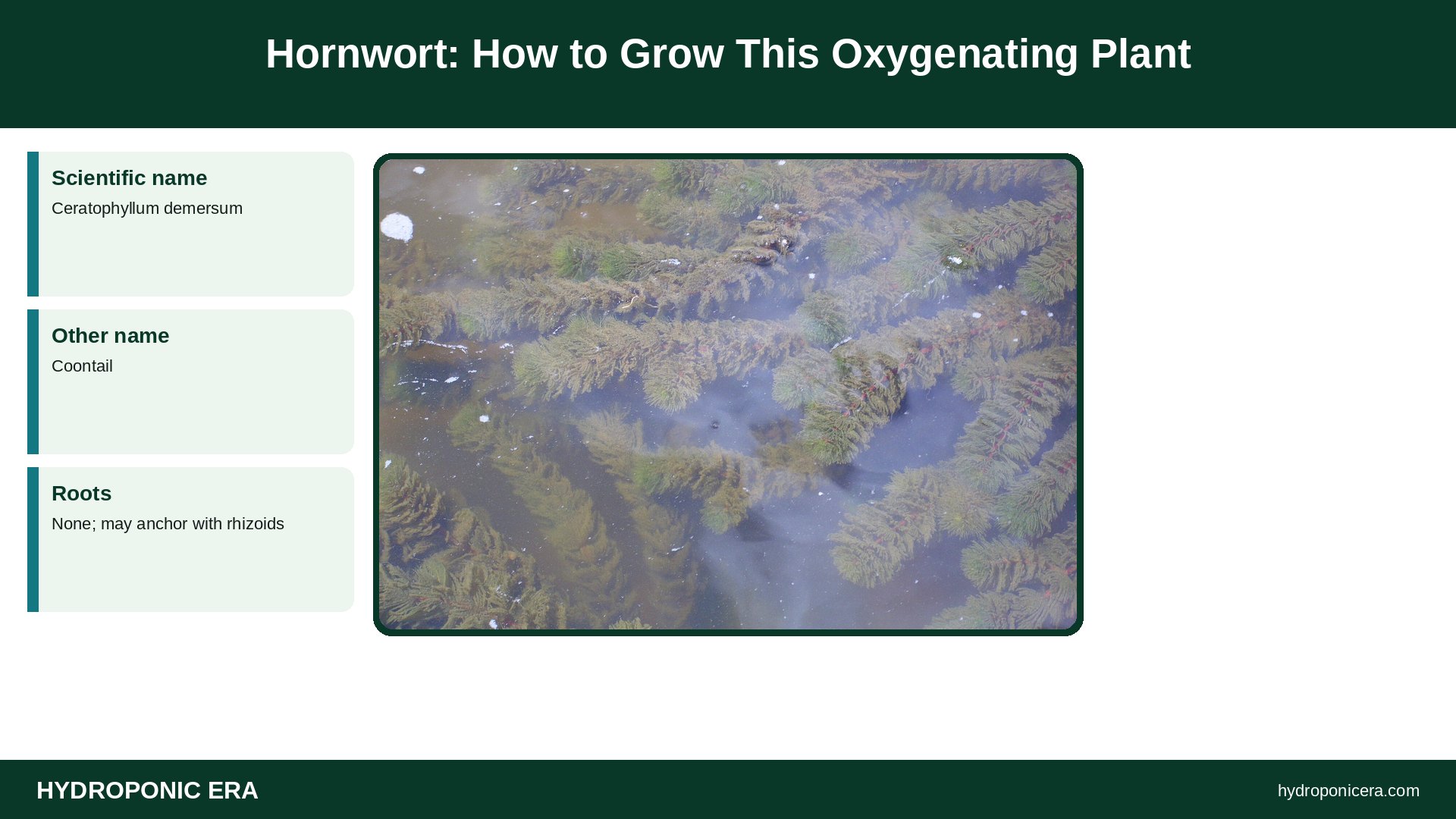
| Scientific name | Ceratophyllum demersum |
| Other name | Coontail |
| Roots | None; may anchor with rhizoids |
| Leaves | Stiff, forked, in whorls of five or more |
| Length | Can exceed 15 ft (4.6 m) in the wild |
| Light | Tolerates low light and shade |
What Is Hornwort?
Hornwort is a dark green, submerged perennial aquatic plant. Rutgers describes stiff, forked leaves arranged in whorls, with small teeth that give it a rough feel and a bushy “raccoon tail” look near the tips. It lacks true roots, though buried stems called rhizoids can loosely anchor it to the bottom.
It is native to the entire United States and most of Canada and is sold as an aquarium and pond plant. It is sometimes confused with milfoil or fanwort, but its leaves are spiny and forked rather than feathery.
Why Grow Hornwort in a Tank or Pond?
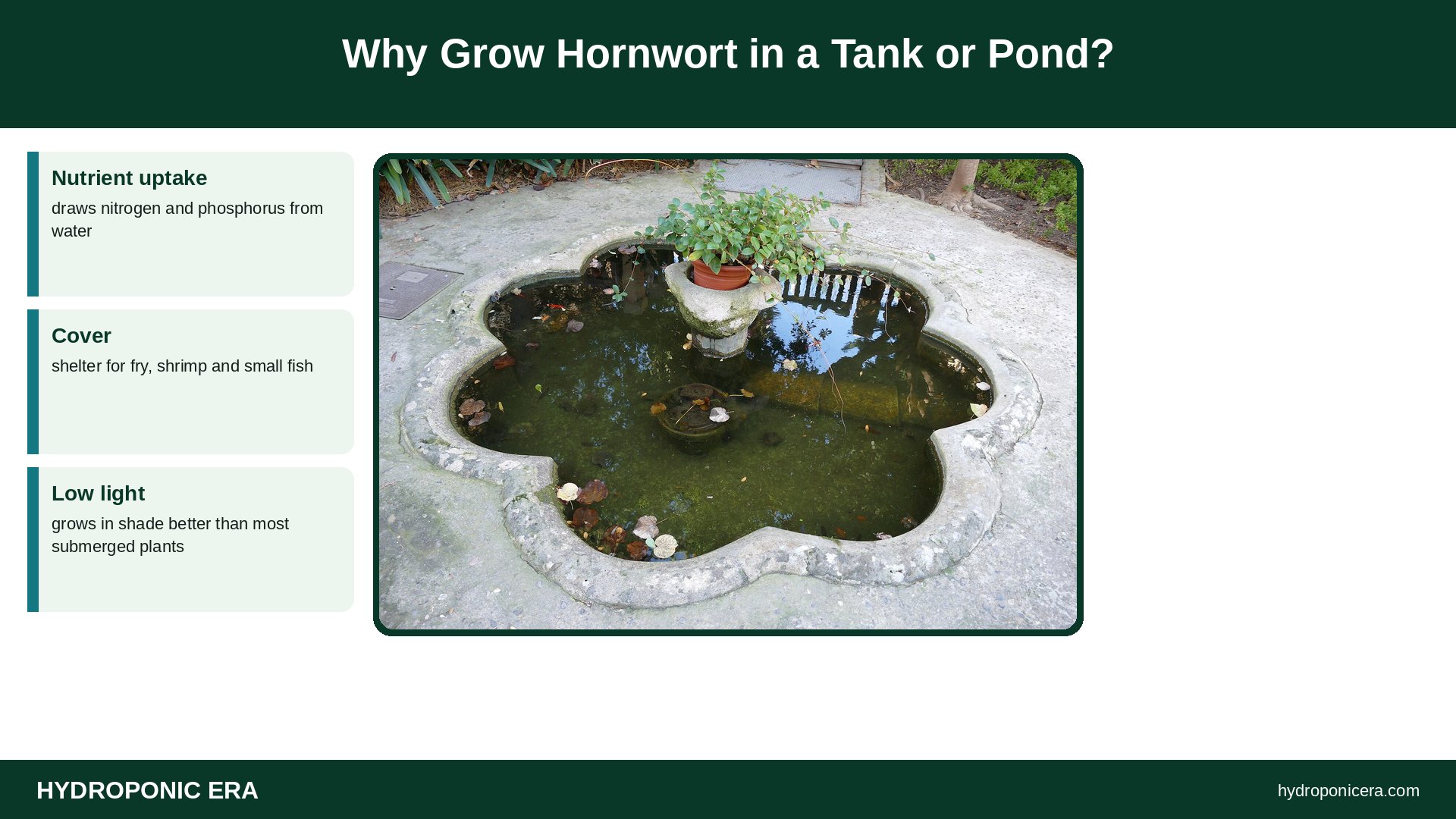
Gardeners grow it because it absorbs nutrients directly from the water, which can compete with algae and improve clarity. Rutgers notes it provides year-round habitat for young fish and small aquatic insects and often stays green through winter. It also gives fry and shrimp a dense place to hide.
- Nutrient uptake: draws nitrogen and phosphorus from water.
- Cover: shelter for fry, shrimp and small fish.
- Low light: grows in shade better than most submerged plants.
- Easy: no soil or planting needed.
For algae context, see our guide to algae control.
How Do You Plant Hornwort?
To plant hornwort, float the stems at the surface, or weigh the base lightly with a plant weight or tuck it behind a rock. Do not bury the stems deeply in gravel, since the plant has no true roots and takes nutrients from the water. Give it gentle light and room to spread.
- Rinse stems and check for snails or hitchhikers.
- Float or anchor the base lightly.
- Treat water for chlorine before adding plants.
- Provide light; low to moderate is fine.
- Trim weekly once it starts spreading.
- Bag trimmings for the trash or compost, never a waterway.
Our guide to quarantining new plants explains how to check for pests first.
How Fast Does Hornwort Grow?
It can grow quickly in nutrient-rich water. Rutgers notes it forms dense colonies in quiet, high-nutrient water and can reproduce from small fragments. In a fish tank with plenty of waste, expect to trim regularly; in clean water with few fish, growth slows. Growth is a sign it is using nutrients.
Can Ceratophyllum Grow in an Aquaponics System?
Yes. Ceratophyllum can float in the fish tank, sump or a settling tank of a small aquaponics system, where it absorbs nutrients and offers cover. It is not a crop, so keep your main plants in grow beds. Our aquaponics for beginners guide covers system layout.
Keep it out of pump intakes and plumbing, where loose stems can clog lines.
Why Is Hornwort Shedding Needles?
It often sheds leaves after a move to a new tank, a sudden change in light or temperature, or a dose of strong chemicals. Shedding usually slows once the plant settles. If stems turn brown and mushy, remove those parts, keep conditions stable, and net loose needles so they do not rot.
| Symptom | Possible cause | Fix |
|---|---|---|
| Needles dropping | Recent move or change | Keep conditions stable |
| Brown stems | Dying sections | Trim and remove |
| Pale growth | Low nutrients or light | Check light and stocking |
| Dense mats | Too much growth | Thin regularly |
Can Hornwort Become a Problem in Ponds?
It can. Rutgers warns that in high-nutrient water it can form dense subsurface mats that out-compete other plants, deplete oxygen and contribute to fish kills, and create mosquito habitat. Control starts with reducing nutrients, then raking or cutting, removing every fragment because pieces can regrow.
In small ponds, thin it so it covers only part of the water. Aeration helps too; see our guide to air pumps and air stones.
How Do You Use It in a Fry or Shrimp Tank?
In fry and shrimp tanks, a loose tangle of stems gives babies a place to hide from adults and graze on tiny organisms that grow on the leaves. Float a few bunches near the surface or let them drift into a corner. Leave open swimming space and keep the filter intake covered with a sponge.
- Livebearers: dense stems give newborn fry cover.
- Egg scatterers: eggs can lodge between the whorls.
- Shrimp: they pick biofilm off the leaves.
- Snails: check new bunches for unwanted hitchhikers.
What Should You Do With Trimmings?
Trimmings make a useful garden mulch or compost ingredient, since the stems are full of nutrients taken from fish waste. Spread them to dry before adding them to a pile. Rutgers stresses that small fragments can regrow, so never toss cuttings into a ditch, stream or lake, and clean nets and buckets afterward.
Extra stems can also go to other keepers, but rinse and bag them first. A tidy trim routine keeps growth under control, limits decaying plant matter in the water, and protects local waterways at the same time.
Do Fish Eat Hornwort?
Some fish nibble it, and goldfish may graze soft tips, but Rutgers notes it is not considered an important food source for fish and waterfowl. Grass carp will eat it after preferred plants, but they are strictly regulated in many states. In most home tanks, growth keeps ahead of grazing.
FAQ About Hornwort
Does it need fertilizer?
Usually not in a stocked tank; fish waste feeds it.
Can it grow in cold water?
Rutgers notes it often stays green through winter.
Does it need CO2?
No; it grows in low light without added CO2.
Is it legal everywhere?
It is native to the US, but check local plant rules.
How do I propagate it?
Cut a stem; each piece can grow into a new plant.
Sources
- Rutgers Cooperative Extension — Coontail (Ceratophyllum demersum), FS1236
- Minnesota Department of Natural Resources — Coontail
- Kansas State University Research and Extension — Water Gardening: Biological Balance (MF2911)
- Photo credits (Wikimedia Commons, edited with titles): Ceratophyllum demersum 2010-8-14 RioMontoro SierraMadrona by Javier martin (Public domain); Fountain with goldfish in Jardí del Bisbe 03 by Kritzolina (CC BY-SA 4.0); Common Duckweed (Lemna minor) by Mokkie (CC BY-SA 3.0); Pond-edge plants at Achamore Garden – geograph.org.uk – 5446824 by M J Richardson (CC BY-SA 2.0)