
How do you grow azolla? Azolla, or mosquito fern, is a tiny floating fern that grows on still water in partial to full sun. It hosts a nitrogen-fixing cyanobacterium, so it can double as fish feed, mulch or compost. Grow a native species in a closed tub, skim it often, and never use the federally listed noxious A. pinnata.
Key takeaway: Use a native species such as the eastern native, keep it in contained water, and harvest weekly so it never smothers the surface.
| Fact | Detail (NC State / UF IFAS) |
|---|---|
| Common names | Mosquito fern, fairy moss, water velvet |
| Native US species | A. caroliniana (now often placed in A. filiculoides) |
| Prohibited species | A. pinnata, Federal Noxious Weed List |
| Height | Less than 1 in (2.5 cm) |
| Light | Partial to full sun |
| Partner | Nitrogen-fixing Anabaena azollae |
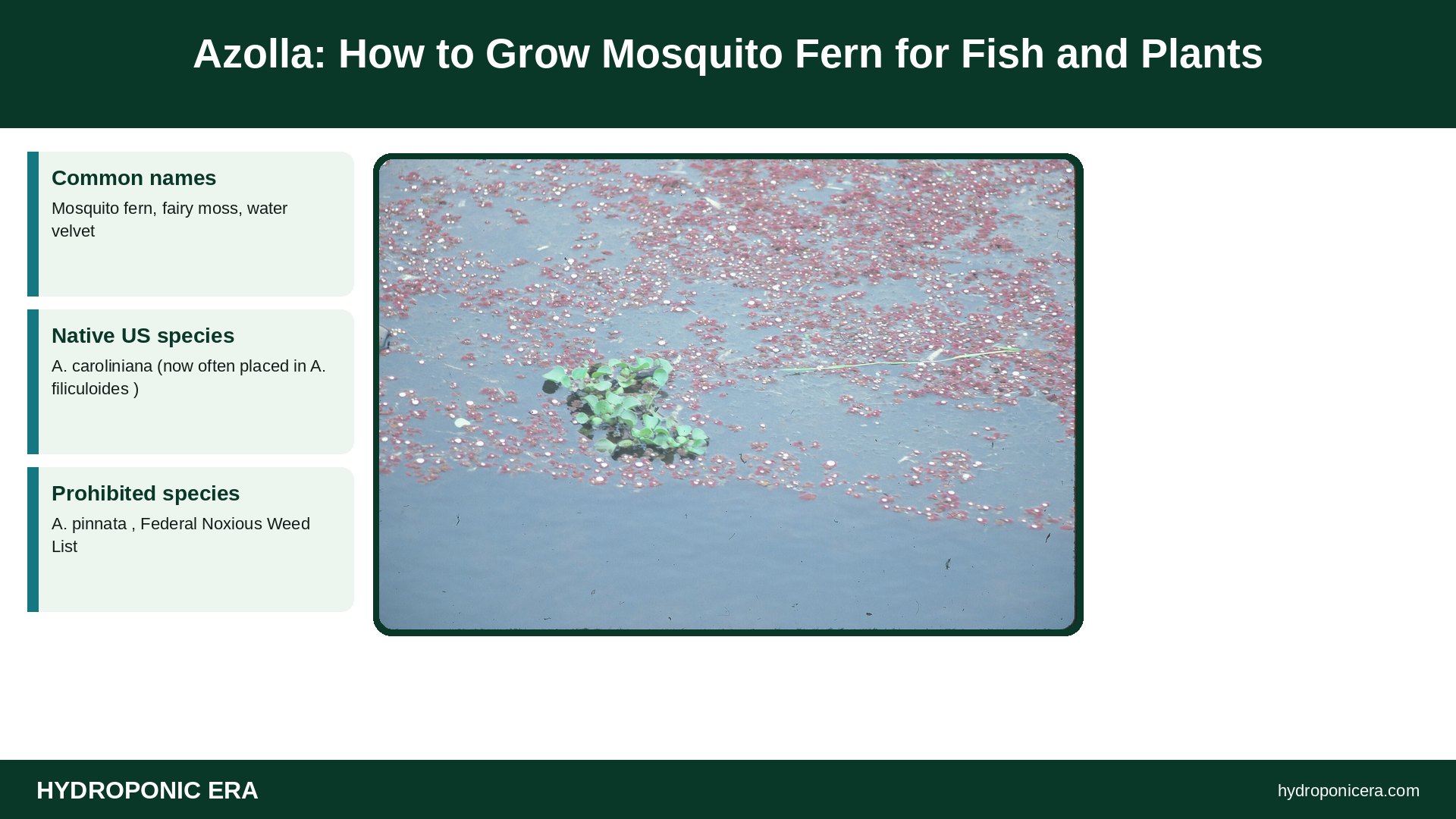
What Is Azolla?
It is a genus of tiny floating ferns. UF IFAS notes the genus has only six or seven species and includes the smallest ferns in the world. NC State Extension describes eastern mosquito fern as a native annual with lacy, overlapping leaves that float as a mat, roots trailing below, turning from green to rusty red in bright light.
Its leaflets house Anabaena azollae, a blue-green alga that fixes nitrogen from the air. That partnership is why gardeners value it as a nitrogen-rich green manure.
Which Azolla Species Is Legal to Grow?
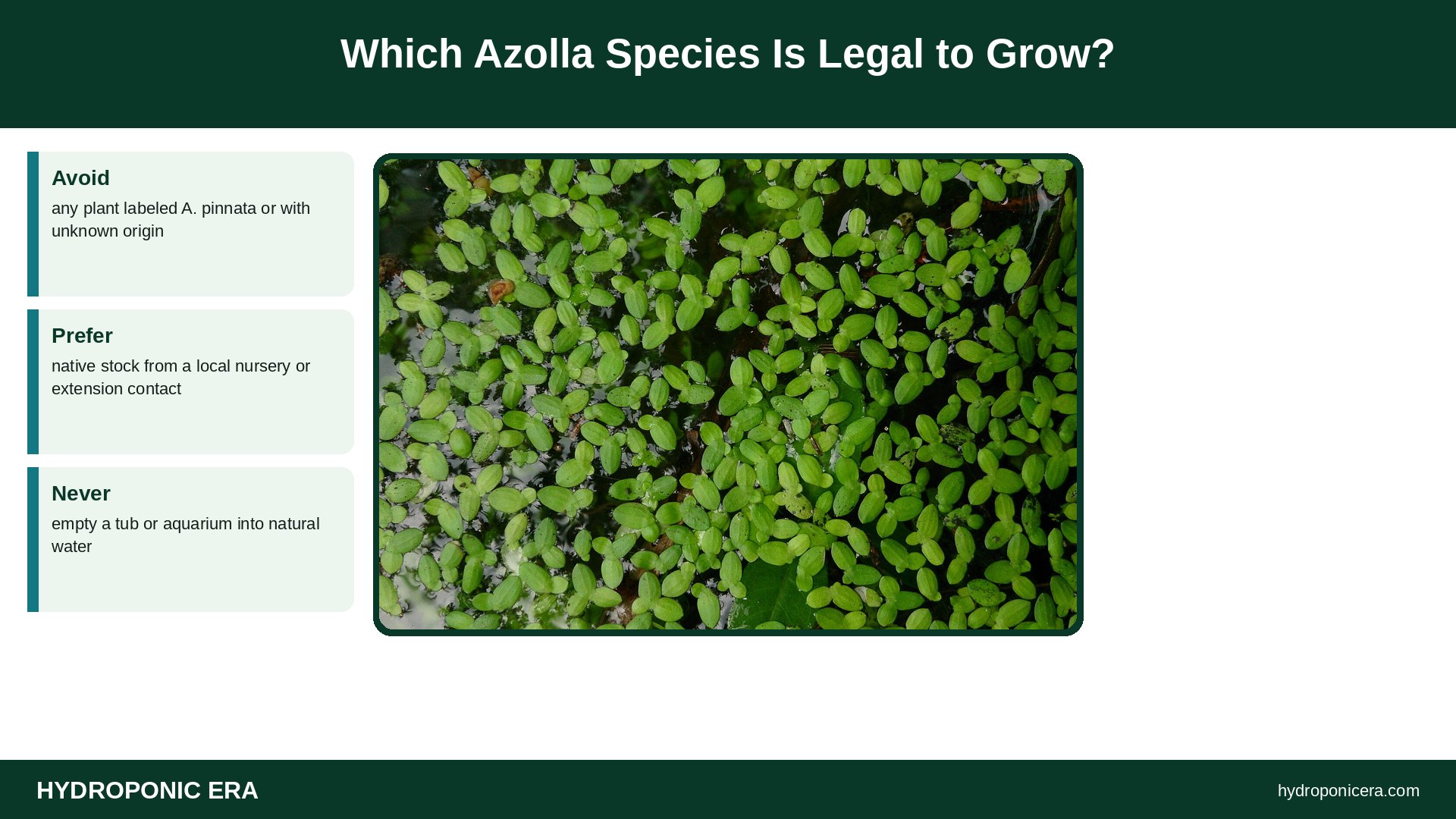
Grow only species native to your area. UF IFAS lists the feathered species, A. pinnata, as prohibited because it is on the Federal Noxious Weed List. It looks larger and more triangular, like a Christmas tree. The native eastern species is not federally listed, but buy from a reputable seller and check state rules.
- Avoid: any plant labeled A. pinnata or with unknown origin.
- Prefer: native stock from a local nursery or extension contact.
- Never: empty a tub or aquarium into natural water.
How Do You Grow Azolla in a Tub?
To grow azolla in a tub, fill a wide container with dechlorinated or rain water, set it in partial to full sun, and float a small handful of plants on the surface. Keep the water still. NC State notes you propagate it simply by moving a portion of the colony to a new spot.
- Choose a wide tub, at least 6 in (15 cm) deep.
- Fill with clean water; rainwater works well.
- Place in sun with some afternoon shade in hot areas.
- Add starter plants to part of the surface.
- Keep water still; avoid strong pumps or fountains.
- Top up as water evaporates.
- Skim weekly once it covers most of the surface.
See our guide to collecting rainwater for clean fill water.
Can You Feed It to Fish?
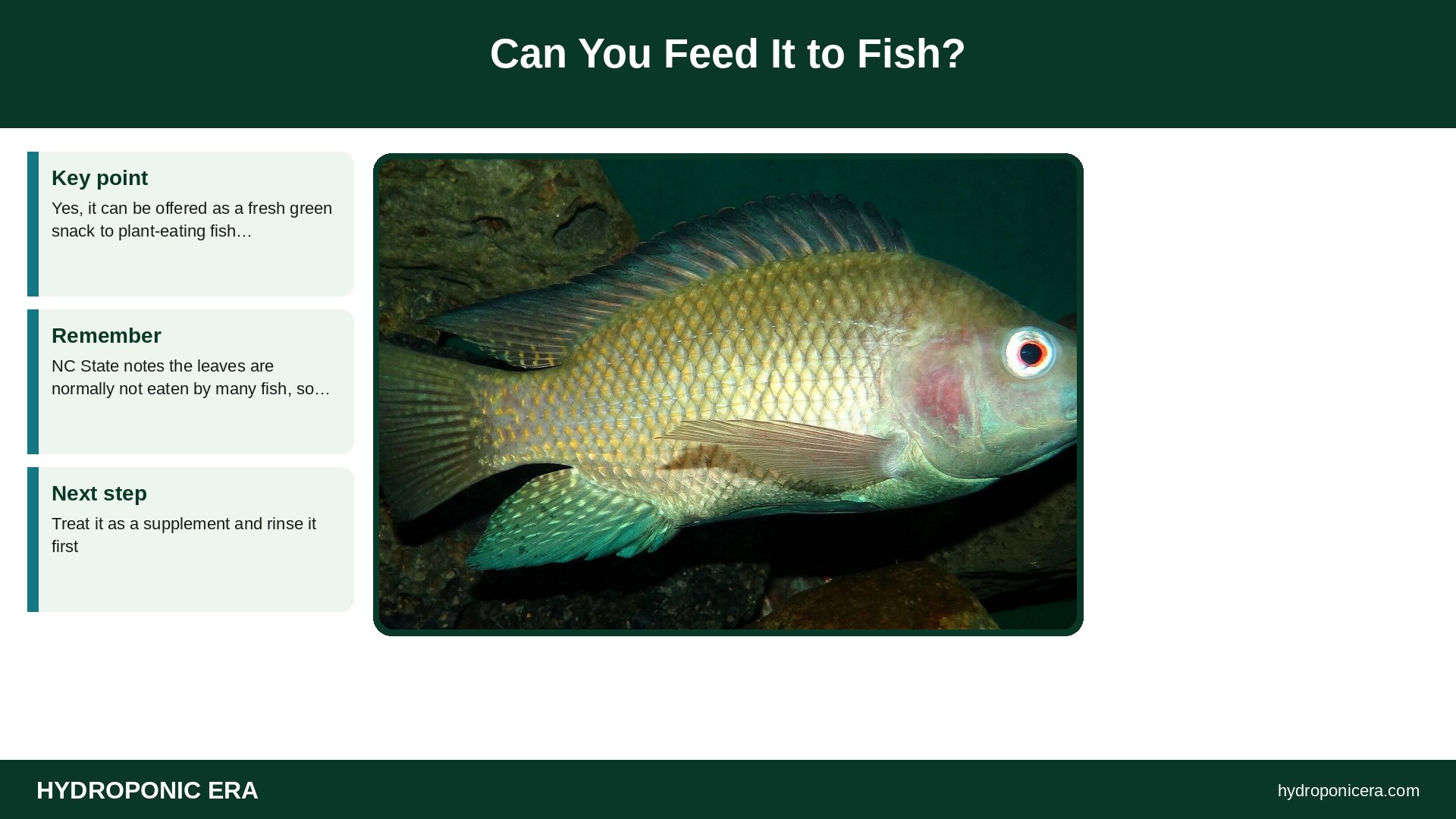
Yes, it can be offered as a fresh green snack to plant-eating fish such as tilapia, and some keepers grow it for poultry too. NC State notes the leaves are normally not eaten by many fish, so acceptance varies. Treat it as a supplement and rinse it first. Our fish farming for beginners guide covers balanced diets.
Because it grows on still water, raise it in a separate tub and add portions to the fish tank, rather than letting it cover the fish tank surface.
Can Azolla Grow in an Aquaponics System?
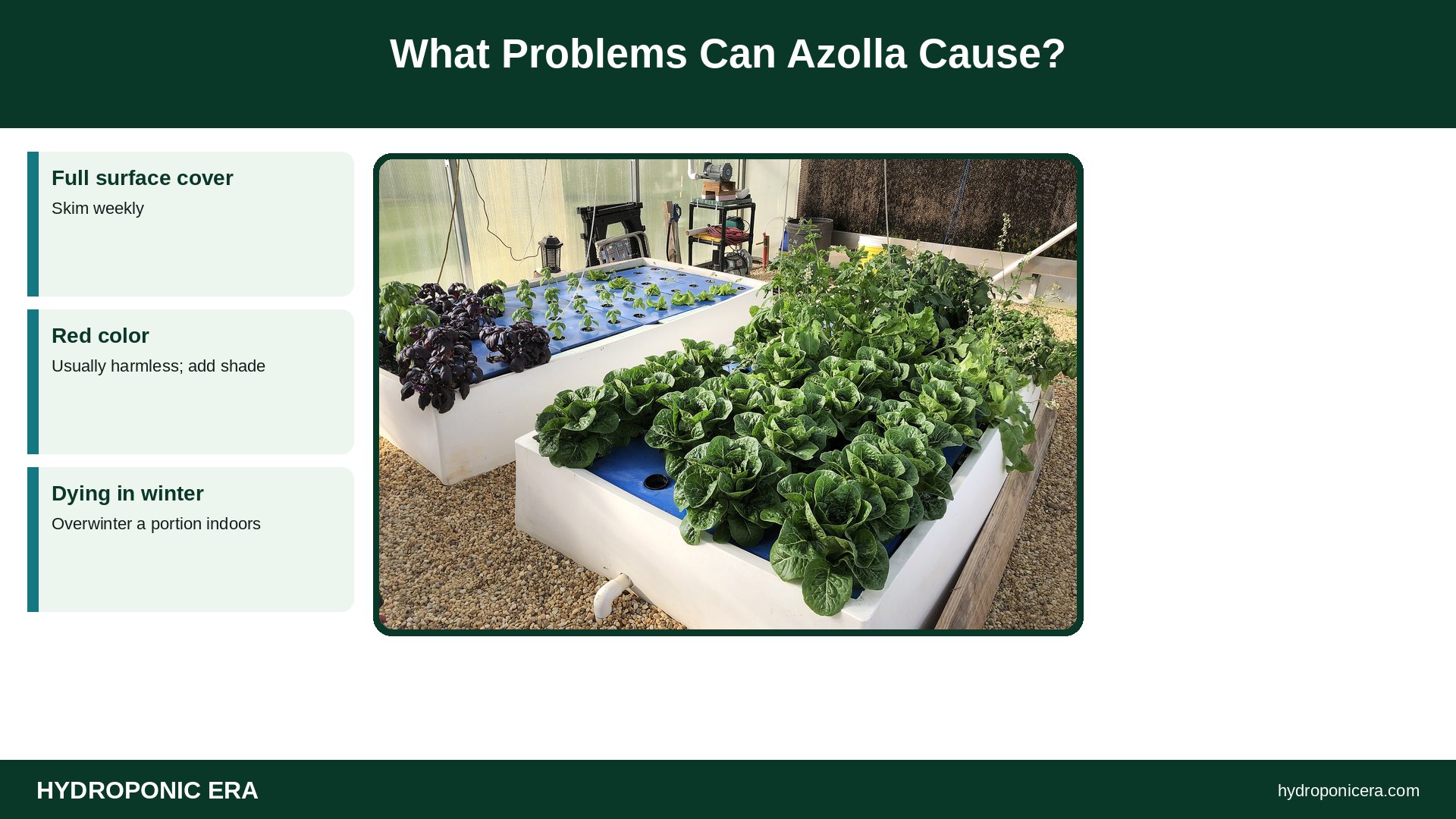
Yes, it can grow on a quiet sump, settling tank or separate tub fed with aquaponics water, where it takes up nutrients. Keep it off the main fish tank surface, where it can block oxygen exchange, and out of pumps and pipes. Our aquaponics for beginners guide explains system layout.
How Do You Use It as Fertilizer or Mulch?
Scoop extra plants, let them drain, and add them to compost or spread a thin layer as mulch around garden beds. Its nitrogen-fixing partner makes it a classic green manure in rice paddies in parts of Asia. Fresh plants break down quickly. Do not let wet mats pile up thickly against stems.
How Do You Harvest and Store It?
Harvest by skimming the surface with an aquarium net or kitchen strainer, taking about a third to half of the mat at a time so the rest keeps growing. Regular skimming keeps the colony young and stops it from crowding itself. Drain the plants for a few minutes before use.
- Fish snack: rinse and offer small portions fresh.
- Compost: mix with dry browns such as leaves or cardboard.
- Mulch: spread thinly so it dries instead of rotting.
- Backup culture: keep a small jar or tub indoors near a bright window.
Fresh material does not store well and turns slimy within days in a sealed bag. Harvest only what you can use soon, and keep a healthy starter culture so you can restart after a cold snap, heat wave or accidental die-off. Clean nets and buckets before moving them between containers.
What Problems Can Azolla Cause?
The main risk is overgrowth. UF IFAS warns the invasive species can form dense mats that block sunlight from submersed plants and reduce oxygen by covering the water surface. In a tub, that means skimming regularly and leaving open water. Insects and algae can also show up in warm, still water.
| Problem | Cause | Fix |
|---|---|---|
| Full surface cover | Fast growth | Skim weekly |
| Red color | Bright light or stress | Usually harmless; add shade |
| Dying in winter | Cold | Overwinter a portion indoors |
| Mosquitoes | Open still water | Keep the mat dense or add a cover |
For larvae in tubs, read our guide to mosquito larvae.
Azolla vs Duckweed: What Is the Difference?
Both are tiny floating plants that spread fast, but this one is a fern with lacy, scale-like leaves that often turn red, while duckweed is a flowering plant with small round fronds. NC State notes the two are often confused. Duckweed is often eaten more readily by fish. See our duckweed guide.
FAQ About Azolla
Does it really stop mosquitoes?
NC State says a dense mat can make egg laying harder.
Can it survive winter outdoors?
NC State suggests overwintering it indoors in cold areas.
Does it need fertilizer?
It fixes its own nitrogen but uses other nutrients in water.
Why is it turning red?
New leaves can fade to rusty red in bright conditions.
How fast does it spread?
Quickly; NC State calls it rapidly growing and spreading.
Sources
- North Carolina Extension Gardener Plant Toolbox — Plant Profile: A. caroliniana
- UF IFAS Center for Aquatic and Invasive Plants — Plant Directory: A. pinnata
- Electronic Code of Federal Regulations — 7 CFR 360.200, Designation of Noxious Weeds
- Photo credits (Wikimedia Commons, edited with titles): Azolla sp Cattle Creek Ingham Queensland 1985 IMG 0040 by John Robert McPherson (CC BY-SA 4.0); Common Duckweed (Lemna minor) by Mokkie (CC BY-SA 3.0); Oreochromis-niloticus-Nairobi by Bjørn Christian Tørrissen (CC BY-SA 3.0); Deepwater Aquaponics Floating Rafts Growing Lettuce, Basil and Arugula by Alabama Extension (CC0)