
Is rice water good for plants? Rice water for plants may add small amounts of nutrients, but its strength varies by batch. University of Maryland Extension has no local research on it and suggests a fertilizer with a known dose for houseplants and food crops. One 2022 soil study found fermented rice rinse water helped choy sum grow. Don’t add it to hydroponic reservoirs.
Key takeaway: Rice water for plants is a low-cost way to reuse kitchen water, not a reliable fertilizer. The best evidence comes from one study in soil, not potting mix or hydroponics. If you try it, use plain rinse water sparingly on ornamental plants and keep a real fertilizer as your main feed.
| Rice water for plants question | Short answer | Source |
|---|---|---|
| Does it contain nutrients? | Some, but amounts vary widely | UMD Extension |
| Is there a set dose? | No recommendation exists | UMD Extension |
| Does research show benefits? | One soil study: fermented rinse water boosted choy sum growth | Nabayi et al. 2022 |
| Downsides found? | More nitrogen leaching from soil | Nabayi et al. 2022 |
| Safe for hydroponics? | Not recommended; unknown dose, organic load | Our guidance |
| Other concern | Rice can carry heavy metals such as arsenic | UMD Extension |
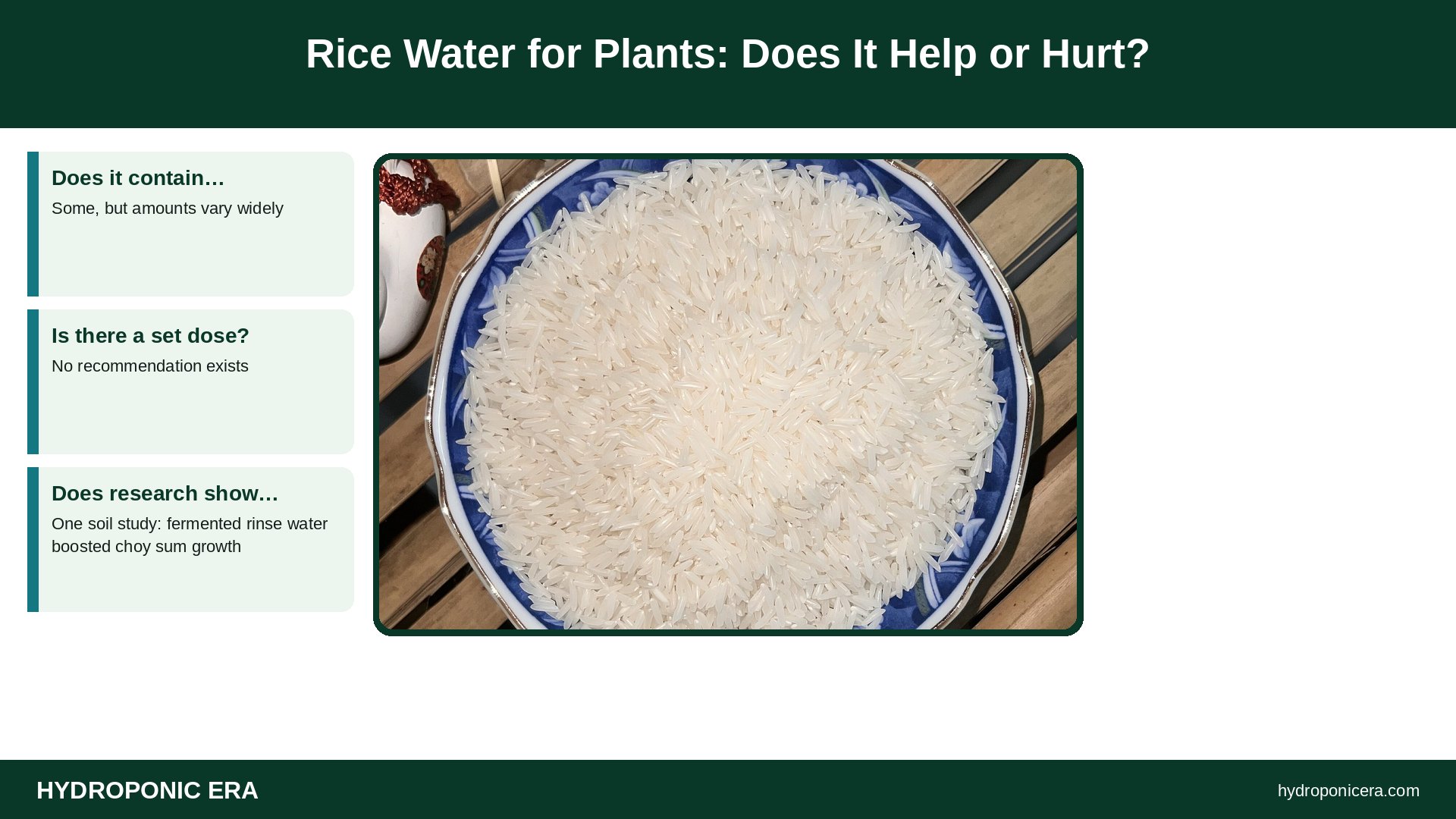
What Is Rice Water for Plants?
Rice water for plants is the cloudy water left after rinsing uncooked rice, or the water left after cooking it. Gardeners pour it on plants hoping the starch and dissolved nutrients act as a mild fertilizer. University of Maryland Extension notes that rice water can contain nutrients plants use, but the amounts depend on the rice variety, where it was grown and how it was prepared.
Does Rice Water for Plants Work as Fertilizer?
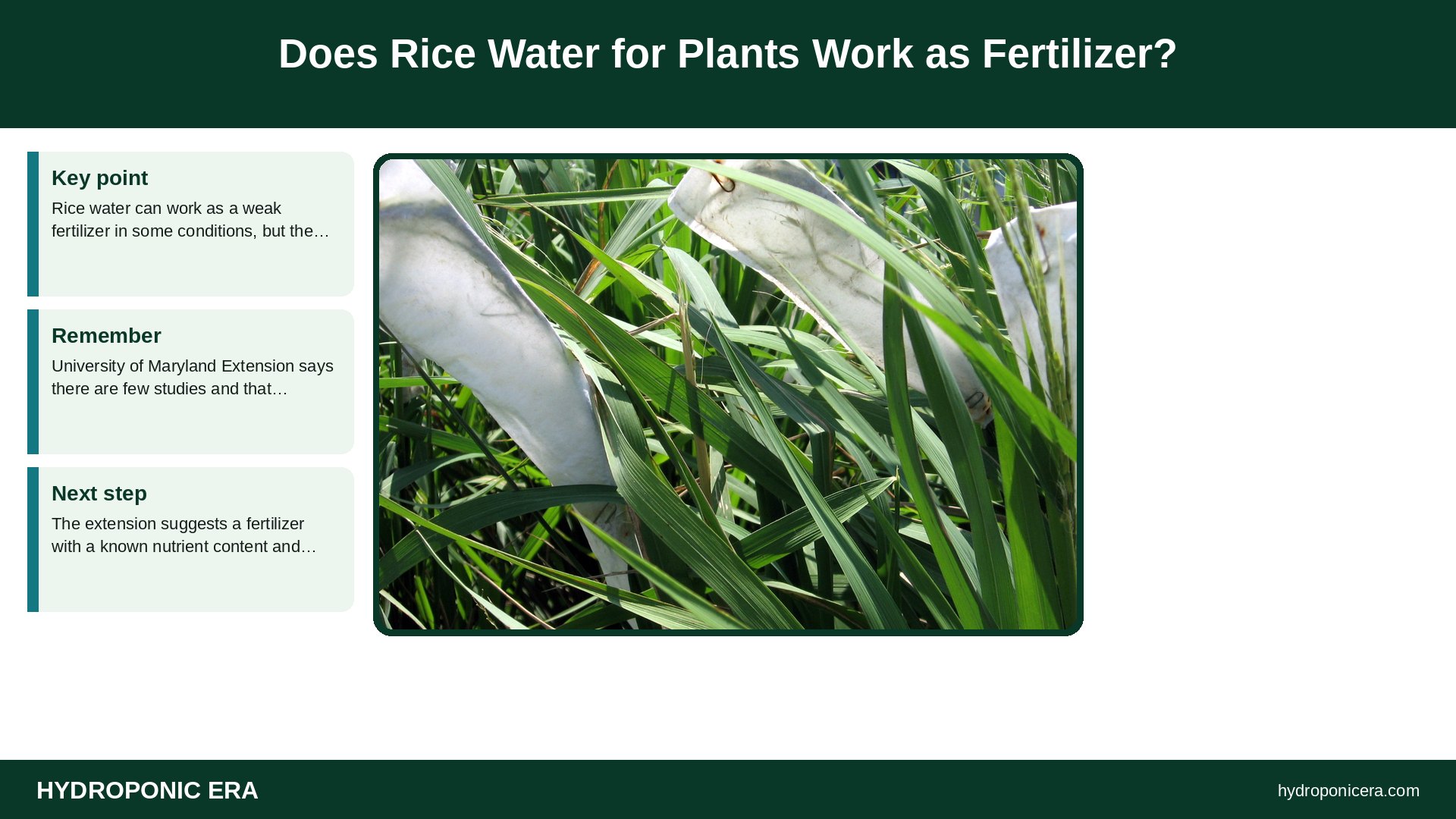
Rice water can work as a weak fertilizer in some conditions, but the evidence is thin. University of Maryland Extension says there are few studies and that it cannot give a specific recommendation because nutrient levels vary too much. The extension suggests a fertilizer with a known nutrient content and dosage for indoor plants and food crops.
If your plants look pale or slow, a real nutrient shortage is more likely than a missing kitchen hack. See our guide to nitrogen deficiency.
What Did Research Find About Rice Water for Plants?
A 2022 study in the journal Agronomy tested washed rice water on choy sum, a leafy Asian green, over three planting cycles in three soils. The researchers compared unfermented rinse water, rinse water fermented for three days, a standard NPK fertilizer and plain tap water.
| Finding | Result reported in the abstract |
|---|---|
| Growth | NPK and 3-day fermented rice water raised leaf weight and leaf area by 5–61% versus the other treatments |
| Plant nutrients | NPK and fermented water gave higher P, K, Ca, Mg and Cu by the third cycle |
| Leaching | Rice water raised ammonium leaching by 37–259% and nitrate leaching by 13–34% |
| Water productivity | NPK and fermented water were 21–42% higher |
The fermented water performed about as well as NPK in that trial, while unfermented water did not stand out.
How Was the Rice Water Study Set Up?
The 2022 trial grew choy sum (Brassica chinensis var. parachinensis) in sandy clay loam, clay and silt loam soils for three back-to-back planting cycles. Clay soil treated with fermented water, unfermented water or NPK held more ammonium, phosphorus, calcium, magnesium, zinc and boron, by 19–152%, than the other soils. Water use efficiency rose with each cycle, but it did not differ between treatments. The results show soil type mattered as much as the treatment.
Rice Water vs Fertilizer: Which Should You Use?
| Feature | Rice water | Labeled fertilizer |
|---|---|---|
| Nutrient content | Unknown, variable | Listed on the label |
| Dose | No recommendation | Clear directions |
| Cost | Free kitchen byproduct | Low per feeding |
| Hydroponic use | Not suitable | Hydroponic formulas available |
Does Rice Water for Plants Help Houseplants?
Rice water may not help houseplants the way it helped soil-grown greens. University of Maryland Extension points out that the 2022 study used real soil, not soilless potting mix. Potting mixes drain, hold nutrients and handle acidity differently, so the results may not carry over. For houseplants, treat rice water as an occasional extra at most.
How Do You Use Rice Water for Plants Safely?
- Use plain rinse water, with no salt, oil or seasoning.
- Let cooking water cool to room temperature before use.
- Start with ornamental plants, which UMD Extension says may be the safer outdoor use.
- Use it in place of a normal watering, not on top of one.
- Use it only now and then, and keep your regular fertilizer schedule.
- Do not let it sit for days unless you are prepared for sour smells.
- Watch for gnats, mold or odor on the soil surface and stop if they appear.
Should You Ferment Rice Water for Plants?
Fermented rice water did better than fresh rinse water in the 2022 study, which linked its effect to nutrients and bacteria. Still, home fermentation is not controlled, and the study does not give a household recipe or dose. If you skip fermenting, you lose little, since a measured fertilizer gives predictable results without the smell.
Can You Use Rice Water in Hydroponics?
No, keep rice water for plants out of hydroponic and aquaponic systems. Its nutrient content is unknown, so it can throw off EC and pH readings. Starch and other organic matter can also feed microbes in a warm reservoir, which may lead to slime, cloudy water and root problems. Use a complete hydroponic nutrient mixed to a measured strength instead.
Learn more in our guides to mixing nutrient solution, biofilm in reservoirs and cloudy nutrient solution. For organic feeding, see organic bioponic nutrients.
What Are the Risks of Rice Water for Plants?
- Unknown dose: UMD Extension says nutrient levels vary greatly.
- Nitrogen loss: the 2022 study found more nitrogen leaching from soil.
- Heavy metals: UMD notes rice readily takes up metals such as arsenic from contaminated soils.
- Pests and odor: starchy, wet soil can attract gnats; see fungus gnats.
FAQs
Is cooked rice water better than rinse water?
No study here compared them; the 2022 trial used rinse water.
Can rice water replace fertilizer?
No. UMD Extension recommends a product with a known dose.
Is rice water safe for vegetables?
UMD Extension suggests a labeled fertilizer for food plants instead.
Will rice water kill my plant?
Occasional plain rinse water is unlikely to, but soured water may cause odors and pests.
Can I add rice water to my hydroponic reservoir?
No. Use a measured hydroponic nutrient.
Is fermented rice water different from fresh rinse water?
Yes. In the 2022 study, rinse water fermented for three days produced better growth than fresh rinse water, which the authors linked to its nutrients and bacteria.
Should I use rice water on seedlings or microgreens?
No. Young, tender crops grown in trays or water do best with clean water and a measured, gentle nutrient feed.
Sources
- University of Maryland Extension via Ask Extension — How to make rice water fertilizer?
- Nabayi A., Teh C.B.S., Tan A.K.Z., Tan N.P. (2022) — Consecutive Application Effects of Washed Rice Water on Plant Growth… Agronomy 12(9):2220
- Photo credits (Wikimedia Commons, edited with titles): Uncooked ST25 rice on bamboo surface by VinhNguyen.1257 (CC BY-SA 4.0); Bagged rice panicles by Desmanthus4food (CC BY-SA 3.0 us); Peace lily – 2 by W.carter (CC BY-SA 4.0); Epipremnum aureum 31082012 by Joydeep (CC BY-SA 3.0); Rice seedlings ready for planting (34341655963) by Martin Lopatka (CC BY-SA 2.0)