
Does baking soda work on plants? Only a little. Baking soda for plants (sodium bicarbonate) can slow powdery mildew, but research reviewed by Washington State University found it rarely works alone and can burn leaves at just 1%. Purdue Extension says it is ineffective against most diseases without oil and leaves sodium behind. Potassium bicarbonate products or sulfur are better choices.
Key takeaway: Baking soda for plants is mostly a garden myth. It stops fungal spores from sprouting rather than killing fungi, washes off easily and adds sodium. If you want a bicarbonate spray, extension experts point to labeled potassium bicarbonate products, ideally with horticultural oil, applied before mildew spreads.
| Baking soda for plants claim | What research says | Source |
|---|---|---|
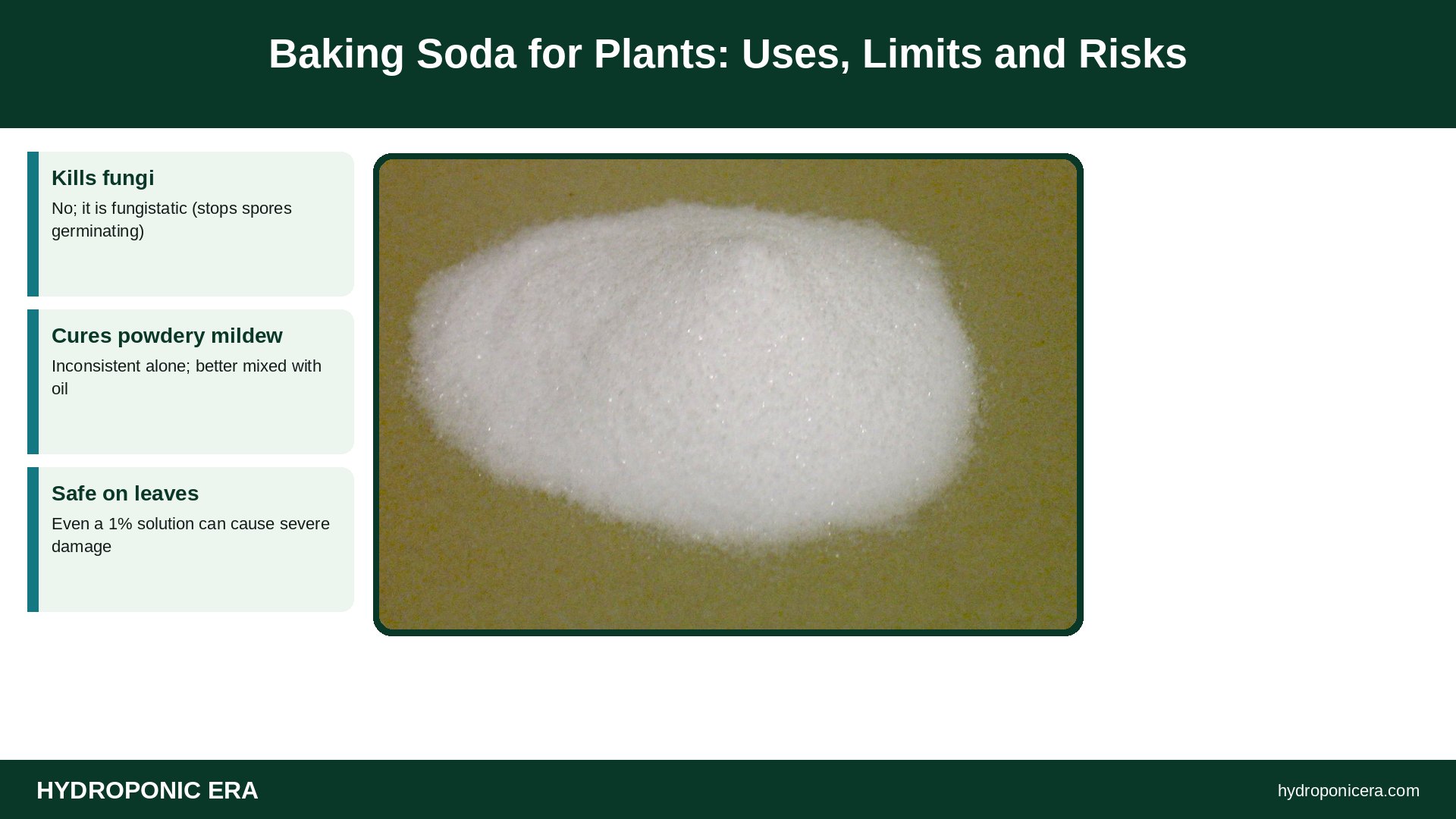
| Kills fungi | No; it is fungistatic (stops spores germinating) | WSU |
| Cures powdery mildew | Inconsistent alone; better mixed with oil | WSU, Purdue |
| Safe on leaves | Even a 1% solution can cause severe damage | WSU |
| Works on cucumbers and squash | Bicarbonate sprays not very effective | UMD Extension |
| Feeds plants | No; leaves toxic sodium | Purdue |
| Better option | Potassium bicarbonate plus oil, or sulfur | Purdue, MOFGA, UMD |
How Does Baking Soda Affect Fungi on Plants?
Baking soda raises the pH on the leaf surface, which stops many fungal spores from germinating, but it does not kill the fungus. Washington State University Extension horticulturist Linda Chalker-Scott explains that sodium bicarbonate is fungistatic, not fungicidal. Once the leaf surface turns acidic again, spores can resume growing.
Because it dissolves in water, WSU notes any effect washes away with the next rain or overhead watering.
Does Baking Soda for Plants Control Powdery Mildew?
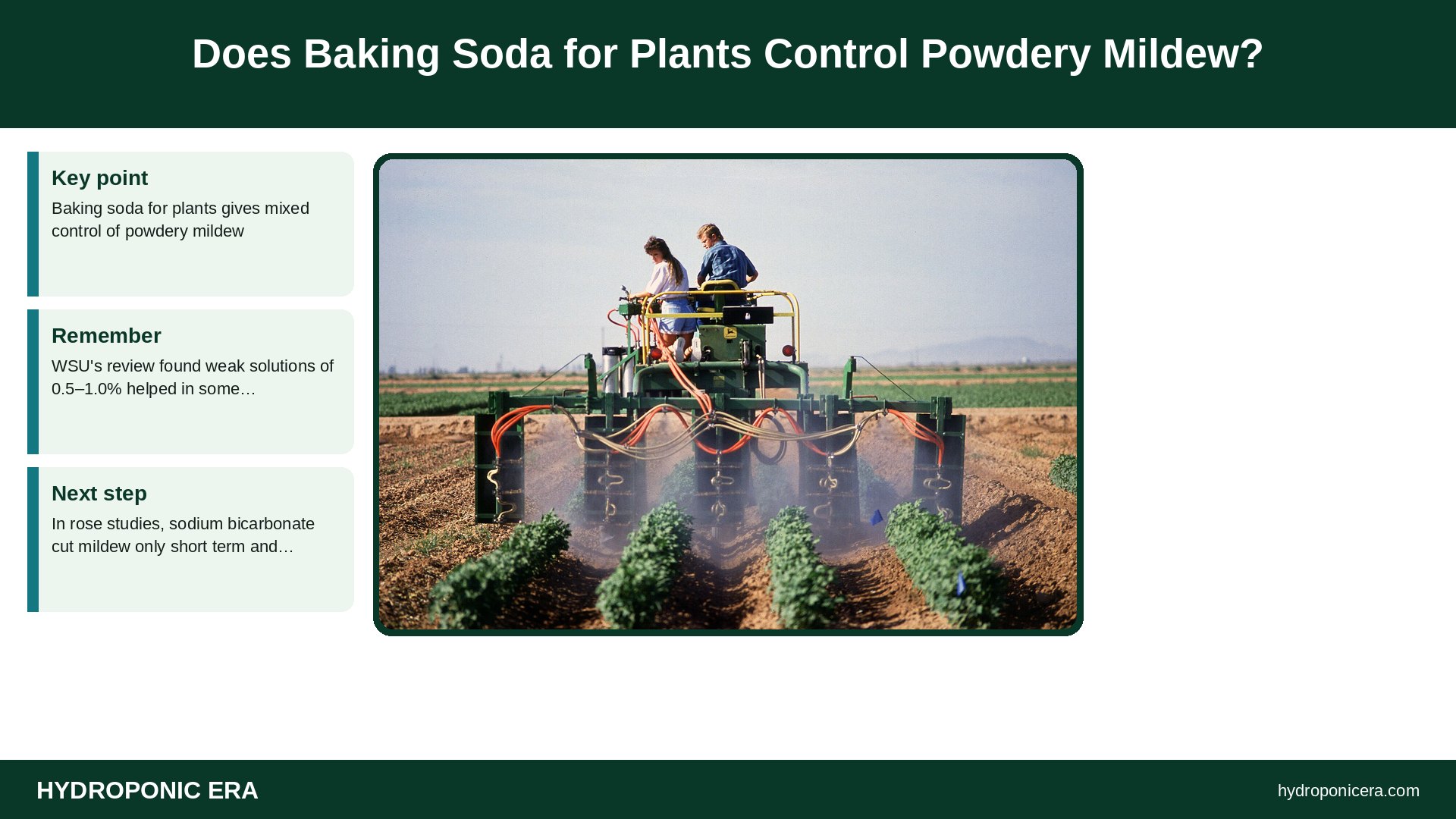
Baking soda for plants gives mixed control of powdery mildew. WSU’s review found weak solutions of 0.5–1.0% helped in some greenhouse work, but field results ranged from good to poor. In rose studies, sodium bicarbonate cut mildew only short term and worked less well than potassium bicarbonate, potassium phosphate or other treatments. Mixed with horticultural oil, it performed better.
University of Maryland Extension adds that bicarbonate fungicides, sodium or potassium, are not very effective on powdery mildew in cucumber-family crops and does not recommend homemade milk and baking soda sprays.
Learn to identify the disease in our guide to powdery mildew in hydroponics.
Why Do Gardeners Still Use Baking Soda for Plants?
Gardeners use baking soda for plants because it is cheap, already in the kitchen and sometimes seems to help. MOFGA notes that home gardeners often report success with milk or baking soda sprays, and that the bicarbonate part of baking soda plays the same protective role as commercial potassium bicarbonate. The catch is the sodium half, plus the fact that no EPA-registered fungicide contains baking soda, so there is no tested label rate.
What Baking Soda Strengths Did Researchers Test?
Studies reviewed by WSU mostly used 0.5–2% sodium bicarbonate, and the safe margin was narrow. The table converts those percentages so you can see how small the amounts are.
| Strength | About per gallon (3.8 L) | WSU findings |
|---|---|---|
| 0.5% | 0.7 oz (19 g) | Reduced mildew in lab; used in greenhouses |
| 1% | 1.3 oz (38 g) | Can cause severe leaf damage |
| 2% | 2.7 oz (76 g) | Damage and residue even on harvested fruit |
These figures describe research, not a home recipe. Extension sources do not recommend making your own spray.
Can Baking Soda for Plants Cause Leaf Burn?
Yes, baking soda can hurt plants. WSU reports that even a 1% sodium bicarbonate solution can cause severe leaf damage, including yellowing between the veins, and that damage rises with concentration, likely because of the sodium. Purdue Extension notes baking soda leaves behind toxic sodium, while potassium and ammonium bicarbonates supply nutrients plants use.
| Bicarbonate | Leaves behind | Extension view |
|---|---|---|
| Sodium (baking soda) | Sodium | Ineffective alone; risk of burn |
| Potassium bicarbonate | Potassium | Recommended over baking soda |
| Ammonium bicarbonate | Nitrogen | Recommended over baking soda |
What Works Better Than Baking Soda for Plants?
Labeled potassium bicarbonate products, sulfur and horticultural oils work better. MOFGA reports that a potassium bicarbonate product combined with horticultural oil worked better than either alone, and that sulfur has outperformed most other organic options for powdery mildew. UMD Extension calls elemental sulfur perhaps the most effective organic choice and warns not to spray sulfur or oil in hot weather.
- Potassium bicarbonate: same protective action without the sodium.
- Sulfur: strong protectant; avoid hot weather and oil sprays close together.
- Horticultural oil: boosts bicarbonates; Purdue lists plants sensitive to oil.
- Resistant varieties: MOFGA notes many cucumbers and melons have bred resistance.
Which Plants Are Sensitive to Oil in Bicarbonate Sprays?
Because bicarbonates work best with oil, check the plant first. Purdue Extension lists black walnut, some maples (especially Japanese and red maple), hickories and smoke tree as oil-sensitive, along with junipers, cedars, spruces and Douglas-fir. On needled plants, damage can range from stripped needles to browning; broadleaf plants may yellow and develop dark spots.
How Do You Prevent Mildew Without Baking Soda?
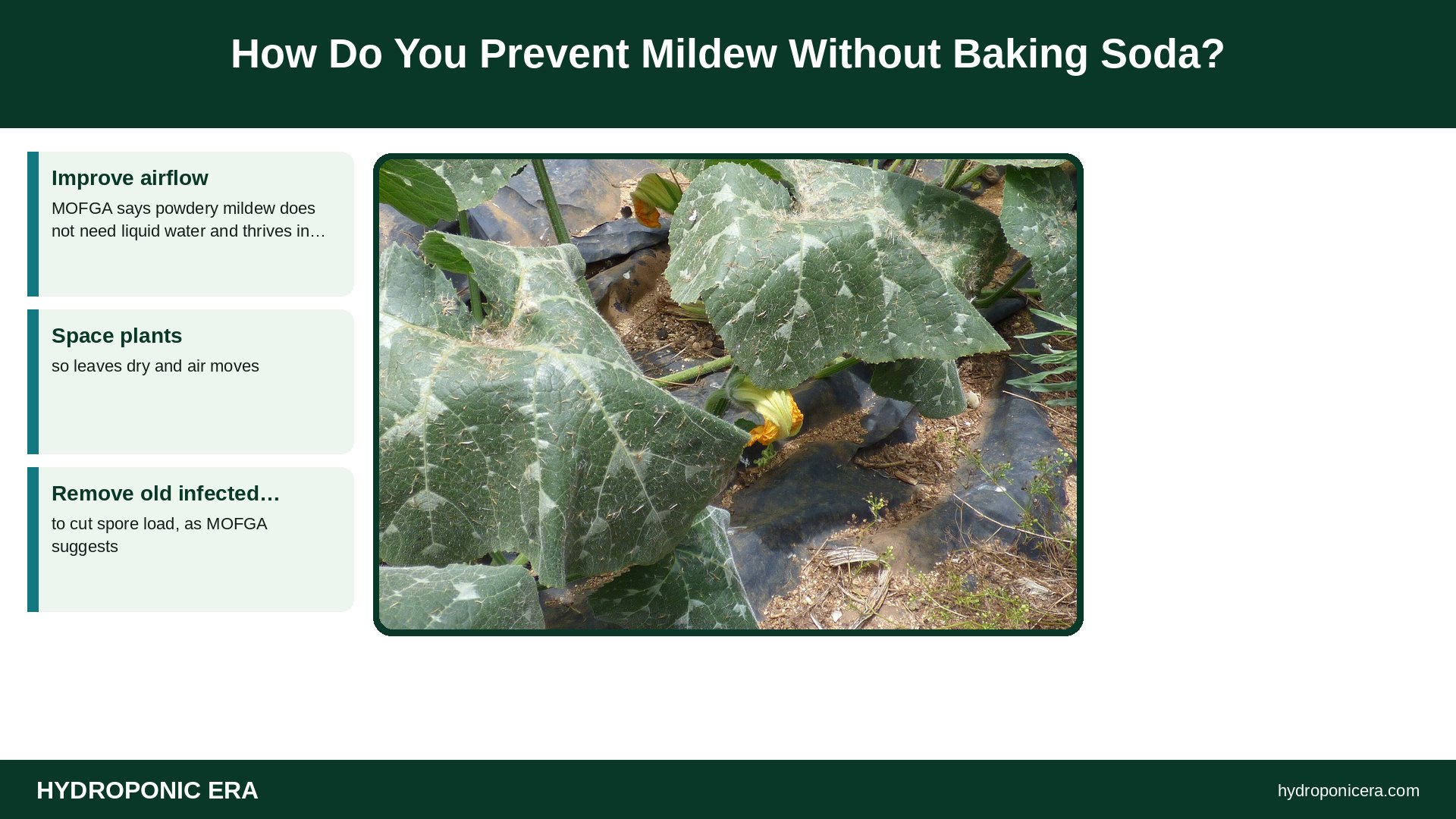
- Improve airflow. MOFGA says powdery mildew does not need liquid water and thrives in humid air.
- Space plants so leaves dry and air moves.
- Remove old infected leaves to cut spore load, as MOFGA suggests.
- Choose resistant varieties when you can.
- Spray protectants early. MOFGA says these work best before infection.
- Cover both leaf surfaces, since WSU notes lower leaves are hard to treat.
- Test any spray on a few leaves first and wait several days.
Can You Use Baking Soda for Plants in Hydroponics?
Do not add baking soda to a hydroponic reservoir. It raises pH and adds sodium, which builds up in recirculating systems and cannot be removed except by changing water. Leaf sprays can also drip residue into the system. Use a labeled potassium bicarbonate product sparingly on leaves, and protect the reservoir.
See our guides to sodium buildup in recirculating hydroponics and white leaf residue vs powdery mildew.
Does Baking Soda for Plants Help Other Diseases?
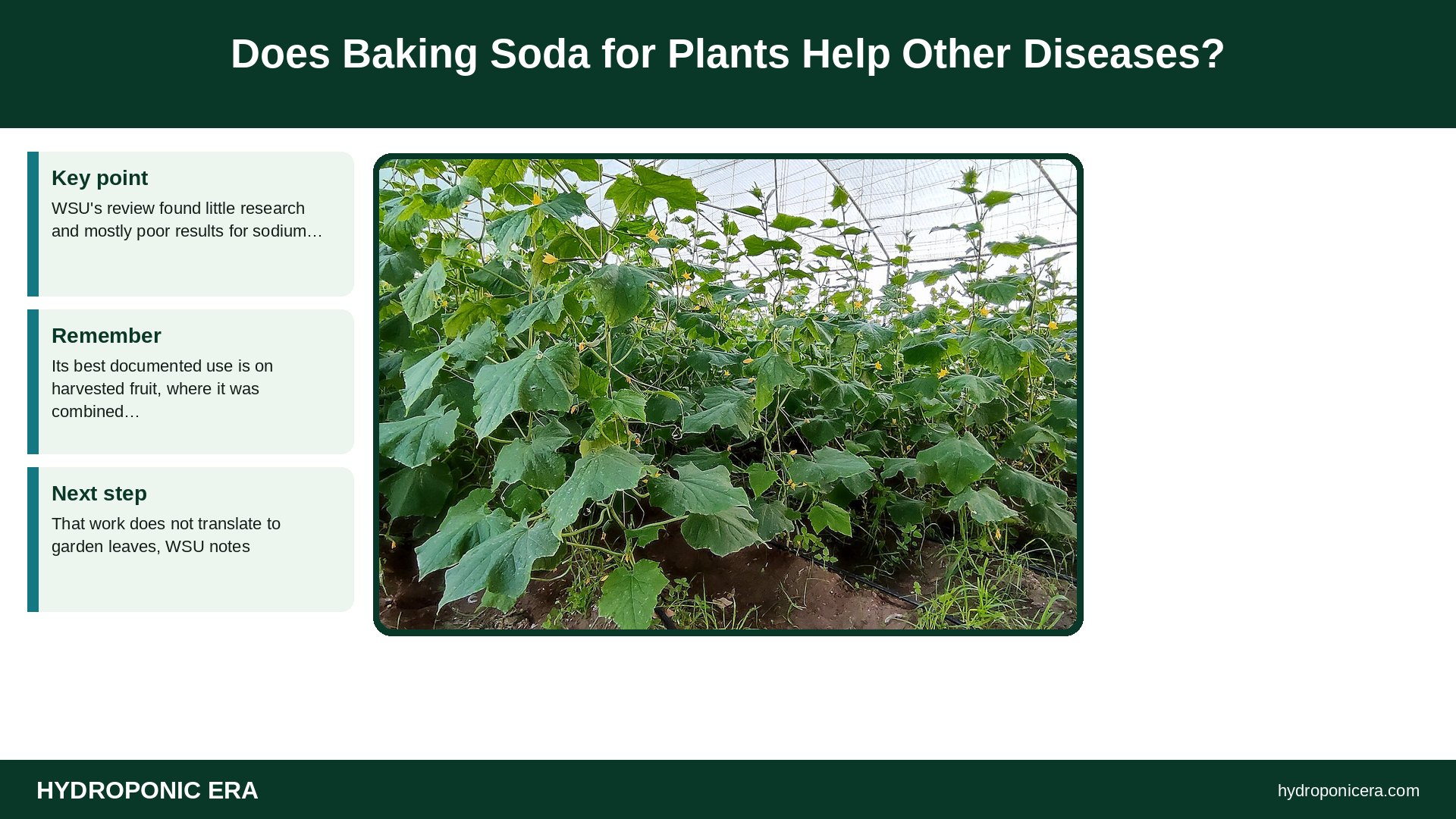
Rarely. WSU’s review found little research and mostly poor results for sodium bicarbonate on leaf diseases other than powdery mildew. Its best documented use is on harvested fruit, where it was combined with waxes, fungicides or beneficial yeasts to slow storage rots. That work does not translate to garden leaves, WSU notes.
For downy mildew, which is a different disease, see downy mildew on hydroponic greens.
FAQs
Is baking soda for plants safe on edible crops?
It is low-toxicity, but it can burn leaves and is not an EPA-registered fungicide, MOFGA notes.
Does baking soda make soil less acidic?
It raises pH but adds sodium, so it is a poor soil amendment.
Can I mix baking soda with milk?
UMD Extension does not recommend that homemade mix.
Is potassium bicarbonate the same?
It works similarly but supplies potassium instead of sodium.
Why did my leaves turn yellow after spraying?
Likely sodium burn. Rinse leaves and stop spraying.
Sources
- Washington State University Extension (L. Chalker-Scott) — Baking Soda: Miracle, Myth… or Marketing
- Purdue Extension — Using Organic Fungicides (BP-69-W)
- University of Maryland Extension via Ask Extension — Milk, water, baking soda mixture for powdery mildew
- MOFGA — Powdery Mildew of Cucurbits
- Photo credits (Wikimedia Commons, edited with titles): Sodium bicarbonate by Thavox (Public domain); K4817-4 (8497812386) by USDAgov (Public domain); Starr-170614-0954-Cucurbita maxima-flowers leaves-Community Garden Sand Island-Midway Atoll (36311291576) by Forest and Kim Starr (CC BY 3.0 us); Cucumber greenhouse plants of Dr. Mahmoud Salem’s farm by Amnsalem (CC BY-SA 4.0); Cucumber in the greenhouse 3 by Pascal Kings (CC BY 4.0)