
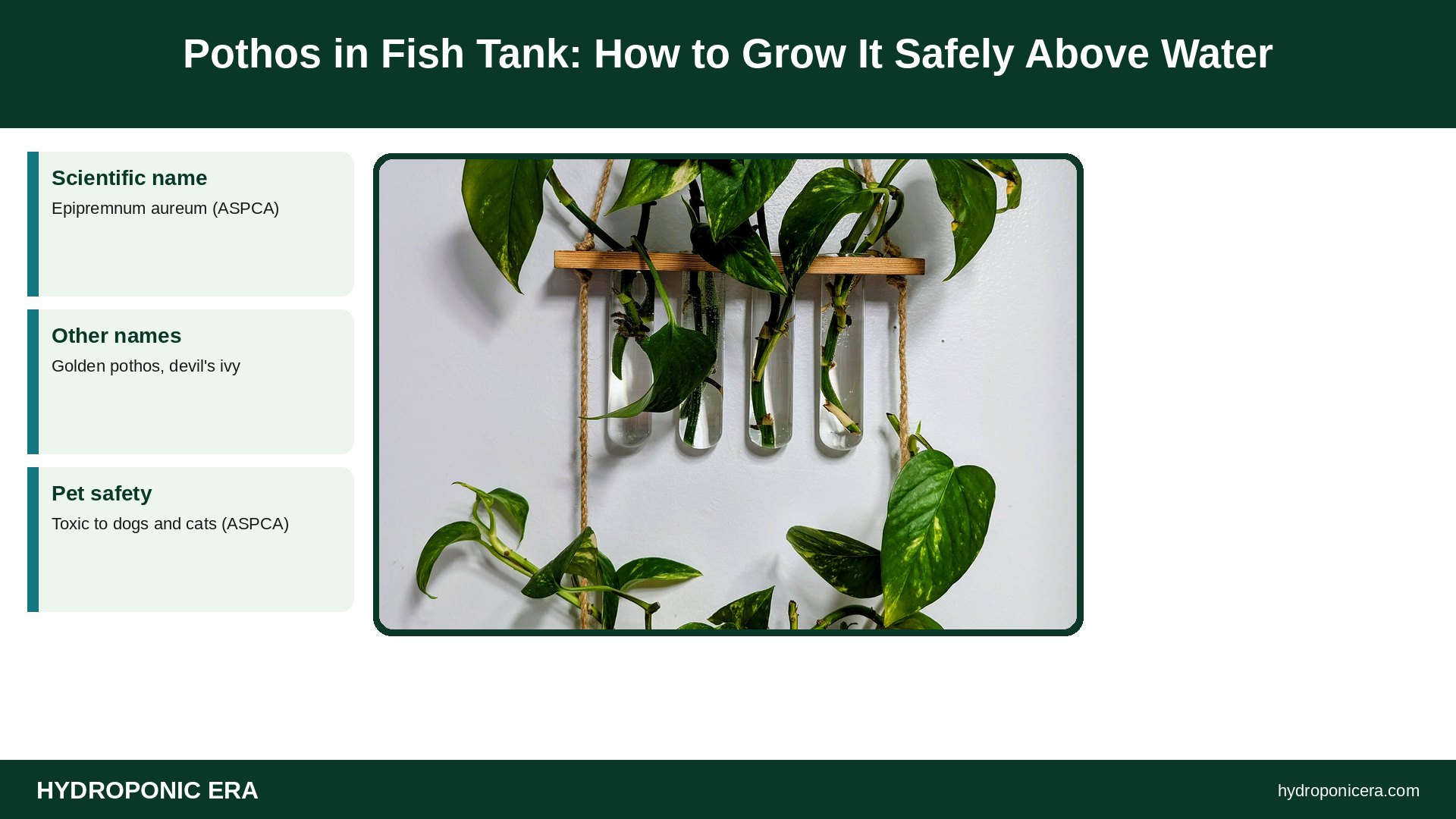
Can you grow pothos in fish tank water? Yes. Pothos in fish tank water thrives when only the roots hang below the surface and the leaves stay above it. The roots take up nitrate from fish waste, and the vine trails out of the tank. Use clean, pesticide-free cuttings, and keep the plant away from cats and dogs.
Key takeaway: For pothos in fish tank setups, it is roots in, leaves out. Submerged leaves rot, and ASPCA lists pothos as toxic to dogs and cats because of insoluble calcium oxalates.
| Fact | Detail |
|---|---|
| Scientific name | Epipremnum aureum (ASPCA) |
| Other names | Golden pothos, devil’s ivy |
| Pet safety | Toxic to dogs and cats (ASPCA) |
| What goes in water | Roots and a short stem section only |
| Light | Bright, indirect room light |
| Main benefit | Takes up nitrate between water changes |
Is Pothos in Fish Tank Water Safe for Fish?
Pothos in fish tank water is widely used by aquarium keepers with only the roots in the water, and it is generally considered safe for fish when kept that way. Problems come from rotting leaves, pesticide residue on store plants, or crushed stems releasing sap. Rinse cuttings well, and remove any leaves that slip under the water.
Do not let fish chew on leaves. Use our aquarium water caution guide to judge risk before sharing water with plants.
How Do You Set Up Pothos in Fish Tank Filters or Rims?
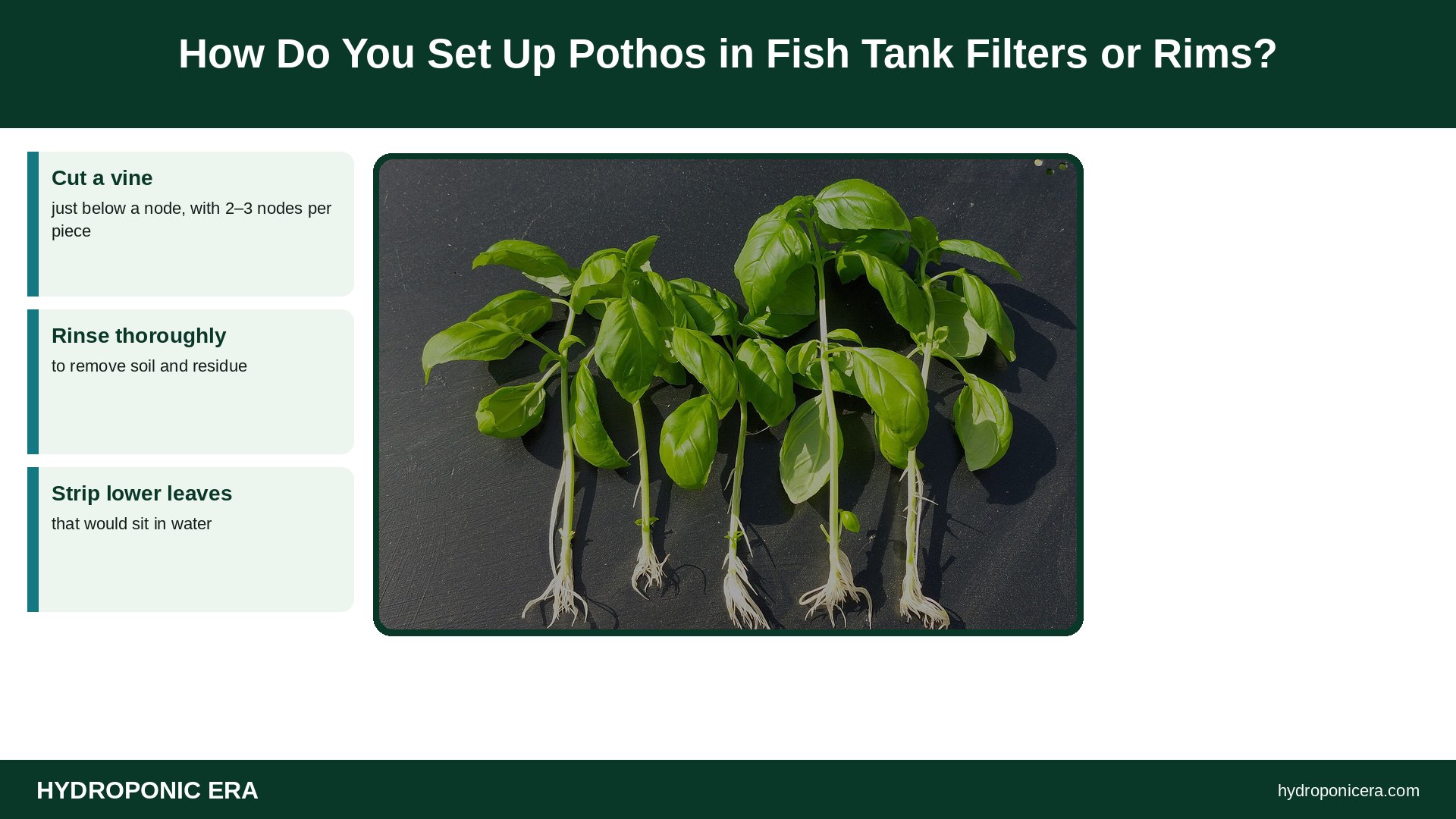
To set up pothos in fish tank filters or rim planters, take a healthy cutting with two or three nodes, rinse it, strip the lowest leaves, and fix the stem so the nodes sit in the water while the leaves stay above. Hang-on-back filters, suction-cup planters or a gap in the lid all work. Roots form from the nodes.
- Cut a vine just below a node, with 2–3 nodes per piece.
- Rinse thoroughly to remove soil and residue.
- Strip lower leaves that would sit in water.
- Mount it in a planter cup, filter box or lid gap.
- Submerge only nodes and roots.
- Give indirect light from a window or room lamp.
- Trim vines to keep them from blocking the light.
Where Should You Place the Cutting?
Placing the cutting in a hang-on-back filter is a favorite spot because flowing water passes the roots and the planter holds the stem steady. A clip-on cup at the tank rim also works. Keep the leaves away from hot lights and avoid blocking the tank light too much, or submerged plants may suffer.
- Filter box: steady flow and a firm hold.
- Rim planter: easy to adjust and move.
- Lid gap: simple, but check the stem stays dry.
Does Pothos in Fish Tank Water Reduce Nitrate?
Like other plants, it takes up nitrogen as it grows, so a vigorous vine can absorb some nitrate between water changes. The effect depends on how much it grows, how many fish you keep and how much you feed. Treat it as a helper, not a replacement for water changes, and test water regularly.
See our guide to water tests and our main guide to pothos in water.
How Do You Keep Pothos in Fish Tank Setups Healthy?
Keep the plant healthy with bright, indirect light, a stable water level and regular trimming. Yellow leaves often mean too little light or old growth; brown, mushy stems mean rot. Cut off damaged parts promptly. Fish waste usually provides enough nutrients, so do not add houseplant fertilizer to the tank.
| Symptom | Likely cause | Fix |
|---|---|---|
| Yellow leaves | Low light or age | Brighter indirect light; trim |
| Mushy stem | Stem or leaves underwater | Raise the cutting; cut rot |
| Slow growth | Low light or few fish | Move to brighter spot |
| Long bare vines | Reaching for light | Trim and re-root tips |
How Much Light Does It Need Over a Tank?
Bright, indirect light suits it best. A spot near a window that gets filtered daylight, or a room with steady artificial light, usually works. Direct afternoon sun on the tank can overheat the water and feed algae, so avoid placing the aquarium in a hot window just to help the vine.
- Too little light: long gaps between leaves and pale color.
- Good light: compact growth and steady new leaves.
- Too much sun: warm water and more algae.
Read our guide to algae control if green growth appears on the glass.
How Many Cuttings Should You Use?
Start with one or two cuttings in a small tank and add more only if growth stays healthy and the fish do well. More roots take up more nutrients, but a dense root mass can trap debris and slow flow in a filter box. Rinse or trim roots during filter maintenance so water keeps moving freely.
In planted aquariums, too many vines can compete with submerged plants for nutrients. Watch for pale submerged plants and balance the number of cuttings with your stocking level.
Can You Use Pothos in an Aquaponics System?
Yes, as an ornamental. Vines grow well in media beds or small rafts fed by fish water, and they help use nutrients. It is not edible, so keep it away from food crops you might confuse it with. Our aquaponics for beginners guide covers grow beds.
What Pothos in Fish Tank Mistakes Should You Avoid?
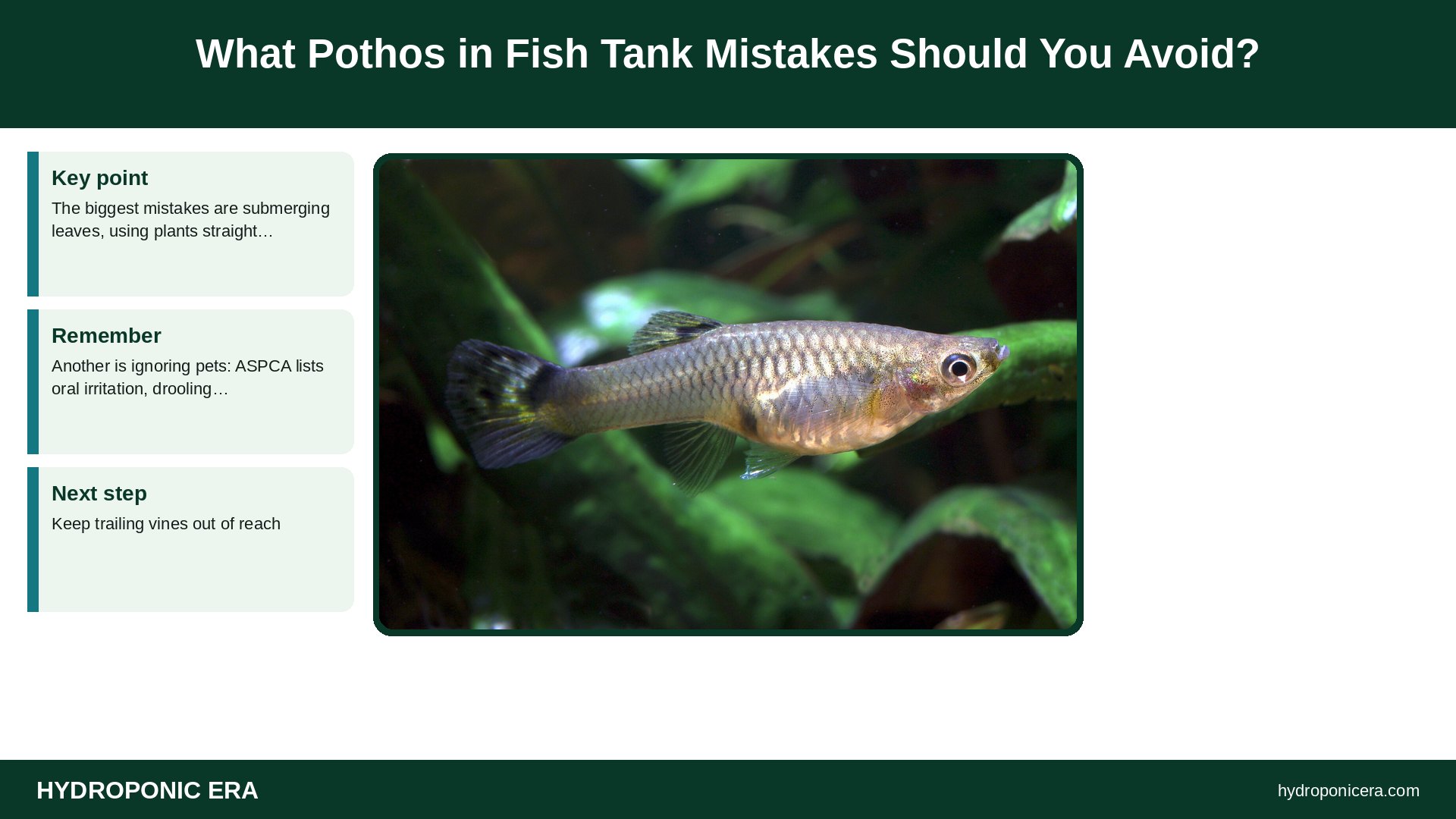
The biggest mistakes are submerging leaves, using plants straight from soil without rinsing, adding houseplant fertilizer, and letting vines block the tank light. Another is ignoring pets: ASPCA lists oral irritation, drooling, vomiting and trouble swallowing as signs in pets that chew it. Keep trailing vines out of reach.
What Other Houseplants Grow Well Over a Tank?
Besides pothos in fish tank filters, several houseplants root well over tanks, including spider plant, peace lily and lucky bamboo, each with its own pet-safety profile. Spider plant is listed by ASPCA as non-toxic to dogs and cats. See our spider plant in water and peace lily in water guides.
FAQ About Pothos in Fish Tank Setups
Can the whole plant go underwater?
No; submerged leaves rot.
Will it harm my betta?
Roots-only use is common in betta tanks.
How fast do roots grow?
Often within a few weeks from the nodes.
Does it need fertilizer?
No; fish waste usually feeds it.
Is it safe for cats?
No; ASPCA lists it as toxic to cats and dogs.
Sources
- ASPCA Animal Poison Control — Golden Pothos
- ASPCA Animal Poison Control — Spider Plant
- Photo credits (Wikimedia Commons, edited with titles): Pothos plant on water by Joli Rumi (CC BY-SA 4.0); Basilikum (Ocimum basilicum) Stecklinge — Josef Schlaghecken by Schlaghecken Josef (CC BY-SA 4.0); Covid test kit 2022 by Downtowngal (CC BY-SA 4.0); Guppy Poecilia reticulata by Holger Krisp (CC BY 3.0)